


The digital nomad dream has matured. For successful entrepreneurs and high-net-worth individuals, the goal is no longer just finding a beach with good Wi-Fi. It has become a strategic exercise in selecting a jurisdiction that offers a superior lifestyle, robust asset protection, and significant tax advantages. Choosing the right country is a critical business decision that can either accelerate wealth creation or trigger unforeseen compliance nightmares. This guide moves beyond generic advice to deliver a detailed analysis of the best countries for digital nomads who demand more: compliant residency, strategic tax positioning, and access to world-class banking.
We will dissect the legal and financial frameworks of 10 premier destinations, providing actionable insights for building a truly global, tax-optimized, and protected life. This is not a travel blog; it is a strategic blueprint for the modern global operator.
Inside, you will discover:
- Actionable visa pathways: A breakdown of specific digital nomad visas, non-lucrative residency permits, and other legal routes to establish a foothold in each country.
- Tax residency triggers: Clear explanations of how to become a tax resident and, more importantly, how to avoid common pitfalls that lead to double taxation.
- Banking and asset protection: Practical guidance on opening bank accounts, structuring corporate entities, and protecting your wealth in stable jurisdictions.
- Real-world costs and lifestyle: A candid look at the cost of living and the quality of life you can expect, from major business hubs to relaxed coastal towns.
Our analysis covers everything from zero-tax hubs like the UAE to EU gateways with favorable regimes like Portugal and Malta. We explore emerging hotspots such as Colombia and established wealth centers like Singapore, all framed for the sophisticated individual seeking a compliant and prosperous international life.
1. Portugal – The EU Gateway with Favorable Tax Incentives
Portugal has firmly established itself as a premier European base for remote entrepreneurs and high-net-worth individuals. Its appeal lies in a powerful combination of EU access, a high quality of life, and, most importantly, the Non-Habitual Resident (NHR) tax regime. This program offers substantial tax benefits for ten years, making it a cornerstone for strategic wealth planning.
The NHR regime allows qualifying individuals to receive most foreign-sourced income, such as dividends, interest, and royalties, tax-free in Portugal. Additionally, foreign-sourced employment and self-employment income can be taxed at a flat rate of 20% if it relates to a "high-value-added activity." This structure provides a clear, compliant path to optimize tax liabilities while residing within the European Union.
Implementation in Practice
High-net-worth individuals often use Portugal as a strategic hub. For example, a tech entrepreneur can establish tax residency in Lisbon, a city with over 1,500 startups, and manage a foreign-domiciled company. Under the NHR, profits distributed from their non-Portuguese company could be received in Portugal with zero personal income tax liability. This makes the country an excellent choice for founders and investors seeking a stable, low-tax environment.
Actionable Steps for Relocation
To secure these benefits, immediate and precise action is required upon arrival.
- Secure Residency: Apply for either the Digital Nomad Visa or the D7 visa to establish legal residency.
- Obtain NHR Status: You must apply for NHR status with the Portuguese tax authority by March 31st of the year following your registration as a tax resident. Missing this deadline is a critical and common mistake.
- Establish Banking: Open a Portuguese bank account early in the process. Some banks require NHR documentation, so this should be a priority.
- Long-Term Planning: For those seeking a more permanent solution, Portugal’s residency pathways can lead to citizenship. For a detailed breakdown of these options, you can explore the requirements for the Portuguese Golden Visa.
By structuring their affairs correctly, entrepreneurs can use Portugal not just as a place to live, but as a critical component in a multi-jurisdictional wealth protection strategy.
2. United Arab Emirates – Zero-Tax Hub for Global Operators
The United Arab Emirates has engineered a world-class environment for global entrepreneurs, anchored by a complete absence of personal income tax. Jurisdictions like Dubai and Abu Dhabi offer 0% personal income tax, 0% capital gains tax, and 0% withholding tax, creating a powerful foundation for wealth accumulation and business scaling. This tax-free status, combined with state-of-the-art infrastructure and a strategic location, makes the UAE a primary choice for founders and investors structuring international operations.
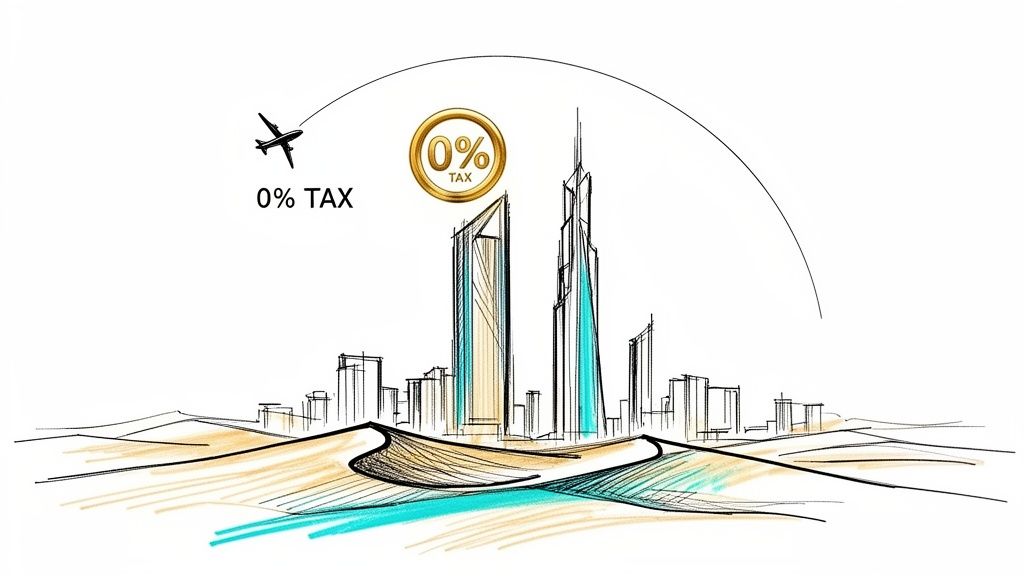
At the core of the UAE's appeal are its numerous freezones, such as the International Free Zone Authority (IFZA), which hosts over 15,000 companies. These zones permit 100% foreign ownership and full repatriation of profits, enabling entrepreneurs to conduct international business with minimal tax friction and administrative burden. This structure is particularly beneficial for operators in sectors like e-commerce, consulting, and crypto, as Dubai has fostered a highly supportive regulatory environment for blockchain and digital asset businesses.
Implementation in Practice
A common strategy involves establishing a Free Zone Establishment (FZE) to serve as an international operating company. An e-commerce entrepreneur, for example, can incorporate in a UAE freezone to manage global sales and logistics. Profits are accumulated in the UAE corporate entity and can be distributed to the owner as salary or dividends with zero personal income tax liability in the UAE, provided the individual is a tax resident there. This creates a clean, compliant, and highly efficient corporate structure.
Actionable Steps for Relocation
Proper sequencing and documentation are critical to successfully establishing a tax-free base in the UAE.
- Establish a Freezone Company: The first step is typically company formation within a freezone like IFZA. This entity will sponsor your residency visa.
- Secure Residency: Obtain your Emirates ID and residency visa, which are prerequisites for establishing tax residency and opening personal bank accounts.
- Obtain a Tax Residency Certificate (TRC): After meeting the physical presence requirements (typically 90 or 183 days, depending on circumstances), apply for a TRC to formally prove your tax status to other jurisdictions.
- Strategic Layering: For enhanced asset protection, consider layering your UAE entity with holdings in another jurisdiction. Our guide to cross-border tax planning provides insights into creating these robust, multi-jurisdictional structures.
By correctly implementing this strategy, entrepreneurs can position themselves at the center of global commerce while legally minimizing their worldwide tax obligations.
3. Singapore – Asia's Premier Wealth & Business Hub
Singapore stands as Asia's primary financial center, offering a stable and efficient environment for entrepreneurs and investors. Its appeal is built on a territorial tax system, a world-class banking sector, and a pro-business legal framework, all conducted in English. This combination makes it a strategic choice for managing and growing wealth in the region.
The country's territorial tax system means that most foreign-sourced income is not taxed in Singapore unless it is remitted into the country. Combined with an extensive network of double taxation agreements and no capital gains tax, Singapore provides a solid foundation for structuring international business operations and investments.
Implementation in Practice
High-net-worth individuals and multinational corporations use Singapore as a central hub for their Asian activities. For example, an entrepreneur can establish a Singaporean holding company to manage investments across Southeast Asia. Profits and dividends from these regional subsidiaries can flow through the Singaporean entity, often with minimal tax friction due to favorable tax treaties.
Major tech companies like Grab and Sea Ltd. have used Singapore as their regional headquarters, a model that remote entrepreneurs can replicate on a smaller scale. This jurisdiction is ideal for founders who need a credible, high-integrity base to attract investment and manage cross-border operations.
Actionable Steps for Relocation
To properly establish a presence in Singapore, a clear, sequential approach is necessary.
- Secure Business Presence: Establish a Singaporean company to act as the primary vehicle for your regional business activities. This is often the first step toward residency.
- Obtain Residency: Apply for an EntrePass or Employment Pass, which are tied to your business operations or employment in the country. These visas are designed for entrepreneurs and skilled professionals.
- Establish Banking: Open corporate and personal bank accounts. Singapore's robust banking system provides access to multi-currency accounts and sophisticated wealth management services, but the due diligence is stringent.
- Long-Term Planning: For those committed to the jurisdiction, these residency pathways can eventually lead to Permanent Resident (PR) status, offering greater stability and benefits. Proper tax planning is critical to manage how and when foreign income is brought into Singapore.
By correctly structuring their corporate and personal affairs, entrepreneurs can use Singapore not just as a place to live, but as a critical component in a global wealth and business strategy.
4. Mexico – North American Gateway with Favorable Residency
Mexico presents a compelling option for entrepreneurs and digital nomads due to its strategic proximity to North American markets, a low cost of living, and straightforward residency pathways. The country offers a high quality of life with vibrant, established expatriate communities, making it an ideal base for managing North American business operations while optimizing personal and corporate tax structures.
Its temporary residency visa is particularly attractive, as certain application routes do not have strict minimum income requirements, lowering the barrier to entry. This accessibility, combined with a familiar time zone for US and Canadian business, has fostered significant digital nomad hubs in cities like Playa del Carmen, Mexico City, and Puerto Vallarta. These locations offer robust infrastructure, including coworking spaces and a strong professional network.
Implementation in Practice
An entrepreneur managing a US-based e-commerce business can establish temporary residency in Mexico to lower their personal cost of living and operational overhead. By structuring their business with a US C-corporation, they can manage operations remotely from a hub like Mexico City, which boasts over 800 startups and a growing venture capital presence. This setup allows them to benefit from the US-Mexico tax treaty and create a clear distinction between personal and corporate tax obligations.
Actionable Steps for Relocation
Proper planning is essential to maximize the benefits of relocating to one of the best countries for digital nomads in the Americas.
- Secure Residency: Initiate the temporary residency visa application at a Mexican consulate in your home country. The process is relatively quick, often taking just 2-4 weeks to complete upon arrival in Mexico.
- Document Tax Status: Once residency is established, maintain clear documentation of your tax residency status. This is critical for legal protection and for correctly applying benefits under international tax treaties.
- Strategic Business Structuring: For those with North American operations, consider layering a Mexican entity with a US C-corporation. This can optimize tax efficiency and simplify cross-border transactions.
- Coordinate Tax Planning: Engage with a professional firm to address US tax obligations, such as obtaining an ITIN and opening US bank accounts if needed. Properly structuring your income is key to benefiting from the US-Mexico tax treaty.
5. Thailand – Southeast Asia's Digital Nomad Capital
Thailand has emerged as Southeast Asia's principal hub for remote entrepreneurs, balancing an extremely low cost of living with a developed infrastructure. Its primary appeal is the combination of high quality of life, access to thriving nomad communities in cities like Bangkok and Chiang Mai, and new long-stay visa options designed for skilled professionals and investors. This makes it an ideal lifestyle base for those structuring their business affairs in more tax-advantaged jurisdictions.

The country offers a practical solution for entrepreneurs who need an operational base in Asia without establishing tax residency there for their core business entities. By maintaining corporate and banking structures in zero-tax or territorial tax jurisdictions like Singapore or the BVI, an individual can enjoy the lifestyle benefits of Thailand while their foreign-sourced income accumulates efficiently offshore. This jurisdictional separation is a key strategy for asset protection and tax optimization.
Implementation in Practice
A common strategy involves a founder living in Bangkok while their business operations are run through a Singaporean Private Limited company. The company invoices international clients and collects revenue in a Singaporean bank account. The founder pays themselves a salary or dividends from the Singaporean entity to their personal offshore account, only remitting funds to Thailand for living expenses. This structure separates personal residency from corporate tax liability, placing Thailand firmly in the "lifestyle" category of a multi-jurisdictional plan.
Actionable Steps for Relocation
To properly establish a presence in Thailand while protecting your global assets, precise planning is essential.
- Secure Long-Term Residency: Apply for the new Long-Term Resident (LTR) visa, which offers a 10-year residency for qualified professionals and investors, providing stability not found in typical tourist visas.
- Maintain Offshore Structures: Before relocating, ensure your corporate entity is established in a tax-efficient jurisdiction like Singapore or the BVI. Work with specialists to ensure compliance.
- Separate Banking: Keep primary business banking outside of Thailand to avoid triggering local tax obligations on corporate income. Use services like Protect Your Wealth to establish the correct offshore accounts.
- Monitor Policy: Visa and tax regulations in Thailand can change. Regularly check official embassy communications and consult with local legal advisors to remain compliant.
6. United Kingdom & London – English-Speaking Wealth Center
The UK, particularly London, remains a premier destination for English-speaking entrepreneurs seeking world-class financial services and access to global capital markets. Its appeal is rooted in a stable legal system, a sophisticated banking infrastructure, and specific visa routes designed for investors and innovators. This makes it a key jurisdiction for high-net-worth individuals aiming to establish a credible, compliant presence in a major economic hub.
For many entrepreneurs, the UK serves as a strategic anchor. Its reputation for strong corporate governance and its extensive network of double-taxation treaties provide a solid foundation for international business structures. The availability of specialized visas, like the Innovator Founder visa, offers a clear pathway for individuals with viable business ideas and investment capital to establish residency and operate from one of the world's leading financial centers.
Implementation in Practice
A common strategy involves using a UK limited company as the primary operating entity for a global business. For example, a fintech founder can establish a company in London, leveraging the city's deep talent pool and access to over 500 global banks. This structure provides instant credibility with North American and European partners and clients. High-net-worth families also frequently use UK trust structures for multi-generational wealth preservation and succession planning, benefiting from the country's established and respected legal framework.
Actionable Steps for Relocation
To effectively use the UK as a base, a structured approach is essential.
- Secure the Right Visa: Explore options like the Innovator Founder visa or the High Potential Individual visa, depending on your business plan and background. These routes have specific and stringent requirements.
- Establish a Corporate Structure: Form a UK limited company early. This is crucial for opening business bank accounts, securing contracts, and establishing a financial footprint. Coordinate this with trusted legal and corporate service providers.
- Open Banking Relationships: Establish both personal and business bank accounts with a major UK institution. This is a foundational step for managing operations and proving substance within the jurisdiction.
- Strategic Structuring: For optimal tax and asset protection, consider layering your UK entity with companies in treaty-friendly jurisdictions like Ireland or Singapore. This requires professional advice to ensure compliance.
7. Hong Kong – Asian Wealth Management & IP Hub
Hong Kong stands as Asia's preeminent international financial center, offering a robust platform for entrepreneurs managing regional operations. Its strength is rooted in a territorial tax system, a common law legal framework, and world-class financial infrastructure, making it a strategic gateway for business activities related to mainland China and the wider Asian market.
The territorial tax principle is a key advantage; only profits sourced from or arising in Hong Kong are subject to taxation. This means foreign-sourced income, such as profits from an overseas subsidiary or investment returns, can be received in Hong Kong entirely tax-free. This system, combined with a simple corporate tax structure, provides a clear and efficient framework for optimizing international business and investment income.
Implementation in Practice
Entrepreneurs frequently establish a Hong Kong Limited company to serve as a regional holding or operational headquarters. For example, a fintech founder can incorporate in Hong Kong to manage software licensing and service contracts across Asia. Profits from clients in Singapore, Japan, and Korea, when structured correctly, are not considered Hong Kong-sourced and would not be subject to local profits tax. This makes it an ideal jurisdiction for centralizing regional intellectual property and managing cross-border transactions.
Actionable Steps for Relocation
To properly structure your presence in Hong Kong, precise steps are necessary to ensure compliance and maximize benefits.
- Establish a Corporate Structure: Form a Hong Kong Limited company to act as the primary vehicle for your Asian operations or as an IP holding entity.
- Secure Banking: Open a multi-currency corporate bank account with a major Hong Kong institution. This is critical for managing regional cash flow and requires thorough documentation of business activities.
- Maintain Substance: To support tax residency claims and benefit from tax treaties, establish genuine substance. This includes securing a physical office, hiring local staff, and ensuring management decisions are made in Hong Kong.
- Diversify Risk: For enhanced political risk diversification and treaty access, consider layering your Hong Kong entity with a Singaporean company. This dual-hub strategy can provide greater asset protection and operational flexibility.
8. Ireland – EU Tax Haven with Tech Industry Leadership
Ireland’s strategic position as an English-speaking EU member with a low corporate tax rate makes it a powerful jurisdiction for entrepreneurs and established companies. The country's 12.5% corporate tax on trading income is one of the lowest in Western Europe, attracting multinational giants like Apple and Google and fostering a dynamic startup ecosystem. This business-friendly environment is ideal for structuring European operations and intellectual property (IP) holding companies.
For sophisticated entrepreneurs, Ireland serves as more than just a place to live; it's a critical tool for global tax planning. The country’s extensive network of double taxation treaties and its favorable treatment of IP create a compliant framework for minimizing tax liabilities on a global scale. This makes it one of the best countries for digital nomads who are scaling a technology business or managing significant IP assets.
Implementation in Practice
A common strategy involves establishing an Irish limited company to hold the IP for a global software or e-commerce business. For example, a fintech founder can license their proprietary technology from their Irish entity to operating companies worldwide. Royalties flow back to Ireland, where they are taxed at the low corporate rate. This structure is particularly effective as over 60% of Fortune 500 companies have similar Irish IP holding structures, establishing a clear and accepted precedent.
Actionable Steps for Relocation
Properly setting up an Irish corporate structure requires careful planning and attention to substance requirements.
- Establish Corporate Substance: Incorporate an Irish limited company and ensure it has legitimate business operations. This includes having a local director, an office, and real economic activity to satisfy anti-avoidance rules.
- Structure IP Ownership: Properly document the transfer of any existing intellectual property to the Irish company. This process must be supported by defensible transfer pricing documentation to avoid challenges from tax authorities.
- Open Corporate Banking: Secure a business bank account in Ireland to manage company finances. This is a critical step for demonstrating local economic substance.
- Coordinate with Jurisdictions: For advanced optimization, layer the Irish structure with entities in other treaty-friendly jurisdictions like Malta or Singapore to manage withholding taxes on cross-border payments.
9. Colombia – Latin America's Emerging Digital Nomad Hub
Colombia has rapidly become South America's premier destination for remote entrepreneurs, blending a low cost of living with a dedicated digital nomad visa. The country offers a vibrant culture and growing infrastructure, making it a strategic choice for those seeking a LATAM base without sacrificing connectivity. Cities like Medellín and Bogotá are now centers for innovation and remote work.

The country's V visa (Remote Work Visa) is specifically designed for this purpose, providing a clear legal pathway for a two-year stay with renewal options. This visa allows entrepreneurs to establish a personal base while maintaining their primary business operations in more tax-advantageous jurisdictions. The combination of a low cost of living, estimated at $1,000 to $1,500 per month, and a favorable visa makes Colombia one of the best countries for digital nomads looking for high lifestyle value.
Implementation in Practice
An entrepreneur can use Medellín, a city with over 1,000 startups, as a base for expanding into the Latin American market. By maintaining their company in a jurisdiction like the US or the UAE, they can minimize their Colombian tax exposure. This structure allows them to benefit from Medellín's innovation ecosystem and growing talent pool, which has produced unicorns like Rappi, while keeping their corporate and personal tax obligations optimized offshore.
Actionable Steps for Relocation
To capitalize on Colombia's benefits, a structured approach is essential from the beginning.
- Secure the V Visa: Apply for the V visa for Remote Workers either before arrival or within the country. This provides a two-year legal residency status.
- Tax Strategy: Structure your business in an international jurisdiction to limit Colombian tax liability. If you plan to stay beyond 183 days in a year, you will become a tax resident, making professional tax planning critical.
- Banking and Operations: Establish local banking for day-to-day expenses but maintain your primary corporate and investment accounts in a stable, offshore financial center.
- Network and Integrate: Leverage the extensive nomad communities and coworking spaces in Bogotá and Medellín. These hubs are excellent for business development and establishing a local professional network.
10. Malta & Cyprus – EU Gateways with Business Incentives
Malta and Cyprus stand out as strategic European Union jurisdictions that offer more than just a Mediterranean lifestyle. For entrepreneurs and high-net-worth individuals, their appeal is rooted in business-friendly tax regimes, an English-speaking professional environment, and full EU market access. These island nations have developed robust legal and financial frameworks, particularly attractive for establishing holding companies and specialized operations.
Both countries offer compelling corporate tax structures. Malta's system allows for a potential effective corporate tax rate as low as 5% through a refund system for shareholders. Cyprus boasts a flat 12.5% corporate tax rate, one of the lowest in the EU, along with exemptions on gains from securities and favorable intellectual property (IP) box regimes. This makes them ideal for structuring international business activities and managing assets from a compliant EU base.
Implementation in Practice
A common strategy involves using a Maltese or Cypriot company as a European holding entity. For example, a global e-commerce entrepreneur can set up a holding company in Cyprus to receive dividends from operating companies located outside the EU. Thanks to Cyprus's participation exemption, these dividends can often be received tax-free, allowing for efficient capital accumulation and reinvestment into EU markets. Similarly, Malta's reputation as the "Blockchain Island" has attracted numerous crypto and gaming companies, which use its clear regulations and tax incentives to build European headquarters.
Actionable Steps for Relocation
Establishing a presence requires careful planning to align personal and corporate residency with tax objectives.
- Corporate Structuring: Engage a local corporate service provider to establish a holding company. Ensure sufficient substance (local office, director) is documented to meet EU anti-tax avoidance requirements.
- Establish Residency: Secure a residency permit in your chosen country. Both Malta and Cyprus offer various pathways, including options for self-sufficient persons and investors.
- Tax Registration: Register for a personal tax identification number and formally declare tax residency to benefit from local tax rules and treaty advantages.
- Long-Term Planning: For those committed to the region, both countries offer routes to permanent residency and citizenship. You can explore the requirements for Cyprus's permanent residency programs for a deeper understanding of these long-term options.
By correctly layering these jurisdictions, entrepreneurs can create a robust, tax-efficient structure for managing international wealth and business operations from within the EU.
Top 10 Countries for Digital Nomads — Comparison
| Jurisdiction | Implementation complexity | Resource requirements | Expected outcomes | Ideal use cases | Key advantages |
|---|---|---|---|---|---|
| Portugal | Medium — residency application, NHR registration, some bureaucracy | Moderate — proof of residency, local banking, legal/tax advice | 10-year tax benefits on foreign income; EU access and healthcare | Digital nomads, HNWIs seeking EU base, entrepreneurs | NHR tax regime, EU/Schengen access, affordable lifestyle |
| United Arab Emirates | Low–Medium — fast freezone setup but substance rules apply | High — company formation fees, bank relationships, higher living costs | Near-zero personal/corporate tax outcome; strong international banking | Global operators, crypto firms, regional HQs | 0% personal tax, 100% foreign ownership in freezones, strategic location |
| Singapore | High — strict compliance, transfer pricing and substance expectations | High — professional fees, banking introductions, high living costs | Territorial tax benefits, treaty access, robust banking and stability | Asian HQs, family offices, sophisticated investors | Territorial system, extensive treaties, world-class financial infrastructure |
| Mexico | Low — temporal residency straightforward; tax rules require care | Low — low cost of living; immigration documentation; some legal help | Flexible residency, proximity/time‑zone alignment with US, cost savings | North American operators, remote workers, entrepreneurs | Easy residency pathways, low living costs, US market access |
| Thailand | Medium — new LTR visa simplifies long-term stay but rules change | Low — very low living costs; may need offshore company arrangements | Long‑stay nomad options, ASEAN gateway, lifestyle advantages | Digital nomads, lifestyle entrepreneurs, regional explorers | Low cost of living, LTR visa, large nomad communities |
| United Kingdom (London) | High — complex visas, residency and tax rules post‑Brexit | Very high — living costs, professional services, regulatory compliance | Access to capital markets, premium banking and legal services | English‑speaking professionals, institutional operators, trusts | Leading financial services, English common law, global credibility |
| Hong Kong | Medium — efficient company setup but substance and compliance needed | High — professional fees, banking access, high living costs | Territorial tax benefits, China market access, strong IP protection | China‑focused businesses, IP holding, family offices | Territorial taxation, IP enforcement, sophisticated banking |
| Ireland | Medium — company/IP structures require genuine substance | Medium‑High — corporate setup costs, compliance, skilled workforce | EU base with 12.5% trading tax, IP benefits, tech talent access | Multinationals, tech firms, IP holding companies | Low corporate rate, EU membership, IP-friendly regimes |
| Colombia | Low — V visa streamlines remote-worker residency; simple process | Low — low living costs; modest administrative needs | 2‑year renewable residency for nomads; LATAM market presence | Digital nomads, LATAM market entrants, budget entrepreneurs | V visa, low cost of living, growing startup ecosystems |
| Malta & Cyprus | Medium — EU compliance and substance increasingly enforced | Medium — formation fees, possible residency/citizenship investment costs | EU access, participation exemptions, capital gains/IP relief (with limits) | European holding/wealth structures, residency/citizenship seekers | EU membership, participation exemptions, IP regimes |
Implementing Your Global Strategy: From Plan to Action
Selecting the right jurisdiction from our list of the best countries for digital nomads is a critical first move, but it represents only the beginning of a much larger strategic play. The true power of a global mobility plan is not found in a single location but in the thoughtful integration of multiple jurisdictions to create a resilient, tax-efficient, and asset-protected structure. The analysis of Portugal, the UAE, Singapore, and others throughout this guide reveals a common theme: each country offers distinct tools, but no single one solves every problem.
The real art lies in the execution. A well-designed global structure might involve holding assets through a Singaporean Private Limited company, banking with a stable institution in the UK, and establishing personal residency in a low-tax EU nation like Malta. This multi-layered approach moves beyond simple lifestyle arbitrage and into the realm of strategic wealth preservation and operational freedom. It transforms your personal and business footprint from a liability into a fortress.
From Theory to Tangible Results
The difference between a successful global entrepreneur and one who faces compliance nightmares is often the quality of implementation. The path is filled with potential pitfalls that can erase any intended benefits.
- Tax Residency Traps: Spending 184 days in one country and 181 in another does not automatically make you a tax resident of the latter. Tax residency is a complex determination based on factors like your "center of vital interests," permanent home availability, and specific treaty rules. A poorly planned move can result in dual tax residency, subjecting your worldwide income to taxation in multiple high-tax countries.
- Banking and Compliance Hurdles: Opening a corporate bank account for a UAE Free Zone company in a jurisdiction like Singapore or the UK is not a simple matter of filling out a form. Banks are under immense pressure to enforce Anti-Money Laundering (AML) and Know Your Customer (KYC) regulations. A failure to provide adequate substance, a clear business plan, or proper corporate documentation will result in immediate rejection or, worse, a frozen account.
- Structural Inefficiencies: Simply having a company in one country and residency in another is not enough. The structure must make sense. For example, if you reside in Portugal under its NHR scheme but operate a UK Ltd company that is "managed and controlled" from your desk in Lisbon, Portuguese authorities may deem the company a tax resident of Portugal, nullifying your intended tax benefits.
Key Insight: A successful global strategy is not a collection of flags on a map. It is an interconnected system where each component (residency, corporate structure, banking) is chosen to legally and practically support the others, creating a compliant framework that withstands international scrutiny.
Mastering this process means achieving genuine freedom. It’s the ability to operate your business globally, protect your assets from frivolous lawsuits or economic instability, and legally minimize your tax burden, all while living the life you choose. This isn't about finding loopholes; it's about understanding and using the established legal and financial systems of the world's most stable jurisdictions to your advantage. The goal is to build a foundation so solid that you can focus on what you do best: growing your business and enjoying your life, secure in the knowledge that your wealth and freedom are well-protected.
Crafting a compliant, multi-jurisdictional plan requires deep, practical expertise. Protect Your Wealth provides hands-on implementation, turning complex strategies into reality by handling everything from company and foundation setups to residency applications and remote bank account openings. To build a robust global structure tailored to your specific goals, schedule a confidential consultation with our team of experienced operators.


