


A Cayman bank account is a sophisticated financial tool used by high-net-worth individuals and global businesses for legal asset protection, operational flexibility, and wealth preservation. Put simply, it’s a strategic component for managing international finances within a secure, stable, and tax-neutral jurisdiction.
Why a Cayman Bank Account Is Your Financial Stronghold

When you hear “Cayman bank account,” it’s easy to think of outdated stereotypes. The reality today is far different. The Cayman Islands has cemented its place as a premier financial jurisdiction built on stability, a solid legal framework, and strict adherence to global compliance standards.
Opening an account here isn’t just a transaction. It’s a strategic decision to connect your wealth to a world-class system engineered for resilience. For global entrepreneurs and affluent families, this jurisdiction provides a secure financial hub in an increasingly uncertain world. It’s a safe harbor where assets can be shielded from the political and economic volatility that can rock one’s home country.
A Sanctuary Built on Stability
The real appeal of Cayman banking isn’t about hiding money; it’s about protecting it within a predictable and reliable environment. As a British Overseas Territory, it boasts an unwavering political and economic climate, with a legal system founded on English Common Law. This provides a familiar and dependable foundation for international clients.
This stability creates a powerful draw for those looking to:
- Diversify Sovereign Risk: Spreading assets geographically reduces your exposure to a single nation’s economic downturns, currency devaluations, or sudden policy shifts.
- Achieve Operational Flexibility: A Cayman account can serve as a central hub for managing international business revenues and expenses in multiple currencies without friction.
- Preserve Generational Wealth: The jurisdiction offers sophisticated trust and corporate structures that work hand-in-hand with banking services for long-term estate planning.
To illustrate these benefits, the table below summarizes the key drivers for choosing the Cayman Islands.
Key Strategic Drivers for Opening a Cayman Bank Account
A summary of the primary motivations and benefits for high-net-worth individuals and international businesses considering a bank account in the Cayman Islands.
| Strategic Driver | Benefit for HNW Individuals & Businesses | Primary Use Case |
|---|---|---|
| Asset Protection | Legally shields capital from frivolous lawsuits, political instability, and creditor claims in the home country. | Holding significant liquid assets in a jurisdiction with strong debtor-creditor laws. |
| Sovereign Risk Diversification | Reduces dependence on a single country’s economic and political system, protecting against currency controls or nationalization. | An entrepreneur in a volatile region securing business profits offshore. |
| Tax Neutrality | The Cayman Islands has no direct taxes (corporate, income, capital gains), allowing for efficient wealth growth. | Holding investment portfolios or corporate profits without tax erosion at the jurisdictional level. |
| Operational Efficiency | Centralizes multi-currency transactions for international businesses, simplifying treasury management and cross-border payments. | A global e-commerce company managing revenues from the US, Europe, and Asia. |
| Confidentiality & Privacy | Strict, legally enforced confidentiality laws protect client information while remaining compliant with global reporting standards. | Protecting personal financial details from public exposure or data breaches. |
These drivers demonstrate that a Cayman account is a versatile tool for both personal wealth preservation and international business operations.
The Scale of a Global Financial Powerhouse
The jurisdiction’s reputation isn’t just talk; it’s backed by immense financial activity. The Cayman Islands is a global leader in cross-border banking, with deposits held with BIS reporting banks reaching $1.069 trillion and projected to climb to $1.230 trillion.
This incredible scale speaks volumes about the trust placed in its system by the world’s most discerning clients. You can explore more data on this robust financial environment on Trading Economics.
Choosing a Cayman bank account means plugging into a financial ecosystem that is not only trusted by individuals but is also a critical node in the global financial network. Its size and sophistication offer a level of security that smaller jurisdictions simply cannot match.
Ultimately, a Cayman bank account provides a fortified platform for managing wealth. It allows legitimate asset holders to operate with confidence, knowing their capital is held in a jurisdiction that prioritizes legal protection, regulatory excellence, and financial strength above all else.
The Bedrock of Cayman Banking: Stability and Regulation
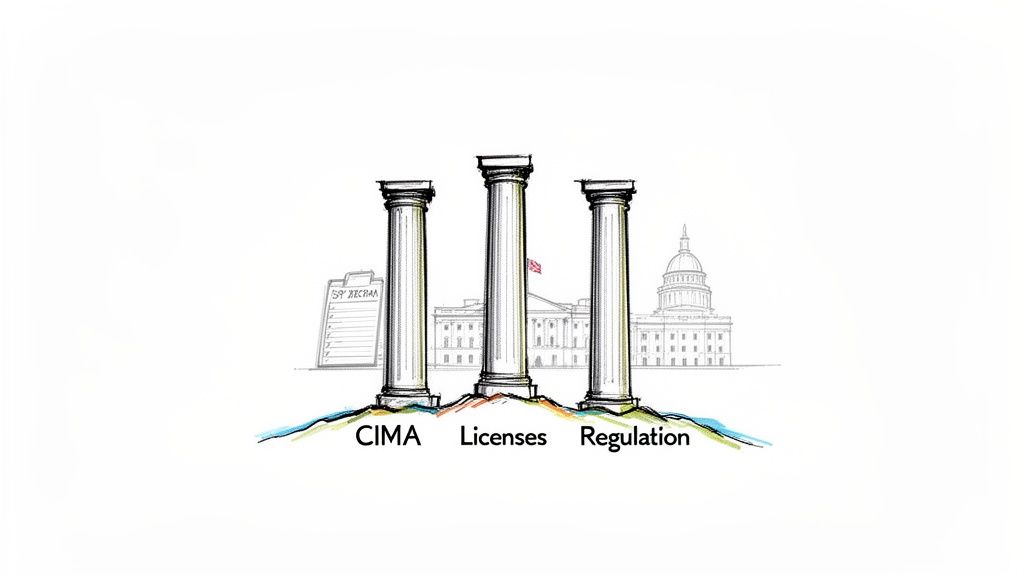
The Cayman Islands’ reputation as a world-class financial hub isn’t some happy accident. It’s the direct result of a deliberate, multi-decade strategy to build one of the most robust and meticulously supervised regulatory environments on the planet.
This structure is what provides the predictability and rock-solid stability that high-net-worth individuals and major corporations not only want but demand.
At the very center of this system sits the Cayman Islands Monetary Authority (CIMA). You can think of CIMA as the vigilant guardian of the jurisdiction’s financial integrity. It’s a completely independent body tasked with licensing, supervising, and enforcing the rules for every single financial institution operating in the islands.
CIMA’s reach is comprehensive, covering everything from banking and trusts to insurance and securities. Its hands-on approach ensures every cayman bank account operates within a framework that meets—and often exceeds—global standards. This creates a secure and trustworthy environment for depositors from all over the world.
The Two Tiers of Banking Licenses
To serve a diverse global client base, CIMA issues two main types of banking licenses. This dual-licensing system is a core feature of Cayman’s success, allowing it to cater to both its local population and its massive international market with surgical precision.
Understanding the difference is absolutely critical for anyone considering banking here.
The two license categories are:
- Category ‘A’ Banking Licence: This license lets a bank handle both local and international business. These are the institutions you’d see on the ground, serving the day-to-day needs of Cayman residents and local businesses, while also being able to serve international clients.
- Category ‘B’ Banking Licence: This is, by far, the most common license in the Cayman Islands. It permits a bank to conduct international business exclusively with non-residents. These banks are specialists in offshore finance, built from the ground up to serve the needs of a global clientele.
This structure means that a bank with a Category ‘B’ license is laser-focused on the sophisticated demands of international asset protection, corporate treasury management, and private wealth services. They aren’t bogged down with retail banking; they are masters of cross-border finance.
The dual-licensing system is a massive strategic advantage. It creates a specialized ecosystem where international clients are served by banks that are built, staffed, and regulated specifically for their complex, cross-border financial lives.
An Engine of Economic Prosperity
The financial services sector isn’t just a part of the Cayman economy—it is the economy. This deep integration creates a powerful, built-in incentive for the government to maintain its world-class regulatory standards and political stability at all costs.
Why? Because the success of the financial sector is directly tethered to the prosperity of the entire nation.
This is no small contribution. The financial services industry, with banking as its anchor, contributes over CI$2.5 billion—a staggering 42% of GDP—and directly employs thousands. The ripple effect generates another CI$1.2 billion in output, creates even more jobs in supporting industries, and provides over CI$500 million in government revenue. You can see the full breakdown in this in-depth economic report from Cayman Finance.
This profound economic reliance guarantees unwavering government support for the industry. Any threat to the banking sector’s reputation is an existential threat to the country’s economic foundation.
When you open a cayman bank account, you aren’t just partnering with a bank. You’re plugging into a national infrastructure that is fully invested in protecting its own stability—and by extension, your assets.
How Modern Compliance Protects Legitimate Account Holders
Let’s clear the air. The old image of a secret, untraceable Cayman bank account belongs in spy novels, not in today’s tightly regulated financial world. The modern reality is built on a principle we call ‘compliant confidentiality.’
What does that mean? It means your privacy is fiercely protected, but always within the rock-solid framework of international law. The Cayman Islands’ unwavering commitment to global compliance standards isn’t a headache for legitimate account holders—it’s one of its greatest strengths. These rules are a feature, not a bug.
For high-net-worth individuals and serious international businesses, this rigorous environment acts as a crucial filter. It systematically weeds out illicit actors, which in turn boosts the reputation, security, and long-term stability of the entire financial system you’re a part of.
The Alphabet Soup of Global Compliance Explained
Navigating international finance means getting comfortable with a few key acronyms that dictate how information is handled. These regulations aren’t unique to the Cayman Islands; they are the global standard for stopping financial crime and ensuring tax transparency.
Think of these rules as the digital security system for the global financial network. They’re designed to verify who you are, watch for red flags, and make sure tax authorities get the information they are legally entitled to.
- AML (Anti-Money Laundering): These are the procedures banks use to stop criminals from washing dirty money. It involves constant transaction monitoring to spot unusual patterns.
- KYC (Know Your Customer): This is the foundation of AML. It’s the deep-dive process where a bank verifies your identity, your background, and the risks of doing business with you. Expect to provide detailed documentation about who you are and where your wealth comes from.
- FATCA (Foreign Account Tax Compliance Act): A U.S. law requiring foreign banks to report on the assets held by their American clients. If you’re a U.S. person, your Cayman bank will report your account details directly to the IRS.
- CRS (Common Reporting Standard): This is the global version of FATCA. Developed by the OECD, over 100 countries have agreed to automatically exchange account information with each other every year to fight tax evasion.
Together, these frameworks create a transparent system where legitimate capital flows freely while illicit funds get identified and shut down.
Compliant Confidentiality in Action
So, what does this actually mean for you as a legitimate account holder? It means your financial affairs are kept confidential from the general public, commercial predators, and nosy litigants. They are not, however, hidden from legitimate government and tax authorities.
Imagine your account is inside a secure vault. The vault has a heavy-duty door that keeps unauthorized people out. But law enforcement and tax authorities from cooperating nations have a special, legally-sanctioned key.
This is the core of compliant confidentiality. Your privacy is shielded from private threats, while your information is available to public authorities through established, legal channels. This system protects you from the risks of shady, non-compliant jurisdictions.
This modern approach is what keeps the Cayman Islands a premier, reputable financial center rather than a high-risk “tax haven.” For a broader look, you might find our guide useful—it details the benefits and risks of different offshore bank accounts in 2025 and how they fit into a legal asset protection plan.
Why This Is a Benefit, Not a Barrier
For any serious entrepreneur or investor, this compliance-first culture is a powerful asset. It guarantees that the bank you’re partnering with is stable, well-capitalized, and has a low-risk profile because it isn’t contaminated by questionable funds.
The strict KYC and AML checks ensure that your financial neighbors are also legitimate players. This collective integrity is what makes the jurisdiction so attractive to global financial institutions, leading to better services, more sophisticated products, and a stronger banking ecosystem for everyone.
Ultimately, these rules ensure your Cayman bank account is part of a secure, reputable, and enduring financial fortress—not a risky gamble. They protect the system’s integrity, which in turn protects the value and security of your assets.
Your Step-By-Step Guide to Opening an Account
So, how do you actually go from wanting a Cayman account to having one? Let’s be clear: opening a Cayman bank account isn’t like walking into your local high-street bank. It’s a deliberate, meticulous process built to protect the jurisdiction’s reputation and ensure every client meets its world-class regulatory standards.
The first step is picking the right banking partner. Cayman banks aren’t all the same; some excel at private wealth management for individuals, while others are geared toward corporate treasury services. The trick is to find an institution whose service model and risk appetite perfectly align with your profile.
The Foundation: Your Documentation Package
Think of your application as the foundation of a house. If it’s weak or incomplete, everything that follows will collapse. The bank needs to build a crystal-clear, verifiable picture of who you are, where your wealth came from, and why you need the account. Incomplete or sloppy paperwork is the number-one reason applications get delayed or flat-out rejected.
At a minimum, you’ll need to assemble a core set of documents:
- Certified Identity Documents: This isn’t just a quick photocopy. You’ll need high-quality copies of your passport, certified as a true likeness by a recognized professional like a notary public, lawyer, or chartered accountant.
- Proof of Residential Address: A recent utility bill or a statement from your current bank (usually dated within the last three months) will be required to confirm where you live.
- Professional Reference Letter: A letter from a long-term professional advisor—think your lawyer or accountant—who can vouch for your good standing and character.
- Bank Reference Letter: Your primary bank will need to provide a letter confirming that you’ve been a client in good standing for a certain number of years.
This strict vetting process isn’t about creating barriers; it’s about ensuring compliant confidentiality, as the diagram below shows.

Global rules dictate the bank’s deep vetting, which in turn provides a protected, fully compliant account for legitimate clients who pass the checks.
Demystifying Enhanced Due Diligence for HNW Clients
For high-net-worth (HNW) individuals or those with complex corporate structures, the standard paperwork is just the starting line. Banks will initiate Enhanced Due Diligence (EDD), a much deeper dive into your financial history. This isn’t an invasion of privacy; it’s a non-negotiable legal requirement to fight financial crime.
Banks are legally obligated to understand the origin story of your wealth. They need a clear, documented narrative explaining how you accumulated your assets, whether through business profits, investments, inheritance, or the sale of an asset. Ambiguity here is a major red flag.
You will be asked to provide hard evidence backing up your Source of Wealth (SOW) and the Source of Funds (SOF) you intend to deposit. This could be anything from:
- Audited financial statements for your business.
- Contracts from the sale of a company or a major real estate asset.
- Brokerage statements showing significant capital gains.
- Official probate documents from an inheritance.
For more on what this involves, you can explore the general requirements for offshore bank account opening to see how the Cayman Islands stacks up against other locations.
Cayman’s due diligence is among the most rigorous in the world. This table gives you a sense of how its requirements compare to other types of jurisdictions.
Cayman Due Diligence Checklist vs Other Jurisdictions
| Requirement | Cayman Islands (High-Standard) | Typical Mid-Tier Jurisdiction | Onshore Financial Center (e.g., USA/UK) |
|---|---|---|---|
| Identity Verification | Notarized/Apostilled Passport Copies | Certified Passport Copy | In-Person ID Check or Digital Verification |
| Address Verification | Certified Original Utility Bill/Bank Statement | Original Utility Bill (less strict on certification) | Bank Statement or Utility Bill |
| Bank Reference | Mandatory, detailed letter required | Often required, but may be less formal | Rarely required for basic accounts |
| Professional Reference | Mandatory from Lawyer/Accountant | Sometimes required for HNW clients | Not typically required |
| Source of Wealth (SOW) | Extensive, documented narrative required | Declaration required, documents on request | Declaration on account opening forms |
| Source of Funds (SOF) | Documented proof for initial deposit mandatory | Required, but may accept a declaration | Usually only for very large transactions |
| Business Plan | Detailed plan required for corporate accounts | Business summary required | Basic business description is often sufficient |
As you can see, the Cayman Islands demands a far more robust and verifiable level of documentation than most other places. While it means more work upfront, it’s this very diligence that underpins the stability and reputation of its financial sector.
Realistic Timelines and Common Roadblocks
Let me be direct: this process requires patience. A realistic timeline, from submitting a perfect application to getting your account details, is anywhere from four to twelve weeks. If your situation is complex, it can take even longer.
What causes the biggest delays? Almost always, it comes down to documentation.
- Incomplete Paperwork: A missing signature, an expired ID, or an uncertified copy will bring everything to a grinding halt.
- Unclear Business Activities: For company accounts, a vague description of what your business does will trigger a flood of questions. Be specific and clear.
- Vague Source of Wealth: Just writing "investments" or "business profits" won't cut it. You must provide a clear, documented trail that tells the whole story.
Finally, be prepared for the financial entry point. Premier private banking in the Caymans often requires an initial deposit of $500,000 to $1,000,000 USD or more. This isn't just a number; it's a reflection of the premium, high-touch service you're signing up for.
Real-World Strategies for Asset Protection and Growth
A Cayman bank account is far more than just a place to park cash; it's an active tool for executing sophisticated financial strategies. Let's move past the theory and look at how these accounts are used in the real world for both protecting assets and growing wealth.
At its core, a Cayman account serves as a strategic buffer against risks tied to your home country. This is what experts call mitigating sovereign risk. Imagine an entrepreneur operating in a country with a volatile currency or an unpredictable political climate. Holding business profits in a stable currency like USD or EUR within a Cayman bank provides an immediate defense against local economic chaos.
This isn't about dodging obligations at home. It's about building a financial firewall so that a crisis in one country doesn't wipe out your entire net worth. You preserve capital for future investments or to secure your family's future.
Hedging Against Global Economic Shifts
One of the most powerful features of a premier Cayman bank account is its multi-currency capability. This lets you hold, transact, and invest in a whole range of global currencies, essentially turning your account into a personal treasury management hub.
Think of a family office trying to protect its purchasing power from inflation. Instead of keeping all its liquid assets in a single currency that might be weakening, it can strategically diversify its holdings across the board.
- USD Holdings: For stability and access to global markets.
- CHF (Swiss Franc): As a classic safe-haven currency during times of global turmoil.
- EUR Holdings: To facilitate investments or business operations within the Eurozone.
This diversification acts as a natural hedge. If one currency stumbles, the strength in the others can balance the portfolio, preserving the real value of the assets over the long haul.
Streamlining International Business Operations
For a global business, a Cayman corporate account is an operational game-changer. It creates a tax-neutral platform where you can centralize international revenues and manage cross-border payments without the usual friction of domestic banking systems.
Scenario: An e-commerce entrepreneur sells products in North America, Europe, and Asia. Funneling all revenue into their home bank account would create a logistical nightmare of currency conversions, transfer fees, and potential capital controls.
By using a Cayman corporate account, the entrepreneur can receive payments in USD, EUR, and GBP directly. They can hold these funds without forced conversion, pay international suppliers in their native currencies, and bring profits home in a structured, compliant way. This turns a complex, multi-regional operation into a sleek, efficient financial machine. The jurisdiction's tax neutrality—meaning no direct corporate or income taxes levied in the Caymans—ensures this hub operates with maximum efficiency, although profits must still be reported according to the owner's home country tax laws. For more context on this, our guide explores the best jurisdictions for asset protection and how they compare.
A Liquid Hub for Global Wealth Management
The strength of these strategies depends entirely on the financial ecosystem that supports them, and a key indicator of that strength is liquidity. Recent data shows that the net foreign assets (NFA) of commercial banks in the Cayman Islands shot up by 12.6% in a single quarter, a testament to its role as a thriving hub for global wealth managers. This robust and highly liquid environment ensures that significant international assets can be managed and moved efficiently. You can see more on this dynamic growth in the official Q1 economic report.
These practical applications prove that a Cayman bank account is not a passive holding tank. It is a dynamic financial instrument for legally protecting assets, managing currency risk, and creating operational efficiency for individuals and businesses on the global stage.
Why You Can't Afford to Go It Alone
Trying to open a premier Cayman bank account by yourself is like trying to navigate a maze blindfolded. It’s not a DIY project. The island’s demanding due diligence, complex paperwork, and the unique risk appetite of each bank create a landscape that’s nearly impossible for an outsider to crack.
This is where a professional, accredited bank introducer becomes your most critical asset. Think of them less as an agent and more as a strategic partner who knows the unwritten rules of the game. Their entire job is to bridge the gap between your goals and the bank's rigid onboarding protocols, making sure your application is positioned for a "yes" from day one.
Stacking the Odds in Your Favor
The main job of a professional introducer is to de-risk your application in the eyes of the bank. They perform a deep pre-vetting analysis, scrutinizing your profile, source of wealth story, and business activities before a single document is ever submitted. This crucial first step filters out potential red flags that would otherwise get your application immediately rejected.
They make sure every piece of your documentation is perfect and tells a clear, compliant story. This level of preparation doesn't just improve your odds of success—it saves you from the very real risk of being permanently blacklisted by a bank because of a poorly assembled initial application.
An experienced introducer already has established relationships with senior bankers. This lets you bypass the bureaucratic logjam of the general application queue, ensuring your file lands on the right desk and is reviewed by decision-makers who understand the nuances of complex international clients.
The Real Value Is in the Strategy
Beyond just paperwork, a professional partner provides priceless strategic advice. They know which banks are quietly receptive to clients in the e-commerce sector and which ones specialize in holding companies for real estate assets. This is insider knowledge you can't find online.
This allows them to:
- Pick the Right Bank: They match your profile to the institution most likely to approve it, saving you months of wasted time and dead ends.
- Frame Your Narrative: They help you articulate your source of wealth and business rationale in a way that clicks with the bank's compliance framework.
- Anticipate and Solve Problems: When a bank comes back with follow-up questions—and they often do—your introducer manages the conversation, providing clear, concise answers that satisfy the compliance department.
Ultimately, partnering with a firm like Protect Your Wealth connects your Cayman bank account to a much broader wealth strategy. It turns a complex, high-stakes process into a managed, predictable engagement. For any serious high-net-worth individual or global business, this professional guidance isn't a cost. It’s an essential investment in a successful, compliant, and efficient outcome.
Your Cayman Banking Questions, Answered
Even after getting the big picture, a few specific questions always come up. Here are some straight-talking answers to the most common things clients ask about opening and running a bank account in the Cayman Islands. This should clear up any final details and help you decide if it's the right move.
Is My Money Actually Safe in a Cayman Bank Account?
Absolutely. The Cayman Islands isn’t just a postcard destination; it’s one of the most stable and buttoned-up financial centers in the world. Everything is overseen by the Cayman Islands Monetary Authority (CIMA), which runs a very tight ship. When you have over a trillion dollars in international deposits, you don’t get there by being careless.
On top of the tough regulations, the commercial banks here are required to maintain high liquidity and a strong net foreign asset position. It's a fancy way of saying they have the cash to back up their obligations, which adds a powerful layer of real-world security for your funds.
Can I Really Open a Cayman Account Without Flying There?
Yes, for the most part, you can open a Cayman bank account entirely remotely. This is a huge plus for international clients who don’t have time to hop on a plane. But don't mistake convenience for lax standards—the due diligence process is just as rigorous, if not more so, than if you were sitting in the banker's office.
This is where working with a professional introducer makes all the difference. We manage the entire remote process, making sure every document is correctly certified and submitted. We act as your bridge to the bank, smoothing out the bumps and ensuring everything is handled to their exacting compliance standards.
The ability to open an account from your home office isn't a loophole; it’s a sign of a highly sophisticated and efficient system. Every remote step is designed to meet global AML/KYC rules, protecting both you and the bank's integrity.
What's the Real Minimum Deposit to Get Started?
There’s no single answer here. The minimum deposit swings pretty widely depending on the bank and, more importantly, on you. A corporate account for an active business will have different requirements than a private banking relationship for a high-net-worth individual.
Let's be clear: for premier private banking, you should be thinking in the range of $500,000 to $1,000,000 USD as a starting point. While some corporate accounts might start lower, Cayman banking is not for small-time retail deposits. The entire system is geared toward substantial, well-documented clients who need sophisticated financial services.
How Does a Cayman Account Fit into Tax Planning?
A Cayman bank account provides tax neutrality. This is a critical concept to understand. It means the Cayman Islands government itself won't hit you with corporate taxes, income taxes, or capital gains taxes on the money in your account.
The real power here is creating a clean, tax-neutral hub to manage international business or hold investments. It allows your assets to grow and move without getting sliced away by local taxes at every turn. But—and this is non-negotiable—it doesn't make you invisible to your home country's tax authorities. You are still fully responsible for reporting all income and gains according to global standards like FATCA and CRS.
Navigating the ins and outs of opening a Cayman bank account requires an expert guide to get it right the first time. At Protect Your Wealth, we specialize in coordinating compliant, privacy-focused financial structures for clients around the globe. We pre-vet your application, handle all the documentation, and use our direct relationships with senior bankers to ensure a smooth, successful onboarding. Contact Protect Your Wealth today to discuss your asset protection strategy.


