


Think of Controlled Foreign Corporation (CFC) rules less as a tax and more as a powerful set of guardrails for a country's entire tax system. They exist for one core reason: to stop taxpayers from indefinitely deferring their tax obligations by parking profits in low-tax foreign companies.
These rules essentially say that certain income is going to be taxed in your home country now, whether you’ve physically received it or not.
What Are Controlled Foreign Corporation Rules
Imagine you own a successful company in a jurisdiction with a 0% corporate tax rate. Without CFC rules, you could let those profits sit offshore for years, even decades, completely untouched by your home country's tax authority. You’d only pay tax when you finally decided to pay yourself a dividend.
This creates a massive incentive to shift mobile income—like royalties, interest, or certain service fees—abroad and simply delay the tax event forever.
CFC rules were designed to plug this very loophole. They are a specific type of anti-deferral legislation. Their message is simple: "If you control a foreign company earning certain types of passive or easily movable income, we will tax you on your share of that income today, as if you’d already received it."
This mechanism effectively pierces the corporate veil for tax purposes. It prevents the foreign company from being used as a personal piggy bank to shield income from the taxman back home.
The Core Concept of Deemed Dividends
The engine that drives all CFC legislation is the concept of a "deemed dividend," sometimes called a "deemed inclusion." This is a legal fiction that treats the CFC's undistributed profits as if they were paid out to you, the shareholder.
- You don’t see the cash. The money never leaves the foreign corporation’s bank account.
- But you get the tax bill. Despite not receiving a dime, you must report your share of this income on your tax return for the current year and pay tax on it.
- Deferral is defeated. This forces immediate taxation on passive income, completely removing the advantage of stashing it offshore.
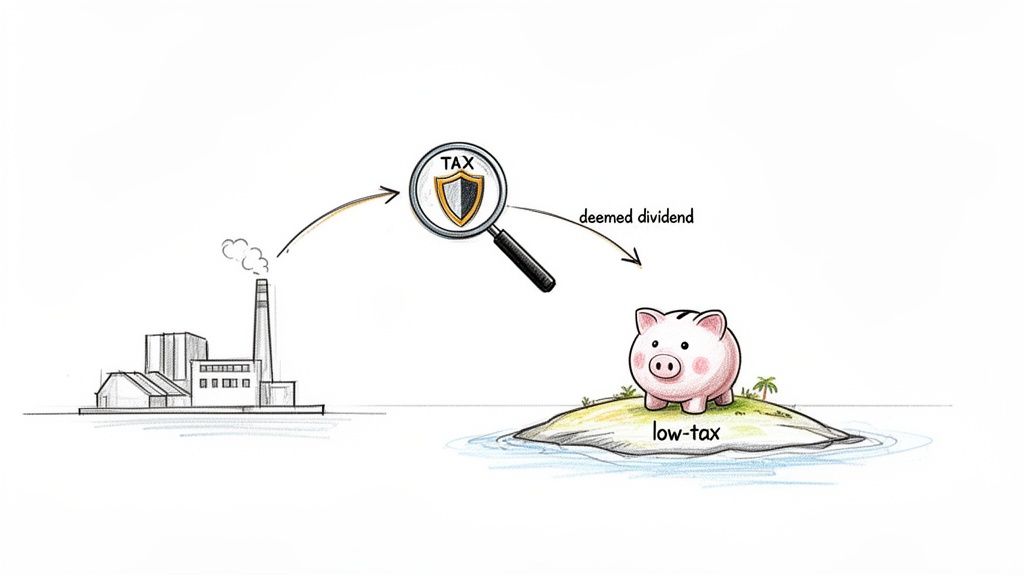
This approach is fundamental to how high-tax countries protect their tax base from erosion. For a deeper dive into structuring your affairs correctly, our guide explains how to legally reduce your tax burden with international structures.
To help you grasp these foundational ideas, here’s a quick overview of the key concepts we'll be breaking down.
CFC Rules At a Glance: Key Concepts
| Concept | Simple Explanation | Primary Goal |
|---|---|---|
| Control Test | Rules defining who “controls” the foreign company (e.g., >50% ownership). | To identify which foreign companies fall under the rules. |
| Income Attribution | Assigning a portion of the CFC’s income directly to the shareholders. | To ensure the right people are taxed on the right amount. |
| Tainted Income | Specific types of “bad” income caught by the rules (e.g., passive income). | To distinguish between legitimate active business profits and passive, mobile income. |
| Deemed Dividend | Treating undistributed foreign profits as if they were paid to shareholders. | To eliminate the tax deferral advantage. |
| Anti-Deferral | The overarching principle of taxing income now, not later. | To protect the domestic tax base. |
These are the building blocks of CFC legislation everywhere. Understanding them is the first step toward navigating the system.
A Global Standard in Tax Enforcement
The use of CFC rules isn't just a quirk of a few aggressive tax authorities; it's a rapidly expanding global standard. International bodies like the OECD are actively pushing for their adoption to fight tax base erosion and profit shifting (BEPS).
According to OECD data, the number of jurisdictions with CFC rules grew from 49 in 2019 to 53 in just a few years, with more on the way. This coordinated push, particularly under the BEPS Project's Action 3, is creating a unified front to ensure that passive income earned in low-tax jurisdictions gets taxed somewhere, somehow.
By understanding this foundational principle—that CFC rules are about timing and attribution, not creating a new tax—you can begin to navigate your global business operations with clarity and confidence. The goal is not to punish international business but to ensure fairness and prevent tax avoidance.
How a Foreign Company Becomes a CFC
Not every foreign company you own will drag you into the complex world of controlled foreign corporation rules. For a company to be classified as a CFC, it first has to trip very specific ownership wires, known as control tests.
Think of these tests as the gatekeepers. Only after your ownership crosses their threshold does the type of income your company earns even begin to matter. These rules are designed to be objective, focusing on a simple question: who really calls the shots and pockets the profits?
The Two Critical Control Tests
The most common trigger that turns a foreign company into a CFC is when its controlling shareholders own more than 50% of it. But "ownership" isn't a single concept here. Tax authorities measure it in two very distinct ways, and failing just one of these tests is usually enough to establish control.
-
The Voting Power Test: This is all about decision-making power. If shareholders from your home country collectively own more than 50% of the company's voting stock, it's considered controlled. This test targets who can direct the company’s future—things like electing the board or deciding whether to pay out dividends.
-
The Value Test: This one follows the money. It's triggered if shareholders from your home country own more than 50% of the company's total stock value. This stops clever workarounds where someone might hold non-voting shares that quietly represent the vast majority of the company's actual worth.
But it gets trickier. Tax laws use complex attribution rules, which means you can be treated as owning shares that are legally held by your spouse, children, or even a family trust. These rules are designed to stop people from simply scattering ownership among relatives to duck under the 50% line.
Distinguishing Between Good and Bad Income
Once a company is officially a CFC, the game changes. The focus shifts entirely from who owns it to what it earns. These rules aren't meant to tax every single dollar a CFC makes. Their real target is what's often called "tainted income"—passive earnings that are easy to shift to low-tax havens.
The entire system is built on one core idea: separating real, active business income from passive, mobile income. The first is generally left alone until you take the money out. The second is targeted for immediate taxation.
This distinction is everything. A CFC that runs a factory, operates a chain of local stores, or provides on-the-ground consulting services is earning active business income. This is generally safe from CFC rules because it’s tied to a genuine economic footprint in that foreign country.
Tainted income, on the other hand, is precisely what these laws were created to stop.
What is Tainted Income?
Tainted income is any revenue stream that isn't connected to a substantial, active business in the foreign country. It’s the kind of money you can easily park in a zero-tax jurisdiction without needing any real operational substance there.
Common examples of tainted income include:
- Dividends and Interest: Profits from holding stocks or lending money.
- Royalties and License Fees: Money earned from intellectual property like patents or trademarks.
- Annuities: Payouts from annuity contracts.
- Rents: Income from leasing out property (unless it's part of an active real estate business).
- Capital Gains: Profits from selling passive assets, like stocks and bonds.
Imagine a CFC set up in a tax-free jurisdiction. Its only purpose is to hold a stock portfolio that spins off dividends and capital gains. That income is 100% tainted. The CFC rules will then reach across borders, attribute that income directly to the shareholders back home, and tax it immediately—even if the cash never leaves the CFC's offshore bank account.
This is the mechanism that makes controlled foreign corporation rules such a powerful weapon against international tax deferral.
Comparing Major CFC Regimes Around the World
Controlled foreign corporation rules aren’t a one-size-fits-all global standard. They're a complex patchwork of national priorities, economic philosophies, and legal traditions. While the end goal is always the same—to stop you from indefinitely deferring taxes on foreign profits—the way different countries get there can be wildly different.
Understanding these nuances is absolutely critical for any entrepreneur or investor with cross-border operations.
A country's approach to CFC rules is a mirror of its economic strategy. Is it a massive capital exporter like the United States, desperately trying to protect its tax base? Or is it part of a trading bloc like the European Union, aiming for a degree of tax harmony among its members? These high-level goals dictate the very mechanics of their legislation.
This visual breaks down the two fundamental questions that drive every CFC analysis: who has control, and what type of income is being earned?
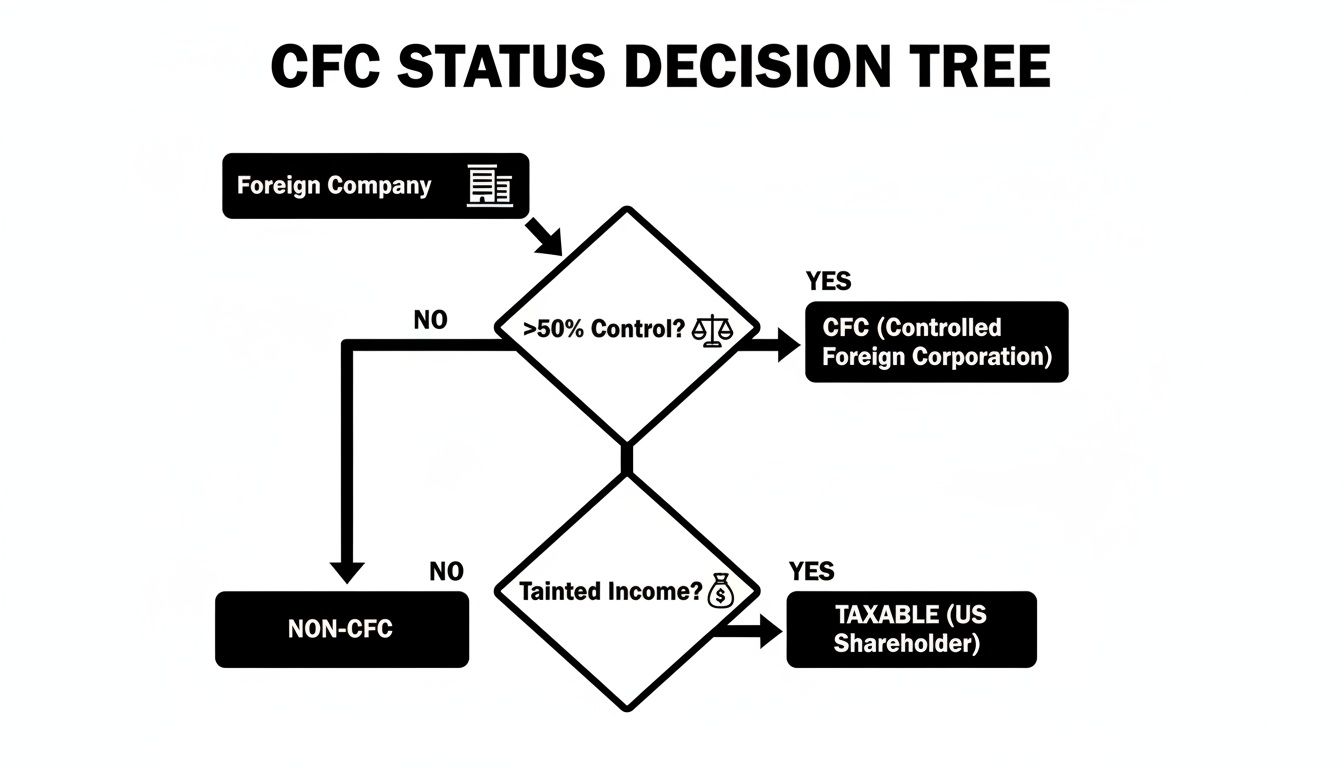
As you can see, the first hurdle is always control. Before a country’s tax authority even bothers to look at your company's profits, they need to establish that you are, in fact, in control of it. Your ownership structure is the first domino to fall.
United States: The GILTI and Subpart F System
The U.S. has what is arguably the most complex and aggressive CFC regime on the planet. It’s built on two powerful pillars: Subpart F income and the Global Intangible Low-Taxed Income (GILTI) rules.
-
Subpart F: This is the old guard of U.S. CFC rules. It’s designed to capture classic passive income—think dividends, interest, rent, and royalties. It works a lot like the "tainted income" concept we discussed earlier, preventing the parking of passive cash offshore.
-
GILTI: Introduced in 2017, GILTI is a much wider, more modern net. It targets U.S. shareholders of CFCs by taxing their share of active business profits that exceed a 10% "routine" return on the company's tangible assets, but only if that income is taxed below a certain threshold abroad. This was a direct shot at companies shifting even their active operations to low-tax hubs.
Together, these two mechanisms make the U.S. system uniquely formidable, catching both passive investment income and a huge chunk of active foreign business profits.
The European Union and the ATAD Approach
Across the Atlantic, the EU has taken a more harmonized route through its Anti-Tax Avoidance Directive (ATAD). This directive establishes a minimum standard for CFC rules that all member states must adopt, though individual countries are free to go further and enact stricter laws.
ATAD gives member states a choice between two primary models for identifying the "bad" income. One option is to list specific categories of passive income, similar to the U.S. Subpart F model. The other, more principles-based approach, targets "non-genuine arrangements" set up primarily to gain a tax advantage.
This flexibility is what allows jurisdictions like Malta to build tax environments that are both competitive and fully compliant with EU law. For a deeper dive, you can explore our analysis of Malta as a strategic EU business hub.
The key takeaway here is that EU CFC rules are about creating a level playing field. They aim to stop aggressive tax competition between member states while simultaneously preventing profit shifting outside the EU bloc.
While the core principles are similar, the real devil is in the details. The following table provides a high-level look at how major jurisdictions stack up, giving you a quick reference for the key differences you’re likely to encounter.
Comparing Key Features of Major CFC Regimes
| Jurisdiction | Primary Mechanism | Typical Income Targeted | Key Exemption/Threshold |
|---|---|---|---|
| United States | Subpart F & GILTI | Passive income (Subpart F) and low-taxed active income (GILTI). | High-tax exceptions; GILTI has a 10% return on tangible assets threshold. |
| European Union | ATAD Directive | Passive income (e.g., interest, royalties) or profits from “non-genuine arrangements.” | Thresholds based on effective tax rate paid; substance exemptions. |
| United Kingdom | Gateway Tests | Profits “artificially diverted” from the UK. | Entity-level exemptions, including those for companies with substantial foreign operations. |
| Australia | Categorical Approach | Passive income, tainted services income, and certain sales income. | Active income exemption for businesses with genuine foreign substance. |
As the table shows, concepts like “substance” and effective tax rates are recurring themes, but their application varies significantly. What passes the test in the UK might not in Australia, making jurisdiction-specific advice essential.
Key Jurisdictional Snapshots
Other major economies have developed their own distinct flavors of CFC legislation, each with its own quirks.
-
United Kingdom: The UK’s system is known for its practical “gateway” tests. These are designed to quickly filter out companies that aren’t artificially diverting profits from the UK. If a CFC has real economic substance abroad, its profits often escape the CFC charge entirely, making it a more business-friendly, substance-focused regime.
-
Australia: Australia’s rules are incredibly thorough, categorizing foreign income into different “baskets” that receive different tax treatments. The system focuses heavily on identifying income that is “passive” or “tainted services income,” with very limited opportunities for tax deferral.
Navigating CFC Compliance and Reporting
Knowing the theory behind CFC rules is one thing. Actually executing your reporting obligations is a whole different ballgame.
This is where abstract concepts like control tests and tainted income collide with the hard reality of tax forms and deadlines. Solid compliance isn’t just good practice; it’s your primary defense against crippling financial and legal penalties.
The shift from theory to practice demands a completely different mindset. You have to go from being a strategic entrepreneur to a meticulous record-keeper. Every single intercompany loan, royalty payment, and management fee needs to be documented with the same discipline you’d apply to your most critical business contracts.
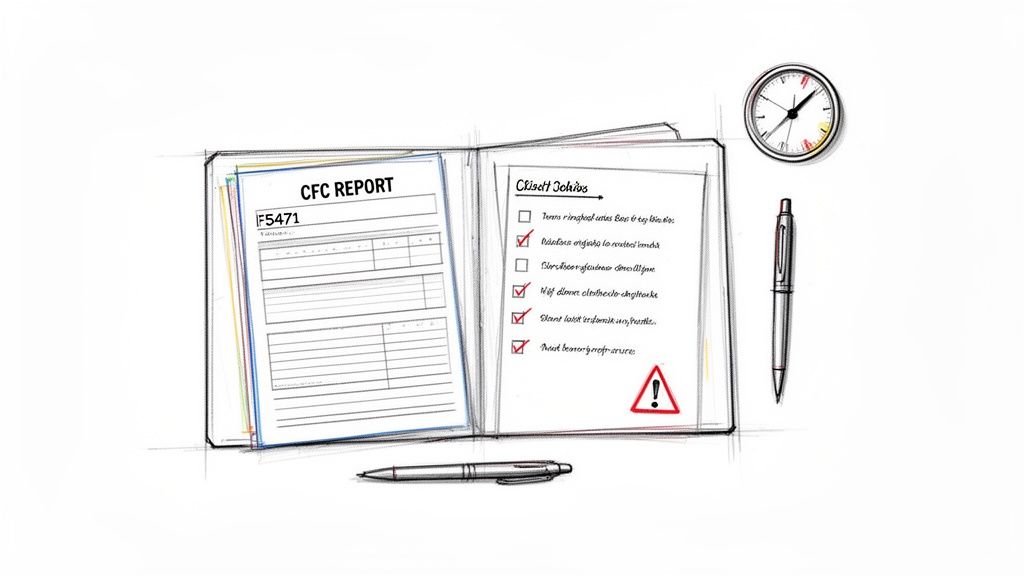
The Anatomy of a CFC Filing
To get a real sense of the detail required, let’s look at the U.S. IRS Form 5471, “Information Return of U.S. Persons With Respect to Certain Foreign Corporations.” This form is notoriously complex and is often described as filing a complete corporate tax return for your foreign company.
Completing it accurately requires a mountain of information, including:
- Detailed Financial Statements: You’ll need a full balance sheet and income statement for the CFC, translated into U.S. Generally Accepted Accounting Principles (GAAP).
- Shareholder and Ownership Data: A crystal-clear record of who owns what, tracking any changes throughout the year.
- Intercompany Transactions: Every transaction between the CFC and its U.S. shareholders or related entities must be disclosed.
- Income Calculations: You must break down the CFC’s income to separate the “bad” passive income (like Subpart F) from the “good” active business earnings.
This isn’t a form you can knock out the night before it’s due. It’s the final output of an entire year of disciplined bookkeeping.
The core principle of CFC compliance is simple: assume everything will be scrutinized. Tax authorities operate on the premise that intercompany transactions are designed to shift profits. Your job is to provide clear, undeniable evidence to the contrary.
The High Stakes of Non-Compliance
Tax authorities don’t mess around with CFC reporting failures. The penalties are deliberately severe to force compliance. A single mistake isn’t just a minor slip-up; it’s a massive red flag that can trigger a much deeper—and more painful—audit of your entire financial life.
In the United States, for instance, failing to file Form 5471 can trigger an initial penalty of $10,000 per form, per year. If the IRS sends you a notice and you still don’t comply, more penalties can pile up to $50,000. Beyond fines, you could lose foreign tax credits and, in the worst cases, even face criminal charges.
This is exactly why proactive work with expert tax advisors isn’t optional—it’s essential for survival.
As global information sharing gets more intense, the chances of getting caught have never been higher. To understand how tax data is now being exchanged automatically, read our guide on DAC8 and the new era of fiscal transparency. A rock-solid compliance framework is your only real defense.
Strategic Planning for CFC Rules
Understanding the mechanics of controlled foreign corporation rules is the first step, but real mastery comes from proactive, compliant strategic planning. This isn’t about finding sketchy loopholes; it’s about lawfully structuring your global operations to align with the intent of these regulations, minimizing friction while maximizing your asset protection and growth.
The goal is to build a resilient, tax-efficient footprint that not only complies today but is flexible enough to adapt to tomorrow’s inevitable regulatory shifts. This moves you from a defensive, reactive posture to an offensive strategy. Instead of just paying taxes as they hit, you design corporate structures that naturally fall outside the most restrictive parts of CFC legislation. This almost always comes down to genuine economic substance and carefully managing the character of your income streams.
Activating Your Business Income
One of the most powerful strategies is to lean into the “active business exceptions.” Most CFC regimes aren’t designed to punish legitimate, on-the-ground foreign operations. They target passive, mobile income that can be easily shifted around.
Structuring your foreign company to perform real economic activities is therefore a cornerstone of smart planning. This could involve:
- Substantial Operations: Ensuring your foreign entity has its own employees, a physical office, and manages its own business activities. It can’t just be a letterbox company.
- Service-Based Models: Structuring service agreements so that the work is genuinely performed by employees of the foreign company for unrelated third parties, rather than just being a passthrough for work done back home.
- Manufacturing and Sales: Locating manufacturing, processing, or significant sales operations within the foreign jurisdiction creates a very strong argument for active business income.
By making sure your foreign company has a real economic pulse, you can often qualify for exemptions that shield its profits from immediate taxation under CFC rules.
Managing Your Income Mix and Thresholds
Another critical planning point is managing the mix of income your foreign company earns. Many jurisdictions have a de minimis rule, where if the “tainted” or passive income stays below a certain percentage of total gross income—often 5% or 10%—the entire amount is ignored for CFC purposes.
Strategic planning here means actively monitoring your revenue streams. If your CFC is getting close to a passive income threshold, you might accelerate active business sales or delay receiving dividends to stay safely under the limit for that tax year.
This requires diligent financial oversight and forecasting. For instance, a holding company in a jurisdiction like the UAE or Singapore can be structured to manage a portfolio of active businesses. While it might receive some dividends (passive income), its primary value can be tied to active management services or strategic oversight, balancing the income mix. This transforms the holding company from a passive investment vehicle into an active management hub.
The Global Context of CFC Planning
Effective planning can’t happen in a vacuum. You have to account for the rapid global adoption of anti-avoidance measures. The OECD’s Corporate Tax Statistics show that 53 jurisdictions now have CFC rules, a significant jump from 49 in 2019.
This trend is intertwined with the Pillar Two GloBE rules, which aim to enforce a 15% global minimum tax on large multinational enterprises. It’s a unified international front against profit shifting. For a detailed report on these trends, you can discover more insights about international tax policy from EY. This global tightening means any strategy you implement must be robust and defensible across multiple jurisdictions.
Integrating Advanced Asset Protection Tools
For high-net-worth individuals and entrepreneurs, CFC planning is almost always integrated with broader asset protection goals. Tools like trusts and foundations can play a crucial role, but they must be structured with extreme care to avoid triggering attribution rules that could make your CFC exposure even worse.
A common strategy involves placing a CFC’s shares into an irrevocably discretionary trust. In some jurisdictions, if structured correctly, this can break the chain of “control.” However, this is highly technical and depends entirely on the laws of both the shareholder’s home country and the jurisdiction of the trust. A poorly executed trust structure can be worse than no structure at all, creating a compliance nightmare. This is where expert guidance is non-negotiable.
Your Top CFC Questions Answered
After digging into the theory, global rules, and compliance work, it’s time to tackle the real-world questions that always come up. When you’re structuring your business across borders, the “what ifs” are what really matter.
Think of this as the practical part of the conversation. We’ll go through the most common scenarios entrepreneurs and investors face when CFC rules move from a concept on paper to a reality for their company.
Do CFC Rules Apply if I Only Own 10% of a Foreign Company?
This question gets straight to the heart of the matter. On its own, a 10% stake in a foreign company usually won’t make it a CFC. For that to happen, most countries require a group of shareholders from your home country to collectively own more than 50% of the company.
But your 10% share is still a critical piece of the puzzle. In the US system, for example, you have to be a “U.S. Shareholder” for the rules to even apply to you, which is defined as someone holding 10% or more of the company.
So, while your slice of the pie doesn’t trigger CFC status alone, it makes you part of the group that tax authorities look at. If five other people from your country each own 10%, the total control hits 60%. Suddenly, the company is a CFC, and the rules apply to every single one of you.
What Happens if My CFC Has Both Active and Passive Income?
This is the norm, not the exception. Very few foreign companies earn 100% active or 100% passive income, which is why your bookkeeping has to be flawless. When a CFC earns a mix, tax authorities expect you to separate the two.
- Active Business Income: Profits from your real, on-the-ground operations—think manufacturing, selling goods locally, or providing services—are generally safe. Most CFC rules still allow you to defer tax on this “good” income.
- Passive (Tainted) Income: The portion of income from dividends, interest, royalties, and some types of rent gets carved out. This is the income the rules are designed to catch, and you’ll likely owe tax on your share of it immediately.
Many countries have a de minimis rule to make life easier. For instance, if passive income makes up less than 5% of the CFC’s total gross income, it might be ignored completely. This creates a clear incentive to manage your income mix carefully and stay under that threshold.
The core idea is that tax authorities will “look through” your company’s total profits and cherry-pick the specific income streams they consider problematic. They aren’t taxing the foreign company; they are taxing you on your share of its tainted income.
Can I Use Losses From One CFC to Offset Income From Another?
This is a common hope, but in most countries, the answer is a firm no. CFC rules are almost always applied on a company-by-company basis, preventing this kind of offsetting.
Imagine you have two CFCs. One earned $200,000 in tainted income, while the other posted a $150,000 loss. You can’t just net the two and report $50,000 of income.
Instead, you would have to report the full $200,000 deemed dividend from the profitable company. The loss from the other CFC is stuck there—you can usually carry it forward to offset its own future profits, but you can’t use it to shelter income from your other successful ventures.
Can I Avoid CFC Rules by Using a Trust?
Using a trust is a sophisticated strategy, not a simple loophole. In fact, if done wrong, a trust can make things much, much worse. Tax laws have powerful attribution rules that look through legal structures to determine true ownership. If you are a beneficiary or have influence over the trust, you will likely still be treated as the owner of the shares it holds.
However, certain structures, like a properly drafted irrevocable discretionary trust where you have completely given up control and beneficial interest, can sometimes break the ownership chain. This is a high-stakes move. The exact wording of the trust deed and the laws of every jurisdiction involved are critical. Trying this without elite-level legal and tax advice is a recipe for disaster and could easily be classified as tax evasion.
Is a Foreign Holding Company Automatically a CFC?
Not automatically, but it’s walking on thin ice. A holding company’s main job is to own shares in other businesses, so its primary income source is often dividends—the classic example of passive, tainted income.
If you and other shareholders from your home country control over 50% of this holding company, and it does little more than collect dividends, it will almost certainly be a CFC with tainted income. Those dividends it receives will flow right back to you as a deemed dividend, triggering an immediate tax bill.
The way to fix this is by giving the holding company real substance. If it provides genuine management services to its subsidiaries for a fee, it starts generating active income. This transforms it from a passive bucket into a functioning headquarters, which can completely change how it’s treated under controlled foreign corporation rules.
Structuring your international operations to be compliant and efficient is a complex challenge.
At Protect Your Wealth, we specialize in creating legal, robust corporate and trust structures that align with your business goals while navigating the intricacies of CFC rules and other global regulations. For a confidential consultation on how to build a resilient international footprint, visit us at https://www.protectyourwealth.com.


