


When people first look into renouncing their U.S. citizenship, they often fixate on a single number they see online. But the real cost of renouncing US citizenship is a far more complex equation, combining a fixed government fee with a potentially massive exit tax and the critical cost of professional guidance.
While the official government filing fee is $2,350, the total financial hit can easily stretch into the tens or even hundreds of thousands of dollars. It all depends on your net worth, the complexity of your assets, and how well you plan.
The Three Pillars of Your Renunciation Budget
The fee you pay at the embassy is just the tip of the iceberg. The real financial danger lurks below the surface, where the exit tax and advisory costs lie in wait. For a high-net-worth individual, this hidden portion is what can turn a straightforward legal process into a catastrophic financial event.

To build a realistic budget, you absolutely must account for three distinct cost categories. Each one plays a non-negotiable role in a successful and compliant exit from the U.S. system.
H3: The Fixed Government Fee
This is the most straightforward part. The U.S. Department of State charges a non-refundable fee of $2,350 to process your renunciation.
You’ll pay this fee directly to the U.S. embassy or consulate when you attend your final renunciation appointment. Think of it as the price of admission—it covers the administrative work needed to process your paperwork and issue your Certificate of Loss of Nationality (CLN).
H3: The Variable Exit Tax
For many of our clients, this is the single biggest financial hurdle. The U.S. government can impose a hefty "exit tax" on anyone it considers a “covered expatriate.”
This isn't just another fee. It's a tax calculated as if you sold every single one of your worldwide assets on the day before you renounced. The tax implications can be staggering, effectively turning a legal decision into a major taxable event.
You fall into the "covered expatriate" trap if you meet just one of these three conditions:
- Your net worth is $2 million or more on the date of expatriation.
- Your average annual net income tax for the past five years exceeds a certain threshold (this number is indexed for inflation, so it changes yearly).
- You fail to certify, under penalty of perjury, that you've complied with all U.S. federal tax obligations for the five years preceding your renunciation.
The exit tax is the U.S. government’s way of getting its final share of your wealth. It's a final reckoning with the IRS, designed to capture taxes on the unrealized appreciation of your global assets before you can leave its tax net for good.
H3: The Essential Advisory Costs
Navigating the financial and legal minefield of renunciation—especially with a high net worth—is not a DIY project. The cost of specialized legal and tax advice isn't an expense; it's an investment in getting this right.
Expect to pay anywhere from $5,000 to over $50,000 for expert guidance, depending on how complex your financial life is. A good team will handle your final tax returns (like Form 8854), calculate your potential exit tax liability down to the dollar, and steer you through the entire legal process. Trying to save money here can lead to mistakes that cost exponentially more in future penalties and legal battles with the IRS.
To give you a clearer picture, here is a summary of the potential costs you should anticipate.
Estimated Cost Breakdown for Renouncing US Citizenship
This table provides a summary of the potential costs involved in the renunciation process, categorized for clarity.
| Cost Category | Typical Range (USD) | Notes |
|---|---|---|
| Government Filing Fee | $2,350 | A fixed, non-refundable fee paid to the U.S. State Department. |
| Exit Tax Liability | $0 – $1,000,000+ | Highly variable. Depends on being a "covered expatriate" and the amount of unrealized capital gains. |
| Tax Compliance & Filing | $2,000 – $15,000+ | Costs for preparing final U.S. tax returns, Form 8854, and ensuring 5 years of prior compliance. |
| Legal Advisory Fees | $3,000 – $25,000+ | Legal guidance on the renunciation process, document review, and appointment preparation. |
| Financial Planning Fees | $2,500 – $20,000+ | Strategic advice on asset structuring, pre-expatriation planning, and tax mitigation. |
| Indirect Costs | Variable | Includes travel to the consulate, document translation/notarization, and potential loss of U.S. benefits. |
As you can see, the initial filing fee is only a small fraction of the total potential cost. Proper planning and professional guidance are essential to manage and potentially mitigate the much larger variable costs.
Your First Hurdle: The Government Renunciation Fee
Every journey to renounce U.S. citizenship begins with one unavoidable cost: the $2,350 government processing fee. Think of it as the non-negotiable price of admission. It’s the first check you’ll have to write, and it’s a fixed cost for virtually everyone, no matter your net worth or your reasons for leaving.
This isn't just some arbitrary number. The fee covers the significant administrative work the U.S. Department of State has to do to process your case. From the consular staff's time during your interviews to the final review back in Washington D.C., this payment funds the official mechanics of severing your ties with the United States.
Where and How You Pay
You'll pay this fee directly at the U.S. embassy or consulate handling your renunciation. It's usually due on the day of your second and final appointment, right when you're taking the formal oath.
One critical point: this fee is completely non-refundable. It doesn't matter if your application gets approved, delayed, or even denied for some unexpected reason—the government keeps the money. You’re paying for the processing, not a guaranteed outcome.
This steep price is a fairly recent change. For years, the fee was a much more reasonable $450. But in 2014, the State Department jacked it up to the current level, making it one of the most expensive citizenship relinquishment fees in the world. This happened right as more and more Americans abroad began renouncing, largely driven by the crushing compliance burdens of laws like FATCA. You can learn more about the history and impact of this fee on SwanWealthCoaching.com.
For a high-net-worth individual, the $2,350 fee is best viewed as the tip of the financial iceberg. While it's a significant sum on its own, it pales in comparison to the potential financial exposure from the much larger, more complex costs that lie ahead.
Putting the Fee into Perspective
While the government fee is the first financial hurdle you'll face, it’s also the most predictable part of the entire process. It’s a known quantity in a journey filled with variables.
Understanding what this fee actually covers helps frame the overall expense:
- Consular Services: It pays for the time and expertise of the consular officers who interview you and witness your oath.
- Administrative Processing: Your case file is reviewed and handled both at the consulate and by the Department of State in the U.S.
- Certificate of Loss of Nationality (CLN): The fee includes the cost of preparing and issuing your official CLN—the document that proves you are no longer a U.S. citizen.
For someone with substantial wealth, this fixed cost should serve as a mental starting line. It’s the first step in a financial marathon. And while you have to pay it, your real focus and planning needs to be on the far larger and more intricate financial challenge we'll tackle next: the U.S. exit tax. That's where the true financial stakes of renunciation are revealed.
The Big One: Unpacking the U.S. Exit Tax
Beyond the initial filing fee, we get to the heart of the matter—the part of the process that can carry the most financial weight. This is the U.S. expatriation tax, better known as the "exit tax." For high-net-worth individuals, this isn't just a line item; it's a complex calculation that can spiral into a seven-figure liability. This is where the real cost of renouncing citizenship often lies.
The exit tax doesn't hit everyone. It's specifically targeted at a group the IRS labels “covered expatriates.” Figuring out if you fall into this category is single-handedly the most crucial financial question you’ll answer in this entire journey.
Are You a “Covered Expatriate”?
You’ll be automatically classified as a covered expatriate if you meet just one of the following three tests on the day you officially renounce.
- The Net Worth Test: Your total worldwide net worth hits $2 million or more. This is a comprehensive valuation—it includes your real estate, stocks, private equity, retirement accounts, art, and everything else you own.
- The Tax Liability Test: Your average annual net income tax bill for the five years before you expatriate is higher than a set limit. This number is indexed for inflation, and for 2024 it was $201,000.
- The Compliance Test: You fail to certify, under penalty of perjury, on Form 8854 that you’ve been compliant with all U.S. federal tax obligations for the five years leading up to your renunciation.
That last one—the compliance test—is the easiest trap to fall into. It’s a stark reminder that you absolutely must have your tax affairs in perfect order before you even think about starting the renunciation process.
Understanding the “Deemed Sale”
For covered expatriates, the IRS uses a “mark-to-market” system to figure out what you owe. It’s a bit of a mental exercise, but with very real consequences.
Think of it this way: on the day before you officially renounce, the IRS pretends you sold every single asset you own, worldwide, for its fair market value.
This is what's known as a “deemed sale.” You don't actually sell anything. Your portfolio stays intact, you keep your home, nothing changes in the real world. But for tax purposes, the IRS calculates the capital gains you would have made if you’d liquidated everything.
The government does offer a fairly generous exemption to soften the blow. For 2024, the first $866,000 of these "deemed" capital gains are completely tax-free. This figure is adjusted each year for inflation. While this exemption is enough to shield many people from paying any exit tax at all, any gains above that threshold are taxed at prevailing capital gains rates.
This flowchart illustrates the straightforward government fee, but keep in mind, the exit tax adds a far more complex—and potentially expensive—layer on top of this.
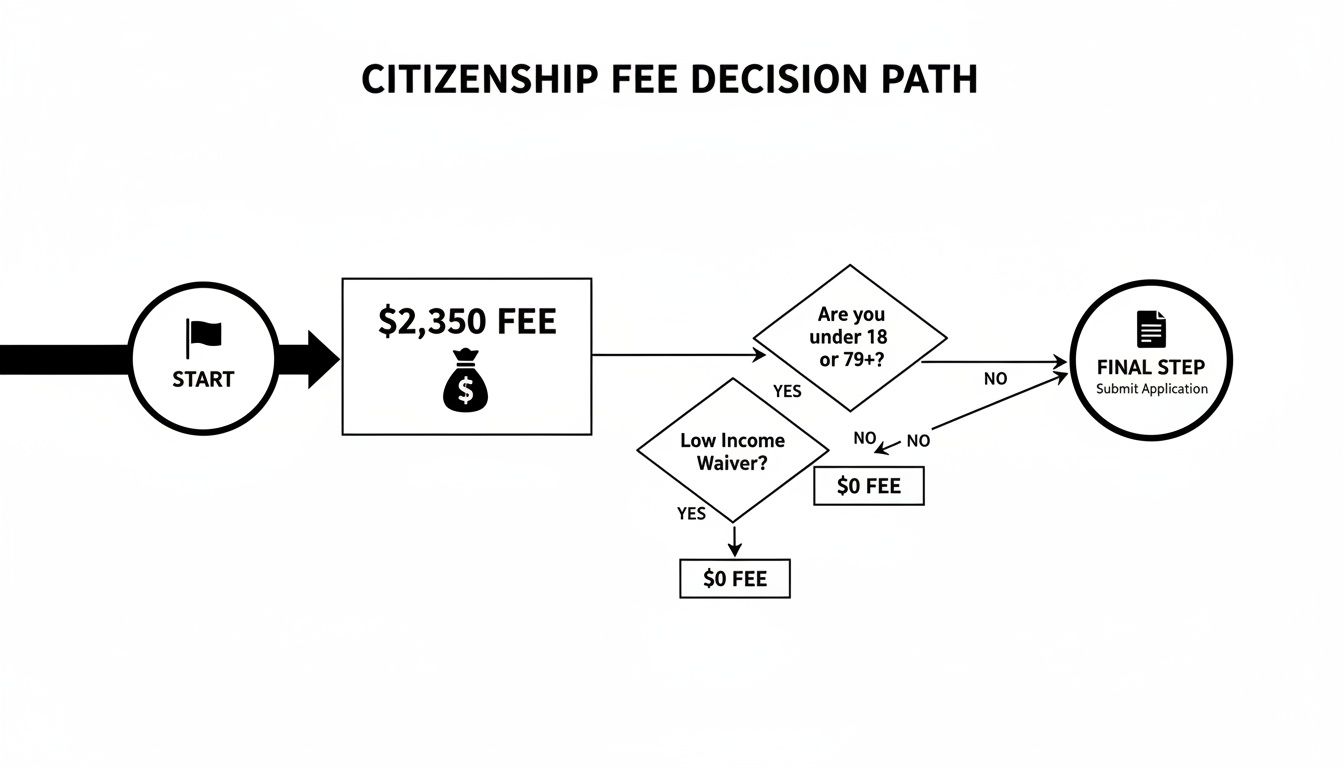
As you can see, paying the basic fee is simple. The exit tax, however, is where the real planning begins.
A Real-World Example of the Exit Tax Calculation
Let's make this tangible. Meet Alex, a covered expatriate with a global asset portfolio. Here’s how the math would break down.
Tally Up the Assets and Gains: Alex starts by listing all his worldwide assets and calculating the unrealized capital gain for each (Current Fair Market Value minus the original Cost Basis).
- U.S. Stock Portfolio: $750,000 gain
- Foreign Real Estate: $400,000 gain
- Investment in a private company: $600,000 gain
- Art Collection: $150,000 gain
- Total Unrealized Capital Gains: $1,900,000
Apply the Exemption: Now, Alex subtracts the annual exclusion from his total gains.
- Total Gains: $1,900,000
- 2024 Exclusion: – $866,000
- Taxable Gain: $1,034,000
Calculate the Tax Bill: Finally, Alex applies the long-term capital gains tax rate to the remaining amount. We’ll assume a 20% rate for this example.
- Taxable Gain: $1,034,000
- Tax Rate: x 20%
- Exit Tax Liability: $206,800
So, in this scenario, Alex's total cost to renounce isn't just the $2,350 filing fee—it's over $209,000. This example shows just how quickly the exit tax can become the single largest cost in the entire process.
Things can get even trickier with certain assets, like holdings in foreign corporations. You can dive deeper into those specific challenges by reading our guide on controlled foreign corporation rules. With smart planning, it's sometimes possible to manage your net worth or strategically time asset sales to reduce this tax, but it demands expert guidance long before you ever set foot in an embassy.
The Essential Costs Of Professional Guidance
Renouncing U.S. citizenship on your own can feel like walking through a minefield with a blindfold. The government fees are clear and the exit tax is formula-driven, but professional advice? That’s where real protection comes in. For anyone with international assets—especially high-net-worth individuals—skipping expert guidance is not worth the risk.
Why You Need A Specialized Team
The IRS doesn’t mess around. They’ve got armies of experts on expatriation rules, and you need your own squad to match them. A general accountant won’t cut it. Instead, you want:
- Tax Advisor: Think of this person as your financial quarterback. They’ll review your last five years of U.S. filings, craft your final dual-status return, and handle Form 8854 down to the last comma.
- Legal Counsel: Your legal expert makes sure every document is flawless, prepares you for the embassy oath ceremony, and shields you from any post-renunciation challenges.
Remember: professional fees are not just an expense—they’re insurance against penalties that could run into the millions.
Estimating Professional Fees
No two cases are identical. A simple portfolio might only require a handful of hours, while a complex web of trusts, investments, and business interests demands deep dives and detailed analysis. To give you a realistic framework, here’s what a full-service team usually covers and what they charge.
Checklist Of Professional Services And Associated Costs
Below is a snapshot of the core services you’ll need and their typical fee ranges:
| Professional Service | Purpose | Estimated Cost Range (USD) |
|---|---|---|
| Initial Consultation & Strategy | Evaluate “covered expatriate” status and map out next steps. | $1,000 – $5,000 |
| Tax Compliance Review | Audit your past five years of returns for any gaps. | $2,500 – $10,000+ |
| Final Tax Return & Form 8854 | Prepare the dual-status return and the Expatriation Statement. | $3,000 – $15,000+ |
| Legal Renunciation Support | Handle embassy paperwork, interview prep, and final oath. | $4,000 – $20,000+ |
This table is your roadmap. Each entry represents an essential stop on the journey to a clean break from U.S. tax obligations.
High-net-worth individuals with intricate holdings should budget between $15,000 and $50,000+ for expert guidance. It may seem steep, but getting the exit tax calculation right and nailing every filing detail can save you from costly IRS headaches down the road. For those dealing with cross-border structures, our specialist knowledge in cross-border tax planning ensures a compliant, optimized departure.
Understanding the Hidden Costs and Long-Term Consequences
The financial bleeding doesn't stop once you've paid the government fees and settled your exit tax. Far from it. A whole new set of hidden costs and long-term consequences will ripple through your life, creating new headaches even as you solve old ones.
These indirect costs are easy to overlook but are a critical part of the true price of walking away.
One of the first walls you'll hit is with the U.S. financial system. As a non-U.S. person, you'll likely find it incredibly difficult to keep your U.S. bank or brokerage accounts. Many institutions simply don't want the compliance nightmare of dealing with non-resident aliens, which could force you to liquidate U.S. investment portfolios or close bank accounts you've held for decades.

Suddenly, managing your wealth becomes a lot more complicated, especially if a good chunk of your assets is still tied to the U.S. market.
The Loss of Tangible Benefits
Renunciation isn’t a trial run; it’s a final, irreversible act that permanently cuts you off from the rights and privileges of being a U.S. citizen. It sounds obvious, but the real-world implications can be jarring and expensive.
You immediately give up benefits that most people take for granted:
- Right to Reside and Work: The automatic right to live and work in the United States vanishes. If you ever want to return, you'll have to navigate the complex and costly U.S. immigration system from scratch.
- Access to Social Security: Your eligibility for Social Security can take a hit. While you might still get the payments you earned, they could be slapped with a 30% withholding tax unless a tax treaty with your new country reduces it.
- Medicare Eligibility: Medicare benefits are generally off-limits for those living outside the U.S., meaning that healthcare safety net is gone.
These aren't just abstract losses—they represent real financial value that disappears overnight. You have to factor in the cost of replacing these benefits, like buying expensive private health insurance or padding your retirement fund to make up the difference. Our guide to dual citizenship tax implications offers more context on how these benefits function across borders.
Renouncing citizenship solves the problem of U.S. tax compliance but introduces a new set of challenges related to travel, banking, and access to benefits. It’s a strategic trade-off that requires a full understanding of what you stand to lose, not just what you hope to gain.
New Logistical and Personal Hurdles
The consequences go far beyond money. Simple things, like visiting family back in the States, now require a visa. And as a former citizen, you are absolutely not guaranteed entry. U.S. border officials have total discretion to turn you away for any reason.
Then there are the emotional costs. Renouncing can strain family relationships and mess with your sense of identity. You are making a permanent statement about where your allegiance lies—a decision with a personal weight that can't be measured in dollars but is a very real part of the overall cost. Thinking through these long-term consequences is just as vital as calculating the exit tax.
Why High-Net-Worth Individuals Choose to Renounce
The decision to renounce U.S. citizenship is almost never made lightly, especially for successful people with deep financial roots. While the cost of renouncing US citizenship is a headline concern, the real motivations run much deeper than a single tax bill. It's often the final chapter in a long story of frustration with a system that feels punishingly out of sync with a globalized world.
The core driver is America's unique and aggressive policy of citizenship-based taxation. The U.S. is one of only two countries on earth to do this. Unlike every other major nation, which taxes you based on where you live, the U.S. demands that its citizens file—and potentially pay taxes on—their worldwide income, regardless of where they reside. For a high-net-worth individual living abroad, this creates a state of permanent dual-tax compliance, overwhelming complexity, and often, double taxation that international treaties don't fully solve.
The Compliance Nightmare of FBAR and FATCA
It’s not just the taxes themselves; it’s the relentless reporting that has become the real source of pain. The Foreign Account Tax Compliance Act (FATCA) and the Report of Foreign Bank and Financial Accounts (FBAR) impose a staggering administrative load.
These rules mandate a meticulous annual report of every single foreign financial asset you hold. The penalties for an innocent mistake or an accidental oversight are draconian, frequently hitting tens of thousands of dollars per violation, even for non-willful errors. It creates a high-stakes environment where a simple clerical slip-up can trigger financial ruin.
For many affluent global citizens, renunciation isn’t about evading taxes they already owe. It’s a strategic exit from a complex and punitive compliance system that treats them like potential criminals for simply living and investing outside the United States.
This compliance burden has also created a phenomenon I call "financial exile." Unwilling to deal with the expensive reporting duties demanded by FATCA, many foreign banks have just started refusing to work with American clients altogether. This can make it nearly impossible for U.S. citizens abroad to open a basic bank account, get a mortgage, or manage their investments—effectively locking them out of the financial system in their own country of residence.
A Growing Trend Fueled by Frustration
This isn't just an anecdotal problem. Recent data shows a massive shift in how Americans overseas feel. A survey highlighted this growing frustration, revealing that nearly half of U.S. expats are either planning or seriously considering renunciation. This surge is tied directly to the high costs of annual tax filings and the banking roadblocks created by FATCA. You can see a detailed breakdown of this trend in the expat survey from GreenbackTaxServices.com.
The generational divide is also stark. Millennials and Gen X expats are far more likely to consider giving up their passports than older generations.
Ultimately, for a growing number of people, the choice to renounce becomes a calculated business decision. It's a trade-off. By paying the one-time financial and emotional price of renunciation, they gain long-term financial freedom, privacy, and simplicity. They are choosing to align their citizenship with their life and business, opting for a system that taxes them where they actually live—not just based on the passport they happen to hold. It is a definitive step toward a more predictable and less complicated financial future.
Common Questions About Renouncing US Citizenship
One of the first questions people ask is, "How long will this take?" The honest answer is: it depends entirely on where you are. The timeline for renouncing U.S. citizenship can vary wildly from one embassy to another, driven by demand and staffing.
In some major cities, you might find yourself on a waiting list for months just to get an appointment. After you finally take the oath, an internal State Department review adds another two to six months to the clock. This is why patience and planning are non-negotiable. Unexpected delays don't just test your patience; they can drive up travel and accommodation costs.
- Major embassies often book out 3–6 months in advance.
- After your appointment, expect a 4 to 12-week wait for processing.
- The final delivery of your Certificate of Loss of Nationality (CLN) adds even more time.
Keep in mind that embassy closures for local or U.S. holidays can throw another wrench in the works, extending wait times unpredictably.
The Critical Role of Tax Compliance
Let's be clear: you cannot renounce your U.S. citizenship without being in good standing with the IRS. This is an absolute deal-breaker.
Before the State Department will even process your application, you must certify—under penalty of perjury—that you have filed all required U.S. tax returns for the past five years. Any failure to comply will bring the entire process to a screeching halt and could expose you to crushing financial penalties. For instance, a single missed FBAR filing can trigger a penalty exceeding $10,000.
Your pre-renunciation checklist must include:
- Filing all U.S. tax returns and FBARs for the last five years.
- Correctly completing and submitting Form 8854 (the "Exit Tax" return).
- Paying every penny of tax you owe before you walk into that final appointment.
Can I Get My Citizenship Back Later?
Renunciation is a permanent, life-altering decision. The U.S. government treats it as an irrevocable act, and you should too.
Renouncing U.S. citizenship is a one-way door. Once you walk through it, there’s no special path back.
Technically, a former citizen can apply to naturalize again, but they join the back of the line with every other foreigner. There are no shortcuts or special waivers. You would need to establish legal residency in the U.S. and wait the standard five years, all while meeting every requirement that applies to any other immigrant.
Thinking about these realities upfront helps you plan your timeline, budget for the true costs, and make this monumental decision with your eyes wide open.
Ready to protect your international assets? Connect with Protect Your Wealth


