


Let's get one thing straight right away: Costa Rica does not have a direct citizenship by investment program. This is a huge point of confusion for many. What it does offer is a highly respected Residency by Investment (RBI) pathway that can lead to naturalization over time.
For high-net-worth individuals looking for a genuine connection to a stable, beautiful country—not just a transactional passport—this distinction is everything.
Unpacking The Path To Costa Rican Citizenship
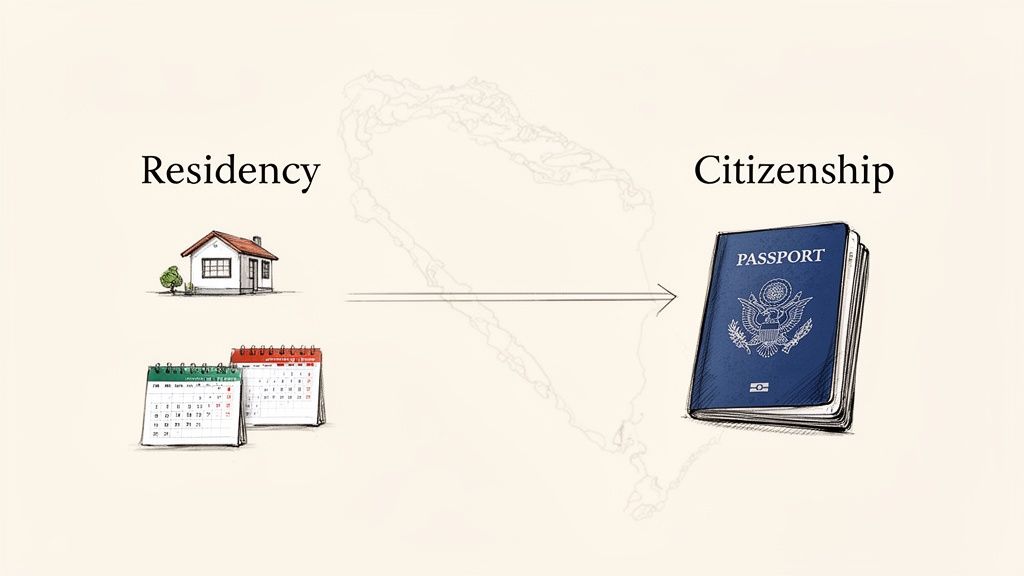
When people search for "Costa Rica citizenship by investment," they're usually expecting a fast-track process like you see in some Caribbean nations. Costa Rica’s approach is fundamentally different. It's built on the idea of long-term integration, not quick passport sales.
Think of it less as buying a passport and more as a strategic, multi-year commitment to one of Latin America's most peaceful and stable democracies. This residency-first model ensures that new citizens actually have real ties to the country. It’s designed for those who truly value the "Pura Vida" lifestyle, the rock-solid political stability, and a secure environment for their family and their wealth. This measured process protects the integrity of Costa Rican citizenship, giving you a far more meaningful and substantial outcome.
A More Accessible Investment Threshold
To attract foreign capital and talent, Costa Rica got smart and updated its investor residency program with Law 9996 back in 2021. This move significantly lowered the minimum real estate investment from $200,000 down to just $150,000. Suddenly, Costa Rica became one of the most accessible and attractive residency programs in the entire region.
But there’s a crucial detail that came with this change—one that many people miss. The law now requires that the property you buy must be held in your personal name, not through a company or corporation. This is a vital distinction. Getting this wrong when structuring your investment can create major headaches, which is exactly why getting expert guidance from the start is so important. You can learn more about Costa Rica's property residency rules to get a handle on these nuances.
The Key Stages Of The Journey
The path from investor to citizen isn't a single transaction; it's a structured journey. This multi-step process is designed to build a genuine connection between you and the country.
Here's a quick look at the major stages you'll go through.
Costa Rica's Path To Citizenship At A Glance
This table breaks down the entire process, giving you a clear snapshot of what to expect from your initial investment to holding a Costa Rican passport in your hand.
| Stage | Minimum Investment | Initial Status | Key Requirement | Total Timeline To Citizenship |
|---|---|---|---|---|
| Initial Investment | $150,000 in real estate | Applicant | Purchase qualifying property in your personal name. | – |
| Temporary Residency | – | Temporary Resident (Inversionista) | Maintain investment & residency for 3 years. | 0-3 Years |
| Permanent Residency | – | Permanent Resident | Apply after 3 years of temporary residency. | 3-7 Years |
| Citizenship | – | Citizen | Apply after 7 years of total legal residency. | 7+ Years |
As you can see, the progression is logical and deliberate, reinforcing the country’s focus on attracting committed residents rather than passport shoppers.
The primary stages include:
- Initial Investment: It starts with making a qualifying investment. The most common route is purchasing real estate valued at $150,000 or more.
- Temporary Residency: Based on that investment, you’ll obtain an initial two-year temporary residency permit, known as the Inversionista visa.
- Permanent Residency: Once you’ve held temporary residency for three years, you become eligible to apply for permanent resident status.
- Citizenship Application: After a total of seven years of legal residency in Costa Rica, you can finally apply for naturalization and get your passport.
This structured, seven-year timeline is a clear signal of Costa Rica’s commitment to genuine integration. It’s designed to ensure that applicants build a real, tangible connection to the country, its culture, and its people before becoming citizens. This is what sets it worlds apart from purely transactional programs.
How to Qualify for the Investor Residency Program
Let’s get one thing straight: Costa Rica doesn’t sell passports. There’s no direct citizenship-by-investment program where you write a check and get a passport in return. The real path—the one that works—is through the Inversionista (Investor) visa. This is your gateway.
Think of it as the official, government-sanctioned route for high-net-worth individuals to gain residency. It’s designed for people ready to make a real financial commitment to the country. Getting the details right here isn’t just important; it’s everything. This is the foundation of your entire plan.
The Three Core Investment Pathways
Costa Rica gives you three main ways to qualify as an investor. Each has its own strategic angle, depending on what you’re trying to achieve with your capital and how you prefer to manage your assets. The non-negotiable part is the minimum investment threshold: $150,000 USD.
Here’s how you can structure your investment:
- Real Estate: This is the most common and straightforward option. You buy property—a family home, a rental villa, or even a plot of land—valued at $150,000 or more. Simple, tangible, and popular for a reason.
- Registered Securities: If you’re more comfortable in the financial markets, you can invest the $150,000 minimum into stocks, bonds, or other securities that are registered and regulated within Costa Rica.
- Approved Business Projects: For the entrepreneurs. This route lets you invest $150,000 into a business, whether it’s a new venture or an existing one. It could be anything from a tech startup to a small hotel, as long as it gets the green light from immigration authorities as a benefit to the national economy.
Crucial Point: If you choose the real estate route, the property title must be in your personal name. Trying to use a property held in a corporation or LLC to qualify is one of the most common mistakes we see—and it’s an instant application killer.
Understanding The Financial Threshold
That $150,000 figure is a hard line, and it’s not about what you paid—it’s about the officially registered value. When you buy a property, its value is recorded in the National Registry (Registro Nacional). That’s the number immigration will look at.
For instance, if you buy a house for $200,000 but register it at $140,000 to sidestep some property taxes, you’ve just disqualified yourself. The government needs to see the full $150,000 on the books. Full transparency is mandatory, and you must maintain this investment for your entire temporary residency period to stay in good standing.
Beyond The Investment: Your Personal Profile
Putting up the capital is only half the job. Costa Rica is also sizing you up as a potential future resident. You have to prove you’re of good character and financially sound, which means compiling a solid portfolio of personal documents.
Essential Non-Financial Requirements:
- Clean Criminal Record: You’ll need a certified police clearance from your home country and any other country where you’ve lived recently. This is non-negotiable.
- Proof of Identity: Official, apostilled copies of your birth certificate are required. If you’re applying with a spouse, you’ll need your marriage certificate too.
- Financial Stability: The investment shows your commitment, but officials may also want to see proof of a stable income stream to ensure you can support yourself and your family without becoming a burden.
- Consular Registration: A simple but necessary step is registering with your home country’s consulate located in Costa Rica.
Immigration wants to see the whole picture: a committed investor who is also a stable, law-abiding individual ready to integrate into Costa Rican society. Cutting corners on any of this paperwork is a surefire way to get your application delayed or flat-out rejected. Meticulous preparation is the only way to succeed.
Mapping Your Journey From Resident To Citizen
The path to a Costa Rican passport is a marathon, not a sprint. This isn’t one of those “instant citizenship” programs; it’s a journey built on genuine residency and integration. Understanding this multi-year timeline is the single most important part of managing your expectations and planning for the long haul.
Think of it as a series of well-defined stages, each with its own set of rules and a specific duration. The whole process is designed to build a real connection between you and the country. By the time you become a citizen, you’ll have legitimate, established ties to Costa Rica. Let’s walk through each phase so you can see the full picture.
This timeline breaks down the core steps for an investor aiming for Costa Rican residency.
As you can see, it’s a clear, linear path. Your investment is the key that unlocks the door to the residency application process.
Phase 1: Initial Temporary Residency
Your journey starts with the Inversionista (Investor) visa, which gives you temporary residency. This first permit is typically valid for two years. During this period, your main responsibility is to simply maintain the qualifying investment—whether that’s your $150,000 property or another approved asset.
This is your entry point. It’s the phase where you get to live in Costa Rica, manage your affairs, and start building your residency track record. Think of it as a probationary period where you demonstrate your commitment.
Phase 2: Transitioning To Permanent Residency
After you’ve held temporary residency for three consecutive years, you hit a major milestone: you can now apply for permanent residency. This is a huge upgrade. Permanent residency scraps the requirement to maintain your original investment, which gives you much more financial freedom.
To make the jump, you’ll need to show you’ve been a resident in good standing and have met the physical presence requirements during those first three years. Once it’s granted, you have nearly all the rights of a citizen, including the ability to work for a local company without needing a special permit.
Phase 3: Applying For Naturalization
The final leg of the journey is applying for citizenship through naturalization. All in, you’re looking at a seven-year commitment from the day your initial residency was approved. This is a critical detail—your time spent as a tourist before getting residency doesn’t count toward this clock.
You become eligible to apply for your passport after racking up seven years of continuous legal residency. This long-term commitment is exactly what gives a Costa Rican passport its value; it’s an asset earned through genuine integration. For a wider view on global mobility options, our guide on how to get a second passport offers some broader context.
A key takeaway here is that “continuous” residency doesn’t mean you can never leave the country. However, for citizenship purposes, you must demonstrate significant physical presence, generally interpreted as spending more than 183 days per year in Costa Rica.
The Final Hurdles: The Citizenship Tests
Once you’ve met the seven-year residency requirement, there are two final tests to pass:
- Spanish Language Test: You’ll need to demonstrate a conversational command of Spanish.
- Civics and History Test: This exam covers the basics of Costa Rican history, government, and culture.
These tests are straightforward but do require some prep work. However, there’s a huge exception: applicants aged 65 or older are exempt from these exams, which makes the final step much simpler for retirees. It’s a thoughtful provision that highlights Costa Rica’s welcoming attitude toward those choosing to spend their later years in the country.
Why Savvy Investors Choose Costa Rica
So, beyond the paperwork and timelines, what’s the real reason to choose Costa Rica? For smart global investors, it’s not just about getting another passport. It’s a strategic move to secure their family’s future and protect their wealth in one of the safest, most stable, and tax-friendly countries in the Americas.
While there’s no direct “Costa Rica citizenship by investment” program, the residency path that leads to it offers advantages that often eclipse many of the instant-citizenship options out there. This is a choice for those who value substance over speed.

A Beacon of Stability and Security
Costa Rica is often called the “Switzerland of Central America,” and for good reason. The country famously abolished its army back in 1949 and has since poured those resources into education, healthcare, and protecting its incredible environment. This long-standing commitment to democracy and the rule of law creates a predictable, safe environment for both your family and your capital.
For high-net-worth individuals, this isn’t just a nice-to-have; it’s a non-negotiable. It means your investments are safeguarded by a reliable legal system, and your family can enjoy a high quality of life in a country that genuinely values peace. This is the foundation of the famous “Pura Vida” (Pure Life) lifestyle—a real, tangible philosophy of well-being that you feel every day.
The ‘Pura Vida’ lifestyle is more than just a slogan for tourists. For residents, it translates into a tangible sense of security, lower stress levels, and a focus on what truly matters—a safe and predictable environment to raise a family and protect your legacy.
The Territorial Tax System: A Strategic Advantage
One of the biggest draws for global entrepreneurs and investors is Costa Rica’s territorial tax system. This is a game-changer if you have international income streams. Put simply, as a resident, you are only taxed on income you generate inside Costa Rica.
This means any money you earn from foreign sources—like profits from an international business, overseas investments, or remote work for a non-Costa Rican company—is generally not touched by local income tax. This structure opens up huge opportunities for tax optimization, allowing you to legally protect your global earnings while living in a tropical paradise. For another take on a tax-friendly residency, see our guide on residency in Paraguay benefits and requirements.
Dual Citizenship and Global Mobility
A critical detail that makes Costa Rica so attractive is its acceptance of dual citizenship. When you eventually become a Costa Rican citizen through naturalization, you are not forced to give up your original passport. This lets you hold multiple citizenships, which is a massive boost for your global freedom and a vital layer of geopolitical diversification.
This benefit is becoming increasingly rare and incredibly valuable. It’s no surprise that Costa Rica’s program is now seen as one of the world’s top investment migration pathways. In fact, demand from North Americans has exploded, with the number of U.S. clients jumping by over 1,000% compared to 2019.
The Costa Rican passport itself is quite powerful, offering visa-free or visa-on-arrival access to over 150 countries. All these factors combine to make the country a complete solution for investors who want more than just a new home—they want a comprehensive strategy for wealth protection, personal freedom, and a better future for their family.
How Costa Rica Compares To Other Global Programs
When you start exploring global mobility, it’s easy to get lost in a sea of options. The key is understanding that not all programs are built the same. Costa Rica’s residency-led approach offers a fundamentally different value proposition compared to the fast-track passport programs in the Caribbean or the high-investment “Golden Visas” of Europe.
The right path really comes down to your personal goals. Are you just looking for the fastest possible second passport, or are you genuinely seeking a stable, long-term home in a country with an incredible quality of life? The answer to that question will tell you everything you need to know.
Costa Rica vs. Caribbean CBI Programs
The biggest difference here is one of philosophy. Caribbean nations like St. Kitts & Nevis or Antigua & Barbuda offer direct Citizenship by Investment (CBI). Think of these as transactional programs designed purely for speed.
- Timeline: You can often get a passport in your hands in as little as 3-6 months.
- Investment: This usually means a non-refundable donation, often starting at $100,000 – $150,000, or a real estate purchase.
- Connection: There’s typically no physical residency requirement. The entire process is handled remotely, designed for investors who may never even set foot in the country.
Costa Rica is playing a completely different game. It requires a seven-year commitment to residency before you can even apply for citizenship. Its $150,000 investment is also recoverable—it’s your asset—but the reward is a passport earned through genuine integration, not a quick purchase. It’s a slower path, but it leads to a passport from a country known for its stability and integrity, which carries real weight on the world stage.
Costa Rica vs. European Golden Visas
European programs, like those in Portugal or Greece, are often seen as the “gold standard” for residency by investment. They offer a foothold in the Schengen Area and a pathway to EU citizenship, but the barriers to entry are significantly higher.
- Investment Threshold: European Golden Visas typically demand investments from €250,000 to over €500,000. That’s a massive jump from Costa Rica’s $150,000 entry point.
- Physical Presence: While some have lenient stay requirements, many demand more time on the ground than Costa Rica’s flexible temporary residency rules.
- Taxation: Here’s the big one. Becoming a resident in a European country can expose your worldwide income to punishingly high tax rates. This is a world away from Costa Rica’s favorable territorial tax system.
Costa Rica strikes a unique balance. It offers a clear and affordable pathway to a respected second citizenship without the high tax burdens and massive capital outlay required by many European Union programs. It’s a strategic choice for those prioritizing lifestyle and tax efficiency.
For a more detailed look at the landscape, our overview of different residency by investment programs provides valuable context to help you compare your options.
The table below gives you a clear, at-a-glance comparison of the features that matter most to serious investors.
Global Mobility Program Comparison
This breakdown shows just how different Costa Rica’s residency program is when stacked up against other popular CBI and Golden Visa options.
| Program Feature | Costa Rica (RBI) | Caribbean (CBI) | Europe (Golden Visa) |
|---|---|---|---|
| Minimum Investment | $150,000+ (Real Asset) | $100,000+ (Donation) | €250,000 – €500,000+ |
| Timeline to Passport | 7+ Years (Residency First) | 3-6 Months (Direct) | 5-10 Years (Residency First) |
| Physical Stay Required | Yes (for citizenship) | Generally No | Varies (often minimal) |
| Tax System | Territorial (Foreign income tax-free) | Favorable (Low/No Tax) | Worldwide Income |
Ultimately, Costa Rica isn't trying to compete on speed. It competes on stability, quality of life, and long-term value. It’s the right choice for investors who see a second citizenship not just as a travel document, but as a core component of a secure and prosperous future.
Putting It All Together: From Plan to Reality
Knowing the path is one thing; actually walking it is another. Securing your future in Costa Rica isn’t just about filling out forms—it's about navigating a maze of bureaucracy where a single misstep can cost you months or even lead to an outright rejection.
Think of it like trying to navigate a foreign legal system without a map. Documents need to be perfectly apostilled, translated by government-approved professionals, and filed in a precise sequence. This isn't just about paperwork; it's about strategy and execution. One mistake, and you’re back to square one. This is exactly where professional guidance becomes indispensable.
Your Turnkey Solution for Costa Rican Residency
At Protect Your Wealth, we don't just advise—we execute. Our service is designed to handle every single detail with the precision and confidentiality you'd expect, freeing you up to focus on your life and business. We act as your dedicated project managers, ensuring your move toward global freedom is smooth and successful.
Our process is structured, transparent, and built to eliminate any chance of error:
- Initial Strategy Session: We start by getting a deep understanding of your real goals—not just residency, but wealth protection, family needs, and long-term global access. This allows us to make sure the Costa Rican program fits perfectly within your bigger picture.
- Investment & Due Diligence: We guide you in selecting and structuring the right investment, whether that's real estate or a business. Our local team ensures everything is legally sound and that your capital is protected from the get-go.
- Dossier Preparation & Filing: Forget the headaches of paperwork. Our specialists take over the entire process, from gathering and apostilling your documents to managing official translations. We prepare a flawless application and deal directly with the immigration authorities on your behalf.
- Ongoing Local Support: Our job doesn't end when the application is submitted. We’re on the ground to help with everything that comes next, from opening local bank accounts to handling your residency renewals. We’re your long-term partner in Costa Rica.
Engaging an experienced partner isn't a cost—it's an investment in certainty. We eliminate the guesswork, prevent costly errors, and provide the professional oversight needed to ensure your journey to Costa Rican residency is successful and stress-free from start to finish.
Your Questions About Costa Rican Residency, Answered
When you're considering a move like this, a thousand questions pop into your head. It's completely normal. Here, I'll tackle the most common ones we get from clients looking at Costa Rica, giving you direct, no-nonsense answers.
Can My Family Join Me?
Yes, absolutely. Costa Rica’s investor program isn't just for you; it's designed with families in mind. You can include your spouse and children under 25 in your application from the very beginning. Dependent parents or adult children with disabilities can often be included as well.
It just means a bit more paperwork. Each person will need their own official documents, like birth and marriage certificates, all properly apostilled to prove your relationships. But the key takeaway is that you can all start this new chapter together.
What Does It Take to Keep My Residency Active?
Maintaining your temporary residency is surprisingly straightforward. There are really only two things you need to focus on.
First, you must hold onto your qualifying investment. Whether it's the $150,000+ property or another approved asset, it needs to remain in your name throughout the temporary residency period. Second, you have to show you’re actually connected to the country by visiting at least once a year. They aren't tracking your every move, but this simple check-in demonstrates your commitment.
How Does The Territorial Tax System Actually Benefit Me?
This is where Costa Rica becomes incredibly powerful for global entrepreneurs and investors. The country runs on a territorial tax system. In simple terms, this means you only pay taxes on income that you generate inside Costa Rica.
Key Insight: Any money you earn from outside the country is generally off-limits to the Costa Rican tax authorities. This includes profits from your overseas businesses, returns from international investments, or salary from a remote job with a non-Costa Rican company. It's a clean, legal, and highly effective way to structure your financial life.
What Happens If I Sell My Investment Property?
This is a critical point to understand. Your temporary residency is directly tied to your qualifying investment. So, if you sell that $150,000 property, you risk losing your residency status.
But you're not shackled to one piece of real estate forever. You absolutely can sell it. The catch is you must reinvest the money into another qualifying property or approved investment within a specific window of time. Managing this transition smoothly is crucial to avoid any gaps in your legal status, and it’s something you definitely want expert guidance on.
Getting these details right is the difference between a smooth transition and a bureaucratic nightmare. The team at Protect Your Wealth handles every single step—from structuring your initial investment to making sure your final application is flawless. We ensure your path to a new life in Costa Rica is not just successful, but secure.
To start your journey with confidence, schedule your confidential consultation with Protect Your Wealth today.


