


In an era of unprecedented global mobility, entrepreneurs and investors are no longer bound by the tax regimes of their birth countries. The strategic selection of a tax residency is one of the most powerful tools available for wealth preservation and growth. However, identifying truly advantageous countries with low taxes requires looking beyond headline rates. Factors like territorial vs. worldwide taxation, corporate substance requirements, banking stability, and long-term political risk are critical.
This guide cuts through the noise, offering a detailed analysis of the top 12 jurisdictions for 2026. We'll explore not just the tax benefits but the practical realities of establishing residency, forming companies, and ensuring long-term compliance. This is not just a list; it's a strategic roadmap for building a resilient, tax-efficient international structure. Forget generic advice; we provide a clear blueprint for high-net-worth individuals, international business owners, and digital nomads seeking financial sovereignty.
Inside, you will find a jurisdiction-by-jurisdiction breakdown covering:
- Tax Summaries: Personal and corporate tax rates, including key exemptions.
- Residency & Citizenship: Pathways, requirements, and timelines.
- Compliance & Substance: What you need to do to maintain your status legally.
- Banking & Privacy: Insights into the local financial environment.
- Suitability Profiles: Who each jurisdiction is best for, from family offices to e-commerce entrepreneurs.
Our goal is to equip you with the actionable intelligence needed to make informed decisions. We will dissect the nuances of each option, from the UAE’s zero-tax framework to Portugal’s Non-Habitual Resident (NHR) regime, providing a comprehensive toolkit for optimizing your global footprint.
1. United Arab Emirates (UAE) – Zero Personal Income Tax Haven
The United Arab Emirates stands out as one of the most prominent countries with low taxes, primarily because it levies zero personal income tax. This applies to salaries, capital gains, dividends, and interest for tax residents, making it a powerful hub for wealth accumulation. Its system is territorial, meaning only income sourced within the UAE is potentially taxable, and even then, most personal income remains untaxed.
For entrepreneurs, the UAE’s free zones, such as the Dubai International Financial Centre (DIFC) and Jebel Ali Free Zone (JAFZA), offer a 0% corporate tax rate on qualifying income and 100% foreign ownership. This structure is ideal for international business operations, from tech startups to e-commerce distribution centers.
Implementation and Key Considerations
Establishing tax residency is the critical first step. This typically involves obtaining a residency visa, often through property investment, company formation, or employment, and spending a significant portion of the year (e.g., 183 days) in the country.
- Actionable Tip: Upon arrival, immediately apply for a Tax Residency Certificate (TRC). This document is essential for activating benefits under the UAE's extensive network of double taxation treaties, preventing your home country from taxing your UAE-based income.
- Corporate Structuring: For maximum benefit, structure your business within a free zone that offers long-term tax holidays. The IFZA Elite license, for instance, can provide a 50-year tax exemption, securing your company’s tax-free status for decades.
- Residency Proof: Meticulously maintain records of your physical presence, including entry and exit stamps, utility bills, and local bank statements. This documentation is crucial for proving your tax residency status to foreign tax authorities.
2. Singapore – Territorial Tax System with Strategic Exemptions
Singapore is a premier choice among countries with low taxes, not for zero tax, but for its intelligent territorial system. It only taxes income sourced within Singapore or remitted into the country. Personal income tax rates are progressive, capping at a moderate 24%, while foreign-sourced income like dividends, branch profits, and service income can be exempt from tax when remitted, provided certain conditions are met. This makes it a strategic hub for holding companies and regional headquarters.
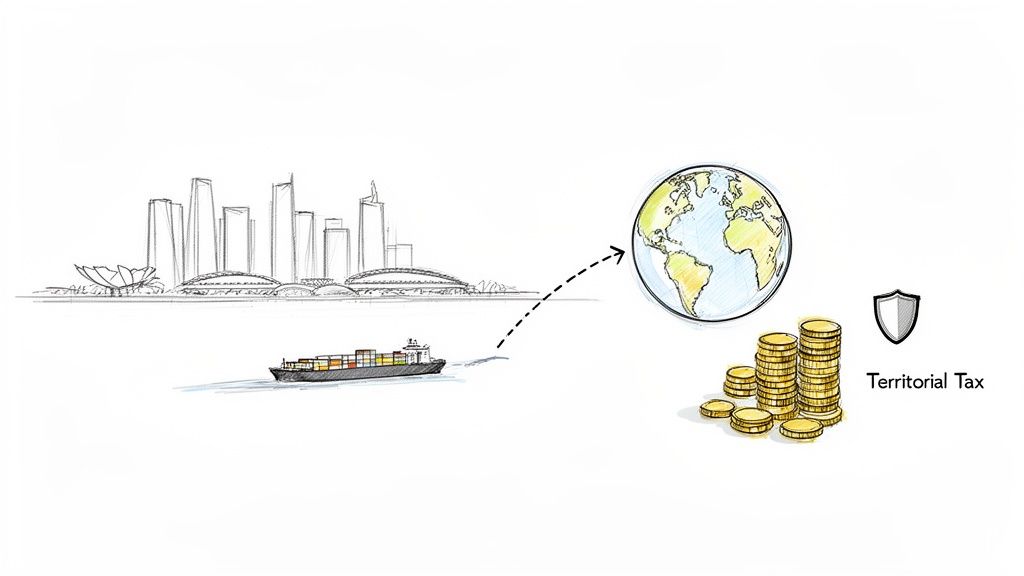
The system is highly attractive for entrepreneurs and corporations managing Asian portfolios. Major tech companies like Google and e-commerce giants serving ASEAN markets use Singaporean holding companies to benefit from its stability, extensive treaty network, and favorable tax regime on foreign profits. The corporate tax rate is a flat 17%, but startups can enjoy significant exemptions in their first three years.
Implementation and Key Considerations
Achieving tax benefits requires careful structuring and a clear understanding of residency rules. Unlike a simple day count, Singaporean tax residency is determined by qualitative factors and intent, although spending 183 days or more in a calendar year automatically confers it.
- Actionable Tip: Structure foreign subsidiaries to maximize the participation exemption. Ensure your Singaporean holding company owns at least a 5% stake in the foreign entity and that the foreign jurisdiction has a headline tax rate of at least 15% to qualify for tax-free remittance of dividends.
- Corporate Structuring: Use a Singaporean holding company to own foreign operating subsidiaries. This isolates foreign-sourced income, preventing it from being automatically taxed in Singapore unless it is remitted. This is ideal for managing regional operations.
- Residency Proof: Maintain meticulous records proving the foreign source of your income. The Inland Revenue Authority of Singapore (IRAS) requires clear substantiation to grant tax exemptions, so documentation of where revenue was generated is non-negotiable.
3. Monaco – Zero Income Tax for Residents
The Principality of Monaco is a world-renowned European hub for the ultra-wealthy, solidifying its place among the top countries with low taxes by levying zero personal income tax, capital gains tax, and wealth tax on its residents. This complete absence of direct personal taxation makes it an exceptionally attractive jurisdiction for high-earning individuals, such as professional athletes, retired entrepreneurs, and prominent figures in luxury industries seeking to preserve their capital in a stable, prestigious European location.
For individuals earning significant income from global activities, such as Formula 1 drivers or cryptocurrency founders, Monaco offers a legitimate tax residence without the complexities of territorial or remittance-based tax systems. The main challenge is the high barrier to entry, as residency is tightly controlled and requires demonstrating substantial financial means, often through a significant property purchase or rental agreement and a large bank deposit in a Monaco-based bank.
Implementation and Key Considerations
Gaining residency in Monaco is a meticulous process focused on proving financial self-sufficiency and a genuine commitment to living in the principality. The first step involves securing a long-stay visa and then applying for a residence permit (Carte de Séjour) upon arrival.
- Actionable Tip: Establish your Monaco residency before a major liquidity event or a high-income year. Timing is critical, as many home countries will tax you for the full year if you are not a confirmed tax resident elsewhere at the start of the tax period.
- Residency Proof: Beyond the initial requirements, diligently maintain records proving your physical presence for over 183 days a year. This includes utility bills, local bank statements, club memberships, and even port records for yacht owners, as this documentation is vital to defend your tax status.
- Financial Commitment: Be prepared for a substantial financial outlay. Securing a rental lease often requires a full year's rent upfront, and purchasing property typically starts at over €1 million. A local bank deposit of at least €500,000 is also a standard requirement for the residency application.
4. Cayman Islands – Corporate Tax Exemption with CRS Compliance
The Cayman Islands is globally recognized as one of the premier countries with low taxes for corporate structuring, offering a zero-tax environment for exempted companies, partnerships, and trusts. This means no corporate income tax, capital gains tax, or withholding tax on profits distributed to shareholders. This framework makes it a dominant jurisdiction for investment funds, holding companies, and specialized financing vehicles.
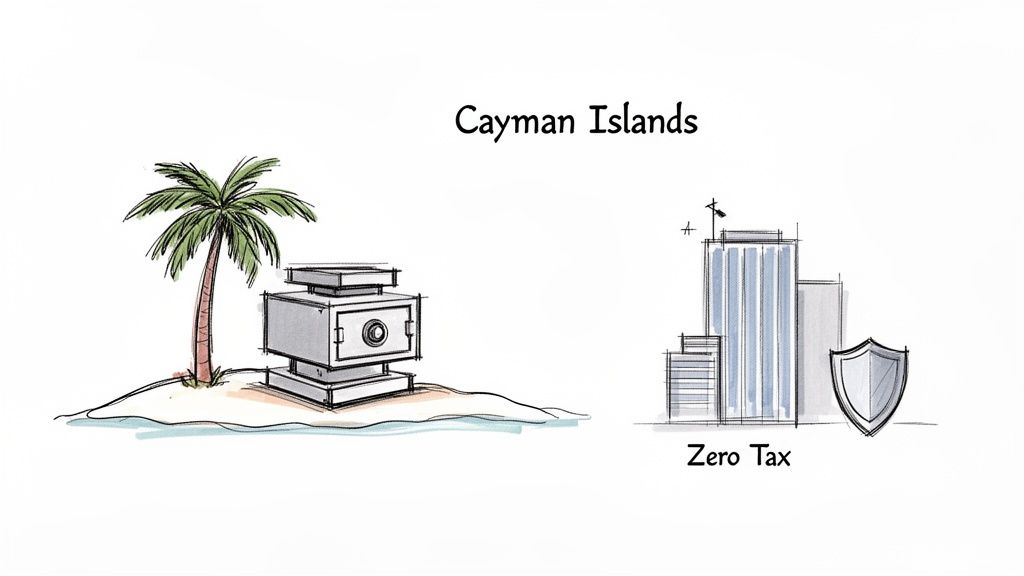
This tax neutrality is designed for international business, attracting private equity firms like KKR and Apollo, multinational enterprises holding intellectual property, and family offices. While offering tax efficiency, the jurisdiction is also a leader in regulatory transparency, fully complying with global standards like the Common Reporting Standard (CRS) and FATCA. Its strong legal system, based on English common law, provides a stable and predictable environment for complex asset protection and corporate governance structures. The combination of a sophisticated financial sector and zero direct taxation is a powerful incentive for global investors and corporations.
Implementation and Key Considerations
The core strategy involves using an "exempted company," a legal structure designed for business conducted outside the Cayman Islands. This entity type can receive a Tax Exemption Certificate, guaranteeing its tax-free status for up to 30 years.
- Actionable Tip: Structure your international operations with a Cayman exempted company at the apex of the holding structure. This allows profits from foreign operating subsidiaries to flow up to the Cayman entity without incurring local corporate taxes, optimizing global tax efficiency.
- Asset Protection: Combine a Cayman Islands exempted company with a Cayman foundation or trust. This creates a powerful two-layer structure that segregates business assets from personal wealth, enhancing both succession planning and creditor protection. The jurisdiction is well-regarded for its financial privacy and robust legal frameworks; explore the best jurisdictions for offshore banking to complement this strategy.
- Substance and Compliance: To legitimize the structure, establish real economic substance. This includes appointing qualified local directors, holding board meetings in the Cayman Islands, and meticulously documenting all major business decisions made within the jurisdiction. This is crucial for avoiding challenges from foreign tax authorities.
5. Malta – EU Tax Residency with Strategic Exemptions
Malta offers a unique proposition within the European Union, blending EU-member access with a strategic tax system that makes it one of the most compelling countries with low taxes for specific individuals and businesses. Its appeal lies in its non-domiciled tax regime, where foreign-sourced income that is not remitted to Malta can remain tax-free for residents. This territorial approach, combined with a full imputation corporate tax system, creates significant planning opportunities.
For corporations, Malta has a headline corporate tax rate of 35%, but a system of tax refunds allows shareholders to claim back a significant portion of the tax paid. In many cases, this can reduce the effective corporate tax rate to as low as 5%, making it ideal for EU-focused tech startups, blockchain companies, and professional services firms establishing a European headquarters.
Implementation and Key Considerations
The key to unlocking Malta’s tax benefits is correctly structuring your residency and business operations. Obtaining non-domiciled (non-dom) resident status is a critical step for individuals seeking to exempt foreign income.
- Actionable Tip: To benefit from the non-dom regime, ensure foreign source income remains outside Malta. Only remit the funds necessary for living expenses, as any money brought into the country becomes taxable.
- Corporate Structuring: Utilize the corporate credit and refund system by properly structuring your company and shareholder agreements. This process is complex, so engaging a local tax advisor is essential to ensure you can legally claim the refunds and achieve a low effective tax rate.
- Residency Proof: As an EU jurisdiction, Malta requires genuine substance. Maintain meticulous records of your physical presence, local ties such as utility bills and rental agreements, and document your center of life to satisfy both Maltese and foreign tax authorities.
6. Antigua and Barbuda – Citizenship by Investment with Tax Benefits
Antigua and Barbuda presents a unique strategy among countries with low taxes, combining a powerful second passport with significant tax advantages. The country levies zero personal income tax on worldwide income, capital gains, wealth, or inheritance for its residents. However, its primary appeal is for non-resident citizens who can leverage its passport for global mobility while maintaining tax residency in another low-tax jurisdiction.
The main draw is its Citizenship by Investment (CBI) program. Entrepreneurs can obtain a second passport, allowing visa-free travel to over 150 countries, including the UK and the EU Schengen Area. This is ideal for global business owners who require mobility but want to avoid establishing tax residency in a high-tax country. An e-commerce entrepreneur, for example, could use an Antigua passport for travel while operating their business from a territorial tax hub like Singapore.
Implementation and Key Considerations
The core strategy involves obtaining citizenship while intentionally not becoming a tax resident. This is achieved by limiting physical presence in the country to fewer than 183 days per year, thereby avoiding tax obligations on your global income.
- Actionable Tip: Time your citizenship application strategically. It's often best to secure your second passport before a major income-generating event or business expansion to establish your non-resident status from the outset.
- Maintain Non-Residency: Diligently track your days in the country. Your primary goal is to use the citizenship for its travel and banking benefits, not to become a tax resident. Keep meticulous records of entry and exit stamps to prove you spent less than the 183-day threshold.
- Corporate Synergy: For an optimized structure, you can establish an Antigua holding company to manage international assets or intellectual property while you personally remain a non-resident citizen, separating your corporate and personal tax profiles.
7. Bahamas – Zero Tax Jurisdiction with Offshore Banking Legacy
The Bahamas leverages its status as one of the quintessential countries with low taxes by imposing zero personal income, corporate, capital gains, or inheritance tax. This complete absence of direct taxation, combined with a mature offshore banking and insurance industry, makes it a strategic base for wealth preservation and international business, particularly for North American-focused operations. Its English common law framework provides a stable and familiar legal environment for investors.
This jurisdiction is particularly effective for holding companies, investment firms, and insurance entities. For example, a US-based investment firm can establish a Bahamian entity to manage international assets, benefiting from the 0% tax environment on investment growth. Similarly, trading companies use Bahamian structures to optimize profits from commodity transactions without incurring corporate tax.
Implementation and Key Considerations
Gaining the benefits of the Bahamas requires careful structuring and an understanding of its residency and compliance landscape. Economic Permanent Residency can be obtained through a significant real estate investment, securing a long-term foothold in this tax-neutral jurisdiction.
- Actionable Tip: Structure your Bahamas entity as a holding company rather than an operating one. This strategy enhances legitimacy and simplifies compliance, especially when paired with an operating company in another jurisdiction, like a US Delaware LLC.
- Substance Requirements: While minimal, establishing substance is crucial for credibility. Maintain a registered office and consider appointing a local director or manager. This helps demonstrate that the company is managed and controlled from within the Bahamas, strengthening its tax residency claim.
- Banking Diligence: Due to proximity to the US, Bahamian banks are under significant regulatory scrutiny. Meticulously document your company's beneficial ownership and ensure all FATCA/CRS reporting is flawless to maintain stable banking relationships.
8. Hong Kong – Territorial Tax System with Foreign Income Exemption
Hong Kong’s appeal as one of the world's premier countries with low taxes is rooted in its territorial tax system. This means only income arising in or derived from Hong Kong is subject to tax, while foreign-sourced income is completely exempt, provided it remains offshore. With a simple, low-rate tax regime on local income (capped at 15% for salaries tax) and no tax on capital gains or dividends, it is a strategic jurisdiction for entrepreneurs and investors with global operations.
Its status as a gateway to Asia makes it ideal for regional headquarters of multinational companies and trading firms serving the Asia-Pacific market. For example, private equity firms often use Hong Kong to manage Asian portfolios, leveraging its robust financial ecosystem while legally isolating their foreign-source profits from taxation. This structure is highly efficient for international trade and investment management.
Implementation and Key Considerations
The key to leveraging Hong Kong’s system is meticulous documentation proving that income is foreign-sourced. Establishing clear separation between local and international activities is paramount for maintaining the tax exemption.
- Actionable Tip: To maintain the tax-exempt status of foreign income, avoid repatriating it into a Hong Kong bank account. Instead, keep these funds in a separate offshore account, such as in Singapore or Switzerland, to create a clear audit trail.
- Corporate Structuring: Utilize a Hong Kong holding company for foreign subsidiaries. This structure legally isolates foreign-source profits, ensuring they do not fall under the Hong Kong tax net. Document all inter-company transactions carefully.
- Residency Proof: Obtain a Tax Residency Certificate (TRC) upon establishing residency. This document is essential for activating benefits under Hong Kong’s double taxation agreements and proving your status to foreign tax authorities. Meticulously track your days in the jurisdiction.
9. Seychelles – Tax Neutrality with Privacy and Asset Protection
Seychelles solidifies its place among countries with low taxes by offering a territorial tax system that provides tax neutrality for foreign-sourced activities. International Business Companies (IBCs) and their owners benefit from zero corporate and personal income tax on foreign-sourced income. This makes the jurisdiction an excellent hub for holding companies, asset protection vehicles, and privacy-focused financial structures.
The nation's appeal lies in its combination of tax efficiency and strong legal frameworks for asset protection, including robust foundation and trust laws. Seychelles is commonly used for international holding companies managing real estate or intellectual property, trading businesses, and wealth preservation structures where confidentiality is a priority. It serves as a strategic component in a larger international plan rather than a primary operational base.
Implementation and Key Considerations
The key to leveraging Seychelles is to use it for its intended purpose: as a passive holding or asset protection jurisdiction. Establishing an IBC is straightforward, but maintaining its benefits requires careful compliance and structuring.
- Actionable Tip: Structure your Seychelles IBC as a holding company for assets like real estate, intellectual property, or shares in operating businesses located elsewhere. This segregates risk and isolates passive, foreign-sourced income in a zero-tax environment.
- Substance and Banking: Pair your Seychelles entity with a legitimate operating company in a jurisdiction with more substance, like the UAE or Singapore. This helps satisfy international banking and compliance requirements, as Seychelles entities can face scrutiny when opening accounts alone.
- Compliance Documentation: Meticulously maintain records, including a registered office and director presence, to meet substance requirements. Implement strict CRS/FATCA compliance procedures to ensure your banking relationships remain stable and avoid regulatory penalties.
10. Dominica – Economic Citizenship Program with Zero Tax Status
Dominica offers a unique proposition for those seeking countries with low taxes by combining a fast and cost-effective citizenship-by-investment (CBI) program with a favorable tax regime. The core benefit is that non-resident citizens pay zero tax on foreign-sourced income, including capital gains, dividends, and wealth. This makes Dominica an excellent tool for securing a second passport while diversifying one’s tax footprint, rather than establishing a full-time residence.
The main draw is its CBI program, one of the oldest and most respected in the Caribbean. Entrepreneurs and investors can gain citizenship, and the associated travel and financial freedoms, without needing to relocate. This is ideal for individuals who want a powerful contingency plan or a second passport to ease global mobility while maintaining their primary tax residence in another low-tax jurisdiction.
Implementation and Key Considerations
The path to tax benefits begins with obtaining citizenship, which doesn't automatically confer tax residency. The key is to maintain non-resident status by spending fewer than 183 days per year in Dominica.
- Actionable Tip: Choose the CBI option that best fits your goals. The non-refundable government donation is often faster and simpler for individuals, while the real estate investment option can provide a potential return and a tangible asset on the island.
- Residency Management: To preserve your zero-tax status on foreign income, meticulously track your days in Dominica. Proactively manage your physical presence to stay below the 183-day threshold and avoid becoming a tax resident.
- Strategic Pairing: Use your Dominican citizenship as a foundation. Pair it with establishing actual tax residency in a territorial or zero-tax country like the UAE or Panama. This combination creates a robust structure, separating your citizenship from your tax obligations for maximum planning flexibility.
11. Panama – Territorial Tax Regime and Friendly Nations
Panama is a classic choice among countries with low taxes due to its territorial tax system. This principle means that only income generated from sources within Panama is subject to tax, while foreign-sourced income is completely tax-free for residents. This makes it an exceptional jurisdiction for international entrepreneurs, consultants, and investors whose earnings originate outside the country.
The nation's appeal is amplified by its flexible residency programs, most notably the Friendly Nations Visa. This program offers a straightforward path to residency for citizens of 50 allied countries, creating a simple entry point for individuals seeking to benefit from the territorial tax system. Combined with its robust banking sector and strategic location, Panama is a premier hub for Americas-focused business and holding company structures.
Implementation and Key Considerations
Gaining tax residency is tied to obtaining legal residency. The Friendly Nations Visa is often the most efficient route, requiring an economic tie to Panama such as a real estate investment or a local bank deposit. Once residency is established, the territorial tax benefits apply automatically to foreign income.
- Actionable Tip: Diligently document the source of all your income. Maintain clear records, contracts, and invoices that prove your earnings originate from clients and activities outside Panama. This documentation is your primary defense against any potential tax challenges.
- Corporate Structuring: A Panamanian corporation (Sociedad Anónima) is an excellent vehicle for holding regional assets or managing international service-based businesses. Ensure the entity has demonstrable substance, such as a local office or director, to maintain strong banking relationships and credibility.
- Residency Coordination: If you leverage the Friendly Nations Visa, consult with tax advisors in both Panama and your home country. This coordination helps you avoid accidental tax residency elsewhere and ensures compliance with any Controlled Foreign Corporation (CFC) rules that might apply.
12. Portugal – Non-Habitual Resident (NHR) Regime and Golden Visa Options
Portugal secures its spot among countries with low taxes through its highly attractive Non-Habitual Resident (NHR) regime. This program offers new tax residents a 10-year window of preferential tax treatment, including a flat 20% rate on certain Portuguese-source professional income and, more importantly, a potential tax exemption on most foreign-source income like dividends, interest, and royalties, provided certain conditions under tax treaties are met.
This makes Portugal an excellent EU base for retirees, digital nomads, and entrepreneurs. For instance, a retiree from Northern Europe can receive their foreign pension tax-free in Portugal, while a tech entrepreneur can manage their non-Portuguese business operations from a sunny, affordable European hub. Combined with residency pathways like the Golden Visa program, it offers a powerful route to EU residency and significant tax planning opportunities.
Implementation and Key Considerations
To benefit, you must not have been a Portuguese tax resident in the five years prior to your application. Securing tax residency, often by spending over 183 days in the country or having a primary home there, is the first step.
- Actionable Tip: You must apply for NHR status by March 31st of the year following the one in which you become a tax resident. Missing this deadline means forfeiting the NHR benefits for that year, so timely application is critical.
- Pension Planning: Before moving, review the double taxation treaty between Portugal and your pension's source country. The NHR exemption often depends on the source country having the right to tax the income, even if it doesn't exercise it.
- Documentation: Maintain meticulous records to prove your NHR eligibility and foreign income sources. Engage a Portuguese tax advisor to navigate the application process and ensure full compliance with local and international reporting standards.
12 Low-Tax Countries Comparison
| Jurisdiction | Implementation complexity | Resource requirements | Expected tax outcomes | Ideal use cases | Key advantages |
|---|---|---|---|---|---|
| United Arab Emirates (UAE) | Moderate — 3–6 months (residency, free-zone setup) | Visa sponsorship or Golden Visa, local agents, bank accounts, office/substance for mainland | Zero personal income tax; 0% corporate in many free zones; 15% mainland >AED375k; 5% VAT | Regional HQ, family offices, entrepreneurs, crypto firms | Zero personal tax; strong banking/treaty network; political stability |
| Singapore | Moderate — 2–4 months (entity + passes) | Employment/Investor pass, corporate setup, substance, professional advisors | Personal 5–22%; corporate 17% with foreign‑source exemptions; GST 8% | Regional HQ, holding companies, investment funds | Territorial exemptions, participation exemption, robust treaty network |
| Monaco | High — 6–12 months (residency substantiation, property) | Significant capital (property ~€1M+), local banking, residency documentation | 0% personal income & capital gains for residents; corporate tax on Monaco‑sourced income | Ultra‑high‑net‑worth individuals, retirees, sports professionals | Zero personal tax; prestige and privacy; European access |
| Cayman Islands | Low — 2–4 weeks for entity; banking 4–8 weeks | Exempted company registration, professional service providers, CRS/FATCA compliance, substance documentation | 0% corporate and personal for exempted entities; no VAT/GST | Hedge funds, private equity, holding vehicles, IP structures | Zero taxation for exempted entities; specialized fund/legal infrastructure |
| Malta | Moderate — 2–3 months (residency, entity) | Residency (183 days), NRD paperwork, corporate refund planning, advisors | Nominal corporate 35% (effective ≈6.25% after refund); personal 6–35% with NRD exemptions; VAT 18% | EU base, crypto/blockchain firms, digital nomads | EU access, refundable corporate system, NRD foreign income relief |
| Antigua & Barbuda | Low–Moderate — 3–6 months for citizenship; quick entities | Investment for CBI (US$100k–250k), limited banking, basic compliance | 0% on foreign‑sourced income for non‑residents; corporate 0% on foreign income | Second passport holders, mobile entrepreneurs, tax diversification | Citizenship by investment, visa‑free travel, preserve non‑resident tax status |
| Bahamas | Low — 2–4 weeks entity; banking 4–12 weeks | Offshore banking relationships, registered agent, increasing substance expectations | 0% personal, corporate, capital gains, inheritance tax | North America‑focused holdings, insurance/reinsurance, trading firms | Absolute zero taxation; mature offshore banking; US proximity |
| Hong Kong | Moderate — 2–3 months (residency + entity) | Work/residency permit, robust banking, careful documentation of foreign income | Territorial: foreign‑sourced income exempt if kept offshore; personal 2–17% local; corp 16.5% local | China/Asia regional HQ, trading, holding companies | Full foreign‑source exemption, access to China, strong finance sector |
| Seychelles | Low — 2–4 weeks entity; banking 2–8 weeks | Offshore company setup, service providers, limited banking, substance docs | 0% personal and corporate on foreign‑sourced income; no VAT | Holding companies, asset protection, privacy‑focused structures | Tax neutrality, asset protection, simple incorporation |
| Dominica | Low — 30–60 days for citizenship; quick entities | CBI investment (~$100k+), minimal substance, limited banking | 0% on foreign‑sourced income for non‑residents; corporate 0% on foreign income | Cost‑effective second passport seekers, tax diversification | Fast, low‑cost CBI; zero tax for non‑residents |
| Panama | Moderate — 1–3 months (residency/options) | Friendly Nations/pensionado visa, company setup, source‑of‑income documentation | Territorial: Panama‑sourced income taxed; foreign‑source income generally exempt if not remitted | Latin America/US holding & trading, expat residency | Territorial regime, friendly visas, regional banking links |
| Portugal | Moderate–High — 2–6 months (residency & NHR) | Residency, NHR application within 1st year, possible Golden Visa investment, legal/tax advisors | NHR: possible exemptions/flat rates for 10 years; ordinary residents taxed up to ≈48% | EU residency seekers, retirees, entrepreneurs with foreign income | EU access, NHR preferential regime, high quality of life |
From Theory to Action: Designing Your Global Tax Strategy
Navigating the landscape of countries with low taxes is far more than an academic exercise in comparing rates. As we've explored, the journey from identifying a potential jurisdiction to implementing a resilient, compliant international structure is a multi-layered process. The true power lies not in selecting a single "best" country, but in strategically assembling a global footprint that aligns with your specific personal, financial, and business objectives.
This roundup has showcased the diverse toolkit available to the modern global citizen and entrepreneur. From the complete absence of personal income tax in the UAE and Monaco to the strategic territorial systems of Singapore, Hong Kong, and Panama, each option presents a distinct advantage. We've seen how EU residency in Malta or Portugal can unlock access to the Schengen Area, while Caribbean citizenship programs in Antigua or Dominica provide unparalleled mobility and asset protection.
Key Takeaways: Beyond the Tax Rate
Simply chasing a zero percent tax rate is a common but critical mistake. An effective strategy recognizes that the most important factors often lie beyond the headline number.
- Substance is Non-Negotiable: Jurisdictions like the UAE and Singapore are actively enforcing economic substance requirements. A "paper company" is no longer a viable strategy. Your structure must have genuine operational presence, management, and control within the chosen jurisdiction to withstand scrutiny.
- Compliance is Paramount: The era of opaque offshore banking is over. Automatic Exchange of Information (AEOI) frameworks like the Common Reporting Standard (CRS) mean that financial transparency is the global standard. A successful structure is one that is fully compliant from day one, not one that tries to hide.
- Holistic Integration is Essential: Your choice of jurisdiction must integrate with your lifestyle and business needs. Consider factors like time zones, banking infrastructure, political stability, and travel connections. A tax-efficient structure in an impractical location creates more problems than it solves.
Building Your Bespoke Global Structure
The most sophisticated strategies often involve a combination of jurisdictions, each serving a specific purpose. This "jurisdictional stacking" allows you to leverage the unique strengths of different countries to create a truly optimized and robust framework.
Imagine a scenario:
- Operating Hub: An entrepreneur establishes an operating company in a UAE free zone to manage their global e-commerce business, benefiting from zero corporate tax and strong logistics infrastructure.
- Holding Company: A Seychelles IBC (International Business Company) is used as a holding entity for intellectual property and other assets, capitalizing on its privacy features and tax neutrality.
- Personal Residency & Citizenship: The individual secures residency in Portugal through the NHR program to live in Europe with significant tax benefits on foreign income, while also holding a passport from Antigua for enhanced visa-free travel.
This multi-jurisdictional approach creates a powerful, diversified, and compliant system. However, orchestrating this requires deep expertise to ensure each component works seamlessly together without creating legal or tax conflicts.
The path to global tax optimization is a strategic one, demanding careful planning, expert guidance, and a clear understanding of your long-term goals. The countries detailed in this article are not just destinations; they are powerful tools. When used correctly, they can help you legally minimize your tax burden, protect your assets from unforeseen risks, and unlock a new level of personal and financial freedom. Moving from theory to action is the definitive step in transforming your financial future.
Ready to architect your own compliant, tax-efficient global strategy? At Protect Your Wealth, we specialize in implementing the complex structures discussed in this article, drawing on real-world operator experience across more than 50 jurisdictions. Let our team of vetted professionals provide a single, trusted point of contact to build your robust international footprint. Visit Protect Your Wealth to schedule a consultation and move from planning to execution.


