


Think of cross-border tax planning as the rulebook for legally arranging your finances across multiple countries to minimize your total tax bill. It's about strategically using international tax laws, treaties, and corporate structures to manage your income and assets efficiently, ensuring you don’t pay a dollar more in tax than you legally have to.
Why a Global Mindset Is Essential for Your Finances

Imagine trying to conduct a world-class orchestra where every musician plays by a different set of rules. The German section follows one score, the Americans follow another, and the Singaporean group has its own unique guidelines. This is the reality of modern international business, and effective cross border tax planning is the conductor that makes sure every part works in perfect harmony.
This guide is designed to cut through the confusing jargon and show you why a compliant, intelligent tax strategy is non-negotiable for today's global entrepreneurs and investors. We'll get straight to the core tension between national tax laws and international business, setting you up for the practical strategies ahead.
The New Reality of International Business
Going global isn't just for massive corporations anymore. A software developer in Canada can earn a salary from U.S. clients. An e-commerce store in the UK can hold inventory in an EU warehouse. An investor in Dubai might own real estate in London. Each of these everyday scenarios creates a complex web of tax obligations that can quickly become a nightmare without a solid plan.
The goal isn't just to be tax-efficient; it's to build a structure that is both resilient and legally sound. This isn't about exploiting shadowy loopholes. It's about making smart, informed decisions that stand up to scrutiny.
The core principle of effective cross border tax planning is proactive design, not reactive problem-solving. It's about building a sustainable framework that supports growth while managing risk in a transparent and defensible way.
What You Will Learn
This guide will give you a solid foundation in the key elements needed to create a robust international financial structure. We want to arm you with the knowledge to spot both opportunities and risks, so you understand exactly when and why you need to bring in a professional.
By the end of this article, you'll have a much clearer picture of:
- Core Concepts: The fundamentals that drive everything, like tax residency, double taxation treaties, and transfer pricing.
- Effective Structures: How legal tools like holding companies and trusts are used to protect assets and optimize tax outcomes.
- Jurisdiction Selection: The real criteria for choosing the right country for your business or investments, looking far beyond just the headline tax rate.
- Compliance and Reporting: How to navigate critical global standards like FATCA and CRS that demand total transparency.
Ultimately, our goal is to demonstrate that smart planning is all about building a resilient, transparent, and legally optimized global footprint that manages risk and powers sustainable growth.
The Core Principles of International Tax Strategy
If you want to build a solid international financial structure, you have to start with the foundations. Proper cross-border tax planning isn’t some magic trick; it’s about layering a few key principles to create a strategy that is both efficient and legally sound.
Think of it like building a high-performance engine. Each component has a specific job, and they all have to work together perfectly to reduce friction and maximize power.
It All Starts with Tax Residency
The absolute heart of any international plan is tax residency. For you as an individual, it’s usually where you live, spend most of your time, or have your main economic center of life.
For a company, it’s a bit more complex. It might be where the company is incorporated on paper, but what really matters is where its “mind and management” is located—the place where the big, strategic decisions are actually made. A company registered in Delaware but run entirely by a team in Dublin will almost certainly be considered an Irish tax resident.
Getting residency right is the critical first step. It determines which country gets the primary right to tax your worldwide income. If you mess this up, you could find yourself with surprise tax bills in multiple countries, which will wreck even the best-laid plans.
How Corporate Structures and Profits Fit In
Once you've sorted out residency, the next layer is figuring out how the different pieces of your business deal with each other financially. Two concepts are non-negotiable here: Controlled Foreign Corporation (CFC) rules and transfer pricing.
Controlled Foreign Corporation (CFC) rules are basically anti-avoidance measures. Countries like the United States put them in place to stop people from just hoarding profits in offshore companies in low-tax jurisdictions to delay paying tax. If you control a foreign company, these rules can force you to pay tax on its profits right now, even if you haven't brought the money home yet.
Transfer pricing is all about how related companies within a single multinational group buy and sell from each other. The guiding light here is the “arm's length principle.” It just means the price charged between your own companies has to be the same price you'd charge a completely unrelated third party.
Here’s how it works in the real world: Imagine a software company with its main office and intellectual property (IP) registered in Ireland. They have a development team in Poland and a sales office in the United States. Transfer pricing rules determine the fair market "price" the U.S. sales office has to pay the Irish HQ for the license to sell the software. That price directly shapes where profits show up—and where they get taxed.
Navigating Treaties and the New Global Tax Rules
The final, essential layer is the web of international agreements that keep the whole system from descending into chaos. Double Taxation Treaties (DTTs) are just agreements between two countries to make sure you don't get taxed twice on the same income. They are the bedrock of cross-border planning and often slash the taxes on dividends, interest, and royalties moving between countries.
But the ground is shifting under our feet. Global initiatives are forcing a much more transparent and standardized system. The OECD's Pillar Two framework, for instance, is a massive change designed to stop companies from shifting profits to tax havens by setting a global minimum corporate tax rate.
For any large multinational, this is no longer optional. It demands a serious look at how you structure your cross-border operations to stay compliant. You can find more details on these BEPS actions directly on the OECD website.
This global cooperation means that while you can still plan for efficiency, every strategy must have real business substance and be completely transparent. These three pillars—residency, corporate rules, and treaty networks—are what any successful cross-border tax strategy is built on.
Effective Legal Structures for Global Entrepreneurs
Once you understand the core tax principles, the next step is putting them into practice. This is where the real power of cross border tax planning comes to life—by choosing the right legal structures.
Think of these structures like specialized vehicles. You wouldn't take a race car off-roading, and you wouldn't bring a rugged SUV to a Formula 1 track. In the same way, the right corporate or personal structure is essential for navigating the global financial landscape efficiently and safely.
For any global entrepreneur or investor, this is the most critical step. It’s how you translate a smart strategy into tangible results, building a framework that not only optimizes your tax position but also protects your assets and supports long-term growth.
The Power of International Holding Companies
One of the most common and effective tools in the international playbook is the international holding company. Imagine a parent company that doesn't actually produce goods or services. Instead, its sole job is to own shares in various subsidiary companies operating in different countries. This structure creates a central hub for managing global assets and cash flow.
The real magic happens when this holding company is set up in a jurisdiction with a strong network of Double Taxation Treaties (DTTs). When a subsidiary in a high-tax country like Germany pays a dividend, it first flows to the holding company. If that holding company is based somewhere like Ireland or Singapore, favorable treaty terms can slash—or even eliminate—withholding taxes on that dividend.
This allows you to consolidate profits with maximum efficiency before reinvesting them or distributing them to shareholders.
Protecting Assets with Trusts and Foundations
While holding companies are fantastic for managing active business operations, trusts and foundations serve a completely different but equally vital purpose: asset protection and succession planning. These structures create a legal separation between an individual and their assets.
- Trusts: A trust is created when a "settlor" transfers assets to a "trustee," who then manages them for the benefit of the "beneficiaries." It's a powerful tool for safeguarding wealth from creditors, political instability, or messy legal disputes. Once assets are placed in a properly structured irrevocable trust, they are generally no longer considered part of the settlor's personal estate.
- Foundations: More common in civil law countries, a foundation is a distinct legal entity with no shareholders. It's managed by a council for a specific purpose laid out in its charter. Panama Foundations, for example, are highly regarded for their robust confidentiality and asset protection features, making them a cornerstone for many high-net-worth families.
The flowchart below shows how the core principles we've discussed fit together to inform the selection of these structures.
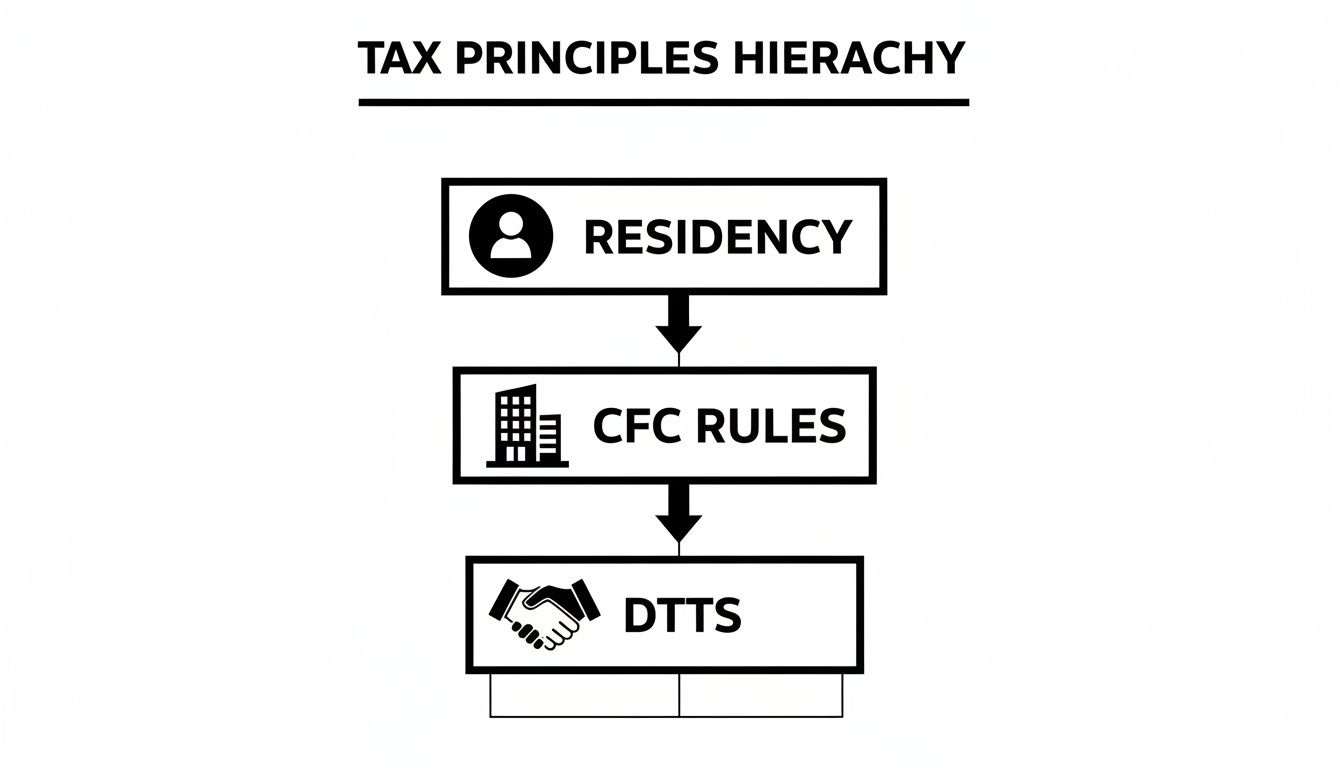
As you can see, determining tax residency is the foundational first step. From there, you must navigate Controlled Foreign Corporation (CFC) rules and then leverage Double Taxation Treaties to optimize the entire structure.
Establishing Regional Headquarters for Operational Efficiency
For businesses that are expanding their physical footprint, establishing a regional headquarters (RHQ) is a classic strategic move. An RHQ acts as a centralized command center, handling management, administrative, and support functions for a specific area, like the Asia-Pacific or European markets.
Placing an RHQ in a strategic hub like Dubai, Hong Kong, or the UK offers more than just tax advantages. It provides access to skilled talent, world-class banking, and direct proximity to key markets. From a tax standpoint, these jurisdictions often roll out the red carpet with incentives, low corporate tax rates, and, most importantly, access to their extensive treaty networks.
This simplifies financial flows across the entire region. If you're looking for more information, you can learn more about how to legally reduce your tax burden with international structures in our detailed guide.
The ultimate goal is to create a cohesive ecosystem where each legal entity has a clear commercial purpose. A structure that exists purely for tax reduction without genuine business substance is a major red flag for tax authorities worldwide.
To help you visualize the differences between these options, the table below provides a side-by-side comparison.
Comparing Common Cross Border Structures
This table breaks down the primary features, benefits, and ideal use cases for the most common structures used in international planning.
| Structure Type | Primary Purpose | Key Benefits | Ideal For | Example Jurisdictions |
|---|---|---|---|---|
| Holding Company | Centralized ownership of global operating subsidiaries. | Reduction of withholding taxes on dividends, interest, and royalties; simplified management. | Multinational businesses, e-commerce empires, investment portfolios. | Ireland, Singapore, UK, Netherlands |
| Trust | Asset protection, estate and succession planning. | Legal separation of assets from personal ownership, creditor protection, confidentiality. | High-net-worth individuals, family offices, legacy planning. | USA (specific states), New Zealand, Cayman Islands |
| Foundation | Asset protection, long-term wealth preservation. | Distinct legal personality, no owners, high degree of confidentiality. | Families seeking privacy and control over generational wealth. | Panama, Liechtenstein, Netherlands |
Ultimately, the right combination of these tools depends entirely on your specific situation—your business model, personal residency, and long-term financial goals. A well-designed plan often integrates several of these structures into a single, compliant, and highly effective global framework.
How to Choose the Right Jurisdiction
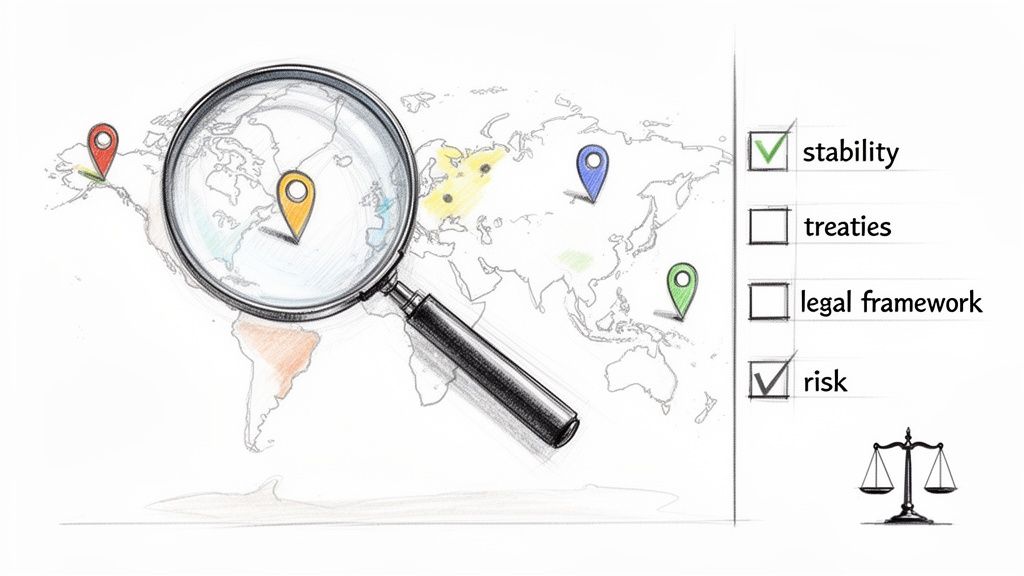
Choosing the right jurisdiction is one of the most misunderstood parts of cross-border tax planning. It’s easy to get fixated on the lowest possible corporate tax rate, but that’s a rookie mistake that can lead to disaster. The best jurisdiction isn’t the one with the flashiest tax number; it’s the one that provides a stable, predictable, and legally sound environment for your assets and operations.
Think of it like choosing a foundation for a skyscraper. You wouldn’t pick a site known for earthquakes just because the land is cheap. You need solid ground that can support your structure for decades to come. In the same way, a jurisdiction has to offer more than just tax incentives—it needs to provide a rock-solid base for your entire global financial life.
A low-tax jurisdiction that has a sudden political shift or banking crisis can wipe out any savings overnight. This is why a thoughtful, multi-factor analysis is absolutely non-negotiable.
The Stability and Legal System Check
Before you even glance at a tax table, your first questions should be about stability and the rule of law. A country’s political and economic climate is the bedrock of its reliability as a financial center. Is the government stable? Is the economy diversified and resilient?
Just as important is the legal framework. A jurisdiction with a common-law system—like the UK, Singapore, or Hong Kong—often provides far greater certainty for business and asset protection. These systems are built on centuries of precedent, making them much less susceptible to abrupt, politically motivated changes. A strong, independent judiciary is your best insurance policy against arbitrary government actions.
Evaluating the Treaty Network and Incentives
Often, the real power of a jurisdiction is found in its connections. A country’s network of Double Taxation Treaties (DTTs) is a critical asset. An extensive and well-negotiated treaty network allows capital—dividends, interest, and royalties—to move across borders with minimal tax friction. This is exactly why hubs like Ireland and the Netherlands are so popular for holding companies.
Beyond treaties, look for specific incentives that align with your business. Singapore, for instance, offers attractive schemes for intellectual property (IP) holding companies, making it a top choice for tech and pharmaceutical firms. The United Arab Emirates, on the other hand, provides tax-free zones and world-class logistics, which is ideal for international trade and e-commerce operations.
The real art of jurisdiction selection lies in matching the unique strengths of a country with the specific needs of your business or investment portfolio. A one-size-fits-all approach simply doesn’t work in sophisticated cross-border tax planning.
This level of strategic planning is now essential. The scale of capital being managed is immense; cross-border tax planning by U.S. multinationals alone represents a massive revenue shift, costing the American government over $100 billion annually. By 2021, foreign affiliates of U.S. firms reported 34% of their income in low-tax jurisdictions that account for just 2% of global GDP. You can explore more of these findings on how U.S. firms use international tax planning.
Banking Privacy and Operational Practicality
Finally, think about the practical elements of doing business there. The quality and privacy of the banking system are paramount. While global transparency standards like the Common Reporting Standard (CRS) have reduced absolute secrecy, reputable financial centers still offer robust client confidentiality and sophisticated banking services. You can learn more in our guide on the best jurisdictions for asset protection and offshore bank accounts.
A jurisdiction’s reputation also matters. Using a country on an international “blacklist” can create serious operational headaches, from opening bank accounts to dealing with suppliers. The ideal location is one that is both tax-efficient and globally respected, ensuring your business operations run smoothly and without interruption.
Navigating Global Transparency and Reporting Standards
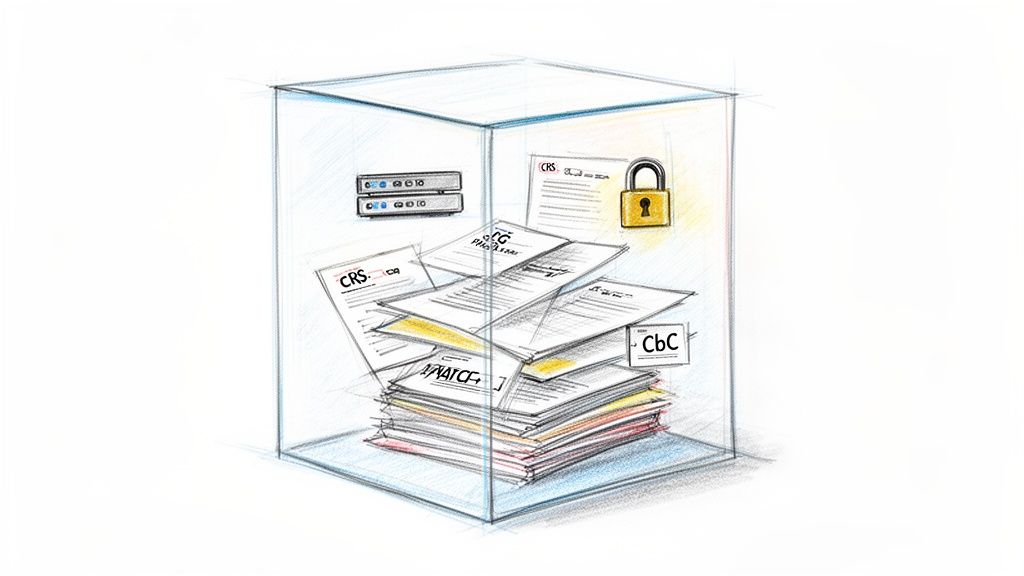
Not long ago, international finance operated behind a thick veil of secrecy. That veil has been completely torn away. We’ve moved from an age of financial privacy into an era of radical transparency, where total compliance is the price of admission to the global stage.
Modern cross border tax planning has to operate like a glass box—fully visible, legally sound, and built to withstand intense scrutiny from tax authorities all over the world. The old strategies of hiding assets in opaque structures are not just risky anymore; they are a direct path to crippling penalties and legal disaster.
This shift means compliance is no longer a boring administrative task. It’s now the absolute core of any sustainable, low-risk international strategy. Getting it right is not optional.
The New Rules of the Game: CRS and FATCA
Two game-changing regulations have fundamentally rewired the global financial system, creating an automatic information-sharing network that leaves nowhere to hide. If you have foreign assets, you need to understand them.
-
The Common Reporting Standard (CRS): This is the OECD’s global standard for automatically exchanging financial account information. Over 100 countries have agreed to collect data from their banks and automatically share it with the tax authorities in an account holder’s home country. In simple terms, your local tax office will know about the bank accounts you hold abroad.
-
The Foreign Account Tax Compliance Act (FATCA): Think of this as the U.S. version of the same concept. FATCA forces foreign banks and financial institutions to report on the assets held by their American clients. It essentially turns every major bank in the world into an information-gathering agent for the IRS.
Together, these two frameworks have created a powerful global surveillance system. The days of opening an offshore account and just assuming it would stay private are over.
Modern cross border tax planning is no longer a game of hide-and-seek. It’s a game of chess where every move is visible, and the winning strategy is built on compliance, substance, and complete transparency.
Reporting for Multinationals and the Digital Taxman
For larger businesses, the transparency demands are even more intense. Country-by-Country (CbC) Reporting, a key part of the OECD’s Base Erosion and Profit Shifting (BEPS) project, forces large multinational companies to file a detailed annual report.
This report breaks down their income, taxes paid, and economic activity for every single jurisdiction where they operate. It gives tax authorities a high-level, instant snapshot of a company’s global footprint, making it incredibly easy to spot situations where profits are parked in a low-tax country with no real business happening there.
This trend is only getting faster. A recent Deloitte survey of over 1,100 tax and finance leaders identified ‘transparency & reporting’ and the ‘digitalization of tax’ as the two forces having the greatest impact on their business. In fact, by 2025, 31 countries will have mandatory disclosure rules to combat BEPS, mostly in Europe. You can see the full breakdown in Deloitte’s comprehensive 2025 Global Tax Policy Survey.
This data-driven world is always changing. For instance, if you’re involved with crypto, you need to read our guide on how DAC8 will impact crypto reporting in the EU. This new directive pulls crypto-asset providers into the same automatic information-sharing net, closing yet another perceived loophole.
Staying ahead of these rules is critical. What’s considered compliant today might land you in trouble tomorrow.
When to Call in a Cross Border Tax Specialist
Handling your own cross border tax planning can feel liberating at first, but there comes a point where the DIY approach creates more risk than it saves. Knowing when to bring in a specialist isn’t admitting defeat—it’s a sign of sophisticated, forward-thinking management.
Think of it like this: you might be a skilled first-aid responder, perfectly capable of handling everyday cuts and bruises. But when faced with a situation that requires complex surgery, you call a surgeon. The stakes are higher, the knowledge is specialized, and the cost of a mistake is irreversible. The same logic applies to your international financial health.
The Tipping Points That Demand an Expert
So, what are the clear signals that you’ve moved from the shallow end to the deep end? It’s rarely one single event but a cascade of changes that ramp up your financial complexity. You’ve almost certainly outgrown a DIY strategy if you’re facing any of these scenarios:
- You’re setting up a foreign company or trust. This isn’t just a paperwork exercise. You’re stepping into another country’s legal and tax framework, where a small oversight can lead to huge tax bills or legal penalties down the road.
- You’re planning for a second residency or citizenship. This immediately creates a dual-jurisdiction tax reality. How your new country and your old country view your income, assets, and estate can become incredibly complicated overnight.
- You’re building an international team. Hiring employees or even contractors in different countries opens up a Pandora’s box of payroll taxes, social security obligations, and permanent establishment risks you may not even know exist.
- You’re making a major overseas investment. Whether it’s buying foreign real estate or acquiring an international business, the structure of that investment is critical. The wrong setup can erode your returns and create unnecessary tax burdens.
- You’re planning to pass wealth to the next generation. Transferring assets to heirs living in different countries is one of the most complex areas of law. Without expert coordination, families can face crippling inheritance taxes and legal disputes.
Why a Coordinated Strategy Is Non-Negotiable
A genuine cross-border specialist firm does far more than just file tax returns. Their real value is acting as the “general contractor” for your entire global financial structure. They are the ones who orchestrate the legal, tax, and banking components across every country you operate in, ensuring they all work together as a single, coherent strategy.
Proactive planning is the difference between building a fortress on solid rock and trying to patch up a house sinking into a swamp. One is secure and cost-effective; the other is a frantic, expensive, and ultimately losing battle.
This integrated approach prevents a decision made in one area—like choosing a jurisdiction for a holding company—from creating a disastrous, unforeseen problem somewhere else, like your personal tax residency. By seeing the complete picture, a specialist doesn’t just manage your taxes; they safeguard your wealth for the long term, making sure every piece of your international puzzle fits perfectly.
Frequently Asked Questions
When you start operating internationally, a lot of questions come up. Here are the answers to some of the most common ones we hear about cross border tax planning.
Is Cross Border Tax Planning Legal
Yes, absolutely. Legitimate cross-border tax planning is all about using the existing laws and international treaties to legally and efficiently manage your tax obligations.
This is a world away from tax evasion, which is the illegal act of hiding income. Reputable firms only build structures that are fully compliant with global standards like the Common Reporting Standard (CRS) and FATCA. The entire goal is to create a transparent, defensible framework that stands the test of time.
When Do I Need International Tax Planning
The simple answer? As soon as your business or personal finances cross a border. There’s no magic number, but some triggers make it obvious that it’s time to call in a specialist.
It’s time to get serious about planning if you’re:
- Earning income from another country.
- Hiring employees or key contractors who live abroad.
- Getting a second residency or passport.
- Owning foreign assets like real estate or investment portfolios.
- Setting up a foreign company to serve international clients.
The key is to be proactive. It’s always cheaper and easier to build a smart, compliant structure from day one than it is to clean up a mess of penalties and back-taxes later.
Why Are Double Taxation Treaties Important
A Double Taxation Treaty (DTT) is an agreement between two countries to make sure the same income isn’t taxed twice. These treaties are the bedrock of smart international tax planning.
Without them, a dividend paid from a company in Country A to a shareholder in Country B could get hit with taxes in both places, killing your returns. DTTs prevent this by setting clear rules on who gets to tax what.
They also often create much lower withholding tax rates on things like dividends, interest, and royalties that cross borders. Using holding companies in jurisdictions with great treaty networks is a fundamental strategy for anyone operating globally.
A well-designed international strategy is your best defense against financial uncertainty. Protect Your Wealth specializes in crafting compliant, bespoke structures that protect your assets and optimize your global footprint. If you’re ready to build a resilient financial future, book a consultation with our team of experts today.


