


The real difference between a citizen and a permanent resident boils down to one thing: ultimate security.
Citizenship grants you irrevocable rights, including a passport and the right to vote. Permanent residency, on the other hand, gives you the right to live and work in a country, but that right is always conditional and can be taken away. For global entrepreneurs, this isn't just a legal detail—it's a strategic decision that impacts your wealth, freedom, and long-term security.
A Strategic Overview of Status
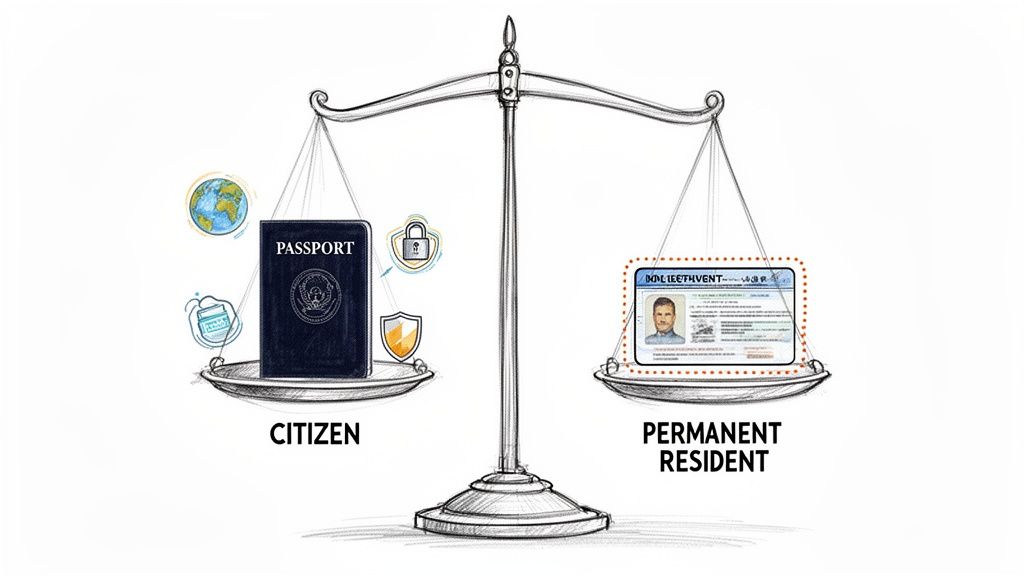
Choosing between permanent residency and full citizenship is one of the most critical decisions a high-net-worth individual will make. While both statuses give you a legal foundation to live and work in a new country, they offer fundamentally different levels of protection, integration, and opportunity.
Permanent residency is an excellent first step. It secures your right to reside, work, and access social services like healthcare and education. The catch? It's a conditional status. It can be lost if you spend too much time outside the country or commit certain offenses, and it doesn’t give you the political voice to influence the very laws that affect your business and assets.
Citizenship, in contrast, is the final destination. It signifies full membership in a nation and grants an absolute, permanent right to live there—one that can't be revoked. This status unlocks the single most powerful tool for global mobility: a passport. It also gives you the power to vote and hold public office, giving you a real say in the economic and legal framework of your new home.
Key Comparison Points
The distinction becomes crystal clear when you look at specific rights and limitations. In the United States, for example, political participation is a major dividing line. In 2023, of the 47.8 million immigrants, 46% were naturalized U.S. citizens with full voting rights. Meanwhile, 23% were lawful permanent residents (LPRs) who could not vote or run for office. This is a critical gap for high-net-worth individuals, as citizens can directly influence tax policies and asset protection laws. You can read more about these U.S. immigration statistics and what they mean for global mobility.
For entrepreneurs, an LPR status allows for work authorization and U.S. banking access, but it still lacks the passport power that provides visa-free travel. A citizen has that freedom.
The strategic takeaway is this: Permanent residency is a foothold, offering stability and the capacity to operate. Citizenship is a fortress, providing ultimate security, political influence, and unrestricted global freedom.
At-a-Glance Comparison Citizen vs. Permanent Resident
To put it simply, here’s a quick summary of the fundamental differences between citizenship and permanent residency across the key strategic areas that matter most to global entrepreneurs.
| Attribute | Permanent Resident | Citizen |
|---|---|---|
| Right to Reside | Conditional; can be revoked | Absolute and permanent |
| Political Rights | None (cannot vote or hold office) | Full (can vote and hold public office) |
| Travel Document | Uses passport of origin country | Receives country’s passport |
| Deportation Risk | Yes, for certain offenses | No (except in rare cases of fraud) |
| Access to Jobs | Some restrictions (e.g., federal) | Unrestricted access to all jobs |
| Family Sponsorship | Limited and often slower | Broader and faster |
Ultimately, the choice depends on your long-term goals. Residency can be a highly effective tool, but citizenship is the only status that guarantees permanent protection and complete freedom.
Your Core Rights: Where Citizenship Truly Matters
The real gap between a citizen and a permanent resident opens up when you look at the fundamental rights each status provides. While permanent residency gives you a solid base to live and work, citizenship offers an unbreakable foundation of political and legal power. This isn't just about legal jargon; it directly impacts your ability to protect your wealth and control your business environment.
A citizen’s greatest power is the right to participate in the democratic process. This means voting in all elections—federal, state, and local—and the ability to hold public office. For a high-net-worth individual or entrepreneur, this is anything but trivial. It’s the power to influence tax laws, property rights, and the exact business regulations that govern your investments.
Permanent residents, on the other hand, are taxpayers who contribute to society but have no formal voice in how it's run. They must follow laws they had no role in creating, a vulnerable position for anyone managing significant assets or complex business operations across different countries.
Political Power as Business Security
Imagine a new wealth tax is on the table, or a law restricting foreign ownership of certain assets is proposed. As a citizen, you can vote for representatives who protect your financial interests, lobby against bad policy, and even run for office yourself to push for pro-business rules. This political access is a powerful form of asset protection.
A permanent resident can only watch from the sidelines. Your entire business structure could be undermined by a political shift you were powerless to stop. Without a vote, your long-term security is ultimately in the hands of others—a risk many successful entrepreneurs simply won't accept.
The core difference is permanence. A citizen's right to live in the country is absolute and unconditional. A permanent resident's right is conditional, creating a layer of jurisdictional risk that citizenship completely eliminates.
Access to Sensitive Industries and Government Work
Another critical dividing line is employment, especially in sectors tied to national security or government contracts. Most countries, including the United States, reserve certain federal jobs exclusively for citizens. More importantly, getting a high-level security clearance is almost always impossible for non-citizens.
This is a make-or-break issue for entrepreneurs working in strategic fields like:
- Aerospace and Defense: Government contracts in these sectors often require key personnel to hold security clearances.
- Cybersecurity: Working with sensitive government data or critical infrastructure is typically off-limits to non-citizens.
- Advanced Technology: Projects funded by national security grants may have strict citizenship requirements for everyone involved.
For an entrepreneur in these fields, permanent residency becomes a hard ceiling on growth. You might build a great company but find yourself locked out of lucrative government contracts or unable to hire top talent who need clearances—all because of your status. Citizenship shatters that ceiling, opening up a whole new tier of business opportunities.
The Unbreakable Right of Return
Perhaps the most fundamental privilege of citizenship is the unconditional right to enter, live in, and leave your country. A citizen’s passport is more than a travel document; it is an ironclad guarantee of entry. You can live abroad for 20 years and return at any moment, no questions asked.
A permanent resident has no such guarantee. If you spend too much time outside the country, immigration authorities can decide you've abandoned your residency, and your status can be revoked when you try to re-enter. For global entrepreneurs who are constantly traveling or managing businesses in multiple countries, this creates a persistent, low-grade anxiety.
Every trip abroad carries a small but real risk. You have to meticulously track your days outside the country and maintain deep ties—property, bank accounts, tax filings—just to prove your intent to reside there. A citizen is free from all these burdens, enjoying total freedom of movement and the peace of mind that comes with knowing home will always be home.
Unlocking Global Mobility And Travel Freedom
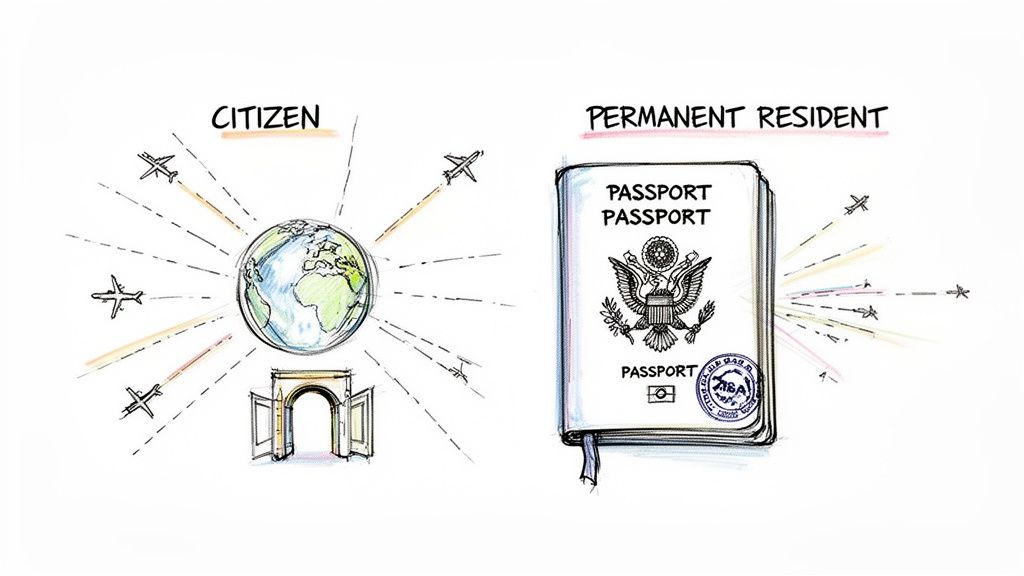
For the global entrepreneur, a passport isn't just a travel document—it's a critical tool for business agility and personal freedom. While both citizens and permanent residents can cross borders, the quality and security of that travel are worlds apart. This distinction is often the single most compelling reason high-net-worth individuals pursue full citizenship.
A permanent resident’s travel freedom is fundamentally chained to their original passport. Your U.S. permanent residency card gets you back into the United States, but it does absolutely nothing to get you into Singapore, London, or Dubai. For that, you’re still relying on your birth passport and all its limitations.
If your original passport is weak, you remain burdened by constant visa applications, unpredictable processing times, and the ever-present risk of rejection. This reality puts a hard ceiling on spontaneity. A last-minute business opportunity or an urgent family matter can quickly become a logistical nightmare of paperwork and appointments.
The Power Of A Citizen's Passport
Citizenship completely rewrites the rules of the game. A passport from a strong jurisdiction—think the United States, an EU member state, or Singapore—unlocks visa-free or visa-on-arrival access to over 170 countries for many passport holders. This single document transforms international travel from a planned ordeal into a simple, frictionless activity.
This is the key difference between citizen and permanent resident status when it comes to mobility. A citizen can act on opportunities immediately; a resident must first ask for permission. You can learn more about how to get a second passport in our detailed guide, which covers the strategies we use to expand our clients' travel freedom.
Citizenship grants the ultimate travel privilege: the unconditional right to enter your country. A permanent resident can be denied re-entry if an immigration officer decides they've abandoned their residency—a risk a citizen never, ever faces.
Real-World Travel Scenarios
Let's look at how this plays out in the real world. The contrast becomes stark when you face common, high-stakes travel challenges.
| Travel Scenario | Permanent Resident | Citizen |
|---|---|---|
| Urgent Business Trip | Must check visa rules for the destination based on their original passport. May need a lengthy visa application, delaying or killing the deal. | Checks their passport’s visa-free list. Can book a flight and travel immediately to most global business hubs. |
| Visa Application | Applies for visas using their home country’s passport. This can mean intense scrutiny and high rejection rates depending on the passport’s strength. | Rarely needs to apply for visas for short-term travel. When required, the process is typically simpler with a much higher success rate. |
| Denied Re-Entry Risk | Faces a very real risk. Extended time abroad can be seen as abandoning residency, leading to status revocation at the border. | Zero risk. Has an absolute, constitutionally protected right to enter their country at any time, for any reason. No questions asked. |
The Security Of Guaranteed Return
That last point—the risk of being denied re-entry—is a source of constant, low-level anxiety for many permanent residents who travel frequently. They must meticulously document their ties to the country—property, tax filings, bank accounts—just to prove their intention to reside there permanently. It's a burden that never truly goes away.
A citizen is completely free from this. You can live abroad for decades, manage a global empire from multiple bases, and always know you have an absolute right to come home.
This level of security is priceless. It offers the peace of mind needed to build and manage wealth on a global scale, solidifying citizenship as the gold standard for anyone who values unrestricted movement and jurisdictional certainty.
Navigating Obligations, Taxes, And Removal Risks
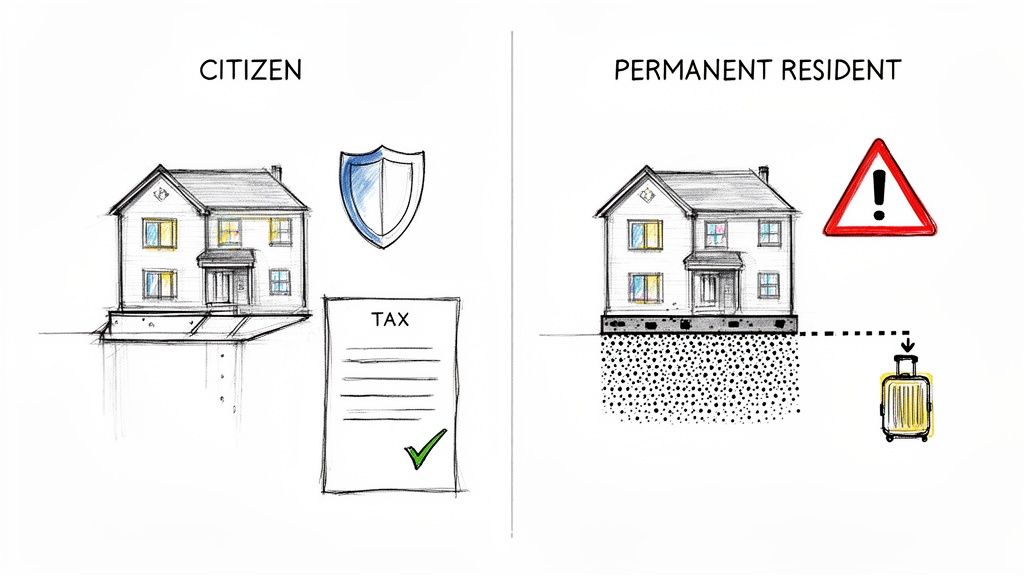
While travel freedoms and daily rights are important, the real difference between citizen and permanent resident status crystalizes when you look at obligations and risks. These are the non-negotiables—taxation, military service, and the ever-present threat of removal—that truly define the security of your standing in a country.
For a high-net-worth individual, overlooking these details isn’t just a mistake; it can be catastrophic.
A common myth is that citizens automatically face a heavier tax burden. In many high-tax jurisdictions, this is simply false. Countries like the United States, for example, tax both citizens and permanent residents (green card holders) on their worldwide income, no matter where they live or earn it.
From a pure tax perspective, both statuses often land you in the same boat. The critical distinction isn't how much you owe, but the bedrock of certainty you have while managing those obligations. This is why strategic cross-border tax planning is non-negotiable for either status.
The Absolute Security From Deportation
Here is the single greatest risk a permanent resident faces: deportation. It's a threat that is entirely non-existent for a natural-born or naturalized citizen. This isn't a minor detail; it’s the fundamental line between conditional presence and absolute belonging.
A citizen cannot be removed from their own country, period—barring rare cases of fraudulent naturalization. A permanent resident, on the other hand, lives with the knowledge that their status can be revoked for a surprisingly wide range of offenses. And we’re not just talking about serious felonies.
Common grounds for removal often include:
- Aggravated Felonies: A dangerously broad legal term that can cover offenses like theft or even tax evasion over a certain dollar amount.
- Crimes of Moral Turpitude: Vague but potent, this can include fraud, larceny, or any crime involving deceit. Just two such convictions could be enough to trigger removal proceedings.
- Controlled Substance Violations: Even a minor drug offense can put your residency in jeopardy.
- Firearms Offenses: Unlawful possession or use of a firearm is a fast track to deportation.
- Abandonment of Residency: This is a silent killer of residency status. Simply spending too much time outside the country without the right permits can be interpreted as abandonment, leading to the loss of your status upon re-entry.
For a global entrepreneur with complex financial dealings, these risks are amplified. An unintentional misstep in tax filings or a minor legal dispute in a business deal could potentially be twisted into a deportable offense, threatening your entire life and asset structure in that country.
Citizenship is the ultimate insurance policy against removal. It transforms your status from a conditional privilege granted by a government into an inalienable right, providing the peace of mind required for true long-term planning.
Understanding Compulsory Obligations
Beyond the risks, it's also crucial to understand the duties you'll share. The most significant is military service. In countries with mandatory conscription, this obligation often extends to both male citizens and permanent residents within a specific age group.
The United States is a perfect example. Male citizens and permanent residents between 18 and 25 must register with the Selective Service System. While there’s no active draft, failing to register can have serious consequences, including making you ineligible for future citizenship.
This shared duty highlights a core imbalance: permanent residents often shoulder the same responsibilities as citizens but with far fewer rights and almost none of the security. You could be called upon to defend a country that could, in turn, deport you for a minor mistake.
Below is a direct comparison of these critical factors.
Risk & Obligation Matrix: Resident vs. Citizen
This table breaks down the fundamental differences in security and compulsory duties, illustrating why citizenship offers a superior foundation for long-term personal and financial planning.
| Factor | Permanent Resident | Citizen |
|---|---|---|
| Deportation Risk | High. Can be removed for a wide range of criminal offenses, immigration violations, or abandonment of residency. | Zero. Cannot be deported from their own country under any circumstances (except for fraudulent naturalization). |
| Tax Obligations | Often Identical. In many countries (like the US), taxed on worldwide income, same as citizens. | Often Identical. Taxed on worldwide income in citizenship-based taxation systems. No inherent tax advantage. |
| Military Service | Often Required. Must register for selective service in countries like the US. Can be drafted. | Required. Must register for selective service and is subject to conscription where it exists. |
| Legal Standing | Conditional Privilege. Status is granted by the state and can be revoked. | Inalienable Right. Status is absolute and cannot be taken away by the government. |
| Long-Term Security | Limited. Always subject to changes in immigration law and government policy. | Absolute. Provides permanent security and a stable foundation for life, family, and assets. |
The takeaway is clear. While a permanent resident can be asked to assume the ultimate obligation of defending a nation, they never receive the ultimate right of belonging to it. This profound imbalance is why the journey from resident to citizen is not just an upgrade—it's the final step in securing your future.
For many entrepreneurs and investors I work with, permanent residency is just a stepping stone. It's a strategic move, absolutely, but the real prize is full citizenship. This is where a conditional status becomes a permanent, non-revocable asset.
This transition, known as naturalization, is the formal process of converting your residency into the ultimate form of security and belonging.
While every country has its own playbook, the core requirements are almost always the same. Think of it less as a bureaucratic checklist and more as a way of demonstrating your genuine commitment to your new home. Understanding these pillars is the key to planning a successful transition.
The process is designed to ensure new citizens are truly part of the fabric of society. But for my globally mobile clients, this can create some unique hurdles. Constant business travel or managing international teams can directly conflict with one of the most fundamental requirements.
Proving Physical Presence
The biggest obstacle for most entrepreneurs is the physical presence requirement. Plain and simple, most countries expect you to actually live there for a set number of years before you can even think about applying for a passport.
For example, the United States generally requires five years of continuous residence. Canada is a bit different, requiring you to be physically present for at least 1,095 days (that's three years) within the five years before you apply.
This isn’t just about having an address on paper. Immigration authorities will comb through your travel records to make sure you haven’t been out of the country for too long. One extended absence could completely reset the clock on your eligibility, pushing your citizenship application back by years. For an entrepreneur who needs to be on a plane for deals, supplier meetings, or managing global teams, this demands careful, forward-thinking planning.
The key is to document every single trip and proactively manage your time in-country. This shifts the physical presence test from a potential deal-breaker into a manageable part of your long-term strategy, ensuring your global business doesn't derail your path to citizenship.
Demonstrating Language and Civic Knowledge
Living in the country isn't enough. Naturalization also demands a deeper level of integration, which is usually measured through two key tests.
- Language Proficiency: You'll almost always need to prove you can speak, read, and write the official language(s) to a functional level. It’s about being able to participate in daily life and commerce.
- Civics Test: This exam covers the country's history, government, laws, and core values. It’s a way to confirm you understand both the rights and the responsibilities that come with being a citizen.
For a busy professional, carving out time to study feels like a luxury, but don't underestimate these tests. Failing either one can cause serious delays, forcing you to reapply and wait months for another shot.
Luckily, there are plenty of resources out there, from official government study guides to private tutors. It's also worth noting that alternative routes, like exploring citizenship by marriage, can sometimes change the residency timelines, but these core integration requirements usually still apply.
The Final Steps: Good Moral Character and The Oath
The last leg of the journey involves a final character check and a public declaration of loyalty. You must demonstrate good moral character, which is just another way of saying you have a clean criminal record and a history of playing by the rules, especially when it comes to paying taxes. Any serious legal trouble is a fast track to denial.
Finally, it all culminates in an oath of allegiance. This is a formal ceremony where you swear loyalty to your new country, officially marking your transition from a resident to a full-blown citizen. This symbolic act solidifies your place as a permanent, protected member of the nation—with all the rights and security that come with it.
Choosing Your Path: Strategic Recommendations
Deciding between permanent residency and citizenship isn't just a legal choice; it's a strategic calculation based on your specific goals for wealth, business, and lifestyle. The right answer depends entirely on your long-term vision.
For some, permanent residency provides all the necessary tools. For others, only the absolute security of citizenship will do.
Understanding the typical path from resident to citizen is crucial for planning. The journey involves clear milestones, including physical presence, language ability, and civics testing. It's a process of integration, not just a paperwork exercise.
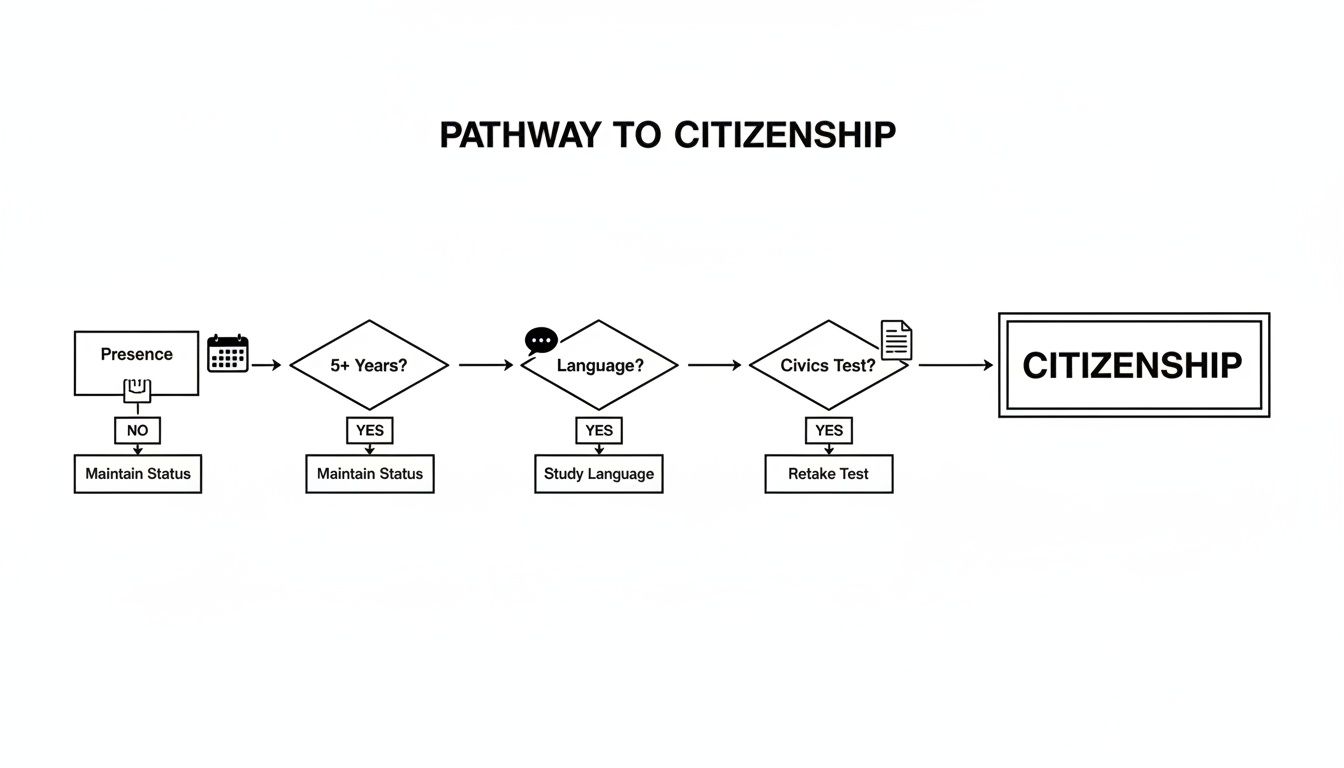
This path demands a significant commitment of both time and physical presence in the country. It's a major factor in deciding which route aligns with your life.
When Permanent Residency Is the Smart Play
Permanent residency can be the ideal solution for specific, well-defined objectives. It’s perfectly suited for entrepreneurs and investors who need a stable base in a new country but don't require full political integration or the ultimate travel freedom a passport provides.
PR is often the most powerful and efficient tool in these scenarios:
- Targeted Business Ventures: If you're launching a U.S.-based company to access the American market and its banking system but plan to manage it from abroad, permanent residency is excellent. It gives you the legal right to live and work in the country as needed.
- A "Plan B" Residency: For those seeking a reliable backup option, a permanent residency in a stable country offers a secure place to relocate if conditions deteriorate at home.
- Strategic Tax Residency: Establishing tax residency in a low- or zero-tax jurisdiction can often be done with permanent residency, allowing for significant tax optimization without the years-long commitment of naturalization.
When Citizenship Is Non-Negotiable
For those whose ambitions are truly global, citizenship isn't a luxury—it's a necessity. It provides a level of security and freedom that permanent residency can never match.
Citizenship becomes the only logical choice in these situations:
- Ultimate Asset Protection: Citizenship shields you from the risk of deportation. For HNWIs with complex financial structures, this eliminates the danger of having your life and assets uprooted by a minor legal issue or a shift in political winds.
- Unrestricted Global Mobility: If your business requires spontaneous travel or you desire a lifestyle with complete freedom of movement, a powerful second passport is your most valuable asset. Citizenship unlocks visa-free access that PR simply cannot offer.
- Generational Security: Citizenship is an asset you can pass down to your children, securing their future with the same rights and freedoms you possess. It establishes a permanent legacy of global access and security for your family.
Your personal and professional goals should dictate the path you choose. While residency is a powerful tool for specific objectives, citizenship is the definitive solution for anyone demanding absolute security and unrestricted global freedom.
Ultimately, designing your ideal strategy requires a bespoke plan. The nuances of immigration law, tax implications, and asset protection are too interconnected to leave to chance. Seeking expert consultation ensures your chosen path aligns perfectly with your long-term vision for prosperity and peace of mind.
Common Questions Answered
When you're dealing with high-stakes business and personal assets, the small details between legal statuses become critical. Let's clear up some of the most common questions about the difference between being a citizen versus a permanent resident.
Can A Permanent Resident Be Denied Re-Entry?
Yes, and this is a risk many people underestimate. An immigration officer can deny a permanent resident re-entry if they believe you’ve "abandoned" your residency. This isn't just about how many days you're out of the country; it’s about a pattern. If you fail to maintain solid ties like property, local business operations, or consistent tax filings, you're creating a vulnerability.
A citizen, on the other hand, holds an unconditional right to enter their country. Period. This simple fact eliminates a huge source of stress and uncertainty for anyone who travels frequently for business or pleasure.
Do Permanent Residents Pay The Same Taxes As Citizens?
In many high-tax countries, like the United States, the answer is a surprising yes. The U.S. government taxes both its citizens and permanent residents (green card holders) on their worldwide income, no matter where they actually live or earn it.
The real difference between citizen and permanent resident status isn't the tax rate—it's the security. A citizen's standing is absolute. A resident's status, however, is conditional. It can be challenged and even revoked, sometimes over complex financial reporting issues that can easily trip up international entrepreneurs.
Citizenship is your ultimate safeguard. It ensures that a tax dispute or a financial error, which could jeopardize a permanent resident's status, will never result in you being forced to leave the country.
Can My Children Automatically Become Citizens?
It all comes down to the country's specific laws. In nations with birthright citizenship (jus soli), such as the United States, any child born on its soil automatically becomes a citizen. The parents' status is irrelevant.
But here’s the crucial distinction: if a permanent resident has a child outside the country, that child gets nothing automatically. They have to be sponsored, which involves paperwork, delays, and uncertainty. A citizen, in contrast, can almost always pass their citizenship down to their children born abroad, securing their family's future and freedom for generations.
At Protect Your Wealth, we build bespoke strategies that align your legal status with your financial and personal goals. We handle the complexities of global mobility, from securing strategic residencies to achieving full citizenship, making sure your assets and your lifestyle are truly protected. Schedule a consultation today and design your path to ultimate freedom and security.


