


So, what does it actually take to get a digital nomad visa? While every country has its own quirks, a few core requirements pop up almost everywhere. You’ll generally need to prove you work remotely for a foreign company, show a minimum monthly income (often between $2,000 to $5,000), carry comprehensive health insurance, and have a clean criminal record.
These visas are a special kind of permit, designed to fill the gap between a short-term tourist visa (which forbids work) and a traditional work visa that ties you to a local employer.
The Rise of the Modern Nomad: Understanding Digital Nomad Visas

The very idea of a “workplace” has changed. It’s no longer just a cubicle in a corporate high-rise. Today, your office can be a beachside café in Bali, a bustling co-working space in Lisbon, or a quiet apartment overlooking the mountains in Georgia. This freedom has created a new class of professional—the digital nomad—and governments are finally catching up.
Digital nomad visas are their answer to this global remote work movement. It’s a smart play, really. Countries get to attract foreign talent and money without putting any strain on their local job market.
A tourist visa says you can’t work. A standard work visa says you must work for a local company. The digital nomad visa carves out a new path entirely.
A digital nomad visa offers a unique middle ground: it provides the legal right to live in a new country while earning your income from foreign sources, effectively allowing you to be a resident consumer without being a local employee.
This distinction is everything. By welcoming professionals who bring their own income, host countries boost their economies through your spending on housing, food, and local services. It’s a classic win-win: you get an incredible new lifestyle, and the country benefits from your economic contribution.
Who Are These Visas For?
And don’t think these programs are just for twenty-something coders and freelance writers. They’re increasingly designed to attract a wide range of remote professionals, including:
- Established Employees: Professionals working remotely for established companies based outside the host country.
- Business Owners and Entrepreneurs: Individuals who own and operate location-independent businesses.
- High-Net-Worth Individuals: Investors and entrepreneurs seeking a new base of operations or a better quality of life.
Getting a handle on the real purpose of these visas is the first step to building a successful application. It helps you anticipate exactly what documents they’ll ask for and how to frame your case to prove you’re the ideal, self-sufficient candidate these countries are so eager to attract.
Decoding Your Eligibility for a Digital Nomad Visa
Qualifying for a digital nomad visa often feels like a puzzle, but once you understand the core pieces, it all clicks into place. While every country adds its own local flavor, nearly all programs are built on the same four foundational pillars. These aren’t just arbitrary hurdles; they’re designed to ensure you can support yourself comfortably without ever competing for local jobs.
Think of it as a four-part checklist. A host country wants to see verifiable proof of remote income, sufficient financial savings, comprehensive health coverage, and a clean criminal background. Meeting these core digital nomad visa requirements proves you’re a low-risk, high-value guest who will contribute to their economy through your spending.
The growth in this area has been nothing short of explosive. As of 2025, over 50 countries now offer dedicated remote-work residence visas, a massive jump from just a handful a few years ago. This shift shows how governments are rethinking their approach to global talent. You can explore this trend and see the full country list on the Digital Nomad Visa Index 2026.
So, what do you actually need to show them? While the specifics vary, a few non-negotiable requirements form the backbone of nearly every application.
Core Eligibility Requirements for Digital Nomad Visas
This table breaks down the universal requirements you’ll encounter. Think of it as your master checklist—get these four areas in order, and you’re well on your way to a successful application, no matter where you plan to go.
| Requirement Category | What You Typically Need to Provide | Why the Host Country Asks for It |
|---|---|---|
| Proof of Remote Income | Employment contracts, client invoices, pay stubs, business registration documents. | To confirm your income is earned from sources outside their country, ensuring you don’t take local jobs. |
| Minimum Income Threshold | Bank statements (3-6 months) showing consistent deposits above a set amount. | To verify you can support yourself financially and won’t become a burden on their social welfare systems. |
| Health Insurance | A policy certificate showing comprehensive medical coverage for your entire stay. | To ensure you can cover any medical emergencies without relying on their public healthcare system. |
| Clean Criminal Record | An official police clearance certificate from your home country (and others where you’ve lived). | To protect their national security and ensure they are admitting responsible, law-abiding individuals. |
Mastering these four pillars is the key to unlocking a successful application. Let's dig a little deeper into what each one really means in practice.
Proving Your Remote Income
This is the most critical pillar of your application. It’s not enough to just show you have money; you have to prove your earnings come from clients or an employer located outside the host country. This is the entire logic behind the digital nomad visa category.
You’ll need to provide concrete evidence, and the right documents depend on how you work:
- For Employees: A signed employment contract, recent pay stubs, and an official letter from your company confirming your remote status and salary are the gold standard.
- For Freelancers: A strong portfolio of client contracts, a history of recent invoices, and bank statements showing consistent payments from foreign clients are a must.
- For Business Owners: You'll need to prepare business registration documents, corporate bank statements, and potentially profit-and-loss statements or dividend distribution records.
The goal is to paint an undeniable picture of a stable, foreign-sourced income stream.
Meeting the Minimum Income Threshold
Beyond proving your work is remote, you have to show you earn enough to live well. Every country sets a minimum income threshold, a financial baseline they use to ensure you won't struggle or rely on public support. This figure varies wildly, from around $2,000 per month in more affordable hubs to over $5,000 per month in pricier European nations.
The income threshold acts as a financial gatekeeper. It’s the country’s way of saying, "We welcome you, provided you can fully support yourself and contribute to our economy through your spending."
This is a non-negotiable line in the sand. You’ll typically need several months of bank statements showing your salary or business revenue consistently meeting or exceeding that magic number. For high-net-worth individuals with more complex income sources, this is where meticulous documentation becomes absolutely vital.
Securing Comprehensive Health Insurance
No country wants to be on the hook for a temporary resident's medical bills. That’s why proof of comprehensive health insurance is a mandatory part of nearly every single application. Your policy must be valid for your entire stay and explicitly cover you in the host country.
Your average travel insurance plan won't cut it here. You need a robust global health plan that covers hospitalization, major medical emergencies, and sometimes even repatriation. This requirement protects both you and the host nation’s healthcare system.
Presenting a Clean Criminal Record
Finally, every country has a duty to protect its citizens. A clean criminal record check is a standard background verification step to ensure you pose no security risk. You'll need to get an official document from the national police authority in your home country—and sometimes from any other country where you've lived for more than six or twelve months.
This document usually needs to be recent (issued within the last three to six months) and may require an official translation or an apostille, depending on your destination. It’s a simple but non-negotiable step to demonstrate that you are a responsible and law-abiding applicant.
Comparing Top Destinations for Remote Work Visas
Choosing where to plant your flag as a remote worker is about far more than just picking a pretty spot on the map. Not all digital nomad visas are created equal—they're strategic tools, and you need to understand the game. Some are designed as gateways to long-term European residency, while others are simply a tax-friendly haven for a year or two. Getting this right is the key to matching a country to your real financial and lifestyle goals.
Think of each visa program as a unique offer on the table. A high-cost country like Spain is naturally going to demand a higher proof of income to ensure you won’t be a burden. On the other hand, a more affordable spot like Mexico might have a lower financial bar but offer a different set of long-term perks. Your job is to look past the beaches and analyze the deal: what’s the income threshold, how long is the visa, what are the tax implications, and does it lead anywhere permanent?
This kind of strategic thinking moves you from a vague "I want to work abroad" to a clear, actionable plan. Let's break down some of the world's most popular programs to see what makes them tick.
The European Hubs: Your Path to EU Residency
For many, the real prize is getting inside Europe's Schengen Area, which unlocks visa-free travel across 27 countries. The programs in Spain and Portugal are the premier gateways to achieve this, but they’re built for slightly different people.
Spain's Digital Nomad Visa (Visado para teletrabajadores)
Spain's program is a heavyweight contender for anyone wanting a foothold in one of Europe's most dynamic cultures. It demands a fairly high income but, in return, gives you a clear and structured path toward putting down long-term roots.
- Income Requirement: You must prove a monthly income of at least €2,762 (around $3,000 USD). This figure is pegged at 200% of the Spanish minimum wage, so expect it to rise if you bring family.
- Key Benefit: The initial one-year visa can be renewed for up to five years. After that five-year mark, you can apply for permanent residency. This makes it an excellent long-term play.
- Best For: Established professionals and high-earners who want deep cultural immersion and have their eye on a permanent EU residency card.
Portugal's D8 Digital Nomad Visa
Portugal has been a darling of the remote work scene for years, famous for its incredible quality of life. Its D8 visa is tailor-made for remote workers and offers a similar residency path to Spain, just with a different financial hurdle.
- Income Requirement: The bar here is set at four times the Portuguese minimum wage, currently about €3,280 per month (or $3,500 USD).
- Key Benefit: Just like Spain, it offers a five-year route to permanent residency and even citizenship. While Portugal's famous Non-Habitual Resident (NHR) tax regime has been updated, it can still provide some powerful tax advantages for the right kind of professional.
- Best For: Entrepreneurs and remote workers chasing a high quality of life, full EU access, and potential tax efficiencies.
No matter which European hub you choose, the core eligibility criteria almost always come down to three non-negotiable pillars: consistent remote income, solid health insurance, and a clean criminal record.
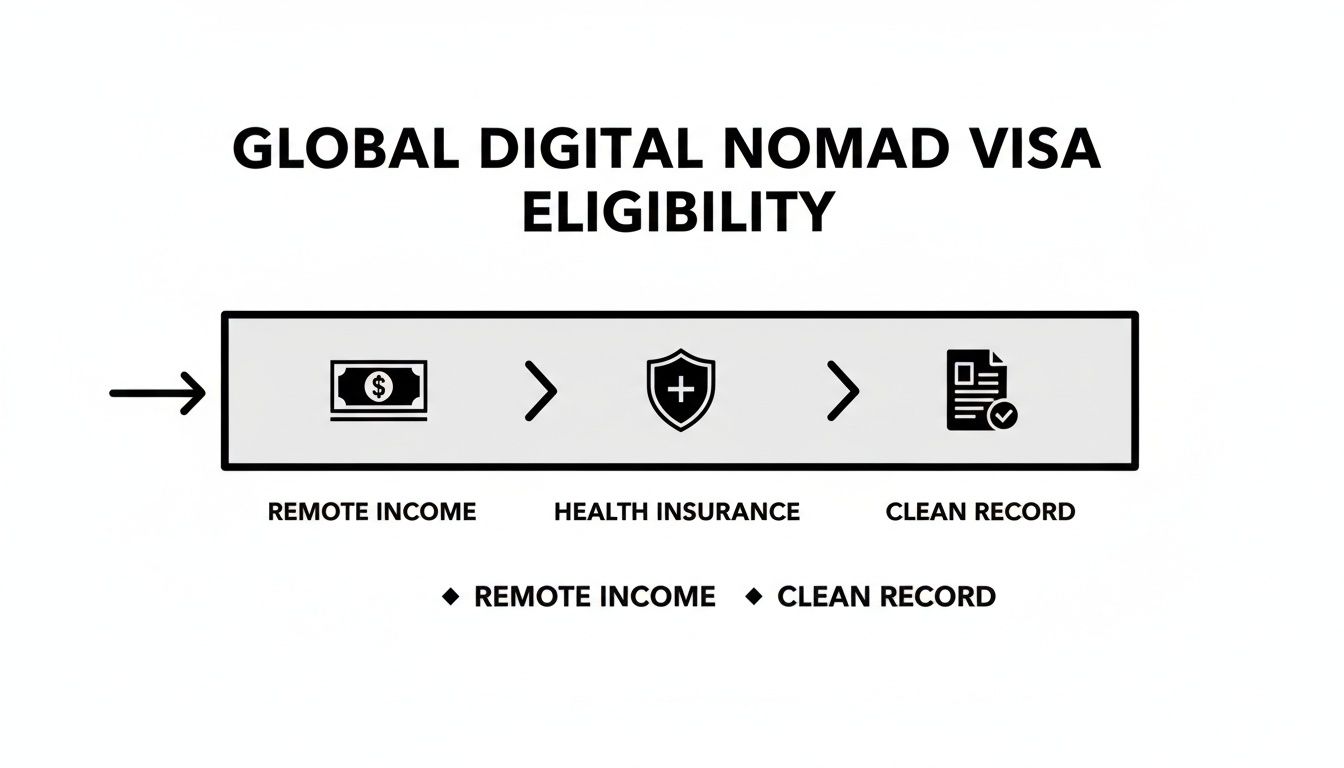
This flowchart neatly summarizes the foundation of any strong application. Get these three things right, and you're already halfway there.
Tax-Advantaged Havens and Americas Hubs
Moving beyond Europe, other global players have crafted programs specifically to attract foreign capital with easy processes and very attractive tax rules. These spots are often perfect for entrepreneurs and high-net-worth individuals focused on financial optimization.
Dubai's Remote Working Visa
Dubai has aggressively positioned itself as a world-class business hub where zero income tax and a high-end lifestyle are the main attractions. Its one-year renewable remote work visa is a perfect reflection of that strategy.
- Income Requirement: A hefty $3,500 USD per month, proven with pay stubs and bank statements.
- Key Benefit: The draw is simple and powerful: 0% personal income tax. For high-earners, this is a game-changer that can dramatically increase net income.
- Best For: High-net-worth individuals, business owners, and solo professionals who see tax optimization as their number one priority.
Mexico's Temporary Resident Visa
While it's not a "digital nomad visa" in name, Mexico's Temporary Resident Visa is one of the most popular and effective routes for remote workers. It's known for being accessible and having a relatively low financial barrier to entry.
- Income Requirement: You can qualify with a monthly income of about $3,275 USD or, alternatively, by showing a bank balance of around $54,600 USD. These figures do shift from time to time.
- Key Benefit: The visa can be issued for up to four years right from the start, offering incredible stability without constant renewals. Mexico's proximity to the U.S. and its low cost of living are also huge draws.
- Best For: Remote workers looking for a long-term, affordable base in the Americas with a refreshingly straightforward application process.
The financial requirements swing wildly from one country to another. For a clearer picture, it's helpful to see these key programs side-by-side, weighing their income demands against the strategic advantages they offer.
Digital Nomad Visa Showdown: Key Program Features
| Country | Required Minimum Monthly Income (USD Approx.) | Key Strategic Benefit | Best For Applicants Seeking |
|---|---|---|---|
| Spain | $3,000 | Structured 5-year path to permanent EU residency | A long-term future and cultural immersion in the EU |
| Portugal | $3,500 | 5-year path to EU residency/citizenship and potential tax advantages | A high quality of life combined with EU access and tax efficiency |
| Dubai | $3,500 | 0% personal income tax and a global business hub | Maximum tax optimization and a luxury lifestyle |
| Mexico | $3,275 (or $54,600 in savings) | Up to 4 years of residency, stability, and low cost of living | A long-term, affordable base in the Americas without frequent renewals |
This table cuts through the noise. A lower income requirement might look good on paper, but a country with a higher bar could unlock far more valuable benefits, like a path to a second passport or significant tax savings. Your final decision should always be a calculated one.
Choosing the right visa isn't about finding the "best" program. It's about finding the best fit for you. A low income threshold in one country might be tempting, but a higher one elsewhere could open doors to permanent residency or save you a fortune in taxes.
Ultimately, you need to weigh the monthly income demands against the long-term strategic upside—whether that's EU access, tax freedom, or simply a better quality of life. Taking this analytical approach ensures your global mobility strategy is built on a rock-solid foundation that serves both your personal ambitions and your financial goals.
Preparing Your Document Checklist for a Successful Application
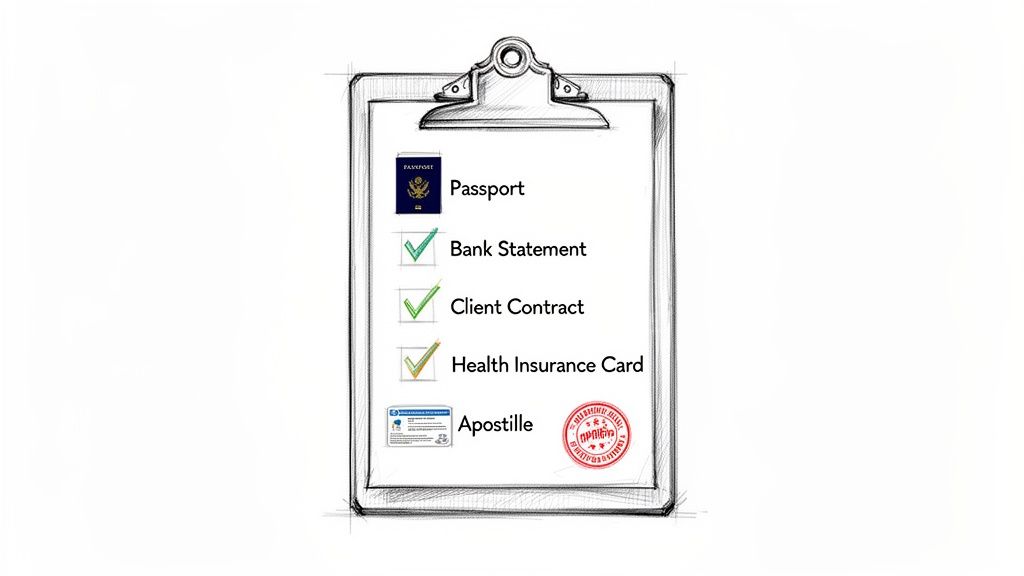
A successful digital nomad visa application isn't just about meeting the income threshold—it's about proving it with a flawless paper trail. Think of your application as a case you're presenting to a judge. Every document is a piece of evidence. A missing page, a shoddy translation, or a vague employment letter can sink the entire thing, leading to frustrating delays or an outright rejection.
Meticulous preparation is your best strategy. Consular officers see hundreds of applications and are trained to spot any weakness or inconsistency. Your goal is to hand them a file so clean, complete, and professional that saying "yes" is the easiest decision they make all day.
This is more than just ticking boxes on a list. You have to understand why they ask for each document to present your case in the most convincing light possible.
Core Document Categories
To keep things organized and ensure nothing falls through the cracks, it’s best to group your documents into four key categories. This framework covers the fundamental pillars that every consulate will scrutinize.
- Identity and Travel Documents: The absolute basics. This proves who you are and that you can legally travel.
- Financial Stability and Income Proof: This is where you show you meet their income rules and won't become a burden on their system.
- Remote Work Verification: Here, you provide hard evidence that your work is genuinely remote and your income comes from outside their country.
- Health and Safety Compliance: These documents assure the host country that you aren't a health risk or a security concern.
Let’s break down what each of these really means, focusing on the details that trip people up.
Documenting Your Identity and Finances
First things first: your identity documents have to be perfect. A passport with less than six months of validity is one of the most common—and easily avoidable—reasons for instant rejection. Beyond that, you'll need passport photos that match the consulate's exact specifications, right down to the background color and pixel dimensions.
When it's time to prove your financial stability, you need to be an open book. You’ll almost certainly need:
- Bank Statements: Plan on providing at least six months of statements. They need to show consistent income deposits that are at or above the minimum threshold. Make it easy for them—highlight the relevant deposits.
- Tax Returns: Your last one or two years of tax returns provide an official layer of verification for your income claims. For Americans abroad, navigating these filings can get complicated, and knowing how to get an ITIN number might be a necessary step.
For entrepreneurs, documenting income from multiple clients or complex business structures is a huge hurdle. Simple bank statements won't cut it. You need to build a stronger case with profit-and-loss statements, dividend reports, or a formal letter from a certified accountant to paint a clear, undeniable financial picture.
For high-net-worth individuals, this level of detail is simply non-negotiable.
Verifying Your Remote Work and Safety
This is the part where you prove you're the real deal—a genuine digital nomad. If you're an employee, you need an official letter from your employer on company letterhead. This letter must confirm your remote status, salary, and job description.
For business owners and freelancers, the game is different. You'll need to show your work with:
- Client Contracts: A solid portfolio of active client contracts is proof of ongoing, legitimate work.
- Business Registration: You must have official documents proving your company is legally registered outside the host country.
- Proof of Global Health Insurance: You’ll need a certificate for a policy that covers you in your destination for the entire visa period. No exceptions.
- Criminal Background Check: This has to be a recent, official document from your home country. But here’s the critical detail many people miss: most countries require this document to be apostilled (an international certification) and submitted with a certified translation. Forgetting this small but vital step will bring your application to a dead stop.
Avoiding Critical Tax and Compliance Traps
Securing your digital nomad visa is a huge win, but honestly, it’s just the first step. The real challenge—and the number one risk for any global professional—is navigating the tangled web of international tax and compliance.
A common mistake is thinking the visa itself grants you some kind of tax-free pass. It doesn’t.
A visa is an immigration document. It gives you the right to live somewhere. Tax residency, on the other hand, is a completely separate legal status determined by a country's own specific rules. Misunderstanding this distinction is how people stumble into accidental tax residency, double taxation, and serious financial penalties. This isn't just a compliance headache; for high-net-worth individuals, it's a critical asset protection issue.
Strategic planning is non-negotiable. You need to build a framework where your global lifestyle doesn't accidentally trigger costly tax obligations in multiple countries at once.
The Myth of the 183-Day Rule
Most nomads have heard of the "183-day rule," a common benchmark countries use to determine tax residency. The logic seems simple: spend less than 183 days in a country, and you're not a tax resident. While it's a useful starting point, relying on it alone is a dangerous oversimplification.
Many countries use a "facts and circumstances" test that goes far beyond just counting days on a calendar. These tests dig into factors like:
- Center of Vital Interests: Where are your primary personal and economic ties? This includes family, social connections, and where your business activities are centered.
- Permanent Home Availability: Do you have a permanent home available to you? This doesn't mean you have to own it—a long-term rental apartment can easily qualify.
- Habitual Abode: Where do you usually live, even if it's not for 183 consecutive days? Patterns matter.
Think of tax residency like gravity. The more ties you have to a country—a long-term apartment, a local bank account, family presence—the stronger its "gravitational pull" becomes. Eventually, you'll be pulled into its tax system, regardless of the 183-day count.
This is exactly where many nomads get into trouble. You could spend just four months in a country but still be deemed a tax resident if you establish significant ties, triggering a local tax bill you never saw coming.
Don't Forget Your Tax Duties Back Home
Another critical error is forgetting about your tax obligations in your home country. For citizens of countries with citizenship-based taxation, like the United States, your filing obligations follow you no matter where you are in the world.
You must file a tax return and report your worldwide income, even if you owe zero tax after applying exclusions and credits.
Failing to file can lead to severe penalties, even if you wouldn't have owed any tax in the first place. The only smart move is a proactive strategy that addresses your tax duties both at home and in your new host country. For those looking to optimize, there are fully compliant ways to structure your affairs. You can explore our expert insights on achieving a more flexible tax residency for global travelers to understand the possibilities.
The Growing Nomad Population and Compliance Risks
The digital nomad movement is no longer a tiny niche; over 40 million people worldwide now identify as location-independent. This explosion, driven heavily by Gen Z and Millennials who make up 64% of the demographic, has put tax authorities on high alert.
The United States is the top country frequented by these travelers at 14%, followed by popular hubs like Thailand and Spain. As governments see this trend growing, they are becoming much more sophisticated at tracking and enforcing tax compliance. You can learn more about these digital nomad population trends and statistics and what they signal for the future of global tax enforcement.
Ignoring these issues is no longer a viable option. As the community grows, so does the scrutiny. Building a compliant, tax-efficient structure from day one is the only way to protect your wealth and ensure your global freedom is built to last.
Building Your Global Mobility Strategy
It’s time to move your remote work dream from a vague idea into a well-defined, actionable plan. The journey to becoming a global citizen isn’t just about a single visa application; it’s about crafting a durable strategy.
This is the roadmap that guides you from initial research to a successful, sustainable relocation, ensuring your freedom is built on a solid foundation. Making smart decisions from the very beginning is the only way to protect your wealth and build the future you actually want. A real strategy considers not just the "how" of getting a visa, but the "why" behind your entire global mobility plan.
Your Four-Step Strategic Roadmap
A successful transition depends on a structured approach. Think of it like building a house: you wouldn't start putting up walls without a blueprint. The same exact principle applies here.
Follow these four strategic steps to create a clear and effective plan:
- Define Your Primary Goals: What’s the core objective here? Are you chasing a better lifestyle, specific tax advantages, or a clear path to long-term residency? Your primary goal will immediately dictate which countries are a good fit and which are a waste of time.
- Shortlist Potential Countries: Use a comparison framework to weigh your options. Pit factors like income requirements against powerful benefits such as EU access, friendly tax rules, and the potential for permanent residency down the line.
- Conduct an Honest Eligibility Assessment: Before you get emotionally invested in a country, do a cold, hard review of your own qualifications. Can you consistently meet the income threshold without issue? Is all your paperwork in perfect order? Be brutally realistic about where you stand.
- Assemble and Plan Proactively: Gather your complete document portfolio well in advance. At the same time, develop a proactive tax compliance plan that addresses obligations in both your home country and your potential new one. Don't leave this to chance.
Your long-term success as a global citizen depends on this holistic strategy. The visa application is merely a single process within a much larger plan for your financial and personal future.
For some, the end goal extends far beyond temporary visas. If permanent relocation is on your radar, you might be interested in our guide on residency by investment programs, which offer alternative paths to long-term stability.
This is all about making smart, forward-thinking decisions that align with your ultimate ambitions, one country at a time.
Frequently Asked Questions About Digital Nomad Visas
The world of digital nomad visas is filled with nuances, and small misunderstandings can create big problems. The rules can seem arbitrary, but once you understand the logic behind them, the entire process becomes much clearer. Here are some of the most common questions we get from clients.
We’re going to tackle the finer points that can make or break your application—from where you’re allowed to apply to the critical, and often misunderstood, difference between your visa status and your tax obligations.
Can You Apply for a Nomad Visa While Inside the Country?
This is one of the first and most important logistical hurdles you'll face. The answer is simple: it completely depends on the country. There is no universal rule, which means you have to verify the policy for your target destination before you book a flight.
Some countries, like Spain, offer incredible flexibility. They actually let you enter as a tourist and then apply for the digital nomad visa from within their borders. This is a massive advantage if you want to get a feel for the country before fully committing.
However, many other nations are far stricter. They demand that you apply from your country of origin or legal residence, period. If you try to apply from inside their borders on a tourist visa, you’re setting yourself up for an automatic rejection. That's a huge waste of time and money.
Does a Digital Nomad Visa Change My Tax Residency?
This is a dangerous and widespread myth. A visa is purely an immigration document—it gives you the legal right to live somewhere. That's it. Tax residency is a completely separate legal status determined by a country's domestic tax laws, often revolving around the "183-day rule" and other tie-breaker tests.
Holding a digital nomad visa does not automatically change your tax status or make you tax-exempt anywhere. Without a clear, proactive tax plan, you can easily find yourself in a nightmare scenario where both your home country and your new host country consider you a tax resident, hitting you with double taxation.
Think of it this way: Your visa is your ticket to the party (residency), but your tax status is determined by how long you stay and what you do there. They are two separate issues that demand separate planning.
What Are the Biggest Application Mistakes to Avoid?
Beyond simple typos or missed deadlines, a few key strategic blunders consistently trip up even the sharpest applicants. Avoiding these common pitfalls is the key to a smooth and successful application.
- Insufficient Proof of Income: This is the #1 reason for rejection, especially for business owners with variable revenue. A few bank statements might not cut it. You often need properly audited financials or a formal letter from an accountant to prove your income is stable and sufficient.
- Improperly Prepared Documents: This is an easy one to mess up. Forgetting to get documents like your criminal record check officially apostilled or translated by a court-certified translator will bring your application to a dead stop.
- Choosing Based on Lifestyle Alone: Picking a country just for its beaches without looking at its tax treaty network is a recipe for disaster. A beautiful location with a poor tax treaty can turn into an expensive, long-term headache.
A successful global mobility plan requires far more than just a visa; it demands a comprehensive strategy for asset protection and tax compliance. For high-net-worth individuals and entrepreneurs, navigating these complexities isn't optional—it's essential. Protect Your Wealth specializes in crafting the bespoke legal and financial structures that align with your international ambitions.
Schedule a consultation today to build a compliant and prosperous future abroad.


