


One of the most powerful tools available to Americans working abroad is the Foreign Earned Income Exclusion (FEIE). This isn't just another deduction; it's a foundational U.S. tax benefit that allows qualified expats to exclude a huge chunk of their foreign-earned income from U.S. taxation.
The whole point of the FEIE is to prevent crippling double taxation. Since the U.S. taxes its citizens on their worldwide income, you could easily end up paying taxes to both your host country and the IRS on the same paycheck. The FEIE is designed to stop that from happening, making life overseas financially viable.
Unpacking the Foreign Earned Income Exclusion
Think of the FEIE as a protective shield the IRS offers to Americans living and working internationally. It effectively carves out a significant portion of your salary, wages, or self-employment income, declaring it off-limits to U.S. income tax.
And this is a big deal. For the 2026 tax year, the maximum exclusion is a substantial $132,900 per person. If you and your spouse both work abroad and qualify, you could potentially exclude double that amount. This figure is indexed for inflation, so it keeps up with the cost of living around the world. You can track the official numbers and annual adjustments directly on the IRS website.
Who Benefits Most from the FEIE?
While any American abroad who meets the tests can claim it, the FEIE is a game-changer for a few specific groups:
- Expats in low- or no-tax countries: If you're living in a place like the UAE or the Cayman Islands, you have little or no foreign tax to claim as a credit. The FEIE becomes your primary strategy for legally eliminating your U.S. tax bill.
- High-earning executives on foreign assignment: Corporate leaders can use the exclusion to dramatically lower their global tax burden while leading international projects.
- Digital nomads and remote workers: Freelancers who structure their travels correctly can shield a huge portion of their income from services performed abroad.
- International business owners: Entrepreneurs with overseas operations can use the FEIE to reduce their personal tax liability on income earned from their company.
The core purpose of the Foreign Earned Income Exclusion is simple: to make American workers and businesses more competitive abroad. By leveling the tax playing field, it ensures U.S. expats aren't unfairly penalized for contributing to the global economy.
The FEIE can turn a complicated, high-tax situation into a much more manageable one. But it’s not automatic—you have to actively claim it and, more importantly, prove you qualify. We'll get into those critical tests next.
For a quick overview, this table breaks down the key components for the upcoming tax year.
FEIE 2026 At a Glance
The following table summarizes the essential elements of the Foreign Earned Income Exclusion for the 2026 tax year, highlighting its strategic value for U.S. expats.
| Component | Details for 2026 | Strategic Importance |
|---|---|---|
| Maximum Exclusion | $132,900 per qualifying individual. | Forms the primary shield against U.S. income tax on foreign earnings. |
| Qualification Tests | Must meet either the Bona Fide Residence Test or the Physical Presence Test. | These are non-negotiable. Failing to meet one means you cannot claim the FEIE. |
| Eligible Income | Applies only to earned income (salary, wages, self-employment). | Passive income like dividends, interest, or rent is not covered by the FEIE. |
| Required Form | Must be claimed by filing Form 2555 with your U.S. tax return. | It’s not an automatic benefit; you must elect to take it each year. |
| Housing Exclusion | An additional exclusion for qualified foreign housing costs. | Allows for an extra tax break on top of the standard FEIE limit. |
Understanding these basics is the first step toward building a sound international tax strategy. Each component has its own set of rules and nuances that can make or break your tax plan.
How to Qualify for the FEIE
Claiming the foreign earned income exclusion isn’t as simple as just packing a bag and moving abroad. The IRS has very specific, non-negotiable rules you have to meet to prove your connection to a foreign country is legitimate. Think of it as an official test with two different paths to pass.
Your journey starts with two foundational requirements. First, your tax home must actually be in a foreign country. This is your main place of business or work, regardless of where your family might be living. Second, you must have foreign earned income—that means salary, wages, or self-employment income from work you physically did outside the United States.
Once you’ve checked those two boxes, you have to pass one of two key tests: the Bona Fide Residence Test or the Physical Presence Test.
This decision tree gives you a quick visual of the qualification path for U.S. citizens.
As you can see, being a U.S. citizen with foreign income is just the starting line. The real challenge is meeting the residency or presence requirements.
The Bona Fide Residence Test
The Bona Fide Residence Test is all about the quality of your life abroad. It’s less about counting days on a calendar and more about proving you’ve genuinely set down roots in a foreign country. To pass, you must be a resident of a foreign country for an uninterrupted period that includes one full calendar year—from January 1 to December 31.
Think of it like this: if you wanted to convince a friend you’d truly moved, you wouldn’t just show them your plane ticket. You’d show them your local driver’s license, your apartment lease, and photos of you joining in local events. That’s essentially what the IRS is looking for.
They’ll look at several factors to size up your situation:
- Your Intentions: Do you plan to stay in the foreign country for a long or indefinite time?
- Your Integration: Have you set up a permanent home, opened local bank accounts, and become part of the local community?
- Your Family: Did your family move abroad with you?
- Your Taxes: Are you paying local income taxes in your host country?
The Bona Fide Residence Test is about demonstrating your center of life has shifted abroad. The IRS wants to see evidence that your foreign country is your home, not just a temporary workstation.
This test is perfect for expats on long-term assignments or anyone who has permanently relocated. Short trips back to the U.S. for vacation or business won’t automatically disqualify you, but your ties to your new foreign home must remain clear and strong.
The Physical Presence Test
If the Bona Fide Residence Test is about quality, the Physical Presence Test is a strict numbers game. It’s purely a quantitative measure based on one thing: how many days you spend on foreign soil.
To pass this test, you must be physically present in a foreign country or countries for at least 330 full days during any consecutive 12-month period. A “full day” is a continuous 24-hour period starting at midnight.
This test offers a lot more flexibility for people who aren’t settled in one spot, like digital nomads or consultants working across several countries. The 12-month period can start on any day of the year, allowing you to pick the window that best fits your travel schedule.
But the rules are unforgiving.
- Travel Days: Any time spent traveling over or within the U.S. does not count toward your 330 days. Even a few hours in U.S. airspace can make that entire day a U.S. day.
- International Waters: Time spent on a ship in international waters doesn’t count as being in a foreign country.
- Record Keeping: Meticulously tracking your travel dates with flight records, passport stamps, and a detailed calendar is absolutely essential. There’s no room for error.
For example, if you fly from Dubai to Los Angeles, both the day you leave Dubai and the day you land in L.A. are considered U.S. days and won’t count. Failing to track your time with precision is one of the most common—and costly—mistakes people make.
If your situation involves a non-U.S. spouse who needs tax identification, you may find our guide on how to get an ITIN number helpful, as this is often a related step in global tax planning.
So, you’ve confirmed you qualify for the Foreign Earned Income Exclusion. Great. But that’s just the first step.
Now comes the crucial part: figuring out exactly how much of your hard-earned money you can legally shield from the IRS. This isn’t about just pulling a number out of thin air. It’s about understanding the annual limits, how they’re prorated, and what the government actually considers “foreign earned income.”
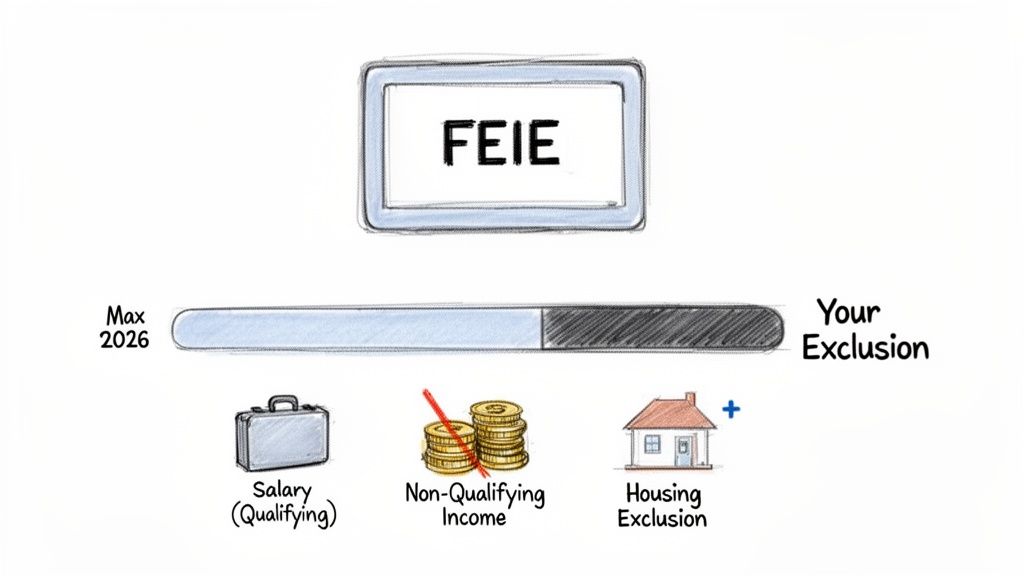
The maximum exclusion is the big headline number, and it gets adjusted for inflation each year. For the 2026 tax year, that limit is $132,900. If you qualify for the entire 365 days, you can potentially wipe out your U.S. tax bill on up to that amount. It’s a game-changer.
But let’s be realistic—most expats don’t spend a perfect calendar year abroad, especially in their first or last year overseas. This is where proration comes in.
Understanding Proration of the Exclusion Limit
Proration is just a fancy word for getting a partial benefit. You get a slice of the maximum exclusion based on how many qualifying days you were actually outside the U.S. during the tax year.
The math is simple: divide your number of qualifying days by the total days in the year (365, or 366 for a leap year), then multiply that by the maximum exclusion amount.
Let’s see it in action.
Example A: Step-by-Step Proration
Imagine Sarah, an entrepreneur, moves to Lisbon on September 1, 2026, and stays there. She intends to meet the Physical Presence Test over the next 12 months.
- Count Her Qualifying Days: From September 1 to December 31, Sarah is in Portugal for 122 days.
- Calculate the Proration Rate: 122 days ÷ 365 days = 33.42%.
- Find Her Personal Exclusion Limit: 33.42% of $132,900 = $44,418.18.
For 2026, Sarah can exclude up to $44,418.18 of her income earned in Lisbon. It doesn’t matter if she earned $60,000 during that time; her excludable amount is capped by this prorated limit. This is a critical detail that trips up a lot of new expats.
What Is Considered Foreign Earned Income?
The IRS is very particular about what “earned income” means. Think of it this way: it’s money you get for your direct, personal effort—work you actively did while physically outside the United States. It’s not money that your money made for you.
Here’s a quick breakdown of what counts and what doesn’t:
-
Qualifying Earned Income:
- Salaries and Wages: Your paycheck for work done abroad. Simple.
- Commissions and Bonuses: Performance-based pay you earned for your services.
- Professional Fees: Income you billed as a consultant or freelancer.
- Self-Employment Income: Net earnings from a business you actively operate overseas.
-
Non-Qualifying (Unearned) Income:
- Dividends and Interest: Money your investments generated.
- Capital Gains: Profit from selling stocks, crypto, or property.
- Rental Income: Cash flow from real estate you own.
- Pensions and Annuities: Retirement money.
- Gambling Winnings: That lucky streak in Monaco doesn’t count.
This distinction is absolute. Even if you manage your entire stock portfolio from your new apartment in Singapore, the dividends are not foreign earned income. You can’t use the FEIE to exclude them.
Introducing the Foreign Housing Exclusion
Beyond the standard exclusion, there’s another powerful tool that works right alongside it: the Foreign Housing Exclusion. This lets you exclude additional income that you use to pay for reasonable housing costs in another country.
This is a lifeline for expats in high-cost cities like Hong Kong, London, or Geneva, where rent can be astronomical.
The Foreign Housing Exclusion is a supplement to the FEIE. It lets you increase your total tax-free amount to cover a big chunk of your overseas rent and utilities, delivering huge additional tax relief.
This benefit is designed to offset the steep cost of living that often comes with an international assignment. It can cover rent, utilities (but not phone or internet), and property insurance. The calculation is tricky, involving a “base amount” and specific caps that vary by city. For self-employed individuals, it’s claimed as a deduction instead of an exclusion.
Using both the FEIE and the housing exclusion is a core strategy for any serious expat looking to maximize their tax savings.
Advanced Strategies for High Earners
For high-net-worth individuals and savvy entrepreneurs, the Foreign Earned Income Exclusion is more than just a tax break—it’s a strategic piece in a larger wealth preservation puzzle. While the basic exclusion is powerful on its own, knowing how to pair it with other tax provisions is what separates a good plan from a great one.
The most critical decision you’ll face is choosing between the FEIE and its main alternative, the Foreign Tax Credit (FTC).
This choice is a fork in the road. You cannot claim both the FEIE and the FTC on the same dollar of income. Think of it like a voucher and a rebate for the same purchase; you have to pick one. The FEIE excludes a chunk of your income from tax, while the FTC gives you a credit for taxes you’ve already paid to a foreign government.
The right move almost always comes down to the tax rate in your country of residence.
Choosing Between the FEIE and the Foreign Tax Credit
Making the right call requires a hard look at your local tax situation, but a simple rule of thumb can point you in the right direction.
-
Low-Tax or No-Tax Countries: If you live somewhere with income tax rates lower than the U.S. (or no income tax at all, like the UAE or Monaco), the FEIE is almost always the better choice. You have little or no foreign tax to claim as a credit, so excluding a big slice of your income is your most effective strategy.
-
High-Tax Countries: If you live in a country where the income tax rate is higher than your effective U.S. rate (like Germany or Japan), the Foreign Tax Credit is often the clear winner. The credit you get for your high foreign taxes can completely wipe out your U.S. tax liability and may even leave you with excess credits to carry forward to future years.
Deciding between the FEIE and the FTC is a strategic pivot point. For those in high-tax countries, the FTC can provide a more significant financial benefit by directly offsetting U.S. tax liability dollar-for-dollar with foreign taxes already paid.
Let’s walk through a quick scenario.
Example B: FEIE vs. FTC Analysis
Imagine two consultants, Mark in Dubai (0% income tax) and David in France (high income tax). Both earn $200,000.
-
Mark in Dubai: With no foreign taxes paid, the FTC is useless to him. By using the FEIE, he excludes the first $132,900 of his income and only pays U.S. tax on the remaining $67,100. For Mark, the FEIE is the only game in town.
-
David in France: David pays a huge amount in French income tax. If he uses the FEIE, he can exclude $132,900 but will still owe U.S. tax on the leftover $67,100. But if he skips the FEIE and uses the FTC instead, the large amount of French tax he paid can likely be used to offset his entire U.S. tax liability on all $200,000. For David, the FTC is the knockout punch.
Navigating Business Income and Self-Employment
For international entrepreneurs, things get more complicated when applying the FEIE to business profits. How the exclusion treats your income depends entirely on your business structure and how you get paid.
One of the biggest surprises for self-employed expats is the self-employment tax. The FEIE only works on income tax. You are still on the hook for U.S. self-employment taxes (Social Security and Medicare) on your net earnings, even if that income is excluded. This can lead to a tax bill of 15.3% on income you thought was tax-free.
The way your business is structured drastically changes the outcome:
-
Sole Proprietorship: Your net business profit is considered self-employment income. While the FEIE can shield it from U.S. income tax, you’re still fully liable for self-employment tax on every dollar.
-
Partnership: Your distributive share of the partnership’s income is generally treated the same way—subject to self-employment tax.
-
S-Corporation: This is where things get interesting. An S-Corp can be highly strategic. You can pay yourself a “reasonable salary,” which is subject to FICA taxes. Any remaining profit can be taken as a distribution, which is not subject to self-employment tax. The FEIE can then be applied to your salary.
This is a critical area where the right legal structure can save you a fortune. For a deeper dive into structuring your affairs across borders, you might be interested in our guide on cross-border tax planning. Choosing the right entity is a foundational step in optimizing your global tax position.
Common Pitfalls and How to Avoid Them

Navigating the Foreign Earned Income Exclusion can be incredibly rewarding, but the path is lined with potential missteps that can trigger IRS scrutiny and expensive penalties. A simple oversight can completely invalidate your claim.
Understanding these common errors is the first step toward building a bulletproof tax position.
Let’s start with the most basic mistake: assuming you don’t need to file a U.S. tax return at all if your income is below the exclusion limit. This is a critical error. You must file a U.S. tax return and attach Form 2555 to officially claim the FEIE. Failing to file is the fastest way to attract penalties and miss out on the exclusion entirely.
Mismanaging the Physical Presence Test
The Physical Presence Test is a strict numbers game, and miscounting your days is an easy way to get disqualified. The IRS demands 330 full days on foreign soil within any 12-month period, and their definition of a “full day” is unforgiving.
A frequent error involves travel days. Any portion of a day spent in the U.S. or over international waters simply does not count toward your 330-day total. A single miscalculation can jeopardize your entire exclusion for the year.
To avoid this trap:
- Maintain a Meticulous Travel Log: Use a spreadsheet or a dedicated app to track every single travel day, including flight times and time zones.
- Keep Your Records: Save boarding passes, passport stamps, and ticket confirmations. This is your proof.
- Build a Buffer: Aim for more than 330 days abroad. This gives you a cushion for unexpected trips back to the U.S. without risking your eligibility.
Forgetting About State Tax Obligations
A huge and often expensive mistake is believing the FEIE eliminates your state tax duties. It doesn’t. The Foreign Earned Income Exclusion is a federal benefit only and has absolutely no bearing on what you might owe to a state.
States like California, Virginia, and New York are notoriously “sticky.” They will continue to consider you a resident until you formally and definitively sever all ties. Just moving abroad is not enough, and this oversight can lead to a surprise tax bill for thousands of dollars.
Key Takeaway: You must proactively cut ties with your former state of residence. This means surrendering your driver’s license, closing local bank accounts, and updating your voter registration to truly establish non-residency.
Overlooking the Revocation Rule and Other Errors
Once you elect to use the FEIE, you’re generally expected to stick with it. If you decide to revoke your election—perhaps to use the Foreign Tax Credit instead—you cannot reclaim the FEIE for five years without getting special permission from the IRS. Accidentally revoking the exclusion can lock you out of a major tax benefit for half a decade.
Other common errors include:
- Forgetting Self-Employment Tax: The FEIE shields your income from income tax, but not the 15.3% self-employment tax on net earnings. This catches many entrepreneurs by surprise.
- Improper Documentation: Failing to keep records that substantiate your bona fide residence claim, such as foreign rental agreements or utility bills, can sink your position during an audit.
Staying on top of these nuances is critical, especially as global reporting standards get stricter. To get a sense of the increasing international transparency, you might be interested in our guide on how DAC8 will impact financial reporting.
Of course. Here is the rewritten section, crafted to match the expert, human-like voice and style of the provided examples.
Common Questions About the FEIE
Even when you grasp the basics of the Foreign Earned Income Exclusion, it’s the real-world “what ifs” that create the most headaches. When you’re planning a life abroad, you need to think beyond the rules on paper and prepare for the unexpected.
This is where we see the most confusion—and the most costly mistakes. Let’s walk through the critical questions we hear from clients every day to make sure you’re building your international tax strategy on solid ground.
Can I Still Contribute to an IRA If I Use the FEIE?
This is a huge detail for anyone serious about long-term wealth building. If you use the Foreign Earned Income Exclusion to wipe out all of your income, the IRS sees your “compensation” for IRA purposes as zero.
That means you cannot contribute to a Traditional or Roth IRA for that tax year. Trying to do so anyway will trigger penalties for making ineligible contributions.
There’s a silver lining, though. If your foreign earned income is higher than the maximum FEIE limit, you might still be able to make IRA contributions. For instance, if you earn $150,000 and exclude the max of $132,900, you’re left with $17,100 in taxable income. That remaining amount is considered compensation and could open the door for an IRA contribution, assuming you meet all other IRS requirements.
What Happens If I Have to Fly Back to the US Unexpectedly?
Life is unpredictable. A family emergency or an urgent business trip can force you back to the United States, and this is a major worry for expats, especially those relying on the unforgiving Physical Presence Test.
Any full or partial day you spend in the U.S. doesn’t count toward your required 330 days abroad. This is why keeping a meticulous, almost paranoid, travel log is non-negotiable. One miscounted trip could blow up your entire FEIE claim for the year.
For those on the Bona Fide Residence Test, there’s a bit more breathing room. Short, temporary trips back to the U.S. won’t automatically disqualify you, as long as you can prove your center of life—your home, family, and economic ties—remains firmly in your host country.
An unexpected return to the U.S. can put your FEIE status at risk, but how much risk depends entirely on which test you’re using. The Physical Presence Test is a strict numbers game, but the Bona Fide Residence Test offers more flexibility if you can prove you haven’t abandoned your foreign home.
No matter which test applies to you, keep detailed records explaining the purpose and length of every U.S. visit. That documentation is your first and best defense if the IRS ever comes knocking.
Does the FEIE Get Me Out of US State Taxes?
This is one of the most dangerous and expensive myths in the expat world. The Foreign Earned Income Exclusion is a federal tax benefit only. It has absolutely zero effect on your state tax obligations.
States like California, New York, Virginia, and New Mexico are notoriously “sticky.” They often assume you’re still a resident—and will tax your worldwide income—unless you formally and decisively cut all ties.
Just packing your bags and moving abroad isn’t enough to break residency. You have to take deliberate steps to show you’re gone for good.
Steps to Formally Sever State Ties:
- Surrender Your Driver’s License: Get a local license in your new country.
- Sell Your Primary Residence: Owning property is a powerful indicator of residency.
- Update Your Voter Registration: Cancel it or register as an overseas voter.
- Close Local Bank Accounts: Move your primary financial life abroad.
- Move Personal Belongings: Shipping sentimental and high-value items demonstrates permanence.
Failing to properly sever these ties can lead to a shocking state tax bill on income you thought the FEIE protected. This is a critical—and too often ignored—part of making a clean international move.
Navigating the complexities of the Foreign Earned Income Exclusion and coordinating it with a broader asset protection strategy requires expert guidance. At Protect Your Wealth, we specialize in creating bespoke legal and tax structures for high-net-worth individuals and global entrepreneurs. If you’re ready to build a compliant and efficient international plan, explore our solutions.


