


For global entrepreneurs, getting Italian citizenship by descent is about far more than reconnecting with your heritage—it’s a powerful tool for unlocking international mobility and business opportunities. This jure sanguinis (right of blood) process is a strategic investment, not just a personal quest. It offers a direct pathway to becoming an EU citizen based purely on your ancestry.
Why Italian Citizenship Is a Strategic Asset
While pursuing Italian citizenship is often a deeply personal journey, for high-net-worth individuals and global entrepreneurs, it’s a calculated move toward greater freedom and financial flexibility. An Italian passport consistently ranks among the most powerful in the world, providing visa-free access to over 190 countries.
But the real prize? The unrestricted right to live, work, and study in any of the 27 EU member states. This isn't just about easier vacations. It's about fundamentally restructuring your life and business operations for a globalized world.
Unlocking European Union Opportunities
The core benefit of an Italian passport is full EU citizenship. This single status unlocks a range of advantages that are especially valuable for entrepreneurs and investors:
- Market Access: Operate a business, invest in real estate, or provide services seamlessly across a unified market of over 440 million people.
- Residency Rights: Establish residency for yourself and your family in stable, high-quality-of-life countries like Germany, Spain, or the Netherlands without fighting through complex and expensive visa applications.
- Financial Diversification: Gain direct access to European banking, investment vehicles, and wealth management services. These are critical components of any robust asset protection strategy. You can learn more about how to get a second passport in our detailed guide.
Before we dive deeper, here's a quick look at why this passport is such a game-changer for business-minded individuals.
Key Benefits of Italian Citizenship for Entrepreneurs
| Benefit Category | Strategic Advantage |
|---|---|
| Business Operations | Full freedom to establish and operate companies across all 27 EU member states. |
| Financial Freedom | Access to stable, world-class European banking and investment platforms. |
| Global Mobility | Visa-free travel to over 190 countries, simplifying international business. |
| Residency & Lifestyle | The right to live, work, and retire in any EU country for you and your family. |
| Asset Protection | Diversify assets and business interests in a stable, predictable economic zone. |
Ultimately, it's about building a more resilient, flexible, and global life for yourself and your family.
A Growing Trend Among Global Elites
The immense strategic value of this pathway is no longer a secret. Demand for Italian citizenship by descent has surged globally, particularly as a hedge against the economic and political instability plaguing other parts of the world.
A remarkable trend has emerged from Latin America that perfectly illustrates the passport's appeal. In 2021, fewer than 4,000 Argentine citizens acquired Italian citizenship by descent. By 2023, that number had quadrupled to over 16,000—a staggering 300% increase in just two years.
This boom, detailed in recent citizenship acquisition reports, highlights how savvy entrepreneurs now view Italian citizenship as a key to EU residency and streamlined business operations. But it's crucial to act on current information. The rules governing eligibility can and do change, and recent legislative updates have already altered generational limits for some claims, making timely action essential.
Is This Pathway Right for You?
Before you start hunting down century-old documents, the first step is a simple eligibility check. The entire principle of jure sanguinis rests on one thing: an unbroken bloodline.
This means you must have an Italian-born ancestor who did not naturalize as a citizen of another country before the birth of the next person in your direct lineage. If they did, the chain of citizenship was broken.
While Italy has historically placed no limit on how many generations you can go back, verifying this one critical naturalization detail is the first and most important hurdle you need to clear.
Understanding the Core Eligibility Rules
The entire journey of getting Italian citizenship by descent hinges on a single legal principle: jure sanguinis, or "right of blood."
Simply put, Italian citizenship flows from parent to child across generations. It’s not about where you were born; it’s about who you were born to. Your one and only mission is to prove an unbroken chain of citizenship from your Italian-born ancestor all the way down to you.
The Unbroken Bloodline Principle
Think of your family tree as a chain. Each link connects one generation to the next, starting with your Italian ancestor (the avo) and ending with you. If even one of those links is broken, the whole claim falls apart.
So, what breaks the chain? The most common culprit is naturalization—the act of an ancestor voluntarily becoming a citizen of another country. If they gave up their Italian citizenship before the next person in your line was born, the connection was severed.
Let's use a real-world example. Say your great-grandfather, Giovanni, left Italy for the US.
- If he became a naturalized US citizen in 1925 but your grandfather was born in 1924, the chain is intact. Giovanni was still Italian when his son was born.
- But if your grandfather was born in 1926, a year after Giovanni naturalized, the line is broken. The citizenship was lost before it could be passed on.
The Critical Role of Naturalization Dates
That date stamped on your ancestor’s naturalization certificate is often the single most important document in your entire file. It’s the make-or-break piece of evidence.
Here’s how it works:
- Naturalization before the next birth: Even by one day, this breaks the chain. Eligibility is lost.
- Naturalization after the next birth: The citizenship was successfully passed on. Your claim is still valid.
- No naturalization at all: If your ancestor never became a citizen of their new country, they died an Italian. The line is considered perfectly intact through them.
This process is more than just a nod to your heritage; it's a strategic move that can unlock tremendous personal and business advantages.
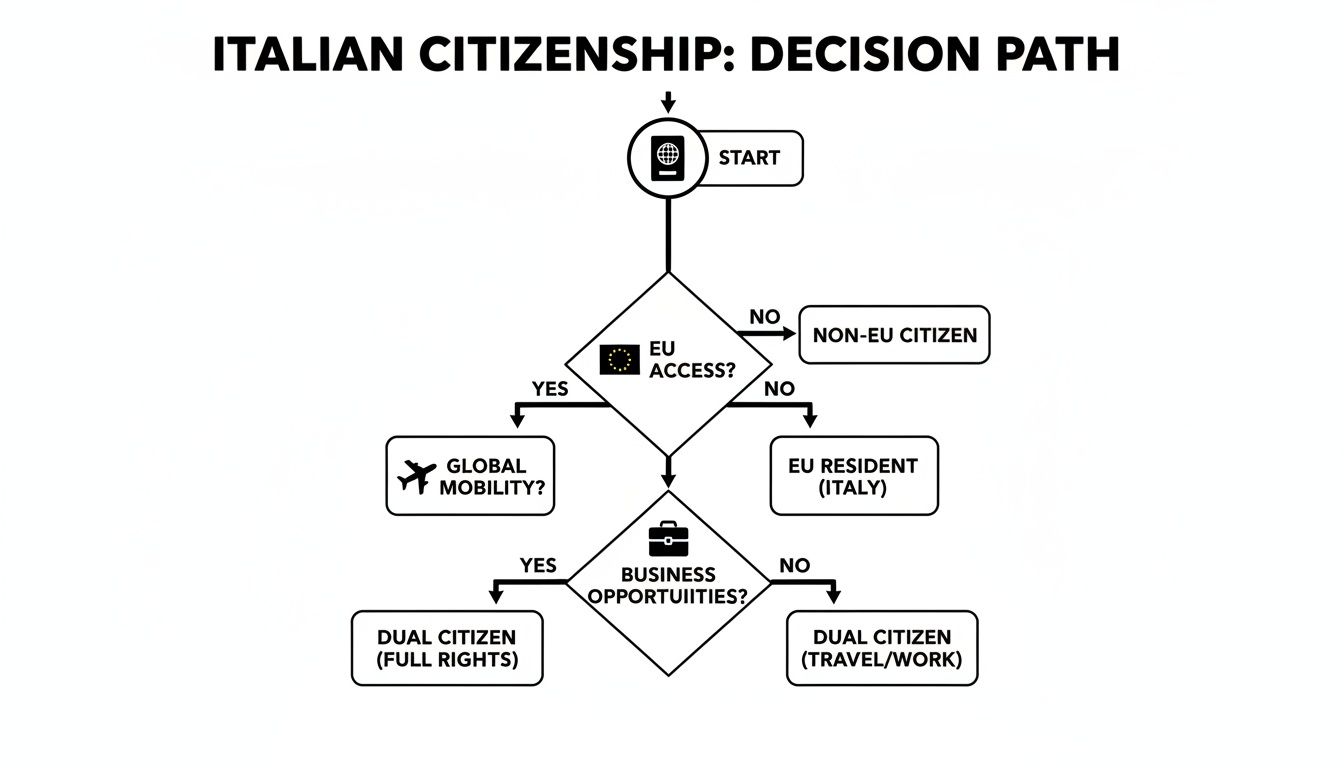
As you can see, the benefits go far beyond a second passport, opening up EU access for business, investment, and lifestyle freedom.
The 1948 Rule for Maternal Lines
For decades, there was a major roadblock for anyone tracing their Italian roots through a woman. Old Italian laws were discriminatory and prevented women from passing citizenship to their children.
The rule was simple: if your Italian lineage runs through a female ancestor (grandmother, great-grandmother), her child had to be born on or after January 1, 1948. This was the date Italy's new constitution took effect, finally giving women equal rights in this regard. If the child was born before 1948, consulates would automatically deny the application.
But things have changed. Recent landmark rulings from Italy's highest courts have acknowledged this historical injustice. While you still can't apply for these "1948 cases" at a consulate, there is now a clear and well-established path to citizenship through the Italian court system.
What was once a dead end is now a viable, and increasingly common, judicial route to getting your citizenship recognized.
Navigating Special Circumstances
Of course, not every family history is straightforward. Many applicants run into unique situations that require a clear understanding of Italian law.
- Adoption: An adopted child can claim citizenship, but the adoption must have been legally finalized before they reached the age of majority (18).
- Ancestors Born Out of Wedlock: This is not a barrier. As long as the Italian parent officially acknowledged the child as their own, the bloodline is considered intact for citizenship purposes.
- Loss of Surname: It doesn't matter if your last name isn't Italian. Surnames often change through marriage or clerical errors over the generations. As long as you can document the blood connection, the name itself is irrelevant.
Keep in mind that this process is entirely separate from other paths to an Italian passport. For example, marrying an Italian citizen falls under a completely different set of laws. You can learn more by reading our guide on how Italian citizenship by marriage works to see how that alternative works.
Your Essential Document Gathering Checklist
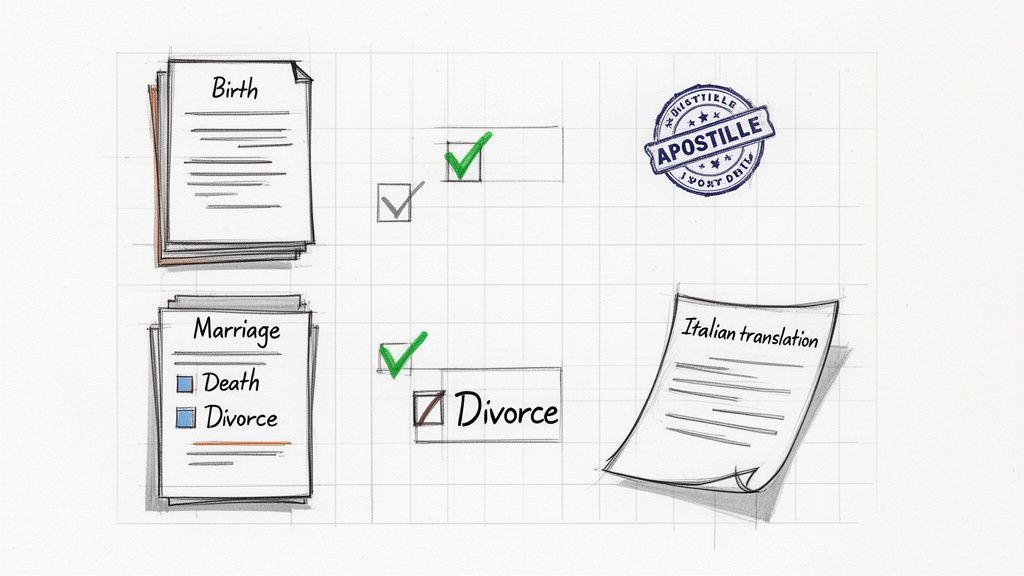
The journey to getting Italian citizenship by descent is a marathon of paperwork. This is where most applications stall, but with a systematic approach, it becomes a manageable project rather than an insurmountable obstacle.
Your goal is to build an airtight portfolio that tells a clear, chronological story of your unbroken lineage.
Think of yourself as a genealogical detective. The Italian government won't take your claim on faith; they require an undeniable chain of official, certified evidence linking you directly to your Italian-born ancestor (avo). Each document you find is a critical link in that chain.
Assembling Your Vital Records Portfolio
You'll need a consistent set of vital records for every single person in your direct line of descent, starting with your Italian ancestor and working your way down to yourself. These core documents are non-negotiable.
If your claim runs through your paternal great-grandfather, for example, you'll need all the relevant records for him, your grandfather, your father, and yourself. It’s not uncommon to end up collecting a dozen or more certificates.
This detailed table outlines exactly what you'll need, where to find it, and how to get it certified. Think of it as your roadmap for the most intensive part of the process.
| Document Type | Sourcing Location (Italian/Foreign) | Required Certification |
|---|---|---|
| Birth Certificate | Comune in Italy / State/Provincial Office | Apostille and Italian Translation for all non-Italian documents |
| Marriage Certificate(s) | Comune in Italy / State/Provincial Office | Apostille and Italian Translation for all non-Italian documents |
| Death Certificate | State/Provincial Office | Apostille and Italian Translation for all non-Italian documents |
| Divorce Decrees | Court that issued the decree | Apostille and Italian Translation for all non-Italian documents |
| Naturalization Records | National Archives (e.g., USCIS in the U.S.) | Must be certified and, if applicable, apostilled and translated |
Each of these documents must be the official, long-form or full version. Abridged or short-form certificates will almost certainly be rejected by the consulate or Comune.
Sourcing Italian and Foreign Documents
Your document hunt will take place on two fronts: Italy and your home country.
Italian records must be requested from the specific Comune (municipality) where the event—the birth or marriage—took place. While many Comuni now accept requests via email, using a certified email (PEC) often yields better results. Be prepared to wait, as responses can take months.
Documents from outside Italy (e.g., the US, Canada, Australia) are sourced from the relevant state or provincial vital records office.
A critical piece of advice: Start gathering documents immediately. It is not uncommon for this phase alone to take 6 to 18 months. Tracking down a single elusive record from a small Italian village or a misindexed US county can add significant delays to your timeline.
The Crucial Steps: Apostilles and Translations
Collecting the certificates is only the first step. To be legally recognized in Italy, your non-Italian documents must undergo a mandatory two-step validation process.
-
Apostille Authentication: An apostille is a specialized certificate governed by the Hague Convention that authenticates a public document for international use. Each of your non-Italian documents must be apostilled by the designated authority in the country where it was issued (like the Secretary of State in a U.S. state). Without an apostille, your document is legally worthless for your application.
-
Certified Italian Translation: After a document is apostilled, the entire package—the original certificate and the apostille itself—must be professionally translated into Italian. This is not a DIY job. Consulates often provide a list of approved translators, and using one is highly recommended. A poor translation can create discrepancies that jeopardize your entire case.
This meticulous preparation is the foundation of your claim. Every name, every date, and every certification must be perfect. Get this part right, and you're well on your way.
Choosing Your Application Pathway: Consulate vs. Comune
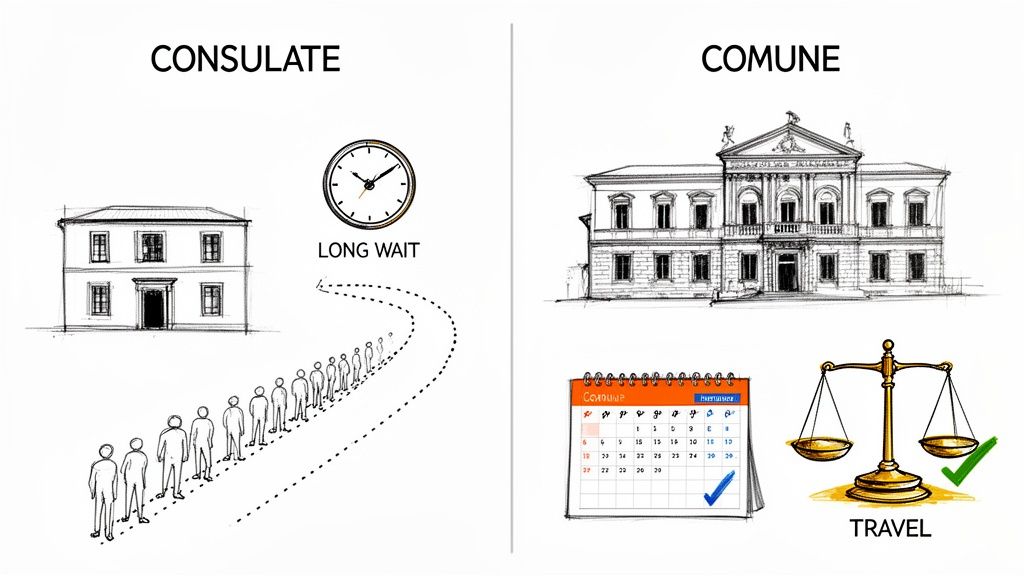
Once your document portfolio is complete, you’ll face a critical decision that will completely define your journey to getting Italian citizenship by descent. It's a strategic choice, not just a logistical one.
You have two main routes: applying through your local Italian consulate or heading straight to Italy to apply in a municipality (Comune). The path you choose should line up with your budget, your timeline, and just how badly you want that EU passport in your hands.
The Consulate Pathway: Your Local Option
The traditional route is applying through the Italian consulate in your home country. On the surface, it seems like the easiest choice—no international travel, no uprooting your life. It's familiar territory.
But this convenience comes with a heavy price: time. An incredible amount of it. Consulates, particularly in places with huge Italian-descendant populations like the U.S., Brazil, and Argentina, are drowning in applications.
- Appointment Wait Times: It’s not uncommon to wait 2 to 4 years just to get your foot in the door for an appointment.
- Processing Delays: After you finally submit your paperwork, the real waiting begins. Expect another 1 to 3 years for processing.
- Total Timeline: All told, you could easily be looking at a 3 to 7 year journey from start to finish. And sometimes, it's even longer.
This path really only makes sense if you have zero urgency and prefer a hands-off, "set it and forget it" process. You hand over your documents and settle in for a long wait, with minimal disruption to your daily life.
The Comune Pathway: The Fast Track in Italy
For the entrepreneur or investor who understands that time is money, applying directly in Italy is a game-changer. This path requires a hands-on commitment: you temporarily move to Italy, establish legal residency, and file your application directly with the local Comune.
The payoff? Speed. Where the consulate process is measured in years, the Comune pathway is measured in months.
Once you've established residency and your application is filed in Italy, the official processing time often falls between 6 to 12 months. This is the express lane to EU citizenship, but it demands a serious upfront investment of your time and resources.
This route requires you to be proactive. You’ll need to find housing, register with the local authorities (Anagrafe), and deal with Italian bureaucracy firsthand. For many, it's an absolutely worthwhile trade-off to get their passport years ahead of schedule.
A Head-to-Head Comparison
To make the right call, it helps to see the trade-offs laid out clearly.
| Factor | Consulate Pathway | Comune Pathway (In Italy) |
|---|---|---|
| Processing Time | Extremely slow (3-7+ years) | Very fast (6-12 months post-residency) |
| Cost | Lower direct costs (application fees, documents) | Higher upfront costs (travel, rent, legal assistance) |
| Logistics | Minimal; apply in your home country | Complex; requires establishing residency in Italy |
| Personal Involvement | Low; mostly a waiting game | High; requires active participation and local presence |
| Best For | Applicants with no urgency and a limited budget | Applicants who prioritize speed and can invest time/money upfront |
The trend is clear: more and more people are choosing the in-Italy approach. In 2024, around 217,000 foreign nationals became Italian citizens, with a significant number of these cases concentrated in specific regions. The Center-North areas, like Lombardy, handle a large percentage, which tells us that certain Comuni are simply more experienced and efficient. You can discover more insights about these citizenship trends to get a better sense of the landscape.
Picking the right Comune is a strategic move, as some are far more efficient than others. This is a vital piece of the puzzle for anyone serious about getting their Italian citizenship by descent on an accelerated timeline.
Strategic Implications for Your Wealth and Mobility
Getting your Italian passport is a huge win, but for a global entrepreneur, it’s not the finish line—it’s the start of a whole new game. The real power of getting Italian citizenship by descent comes from folding it into your global wealth and mobility strategy. This isn't just another travel document; it's a serious tool for diversifying your finances, protecting your assets, and designing the life you want.
An Italian passport instantly gives you full "freedom of movement" across the European Union. This means you and your family can live, work, invest, and go to school in any of the 27 EU member states without the headache of visas. You can launch a business in Germany, buy a villa in Portugal, or send your kids to school in France just as easily as someone born there.
Tax Obligations for Non-Resident Citizens
One of the first questions I get from high-net-worth clients is about taxes. The good news is that Italy, unlike the US, bases its taxes on residency, not citizenship.
This is a critical distinction. Simply having an Italian passport doesn't mean your worldwide income is suddenly fair game for Italian tax authorities. You only become an Italian tax resident if you spend more than 183 days a year in the country or if your main personal and financial hub is located there. For most dual citizens living abroad, this means your Italian tax bill is zero.
This residency-based system offers incredible flexibility. You can enjoy all the benefits of EU mobility and a powerful passport while keeping your primary tax residency in a low-tax jurisdiction. It’s an ideal setup for wealth preservation.
Leveraging EU Citizenship for Business Expansion
For entrepreneurs, an Italian passport erases nearly all the friction of entering the European market. It lets you:
- Set Up Companies Seamlessly: You can form a business in any EU country—say, a stable jurisdiction like Ireland or a tech hub like Estonia—without needing a local partner or jumping through hoops for special permits.
- Access European Banking: Open personal and corporate bank accounts with top-tier European banks, which helps diversify your assets and makes cross-border business a lot simpler.
- Simplify Your Operations: You can move key employees, manage supply chains, and serve a market of over 440 million consumers from inside a single, unified economic zone.
Imagine you need to open a new European headquarters. With your Italian passport, you can fly in to scout locations, sign leases, and hire staff without the delays and uncertainty of work permits. That kind of speed gives you a major competitive edge. For a deeper dive, it’s smart to look into professional cross-border tax planning for entrepreneurs to make sure your entire structure is optimized.
A Cornerstone of Asset and Estate Planning
Beyond business, Italian citizenship becomes a key piece of a smart asset protection plan. It diversifies your personal and political ties, so you aren't completely dependent on a single passport or country. In a world this unpredictable, having a legitimate foothold in a stable democratic bloc like the EU is an invaluable insurance policy.
It also opens up your estate planning options. You get access to European investment vehicles and succession laws that might be more favorable than what’s available in your home country. This lets you build a more resilient, globally diversified legacy for your family—who will also inherit this powerful EU citizenship. It turns a personal heritage quest into a lasting family asset.
Your Questions About Italian Citizenship by Descent, Answered
The road to claiming Italian citizenship by descent is full of nuances. The details matter immensely, and getting clear answers from the start can save you from months of frustration and dead ends. Here are some of the most critical questions we hear from clients, with direct insights to help you navigate the process.
What Happens If I Find Discrepancies in My Ancestors' Documents?
Let’s be clear: you will almost certainly find discrepancies in your family’s old records. Names, birth dates, and even places of birth can vary wildly from one document to the next. This is a completely normal part of the process, but it’s something you must fix head-on.
Italian authorities need a clean, consistent line to verify your claim. Minor variations are often understood and accepted, like the anglicization of a first name—think "Giovanni" becoming "John" or "Giuseppe" becoming "Joseph." A simple one-letter difference in a last name is also usually not a deal-breaker.
But significant differences can stop your application in its tracks. If a birth year is off by five years, or a last name is completely different, you'll have to get the record formally corrected. This usually means petitioning the court in the state or county where the incorrect document was issued. While you can sometimes support your case with other evidence like census records, a legal correction is the only guaranteed solution.
How Long Does This Whole Process Really Take?
This is the big question, and the answer depends entirely on which path you take. The timeline for getting your Italian citizenship recognized can be anywhere from under a year to nearly a decade.
- Applying at a Consulate: This is the slow route. By a huge margin. Wait times just to get an appointment can be 2-4 years long, with another 1-3 years of processing time after you submit your file. It's a very, very long game.
- Applying at a Comune in Italy: This is the fast track. By traveling to Italy, establishing legal residency, and applying directly at a town hall (Comune), you can often wrap up the entire process in 6-12 months. It requires a significant upfront investment of your time and money, but it gets you results years faster.
Don't forget to factor in the document gathering phase. Before you can even book an appointment, pulling together all the vital records, apostilles, and translations can easily take 6 to 18 months on its own.
Do I Need to Speak Italian?
No. There is absolutely no language requirement for claiming Italian citizenship by descent (jure sanguinis). This is a massive advantage over other paths, like citizenship through marriage or naturalization, which require you to pass a B1-level Italian language test.
The legal logic here is simple: you aren't becoming an Italian citizen. You are having your pre-existing birthright officially recognized. In the eyes of the law, you were Italian from the day you were born; this process just makes it official.
That said, while it’s not legally required, knowing some basic Italian will be a huge help if you take the faster Comune route. Being able to handle conversations with officials at the local town hall (Anagrafe) will make establishing residency and submitting your application go much more smoothly.
Will My New Italian Citizenship Affect My Current One?
For the vast majority of applicants, no. Italy has allowed dual citizenship since 1992, so you won’t be asked to renounce your current nationality to become an Italian citizen.
The key, however, is to check the laws of your home country. Most Western nations—including the United States, the UK, Canada, and Australia—also permit dual nationality without any issues. This means you can legally hold both passports and enjoy the rights and benefits of each.
It's always a smart move to confirm this with an expert familiar with your country's laws. A handful of nations have restrictions or require you to formally notify them if you acquire another citizenship. But for most people seeking their Italian roots, it won't create any conflict.
Navigating the complexities of international citizenship, asset protection, and tax law requires expert guidance. At Protect Your Wealth, we provide bespoke strategies for high-net-worth individuals who value compliant, efficient solutions for their global mobility and wealth preservation goals. If you're ready to turn your Italian heritage into a strategic asset, explore our services and start your journey today.


