


Forget everything you know about credit from your home country. In the United States, business credit is an entirely different beast—a powerful, distinct asset that lets your company stand on its own financial feet.
For an international founder, this isn’t just a nice-to-have. It’s a foundational piece of a successful US market entry, allowing you to secure financing and build a financial identity completely separate from your personal life.
Why US Business Credit Is Your Most Powerful Growth Tool
A strong business credit profile is your key to unlocking favorable financing terms, higher credit limits, and corporate cards, all without needing a personal guarantee or a US social security number.
This separation is the whole point. It shields your personal assets from business liabilities and allows your company to build a reputation based on its own merits and financial discipline. For lenders, suppliers, and even potential partners, it’s the ultimate proof of legitimacy.
From High-Risk Concept to Credible Partner
Think of business credit as your company’s trust score. A high score signals that your business is stable, reliable, and capable of meeting its financial obligations. It instantly moves your venture from being perceived as a high-risk foreign startup to a credible, bankable US business partner.
This credibility translates directly into a massive competitive advantage. Data consistently shows that business owners who actively manage their business credit are 41% more likely to get approved for loans. The difference is stark: a brand-new business might scrape by with $5,000 in trade credit, but with just one year of positive payment history, that same company could command $50,000 or more in vendor financing. You can dig into more data on how business credit accelerates growth from Nav’s analysis.
The path is clear: you start by establishing legitimacy, then leverage that foundation to secure financing, and ultimately, achieve sustainable growth.
As this flow shows, each step logically builds upon the last. Foundational legal and financial actions are what turn your vision into tangible business opportunities in the US market.
For an international founder, a strong US business credit file is more than a financial tool—it’s your ticket to playing in the major leagues. It levels the playing field, allowing you to compete for capital on the same terms as domestic companies.
For non-residents, the entire system rests on four essential components. Mastering each one is what creates a profile that US lenders and vendors will actually trust and extend credit to.
The Four Pillars of US Business Credit for Non-Residents
| Pillar | What It Means | Why It’s Critical for You |
|---|---|---|
| Legitimate Entity | Properly forming a US company (LLC/C-Corp), getting an EIN, and setting up a professional US address and phone number. | This is the non-negotiable bedrock of your company’s identity. Without it, you don’t exist in the eyes of the US system. |
| Financial Separation | Opening a dedicated US business bank account and keeping all business transactions strictly separate from personal funds. | This proves you are operating a serious business, not a hobby. It creates the clean financial trail lenders need to see. |
| Positive Payment History | Opening “starter” vendor accounts (tradelines) that report your on-time payments to the business credit bureaus. | This is how you actively build your score. Consistent, positive payment data is the fuel for your credit profile. |
| Strategic Monitoring | Consistently tracking your credit reports with bureaus like Dun & Bradstreet, Experian Business, and Equifax Business. | This allows you to spot and fix errors, understand your score, and know exactly when to apply for larger credit lines and loans. |
Getting these four pillars right from the start isn’t just a good idea—it’s the only way to build a credit profile that truly works for you as an international entrepreneur. This is what unlocks real funding and real growth.
Establishing Your Credit-Ready US Business Entity

Your journey to building powerful US business credit starts with one foundational move: creating a legitimate US business entity. This isn’t just about filing paperwork. It’s about giving your company its own legal and financial identity.
Without this step, your business simply doesn’t exist in the eyes of the American financial system. For international entrepreneurs, the structure you select has massive implications for asset protection, taxation, and your ability to secure financing. You must get this right from day one.
LLC Versus C-Corp: The Strategic Choice for Non-Residents
The two most common paths for international founders are the Limited Liability Company (LLC) and the C Corporation (C-Corp). Neither is universally “better”—the right choice is completely dependent on your business model, your income sources, and your long-term goals.
An LLC is often favored for its simplicity. It creates a vital liability shield that separates your personal assets from business debts, and its pass-through taxation can simplify things for some non-residents. Profits and losses flow directly to the owner’s personal tax returns.
A C-Corp is a more formal structure, taxed entirely separately from its owners. This is the path we see chosen by founders who plan to seek venture capital or eventually take their company public. Its familiar governance and stock structure are what US investors expect and prefer to see.
For many of our clients, an LLC provides the perfect starting point. It offers strong asset protection without the complexities of US corporate tax law. However, if your long-term plan involves raising serious capital from American investors, a C-Corp is often the more strategic move from the outset.
Understanding the tax implications is critical. You can learn more about this by reviewing our guide on the often-forgotten tax obligations for non-resident LLCs.
Obtaining Your Essential Business Identifiers
Once your entity is formed, you need the official numbers that register your business with US authorities and credit bureaus. These are completely non-negotiable for building business credit.
First is the Employer Identification Number (EIN). Think of it as a Social Security Number for your business. As a non-resident without an SSN, you can still get an EIN by filing Form SS-4 with the IRS via mail or fax. This number is the key that unlocks your ability to open a US bank account and apply for credit.
Next, you must get a D-U-N-S Number from Dun & Bradstreet. This unique nine-digit identifier is the universally recognized code for business credit reporting. Countless vendors and lenders will use this number to check your company’s credit file before they even consider extending terms. You can request one for free directly from D&B.
Building Your Professional US Presence
Your business must look, feel, and act like a legitimate US company. This means having a professional US-based physical address—not a PO Box—and a dedicated business phone number.
Here’s why this matters so much in the real world:
- Credibility: A real street address (even a virtual one from a reputable provider) and a business line signal stability. It tells lenders you are serious.
- Verification: Banks and credit bureaus use this information to verify your business actually exists where you say it does.
- Consistency: You must use the exact same business name, address, and phone number across all your official documents—your company formation, EIN application, D-U-N-S registration, and bank accounts. Any small discrepancy can cause major delays or raise red flags.
Imagine a lender reviewing two applications. One lists a residential address and a mobile number. The other has a professional business address and a dedicated business line. Which one seems more established and less risky? That first impression can make all the difference.
Opening a US Bank Account to Establish Your Financial Footprint
With your US entity formed and key numbers in hand, it’s time for the most critical move: opening a US business bank account. This isn’t just a place to hold money; it’s the very foundation of your company’s financial footprint in the United States. Every transaction that flows through this account builds a clear, auditable history that credit bureaus and lenders will scrutinize to judge your company’s health.
For international founders, this step can feel like a major hurdle, but it is non-negotiable. You absolutely must keep your business finances separate from your personal funds. This isn’t just a bookkeeping preference—it’s essential for protecting your personal assets and proving to the US financial system that you are running a serious, legitimate enterprise.
Why Your Bank Account Is Your First Credit-Building Tool
Think of your business bank account as the very first data point in your credit-building journey. Long before you even have a credit score, a healthy average daily balance and consistent transaction history signal financial stability. This operational history can be a huge advantage when you eventually ask your bank for a credit card or loan.
A dedicated US bank account is also the key that unlocks almost everything else. You simply cannot open vendor tradelines, get a business credit card, or accept payments from US customers without it. It is the heart of your financial infrastructure. You can dive deeper with our detailed guide on how to open a US bank account as a non-resident.
The Crucial Role of the ITIN for International Founders
While you can form a US company and get an EIN without a Social Security Number (SSN), opening a bank account is where most non-residents get stuck. This is where the Individual Taxpayer Identification Number (ITIN) becomes your most valuable tool. An ITIN is a tax processing number issued by the IRS to foreign nationals who need a US taxpayer ID but aren’t eligible for an SSN.
For banks, an ITIN is the personal identifier they need to satisfy strict “Know Your Customer” (KYC) regulations. A few niche fintechs might offer an account without one, but the overwhelming majority of reputable US banks will require an ITIN for any non-resident principal. Having an ITIN dramatically expands your banking options, unlocking access to the entire mainstream financial system.
We have found that clients who prioritize obtaining an ITIN early in the process face significantly fewer obstacles. It not only simplifies opening a bank account but also becomes essential when applying for personal or secured business credit cards later on.
Navigating the Bank Application Process
As official bank introducers, we have firsthand experience with which banks are actually welcoming to international clients. Many large, traditional banks make it difficult for non-residents to open accounts remotely, but others have developed more streamlined processes. The secret is to be meticulously prepared.
You should be ready to provide the following documents:
- Company Formation Documents: Your Articles of Organization (LLC) or Articles of Incorporation (C-Corp).
- Employer Identification Number (EIN): Your official IRS confirmation letter.
- Personal Identification: A valid foreign passport and your ITIN confirmation letter.
- Proof of Address: A utility bill or bank statement for both your personal foreign address and your US business address.
The competition for small business financing is fierce. The Federal Reserve’s latest data shows that while 59% of employer firms sought new financing, only 41% received the full amount requested, and nearly a quarter were denied financing altogether. You can explore more of these sobering small business credit statistics from Nav.
A strong banking relationship and a clean financial history—established from day one—are your best defenses against becoming one of those statistics. It’s a foundational step in proving the creditworthiness your business needs to secure the capital it deserves.
Securing Your First Vendor Accounts and Tradelines
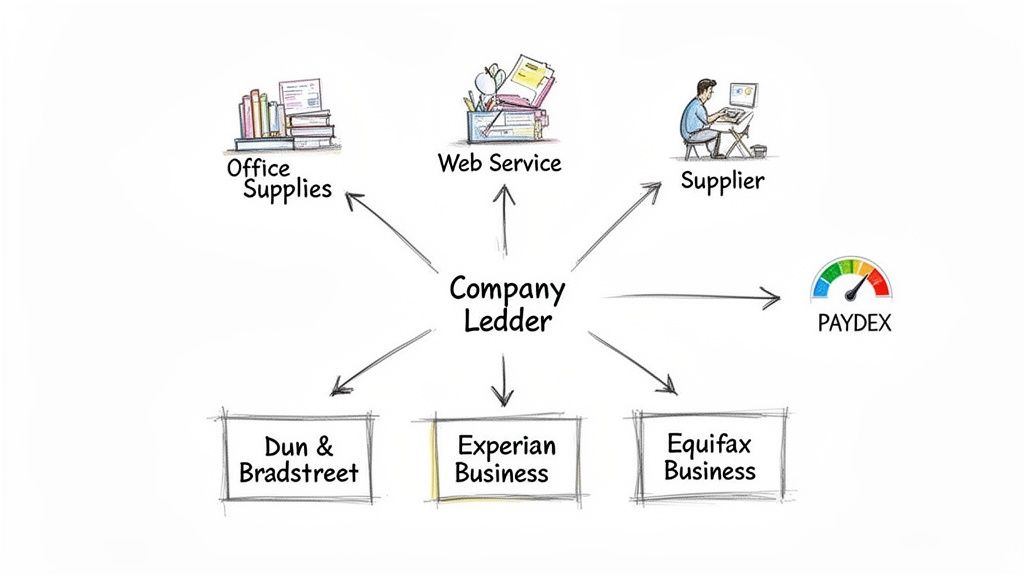
With a legitimate US entity and bank account, you’ve built the launchpad. Now it’s time to generate the thrust that actually gets your business credit profile off the ground. This happens by opening your first vendor accounts—known in the credit world as tradelines.
A tradeline is simply a record of your credit account with a supplier. When that supplier reports your payment activity to the major business credit bureaus—Dun & Bradstreet, Experian Business, and Equifax Business—you begin to build an official payment history. This is the single most critical part of the process.
Choosing Your First Reporting Vendors
The key to a fast start is choosing vendors that actually report your payments. A surprising number of companies don’t, which means your on-time payments do nothing to build your score. You have to be strategic.
Start with what are commonly called “starter” vendors. These are companies known for extending net-30 terms to new businesses, even those without an established credit history. This simply means you have 30 days to pay their invoice. Making these payments on time, or even early, is how you create the positive payment events that build your credit file.
A few well-known starter vendors that report to business credit bureaus include:
- Office Suppliers: Companies like Uline and Quill offer a massive range of business essentials. You can often start with a small order and, after a few successful payments, request net-30 terms.
- Web Services: Many providers for web hosting, domain registration, or other digital services offer business accounts that report your payment history.
- Industrial Suppliers: Companies like Grainger are another common starting point for new businesses needing to establish powerful tradelines.
Always confirm that a vendor reports to at least one of the major business credit bureaus before you open an account. This simple verification step ensures your efforts aren’t wasted. You can usually find this information on their website or by calling their sales department.
Pro Tip: Your initial goal should be to secure at least three to five tradelines that are actively reporting your payment history. This is the minimum threshold the bureaus require to generate a credible business credit score, like the all-important PAYDEX score from Dun & Bradstreet.
Making Your Payments Count
Once your first net-30 accounts are open, your payment behavior is everything. Business credit scoring is heavily weighted toward payment history, but there’s a nuance many people miss. D&B’s PAYDEX score, for instance, actively rewards early payments.
Look at how it works:
- Paying 30 days early: PAYDEX Score of 100
- Paying on the due date: PAYDEX Score of 80
- Paying 30 days late: PAYDEX Score of 50
As you can see, simply paying on time is good, but paying early is what separates an excellent credit profile from an average one. We advise clients to set a firm policy to pay all vendor invoices at least a week before the due date. This creates a powerful and undeniable signal of financial discipline.
Accelerate Your Progress with a Secured Business Credit Card
While starter vendor accounts are essential, they are only one part of a sophisticated strategy. The next powerful move is to open a secured business credit card. This is an outstanding option for international founders, especially if you have an ITIN but no personal US credit history.
A secured card works by requiring a cash deposit that becomes your credit limit. For example, you deposit $2,000 and receive a credit card with a $2,000 limit. This completely eliminates the risk for the bank, making them far more likely to approve your application.
Here’s why a secured card is so effective for this purpose:
- Reports to Bureaus: Most secured business cards report your payment history to the major business credit bureaus, just like an unsecured card would.
- Establishes a Financial Tradeline: This creates a “financial” tradeline, which lenders often view more favorably than a simple vendor or supplier tradeline.
- Creates a Path to Unsecured Credit: After 6-12 months of responsible use and consistent on-time payments, the bank will often refund your deposit and “graduate” you to a standard, unsecured business credit card.
Using this card for small, recurring business expenses—like software subscriptions or digital advertising—and paying the balance in full each month is a fast track to building a strong financial history. You are demonstrating responsible credit management directly to the bureaus that matter. For more context, our guide on accessing American credit for international entrepreneurs provides additional strategies.
This dual approach of using both vendor tradelines and a secured card creates a diverse and robust credit profile far more quickly than relying on one method alone.
Getting your first few tradelines on the books is a huge win, but it’s just the beginning. The real goal is to turn that early credit history into a powerful asset that actually fuels your business’s growth. This is where discipline comes in—you have to monitor your progress and know exactly when and how to use your new financial leverage.
Think of it this way: your first accounts were just practice. Now it’s time to see how you’re performing and plan your next move. That means getting in the habit of regularly checking your business credit reports from the major bureaus.
What Lenders Are Actually Looking At
Your business credit report is your company’s financial report card, and you need to know what score you’re getting. While there are a few different metrics, one of the most critical is the PAYDEX score from Dun & Bradstreet. It’s a simple 1-to-100 score that tells lenders one thing: how quickly you pay your bills.
It’s incredibly straightforward:
- A score of 80 means you pay on time.
- A score of 100 means you consistently pay 30 days before the due date.
- Anything below 80 signals late payments, which is a major red flag for anyone considering extending you credit.
We tell all our clients to aim for a PAYDEX of 90 or higher. The easiest way to get there? Pay every single invoice at least one week early. It’s a small habit, but it builds a reputation for rock-solid financial discipline that makes your business look like a prime candidate for financing.
Your credit report is telling a story whether you like it or not. By monitoring it, you take control of that story. You can find and fix errors, see your strengths, and know precisely when you’re ready to ask for more.
Beyond just the scores, you have to make sure your vendors are actually reporting your payments. If you’ve been paying a supplier on time for months and they aren’t showing up on your report, all that effort is wasted. You need to contact them and confirm they report. If they don’t, it’s time to start shifting your business to vendors who do.
Graduating to More Powerful Credit
Once you have a few months of solid payment history and a strong PAYDEX score, you can start climbing the ladder from starter accounts to more serious financing.
Here’s a real-world scenario we see often. An international e-commerce founder we worked with started with three net-30 accounts and a $2,000 secured business credit card. For six straight months, they put their regular operational spending on these accounts and paid every bill 10 days ahead of schedule.
Their PAYDEX score quickly shot up to 95. The bank saw their perfect payment history and automatically “graduated” their secured card to an unsecured business card with a $10,000 limit, refunding their original deposit. Just like that, they had a major unsecured credit line from a top US bank, all because they played the game correctly.
When to Make Your Move for a Business Loan
The final piece of the puzzle is often a business loan. This is where your personal credit might come back into play, especially if your business is still young. Data on business loan approvals shows that while strong personal credit helps, it isn’t always a dealbreaker. For instance, a recent study found that while over 55% of approved applicants had personal FICO scores of 700 or higher, nearly one in five still got funded with scores below 660. You can see more on these business loan qualification findings on NBC Right Now.
The right time to apply is when you have a clear business case for the money—like a big inventory purchase or a major marketing campaign—and at least 12-18 months of flawless payment history on your business credit file. With a strong business credit profile, a healthy bank balance, and steady revenue, your chances of approval go way up, and you’re far less likely to need a personal guarantee. This is how strategic patience turns all your hard work into real, usable capital.
Common Questions from International Founders
When you’re building a business in the US from abroad, the credit system can feel like a black box. You’ll have questions—very specific, nuanced ones that only non-resident founders face.
These are the exact issues our international clients run into every day, and these are the straightforward answers we give them.
How Long Does It Take to Build a Good Business Credit Score?
You can get on the radar and establish a basic credit file within 30-90 days of your first vendor payment getting reported. That’s the first step—just existing in the eyes of the credit bureaus.
But building a robust score that actually unlocks serious financing is a different story. That journey takes consistent, focused effort over 6 to 12 months. The timeline really depends on how proactive you are about opening accounts that report and paying every single bill on time. It’s a marathon, not a sprint.
Can I Really Build US Business Credit Without an SSN or ITIN?
Yes, you can absolutely get the process started. Forming your US company and getting an Employer Identification Number (EIN) are the foundational steps, and neither requires a personal US tax number.
However, you’ll hit a wall pretty quickly. When it comes time to open a business bank account or apply for a credit card, an ITIN becomes practically mandatory for a non-resident founder. US banks need it for identity verification to comply with federal regulations.
Our advice to every international client is the same: make securing an ITIN a top priority from day one. Waiting will only cause delays later.
For your first few starter vendor accounts, you generally won’t need to provide a personal guarantee. But as you move up the ladder to unsecured credit cards and larger loans, lenders will almost always ask for one, especially from a new business. The stronger your business credit file becomes, the less you’ll have to rely on your personal assets to secure financing.
What Are the Biggest Mistakes I Need to Avoid?
The road to strong business credit is littered with traps. From our experience helping hundreds of founders, these are the most common and damaging mistakes you need to sidestep:
- Mixing Personal and Business Expenses: This is the cardinal sin. It pierces the corporate veil, destroying your liability protection and making your books a mess that no lender wants to touch.
- Using Vendors That Don’t Report: You can have a perfect payment history, but if your vendors don’t report to the business credit bureaus, your efforts are invisible. It’s like training for a race that’s never recorded.
- Applying for Too Much Credit Too Quickly: A sudden flurry of applications signals desperation and raises immediate red flags. Building credit is a strategic, patient process—not a frantic dash for cash.
- Forgetting to Monitor Your Credit Reports: Errors on credit reports are surprisingly common. A simple mistake could be quietly tanking your score, making it critical to check your files regularly.
Avoiding these blunders is just as important as taking the right steps. A disciplined, methodical approach is what separates the founders who successfully build a powerful credit profile from those who never gain real financial traction in the US.
At Protect Your Wealth, we specialize in guiding international founders through every step of this complex process, from ITIN applications to securing US bank accounts and building a powerful credit history. If you need an expert partner to streamline your US financial setup, explore our services and let us build your bridge to American credit.


