


In a world of ever-increasing uncertainty, getting a second passport isn't just a smart move—it’s about securing future-proof optionality for yourself and your family. It means acquiring citizenship in another country, whether through investment, ancestry, or residency, and creating what I consider the ultimate insurance policy for your wealth, freedom, and legacy.
Why a Second Passport Is Now a Necessity, Not a Luxury
The conversation around second passports has fundamentally shifted. What was once seen as a status symbol for the ultra-wealthy is now an essential strategic asset for anyone with a global perspective. Relying on a single passport, even from a powerful nation, is a growing liability. We’ve all seen how quickly political decisions, economic shocks, or unexpected travel bans can limit your freedom of movement and threaten your financial security.
This is where the concept of "geopolitical arbitrage" becomes so powerful. It’s simply the practice of using alternative citizenships to insulate yourself from the risks tied to your home country. You diversify your investment portfolio, so why wouldn't you diversify your most fundamental asset—your citizenship?
The Declining Power of "Strong" Passports
The old assumption that certain passports will always guarantee unrestricted global access is officially dead. Geopolitical tensions and shifting international alliances mean that visa-free travel lists are in constant flux. A diplomatic spat or a sudden policy change can slam doors shut overnight, leaving you and your family stranded.
This isn't just theory; it's a measurable trend. In a surprising turn of events, data now shows that in 2025, Americans became the single largest group of applicants for investment migration programs. This surge is no coincidence—it happened right as the U.S. passport fell out of the top 10 for the first time, its visa-free access chipped away by new restrictions. To see the data for yourself, you can explore the full Henley Global Mobility Report and understand these shifting dynamics.
Securing Your Legacy and Freedom
Ultimately, a second passport is about one thing: control. It ensures that you, not a government, dictate where you can live, work, and travel. It provides a reliable Plan B—a safe haven for your family and your assets if your home country ever faces instability.
A second passport is the ultimate insurance policy. It guarantees that no matter what happens politically or economically in one country, you and your family have a secure alternative, preserving your freedom and legacy for generations to come.
The strategic benefits go far beyond just ease of travel:
- Asset Protection: It unlocks access to international banking and investment structures in more stable, tax-friendly jurisdictions.
- Family Security: It offers a safe harbor for your loved ones, with options for better education and healthcare systems outside your home country.
- Business Expansion: It can open up new markets and investment opportunities, like the U.S. E-2 investor visa, which is only available to citizens of treaty countries such as Grenada.
Quick Overview of Second Passport Pathways
Before diving into the specifics, it's helpful to understand the main routes to a second citizenship. Each pathway has unique requirements and is suited to different personal and financial situations.
| Pathway | Primary Requirement | Ideal Candidate Profile |
|---|---|---|
| Citizenship by Investment (CBI) | A significant financial contribution (donation or real estate purchase). | High-net-worth individuals seeking a fast and direct route to citizenship, often in 3-6 months. |
| Citizenship by Descent (Ancestry) | Provable lineage to a citizen of the country (parent, grandparent, etc.). | Individuals with documented European, Latin American, or other qualifying ancestry. |
| Citizenship by Naturalization | Legal residency in the country for a specified period (typically 3-10 years). | Individuals willing to physically relocate and build long-term ties to a new country. |
| Citizenship by Exception (Merit) | Exceptional achievement in fields like arts, science, or sports. | World-renowned individuals who can bring significant prestige to the country. |
This table gives you a high-level look, but the best path for you will depend entirely on your goals, timeline, and personal circumstances.
Your Three Main Pathways to Second Citizenship
When you start looking into how to get a second passport, you'll quickly find there are a few distinct roads you can take. While the destination is the same—greater global freedom and a solid Plan B—the journey looks very different depending on your family history, financial situation, and how quickly you need results.
Essentially, it all boils down to three proven methods.
This decision tree helps illustrate when a second passport shifts from a "nice-to-have" luxury to a strategic necessity in today's world.
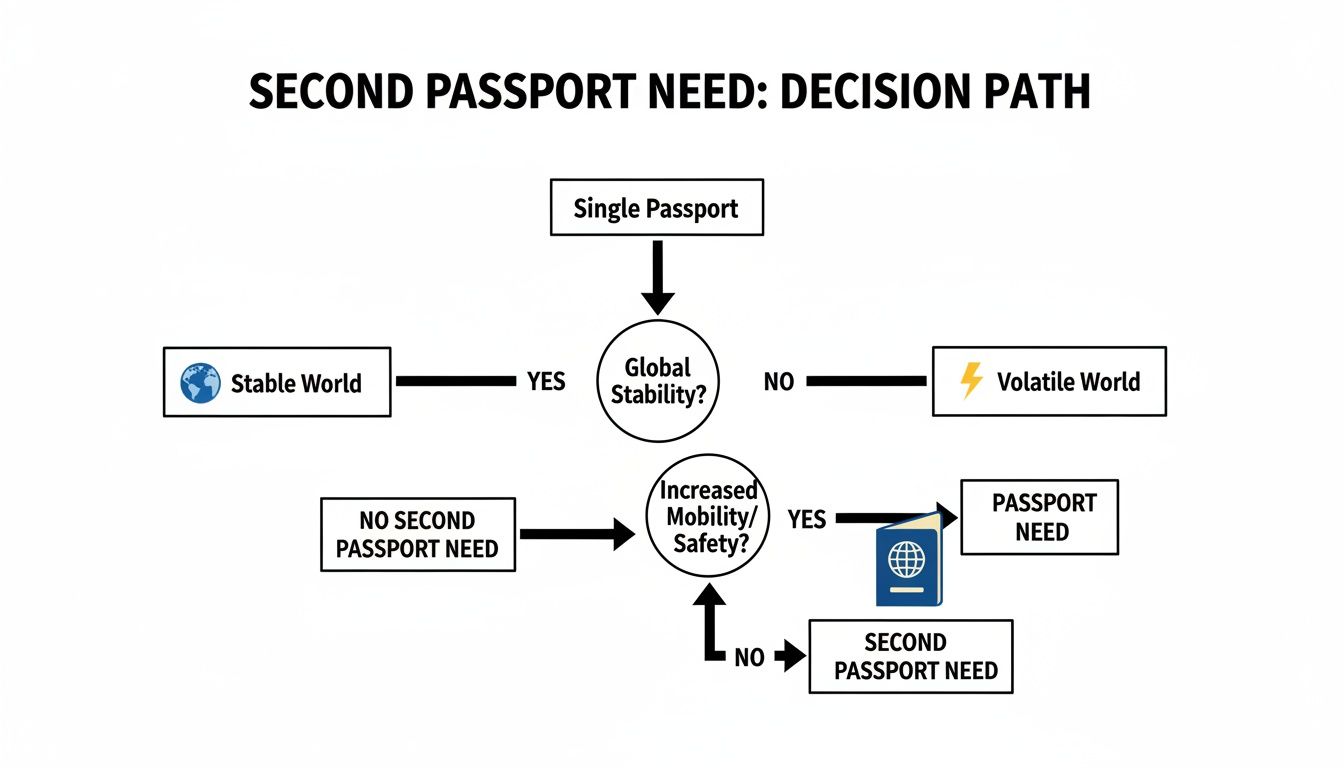
The takeaway here is that rising global instability is the single biggest driver pushing high-net-worth individuals to secure a backup plan they can count on.
Citizenship by Investment (CBI): The Fast Track
For anyone who prioritizes speed and efficiency, Citizenship by Investment (CBI) is the most direct route available. These are government-approved programs that let you make a significant economic contribution to a country in exchange for full citizenship and a passport. This isn't about "buying a passport"—it's a strategic investment that benefits both you and the host nation.
The process is surprisingly straightforward, often taking just 4 to 8 months without you ever needing to live in the country. We’ve seen a global rush for second passports accelerate since the pandemic, with applications soaring from the US, UK, and China. This trend is fueled by tightening visa rules and the fact that nearly one-in-five Americans are now interested in expatriating.
While some programs have faced new hurdles, the Caribbean options remain incredibly robust. St. Kitts and Nevis alone has issued over 20,000 passports since 1984, which is a testament to its stability. For business owners, that passport also grants valuable E-2 investor visa access to the U.S.
A common misconception is that CBI is only for the ultra-wealthy. While it requires a significant outlay, many programs are more accessible than you might think, especially when you factor in the long-term value of the asset you're acquiring.
Take a popular program like Grenada's, for example. It offers two clear options:
- Donation: A non-refundable contribution to the country's National Transformation Fund, starting at $150,000 for a single applicant. This is the simplest, most direct option.
- Real Estate: An investment in a government-approved real estate project, typically starting at $220,000. The initial cost is higher, but you can usually sell the property after a holding period (often 5 years), potentially recovering your entire investment.
CBI is the go-to path for entrepreneurs and investors who need results quickly and can deploy capital to get them. You can dive deeper into the best options in our detailed guide on second citizenship by investment.
Citizenship by Descent (CBD): The Heritage Path
If you happen to have European, Latin American, or other qualifying ancestry, Citizenship by Descent (CBD) could be your most cost-effective ticket. This pathway lets you claim citizenship based on your family tree—your direct link to a parent, grandparent, or even a great-grandparent who was a citizen of another country.
This route isn't about money; it's about proving your heritage through meticulous genealogical research and document gathering.
Key Documents You'll Likely Need:
- Birth certificates for yourself, your parents, and relevant ancestors.
- Marriage certificates for each generation in your direct line.
- Naturalization records (or proof of non-naturalization) for the ancestor who emigrated.
- Death certificates, where applicable.
For instance, imagine your grandfather immigrated to the United States from Italy but never formally renounced his Italian citizenship before your father was born. To prove your claim, you'd need to track down his Italian birth certificate, his marriage certificate, your father's birth certificate, and official U.S. records showing he hadn't yet naturalized as an American at that time.
Be prepared for a long haul. The timeline for CBD can easily stretch from one to three years, thanks to consular backlogs and the exhaustive verification process. It's also critical to stay on top of changing laws. Countries like Italy, for example, have tightened eligibility, making it crucial to act fast if you think you qualify under the current rules.
Citizenship by Naturalization: The Long-Term Commitment
The third major pathway is Citizenship by Naturalization. This is the classic, traditional method of becoming a citizen, but it demands the most significant commitment of your time and physical presence. It means legally residing in a country for a set number of years, integrating into the local culture, and then formally applying for citizenship.
This is absolutely not a quick fix. The residency requirements are serious, often ranging from five to ten years or more. To become a citizen of Portugal, for instance, you generally must hold legal residency for at least five years before you can even begin the application process.
Naturalization is really for individuals or families who are genuinely planning to relocate and build a new life in another country. It requires a deep commitment—learning the language, passing civics tests, and truly becoming part of a new community.
While it's the most immersive path, it is by far the slowest and least practical option for anyone seeking a second passport primarily as a strategic tool for mobility and asset protection. It's a life change, not just a document acquisition.
How to Choose the Right Country for Your Goals
Once you know how you can get a second passport, the next critical question is where? This isn't just about picking a nice spot on the map. Choosing the right country is a strategic decision that has to align perfectly with your financial and personal goals.
You’re not just collecting flags. You’re selecting a powerful tool designed to solve a specific problem or unlock a unique opportunity.
What you prioritize will drive your entire strategy. Are you chasing ultimate global mobility? A tax-neutral home base? Or simply the fastest route to a new travel document? Each goal points to a very different jurisdiction.
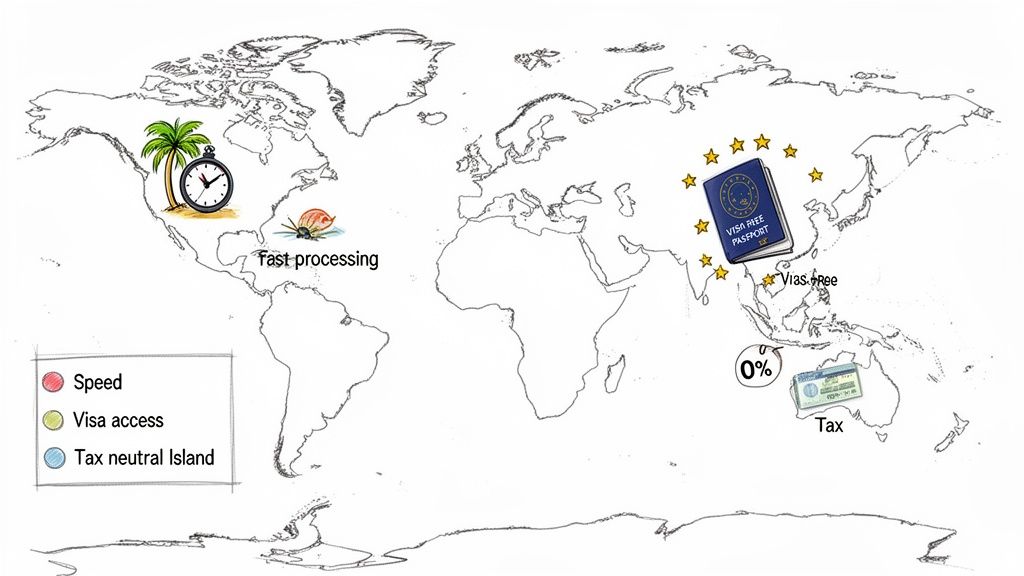
Defining Your Core Objectives
Before you even glance at a list of countries, you have to define what success looks like for you. Your personal objectives are the only lens that matters when evaluating your options.
Think about these common profiles I see all the time:
- The Global Entrepreneur: Your biggest need is frictionless travel to major business hubs—London, the Schengen Area, Singapore. You also need a passport that opens doors to other opportunities, like the U.S. E-2 investor visa.
- The Asset Protector: Your main goal is to legally slash your tax bill and shield your wealth from the economic or political instability back home. A country with zero worldwide income tax is your north star.
- The Family Legacy Builder: You’re thinking long-term, focused on securing a safe, stable future for your children with access to top-tier education and healthcare. An EU passport, even if it takes years to get, is the ultimate prize.
Each of these people needs a different solution. The entrepreneur might lean toward Grenada for its E-2 visa treaty with the U.S. The asset protector, on the other hand, will find a tax-neutral Caribbean nation far more attractive.
A second passport is only as valuable as its ability to meet your specific needs. Don't get distracted by the program with the lowest price tag or the fastest timeline unless those are your absolute top priorities. The right choice is the one that provides the most strategic leverage for your life.
Caribbean Speed vs. European Prestige
For Citizenship by Investment (CBI), the two most common theaters of operation are the Caribbean and Europe. Both can get you a powerful travel document, but they represent a classic trade-off: speed versus scope.
Caribbean programs (think Grenada, St. Kitts & Nevis) are built for efficiency. You can often have a passport in your hands in just 6 to 8 months. They offer excellent visa-free access, typically to over 140 countries, including the UK and the entire EU Schengen Zone. Many are also highly tax-friendly, making them a go-to for wealth preservation.
European "Golden Visa" programs (like those in Portugal or Malta) offer something bigger: a pathway to full EU citizenship. This is the gold standard for global mobility, granting you the right to live, work, and study in any of the 27 EU member states. But this path is a marathon, not a sprint. You'll get a residency permit first and will need to wait several years—often five or more—before you can even apply for a passport. The investment requirements are also much, much higher.
Comparing Popular Citizenship by Investment Programs in 2026
To make sense of the options, it's helpful to see them side-by-side. This table breaks down some of the leading CBI programs, giving you a clear snapshot of what to expect in terms of cost, time, and key advantages.
| Country Program | Minimum Investment | Processing Time | Key Benefits (e.g., Visa-Free Access, Tax Regime) |
|---|---|---|---|
| Grenada | $150,000 (Donation) | 6-9 Months | 148+ countries visa-free; U.S. E-2 visa treaty access; territorial tax system. |
| St. Kitts & Nevis | $250,000 (Donation) | 6-8 Months | 155+ countries visa-free; oldest CBI program; zero tax on worldwide income. |
| Malta | €750,000 (Contribution) | 14-38 Months | Full EU citizenship; 185+ countries visa-free; right to live/work anywhere in the EU. |
| Turkey | $400,000 (Real Estate) | 4-6 Months | Citizenship in a G20 country; visa-free access to 110+ countries. |
This comparison highlights the fundamental trade-offs. The Caribbean offers an incredible blend of speed, access, and tax efficiency at a lower price point. Malta, while far more expensive and slower, delivers the ultimate prize of EU citizenship. Choosing the right one comes down to your personal balance of priorities.
Real-World Scenarios and Strategic Wins
Let's look at how this plays out in the real world. I worked with a U.S.-based e-commerce entrepreneur who wanted to formalize his business operations in America. By getting a Grenadian passport in under a year, he became eligible for the U.S. E-2 investor visa. This allowed him and his family to live and work in the United States—something his original citizenship couldn't offer. For him, the Grenadian passport was the key that unlocked his primary business goal.
In another case, a family from a country with punishing wealth taxes wanted to protect their legacy. Their number one priority was a tax-neutral jurisdiction. They chose a Caribbean program with zero tax on worldwide income, which immediately allowed them to restructure their assets in a much more favorable environment. The visa-free travel was great, but it was secondary to the huge financial advantage they gained.
Choosing the right country is the single most critical decision you'll make. By carefully mapping your goals against the benefits each program offers, you can select a passport that will deliver strategic value for decades. To get started, you can explore a comprehensive list of dual citizenship countries and compare their unique advantages.
Navigating the Application and Due Diligence Maze
The process of applying for a second passport can feel like a black box. You send in a mountain of paperwork, and months later, a decision comes out. But once you pull back the curtain and see how it really works, the whole journey becomes much clearer—and far less intimidating.
At its core, the entire process boils down to one thing: proving you are who you say you are and that your wealth was acquired legitimately. Reputable countries guard their citizenship fiercely, and their due diligence is designed to filter out anyone who could be a reputational or security risk.
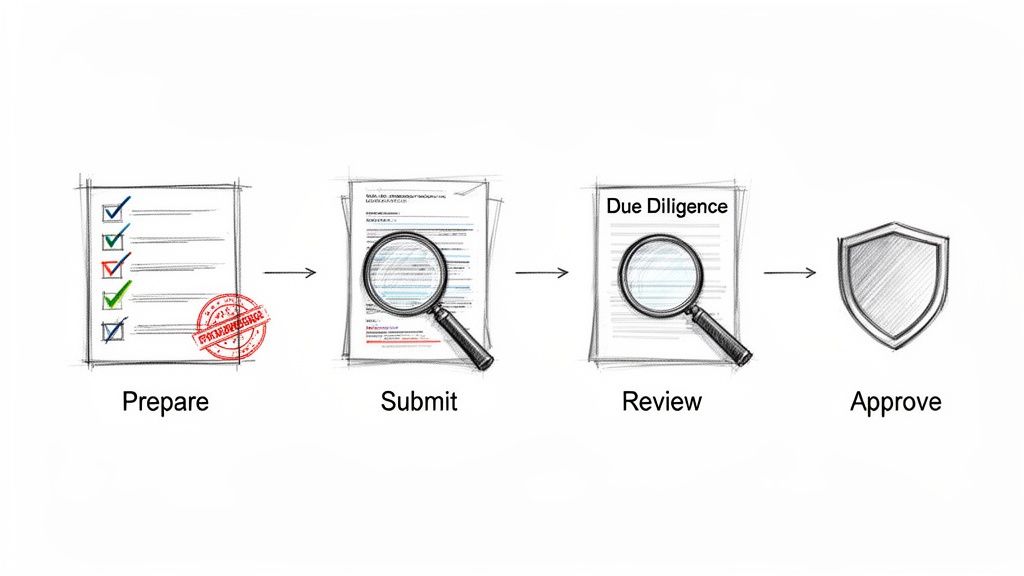
The Critical Role of Due Diligence
Every legitimate Citizenship by Investment (CBI) program runs an intensive, multi-layered background check. This isn't just a box-ticking exercise; it’s the bedrock of the program's integrity. Governments hire top-tier, international due diligence firms to dig deep into every applicant's past.
These checks are incredibly thorough and cover everything:
- Global Sanctions Lists: They scour international databases like Interpol and OFAC to ensure you’re not a wanted person or subject to sanctions.
- Source of Funds Verification: This is a forensic look at your financial history. They want to see a clear, legal path for your investment capital, whether it's from business profits, an inheritance, or a property sale.
- Reputational Risk: Investigators search for any red flags—negative press, messy litigation, or questionable associations—that could tarnish the country’s name.
- Identity Confirmation: All your personal documents, from birth certificates to existing passports, are meticulously verified to rule out identity fraud.
This is exactly why having a completely clean personal and financial history is non-negotiable. Trying to hide an old business dispute or fudge the origins of your funds is a guaranteed path to rejection. In this game, total transparency is your greatest asset.
Preparing Your File for Success
A winning application is one that anticipates every question the review team might have. This is where an experienced, government-licensed agent becomes invaluable. They don't just fill out forms for you; they help you build a bulletproof case file that leaves zero room for doubt.
The documentation is extensive, almost like preparing for a major financial audit. While the specifics differ between countries, you should be ready to provide:
- Proof of Funds: This includes bank statements going back 6-12 months, letters from your banker, and detailed evidence showing exactly how you earned the money you plan to invest.
- Professional References: You'll need letters from a reputable lawyer and accountant who can vouch for your good character and solid financial standing.
- Personal Documents: Think certified copies of passports, birth and marriage certificates, and national ID cards for everyone on the application.
- Police Clearance Certificates: You'll need official reports from every country you've lived in for more than six months over the last ten years.
The single biggest mistake I see applicants make is underestimating the source of funds requirement. It’s not enough to show you have the money. You must provide a clear, documented trail of how you earned it. A well-prepared file tells a simple, verifiable story that makes an official’s job easy.
Your Agent's Role as Your Advocate
In most CBI jurisdictions, you can't even apply directly—working with a government-authorized agent is mandatory. This agent is your official liaison, ensuring your application is complete, compliant, and presented in the strongest possible way.
A good agent gets ahead of potential problems. For instance, if your investment capital came from selling a business a decade ago, they'll make sure you have the sale agreement, tax filings, and bank records to back it up. This proactive approach prevents the government from issuing time-consuming "Requests for Further Information," which can stall an application for months.
This level of meticulous preparation is becoming even more critical as global financial transparency grows. With regulations like DAC8 set to increase cross-border data sharing, a professionally managed application ensures your financial disclosures are consistent and compliant from the start. You can learn more about what DAC8 means for your assets after January 1, 2026.
By understanding the rigor of the due diligence process and partnering with a skilled advisor to prepare a flawless application, you can navigate this maze efficiently. The goal is a smooth journey from submission to passport in hand, free from unnecessary delays and anxiety.
Putting Your New Passport to Work for You
Getting a second passport is a huge win, but it’s crucial to understand that the document itself is just a key. The real value is unlocked when you know which doors to open. Acquiring the passport is the end of one process, but it's the beginning of a much bigger strategy for global freedom and wealth preservation.
This is where theory ends and practice begins. You start turning your new citizenship into a tangible, hard-working asset. The most successful global citizens don’t just use their new passport for visa-free travel; they use it as the foundation for a more resilient, private, and efficient financial life. It's about building a robust international structure that your original citizenship might have made difficult, or even impossible.
Activating Your New Financial Identity
Your new citizenship gives you a new financial identity. This allows you to engage with the global banking and investment world from a completely fresh perspective—often from a much more favorable jurisdiction. One of the first and most powerful steps is opening international bank accounts under your new citizenship.
Imagine you're an American entrepreneur who just acquired a passport from St. Kitts and Nevis. You can now approach a Swiss or Singaporean bank not as a U.S. person—who often faces burdensome FATCA reporting and limited investment options—but as a Kittitian citizen. This simple shift can grant you access to a wider array of financial products and a degree of privacy that was previously off-limits.
The moment you hold a second passport, you are no longer limited to the financial system of your home country. You gain access to world-class banking, investment platforms, and asset management services that operate under different rules, often with greater stability and confidentiality.
Building Your International Corporate Structure
Beyond personal banking, your new passport is instrumental in creating an international corporate structure. This is absolutely essential for entrepreneurs and investors looking to legally optimize taxes and protect their assets. Using your second citizenship, you can establish an offshore company in a tax-neutral jurisdiction like the UAE or the British Virgin Islands.
For instance, a business owner from a high-tax country can set up a holding company using their new citizenship. This new entity can then own assets, receive international payments, and hold investments, all while benefiting from the zero-tax environment of its jurisdiction. This isn't about evasion; it's about legally structuring your affairs to operate more efficiently on a global scale.
Here are some practical steps to take:
- Establish Tax Residency: If your goal is tax optimization, you may need to establish legitimate tax residency in a low- or zero-tax country. Your new citizenship simplifies this process immensely.
- Open Corporate Bank Accounts: Use your offshore company and new passport to open corporate bank accounts in stable financial hubs, separating your business assets from your home country's reach.
- Diversify Investments: Access exclusive investment funds and opportunities that are often not available to citizens of certain countries due to heavy regulatory restrictions.
Unlocking Lifestyle and Legacy Benefits
Finally, the practical advantages extend far beyond finance. Your new passport becomes a tool for enhancing your family's quality of life and securing their future.
This could mean enrolling your children in top European universities as EU citizens, or simply having the peace of mind that comes from holding a travel document from a politically neutral country.
This is the ultimate goal of learning how to get a second passport: creating a life with more options. Whether it’s unrestricted travel, better educational opportunities for your children, or a more secure financial future, your new passport is the instrument that makes it all possible.
Common Questions About Getting a Second Passport
When you're seriously considering a second passport, the questions start piling up fast. It’s a significant move involving serious investment and careful planning, so you need clear, direct answers. Let's cut through the noise and tackle the most common concerns we hear from clients every day.
How Long Does The Entire Process Take?
This is usually the first question people ask, and the answer is: it depends entirely on the path you choose. The timeline can vary dramatically.
Citizenship by Investment (CBI) programs are, by a long shot, the fastest route. If you’re looking at one of the Caribbean nations, you can expect the entire process—from submitting your application to holding your new passport—to take somewhere between 4 and 8 months. This speed is a huge part of their appeal.
Citizenship by Descent, on the other hand, is a much slower journey. It involves digging up extensive documentation and navigating consular bureaucracy, which typically takes 1 to 3 years as you prove your family lineage. And then there's naturalization—the long game. This path requires you to legally live in a country for 5 to 10 years before you can even think about applying.
Will I Have To Renounce My Current Citizenship?
The fear of giving up your original passport is a major hang-up for many, but for most people, it's completely unfounded.
The vast majority of countries with reputable second passport programs fully permit dual citizenship. This includes all the popular Caribbean CBI nations, as well as the United States, Canada, and the UK. You can legally hold both passports, no problem.
However, you must verify this for both your home country and your target country. Some nations, like China, India, and Singapore, have strict rules against it. A good advisor will always confirm the laws on both sides to make sure you aren't walking into a legal conflict.
The goal is to add a passport, not trade one for another. For most applicants from Western countries, renunciation is not on the table. You're expanding your options without losing your original citizenship.
What Are The Most Common Reasons For Rejection?
With proper guidance, application rejections are rare. When they do happen, it almost always comes down to a failure during the due diligence stage. Governments are incredibly protective of their programs' integrity and run deep, thorough background checks on every applicant.
Here are the issues that sink applications most often:
- A Muddy Source of Funds: You must provide a crystal-clear, documented history of how your investment capital was legally acquired. Any gaps or inconsistencies are a deal-breaker.
- A Criminal Record: Any criminal history can be a major red flag, even for what seems like a minor offense from years ago.
- Misleading Information: Lying on your application or strategically omitting important details is an automatic denial. Full stop.
- Undisclosed PEP Status: Being a Politically Exposed Person (PEP) isn't necessarily a disqualifier, but failing to disclose it certainly is.
When it comes to your application, absolute transparency isn't just a good idea—it's non-negotiable.
Can My Family Get Passports With Me?
Yes, absolutely. In fact, most Citizenship by Investment programs are designed with families in mind.
A primary applicant can typically add their spouse and dependent children. Many programs are quite generous with the age limits for children, often extending up to 30 years old, as long as they are unmarried and still financially dependent on you.
It doesn't stop there. You can often include dependent parents and even grandparents in the same application. Of course, each additional family member will increase the total investment and government fees, but it provides a complete solution. You can secure global mobility and a safer future for your entire family in one clean, efficient process.
At Protect Your Wealth, we specialize in crafting these bespoke global mobility and asset protection strategies. We manage the entire process, ensuring your application is flawless and your goals are met with precision and complete confidentiality.
If you're ready to secure your Plan B, explore our residency and citizenship solutions and discover how we can help you build a more resilient future.


