


For any global entrepreneur looking to do business in the U.S., the Individual Taxpayer Identification Number (ITIN) is more than just a piece of tax paperwork. It's the master key that unlocks the entire American financial system.
Getting one means proving your foreign status and identity, justifying why you need the number, and submitting a flawless Form W-7 application to the IRS—often alongside a U.S. tax return.
Why an ITIN Is Your Key to the US Market
Trying to navigate the U.S. market as a non-resident investor or foreign founder without a Social Security Number (SSN) is like hitting a brick wall. Simple but critical actions, like opening a U.S. bank account or setting up payment processors like Stripe, become impossible hurdles.
This is exactly the problem the ITIN was created to solve.
Don't think of the ITIN as another bureaucratic hassle. See it for what it is: a strategic asset. It's the official number that validates your identity to the IRS, allowing you to meet your U.S. tax obligations without needing work authorization. This distinction is crucial and often gets misunderstood.
Distinguishing ITIN from SSN
An ITIN does not authorize you to work in the United States or make you eligible for Social Security benefits. Its sole purpose is federal tax reporting.
But for international business owners, the secondary benefits are where the real power lies.
With a valid ITIN, you can:
-
Open U.S. Business and Personal Bank Accounts: Most financial institutions require an ITIN from foreign owners to comply with Know-Your-Customer (KYC) regulations.
-
Access Payment Gateways: Services like Stripe and PayPal often demand a U.S. tax ID to operate an account linked to a U.S.-based business.
-
Comply with Tax Law: It lets you file the necessary returns for income generated from U.S. sources, like rental properties, software royalties, or direct business activities.
-
Build a U.S. Credit History: An ITIN is the first step toward applying for credit cards and loans, which is essential for establishing a financial footprint in the U.S. You can learn more in our guide on how to access American credit as an international entrepreneur.
To make it perfectly clear, here's a simple breakdown of the core differences between an ITIN and an SSN.
ITIN vs SSN Key Differences at a Glance
| Feature | Individual Taxpayer Identification Number (ITIN) | Social Security Number (SSN) |
|---|---|---|
| Primary Purpose | Federal tax reporting for those ineligible for an SSN. | Tracking earnings for Social Security benefits and federal identification. |
| Who is Eligible | Foreign nationals, non-resident aliens, and their dependents/spouses. | U.S. citizens, permanent residents, and some temporary residents with work authorization. |
| Format | Nine digits, always beginning with the number 9. (e.g., 9XX-XX-XXXX) | Nine digits, format varies. Does not start with a 9. |
| Work Authorization | No. Does not grant the right to work in the U.S. | Yes. Confers the legal right to work in the U.S. |
| Social Security Benefits | No. Does not make the holder eligible for benefits. | Yes. Used to determine eligibility and calculate benefits. |
| Use for Banking & Credit | Yes, widely accepted for opening bank accounts and building credit. | Yes, the standard identifier for all financial and credit activities. |
Understanding which number applies to your situation is the first step in establishing a compliant and functional presence in the U.S. market.
The Economic Impact of ITIN Holders
The IRS launched the ITIN system back in July 1996 specifically for foreign nationals who needed to comply with U.S. tax laws but couldn’t get an SSN. This nine-digit number, always starting with a 9, has since empowered millions to legally access the world’s largest economy.
The numbers speak for themselves. By 2022, IRS data showed that 3.8 million tax returns were filed using ITINs. These filers reported $14.4 billion in taxable income and contributed a staggering $6.5 billion in Social Security and Medicare taxes. This proves ITIN holders aren’t just complying—they are massive contributors to essential U.S. programs.
An ITIN transforms a foreign national from an outsider to a recognized participant in the U.S. financial system, enabling banking, investment, and compliance.
A Real-World Scenario
Let’s say you’re an e-commerce entrepreneur from Singapore selling to American customers. To streamline operations and ditch high currency conversion fees, you need a U.S. bank account. Without an SSN, your application is dead on arrival.
The ITIN is the bridge. Once you obtain one, you can walk back into that bank, open the account, connect it to your payment processor, and manage your U.S. revenue like a local. It’s the foundational piece that makes your entire U.S. business strategy work.
Ultimately, knowing how to get an ITIN is the first step toward building a solid, compliant presence in the United States. It’s the tool that grants you legitimacy and access, turning ambitious global plans into real financial success.
Confirming Your Eligibility and Gathering Documents
Before you even think about filling out Form W-7, the first step is a crucial reality check: do you actually need an ITIN, and are you eligible for one?
The IRS is not in the business of handing out ITINs to just anyone. You must have a legitimate federal tax reporting reason. This is a point of confusion for many who assume needing an ITIN to open a U.S. bank account is a valid justification. It’s not. Your reason has to be rooted in U.S. tax law.
Common Scenarios That Establish Eligibility
Most foreign nationals who apply for an ITIN fall into a handful of common categories. See if your situation fits one of these descriptions:
-
You’re a non-resident alien with U.S.-source income. This is the number one reason we see. It could be anything from rental income on a U.S. property to royalties from a book sold in the States or profits from a U.S. business partnership.
-
You’re a non-resident alien selling U.S. real estate. The Foreign Investment in Real Property Tax Act (FIRPTA) requires an ITIN to manage the tax withholding when you sell.
-
You’re a dependent or spouse of a U.S. citizen or resident alien. If you’re being claimed as a dependent or are filing a joint tax return, you’ll need an ITIN.
-
You’re a non-resident alien student, professor, or researcher. An ITIN is required if you are filing a U.S. tax return or claiming benefits under a tax treaty.
While these cover most cases, other complex situations, like managing certain types of trusts, can also qualify. For entrepreneurs with U.S. business interests, understanding these tax obligations is fundamental, a topic we often cover when discussing LLCs for non-residents and their tax obligations.
The IRS Documentation Gauntlet
Once you’ve confirmed you have a valid reason, it’s time to gather the documents the IRS demands. They need to see proof of two things: your foreign status and your identity.
Be warned: the standards here are incredibly strict. Even a tiny mistake will get you an immediate rejection letter.
The IRS has an approved list of 13 specific document types. But one document is the undisputed champion for simplifying the process: your original, unexpired passport.
A valid foreign passport is the only standalone document that proves both foreign status and identity. Submitting it eliminates the need to provide a combination of other documents, streamlining your application significantly.
Of course, mailing your original passport across the world is a non-starter for most people. Fortunately, you have a couple of other paths.
-
A Certified Copy of Your Passport: This is not a simple photocopy. It has to be a copy officially certified by the agency that issued it—your home country’s passport office.
-
A Combination of Other Documents: If a passport isn’t an option, you must submit at least two other current documents from the approved list. One needs a photograph (like a national ID card), and the other must prove your foreign status (like a foreign birth certificate).
The Critical Difference in Certifications
This is where a huge number of applications go wrong. Many people take their passport to a local notary public and get a stamped copy, thinking this is what “certified” means. It is not.
The IRS will instantly reject a document certified by a regular notary. The certification must come from one of two places:
-
The Issuing Agency: The government office that originally issued your document (e.g., your country’s passport agency or vital records office).
-
An IRS Certifying Acceptance Agent (CAA): These are professionals and firms officially authorized by the IRS to verify original documents for them. We’ll dive deeper into this service later.
This distinction is non-negotiable. Get this wrong, and you’ve virtually guaranteed your application will be sent back, wasting months of your time. Preparing your documents with this level of precision is the single most important thing you can do to get your ITIN application approved on the first try.
A Practical Walkthrough of Form W-7
Once your eligibility is clear and your documents are in order, it’s time to face the heart of the application: Form W-7, Application for IRS Individual Taxpayer Identification Number. Don’t be fooled by its length—this form is where most applications go wrong. Every single line is a potential pitfall that can send your entire package back to you, so getting it right the first time is non-negotiable.
Precision is everything. The IRS systems are automated to flag even the smallest discrepancies, like a name that doesn’t perfectly match your passport or a foreign address formatted incorrectly. There is simply no room for error.
This entire process boils down to a few core steps.
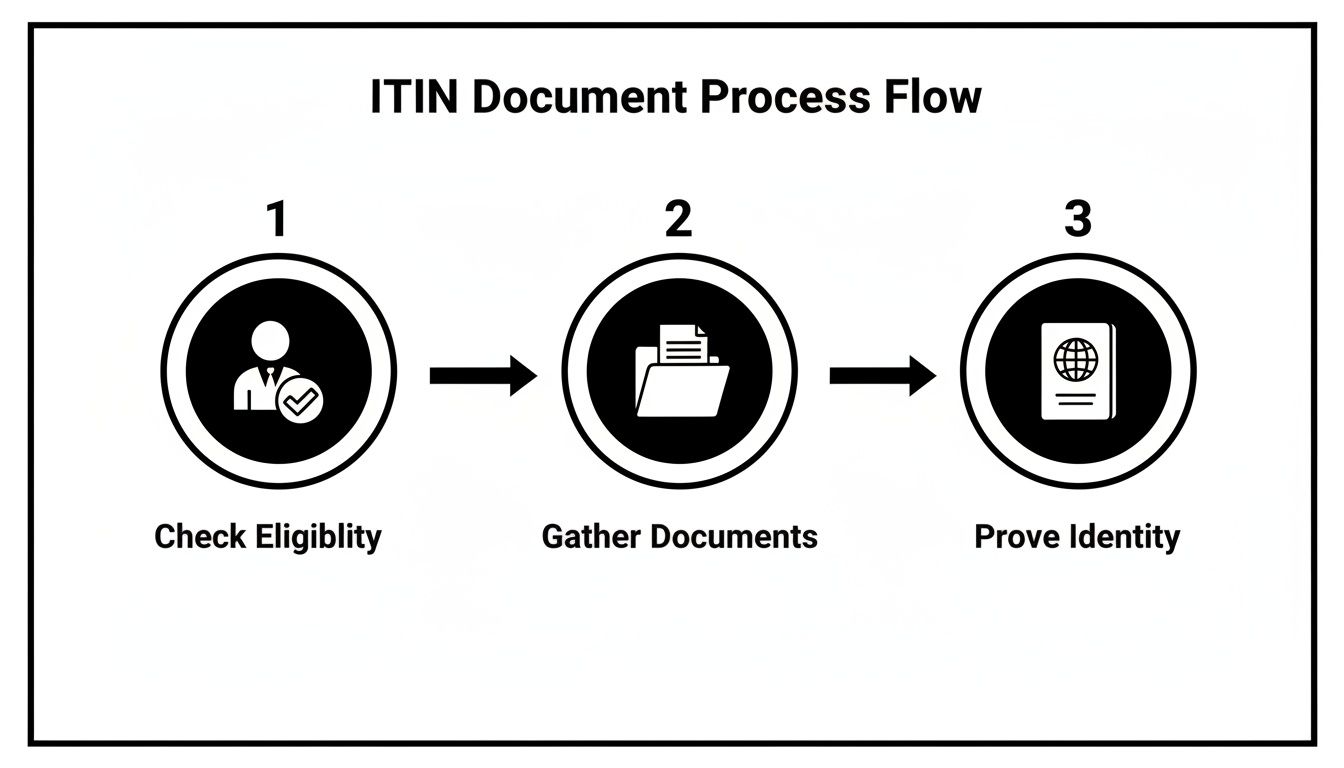
As you can see, confirming your eligibility and gathering the right documents are the foundational steps that all lead to the accurate completion of Form W-7.
Choosing Your Reason for Applying
One of the most critical sections on Form W-7 is the “Reason you’re submitting” field. You absolutely must check the box that aligns perfectly with your circumstances. For most international entrepreneurs and investors we work with, a few options are most common:
-
Box a: Nonresident alien required to get an ITIN to claim tax treaty benefits. This is the go-to if you’re receiving U.S.-source income (like dividends from stocks) where a tax treaty lowers your withholding rate.
-
Box f: Nonresident alien student, professor, or researcher filing a U.S. tax return or claiming an exception. This is specific to those in academic roles who have a U.S. filing obligation.
-
Box h: Other reason. This is a catch-all, but you must be incredibly specific. A classic example is writing in “Nonresident alien owner of a U.S. LLC required to file Form 5472.” Vague answers get rejected.
Picking the wrong reason or failing to include the necessary proof for that reason is the fastest way to get your application denied.
Be direct and honest. If you need the ITIN to meet a business compliance deadline, state that clearly. The IRS isn’t trying to trick you, but they demand absolute clarity on why you need this number.
Always download the latest version of the form and its instructions directly from the official IRS page for Form W-7. They update them periodically, and using an outdated version is an automatic rejection.
The Tax Return Requirement and Its Exceptions
Here’s a major hurdle for many: as a general rule, you must attach a valid, completed U.S. federal income tax return to your Form W-7 application. The ITIN is issued so you can file that return. But what if you need an ITIN for compliance reasons before any tax return is due? This is a common scenario for foreign business owners.
Fortunately, the IRS provides five key exceptions to this rule. For global entrepreneurs, these are lifelines that allow you to get an ITIN without submitting a tax return.
The most relevant exceptions for our clients include:
-
Third-party withholding on passive income: If you have U.S.-source passive income (like royalties) and the payer is withholding tax, you can apply for an ITIN to claim tax treaty benefits. You’ll need an official letter from the withholding agent to prove this.
-
U.S. real property interest: If you’re buying or selling U.S. real estate, you can get an ITIN to manage the tax withholding required under the FIRPTA (Foreign Investment in Real Property Tax Act) rules.
-
Wages for a foreign student or professor: Certain individuals on specific visas who are claiming a tax treaty exception for their U.S. wages can apply without a return attached.
These exceptions aren’t automatic. Each one requires very specific supplementary documentation to prove you qualify, so be prepared to provide more than just your identity documents if you plan to use one.
To help you stay organized, we’ve put together a simple checklist to track all the moving parts of your ITIN application package.
Your Complete ITIN Application Checklist
Use this table to ensure you have every component ready before you submit. A single missing piece can cause significant delays.
| Component | Status (Ready/Not Ready) | Notes |
|---|---|---|
| Completed Form W-7 | Double-check that all fields are filled and names match documents exactly. | |
| Original Foreign Identity Document | Your original passport is the best and most accepted option. | |
| Certified Copy of Identity Document | Alternative to sending your original. Must be from the issuing agency. | |
| U.S. Federal Tax Return (if required) | Required unless you qualify for an exception. | |
| Exception Documentation (if applicable) | E.g., a letter from a withholding agent or FIRPTA documents. | |
| Supporting Foreign Status Documents | National ID card, driver's license, etc. (if needed). |
Once every item on this list is marked "Ready," you can proceed with submission, confident that your package is complete.
Choosing How to Submit Your ITIN Application
Once your Form W-7 and all your supporting documents are ready, you’ve reached a critical fork in the road: how do you actually submit this package to the IRS?
This isn’t just a matter of logistics. Your choice directly impacts your approval odds, how quickly you get a decision, and—most importantly—the safety of your passport. The right method can mean a smooth approval in weeks; the wrong one can lead to a rejection nightmare that drags on for months.
You have four main ways to file. Each comes with its own set of risks and rewards that you need to weigh carefully.
Your Four Filing Options
Let’s break down the pathways for getting your ITIN application into the hands of the IRS.
-
By Mail: You can send your completed Form W-7, tax return (if applicable), and your original identity documents straight to the IRS service center in Austin, Texas. While it sounds simple, it's easily the riskiest route.
-
IRS Taxpayer Assistance Center (TAC): A handful of IRS TACs in the U.S. can accept ITIN applications and verify your documents on the spot. But getting an appointment is mandatory and can be a serious challenge, especially if you’re applying from abroad.
-
U.S. Diplomatic Missions Abroad: Certain U.S. embassies and consulates offer document verification services. This is highly location-dependent and often comes with its own layers of bureaucracy and long wait times.
-
Acceptance Agent (AA) or Certified Acceptance Agent (CAA): These are individuals or companies authorized by the IRS to help with ITIN applications. While they sound similar, the difference between them is monumental.
A regular Acceptance Agent (AA) can help you prepare the paperwork, but they cannot certify your documents. You’ll still have to mail your original passport to the IRS. A Certified Acceptance Agent (CAA), on the other hand, has the authority to verify your documents in person and submit certified copies on your behalf.
The Airtight Case for a Certified Acceptance Agent
Sending your original passport through international mail to a government agency should make any global entrepreneur nervous. The risk of it being lost, stolen, or damaged is very real.
Even if all goes well, the IRS says it can take up to 60 days after they process your application just to mail your documents back. For anyone who needs to travel, being without a passport for months is simply not a viable option.
This is exactly where a CAA becomes invaluable.
A CAA is your trusted go-between with the IRS. They will meticulously review your application for accuracy, verify your passport or other identity documents against the IRS's tough standards, and then issue a Certificate of Accuracy. This certificate, along with copies of your documents, is what gets sent to the IRS. Your original passport never leaves your possession.
Using a Certified Acceptance Agent is the single best way to protect your original documents, slash the risk of errors, and dramatically boost your chances of getting approved on the first try. It turns a high-risk, high-stress process into a secure and managed one.
The Rejection Numbers Don't Lie
If you're still not convinced, just look at the data. The ITIN application process is unforgiving, and a shocking number of self-filed applications fail. Imagine you're a digital nomad from the UAE structuring your business through Panama but need that ITIN to access the U.S. market—the path is littered with traps.
Recent IRS statistics tell a stark story: the overall rejection rate for ITIN applications is a painful 22%. That’s more than one in every five applications getting denied, usually because of simple documentation mistakes.
In sharp contrast, applications submitted through Certified Acceptance Agents had a rejection rate of just 12.27%. You can dig into these numbers yourself in this statistical analysis on obtaining an ITIN from The Wolf Group. The data is clear: working with a CAA cuts your risk of rejection almost in half.
For anyone serious about getting an ITIN efficiently, the choice is obvious. Yes, it involves a professional fee, but that cost is a small price for the security, peace of mind, and vastly improved odds of success that come with expert guidance.
What to Do After You Submit Your Application
Once your application package is in the mail, the waiting game begins. This is a phase that definitely requires patience—the IRS is not known for its speed—but it’s also the perfect time to plan your next moves.
Knowing what to expect and what to do the moment your ITIN arrives will transform this waiting period into a productive, strategic advantage.
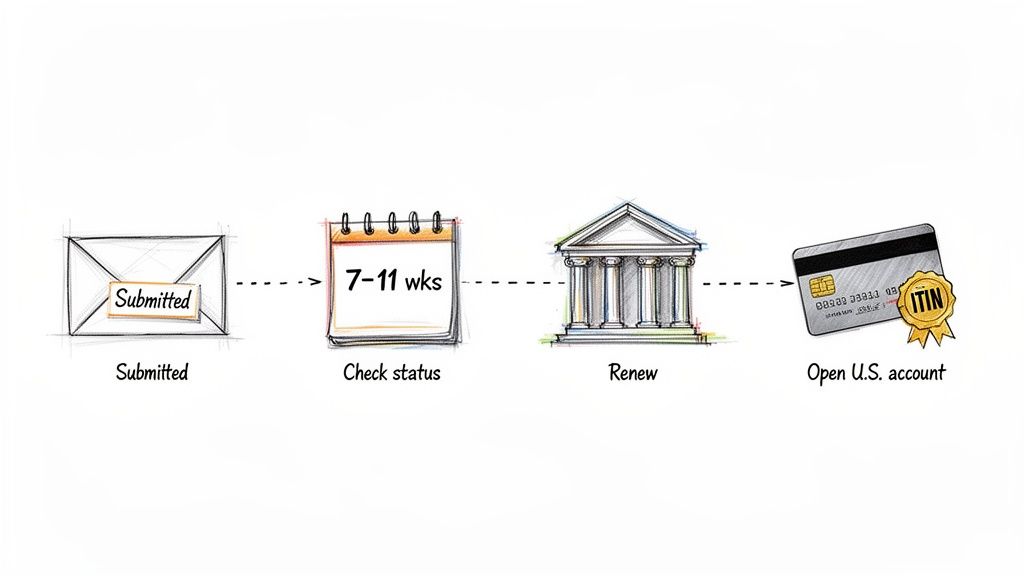
This isn’t a time for passive waiting. Having a clear action plan ready to go will give you a significant head start.
Managing Timelines and Checking Your Status
Officially, the IRS says to allow 7 weeks for them to process your Form W-7 and issue an ITIN. But based on our direct experience, reality looks a bit different. During peak tax season (roughly January through April), processing times can easily stretch to 9-11 weeks, sometimes longer.
If you mailed original documents like your passport, expect an even longer wait to get them back. The IRS often takes up to 60 days after your ITIN is assigned to return them.
You can check on your application's status, but you have to wait for the standard 7-week window to pass first. After that, you can call the IRS directly.
-
Calling from within the U.S.: 1-800-829-1040
-
Calling from outside the U.S.: +1-267-941-1000 (Note: This is not a toll-free number.)
Have all your application details handy before you call. The IRS agent will need to verify your identity before they can share any information about your case.
Understanding ITIN Expiration and Renewal
Your ITIN won't last forever if you don't use it. The PATH Act dictates that any ITIN not used on a U.S. federal tax return for three consecutive tax years will automatically expire. Some ITINs issued before 2013 have also expired based on their middle digits.
The good news? If your ITIN expires, you don’t have to start the entire application process from scratch. You can renew it using the same Form W-7, simply by checking the "Renew an Existing ITIN" box. The main difference is that a renewal application generally doesn't require an attached tax return.
An ITIN is a tool that requires maintenance. Think of it like a business license; you need to keep it active through regular use to retain its benefits. Proactive renewal is far easier than reapplying after an unexpected expiration.
Activating Your Financial Strategy
Receiving your official ITIN assignment letter (Form CP 565) in the mail is the green light. The real value isn't just having the number; it's about what you can do with it. This is where you shift from compliance to opportunity.
Your first move should be establishing a U.S. banking relationship. With your ITIN and foreign passport, you can open both personal and business bank accounts—a critical step for managing U.S.-sourced revenue and accessing payment processors. For global entrepreneurs, this is as crucial as securing international banking, a process we detail in our guide to opening an offshore bank account.
With a U.S. bank account active, your next objective is building a U.S. credit profile.
Your new ITIN allows you to:
-
Apply for U.S. Credit Cards: Certain issuers, most notably American Express, are known to accept an ITIN instead of an SSN on credit card applications. This is the fastest way to start generating a positive credit history.
-
Access Other Financial Products: A solid credit history eventually opens doors to business loans, equipment financing, and other tools designed for growth.
By immediately putting your ITIN to work, you transform it from a simple tax ID into a powerful key for unlocking the full spectrum of U.S. financial services. This proactive approach ensures you maximize the return on your investment of time and effort.
Common Questions About the ITIN Application
Navigating the ITIN process inevitably brings up questions. Even with a clear roadmap, your specific situation might not fit neatly into a template. Let's tackle the most common queries we get from entrepreneurs around the world to give you the clarity you need.
Can I Use an ITIN to Form a US LLC?
Here's a common point of confusion: you don't actually need an ITIN to form a U.S. Limited Liability Company (LLC). The formation paperwork itself doesn't require it.
However, trying to operate that LLC compliantly without one is practically impossible. The ITIN is what allows a foreign owner to file mandatory informational returns, like Form 5472 for foreign-owned U.S. corporations, and any personal tax returns if your business generates what's called "effectively connected income."
More importantly, almost every U.S. bank will demand the foreign beneficial owner's ITIN to open a business bank account. For all practical purposes, the ITIN is the key that unlocks your LLC, bridging the gap between simply existing and being fully operational.
What Happens if My ITIN Application Is Rejected?
If your application gets rejected, the IRS will mail you a notice explaining why. This isn't a dead end, but it does mean you’re going back to square one. Rejections almost always come down to simple, preventable errors: missing documents, incorrect details on the Form W-7, or sending photocopies instead of certified identification.
You have to fix the exact issue the IRS points out and then resubmit the entire application package from scratch. This frustrating loop is precisely why so many people choose to use a Certified Acceptance Agent. A good CAA pre-verifies everything to crush the risk of rejection, saving you months of delays. If you get a rejection notice, getting professional help to diagnose the problem is a smart move before you try again.
A rejection notice isn't a final "no." Think of it as a signal that a critical detail was missed. Addressing the specific IRS feedback with precision is the only way to succeed on your next attempt.
How Long Does It Take to Get an ITIN?
The standard processing time for an ITIN application is usually 7 to 11 weeks once the IRS receives it. But you absolutely have to set realistic expectations.
During the peak tax season, from January to April, that timeline can stretch significantly longer. The IRS is buried in tax returns and applications, and everything slows down.
-
Standard Period: 7-11 weeks
-
Peak Season (Jan-Apr): Often longer than 11 weeks
-
Document Return: Can take an additional 60 days after your ITIN is issued
Unfortunately, there’s no official way to pay for expedited service. The single best way to ensure the fastest possible result is to work with a Certified Acceptance Agent (CAA). They make sure your application is perfect the first time, helping you sidestep the massive delays caused by rejections and resubmissions.
Navigating the complexities of ITIN applications and U.S. entity compliance is what we do best. At Protect Your Wealth, we provide end-to-end execution, from securing your ITIN to opening U.S. bank accounts and building your credit profile. Let our team of experts handle the entire process, ensuring it's done right the first time.
Schedule a consultation today to start your journey into the U.S. market.


