


Forget what you think you know about second passports. This isn’t about collecting stamps or making travel a little easier. For today’s global entrepreneurs and high-net-worth individuals, it’s a non-negotiable tool for financial survival.
In a world where geopolitics can shift overnight and governments can impose restrictive capital controls without warning, relying on a single citizenship is a massive, unnecessary risk.
Why a Second Passport Is Essential for Modern Wealth
A second passport is your ultimate insurance policy. Imagine your home country suddenly introduces crippling banking regulations, freezing your assets or blocking international transfers. It happens more than you think. With a second citizenship, you maintain access to stable banking jurisdictions, ensuring your capital stays liquid and, more importantly, yours.
Diversify Your Personal and Financial Freedom
This is far more than a “Plan B.” It’s about architecting a multi-jurisdictional life where your personal and financial freedom aren’t chained to the political whims of a single nation. A second passport from a strategic country can unlock a world of advantages:
- Access to exclusive markets: Ever tried to invest in emerging hubs like the UAE or Singapore, only to be blocked by your nationality? A new passport can be the key that opens those doors.
- Serious asset protection: You can structure your wealth using trusts and corporate entities in jurisdictions where your new citizenship grants you preferential treatment. This shields your assets from the economic instability or frivolous lawsuits back home.
- Ultimate family security: This is about providing your loved ones with a concrete safe haven. It’s the freedom to live, work, and study in a stable, prosperous country, completely independent of your original passport.
A second passport is the ultimate geopolitical diversification tool. It decouples your personal and financial well-being from the whims of a single government, creating a robust framework for long-term security.
Navigating the Global Mobility Gap
Not all passports are created equal. The gap between the best and the worst is widening, making your choice of citizenship more critical than ever.
The Henley Passport Index lays it out in stark terms. A passport from Singapore gets you into 192 destinations visa-free. One from Afghanistan? Just 24. That 168-destination difference is the gap between global opportunity and being trapped.
It’s why savvy entrepreneurs are chasing passports from top-ranked nations. Just look at the UAE, which jumped 57 spots since 2006 to offer access to 184 destinations. That’s the power of smart diplomacy creating a powerful mobility tool. For digital nomads who need US banking access, pairing a strong second passport with an ITIN setup amplifies their financial freedom exponentially.
This isn’t just a document; it’s a strategic asset that integrates directly into a comprehensive wealth preservation plan, turning a piece of paper into a gateway for opportunity.
Exploring Your Pathways to a Second Citizenship
Getting a second passport isn’t a one-size-fits-all process. The first step is understanding the different routes available, because each one is built for different goals, timelines, and financial realities. Your best path depends entirely on what you’re trying to achieve—whether that’s speed, long-term value, or tapping into a specific regional advantage.
There are five main roads to a second citizenship: Citizenship by Investment (CBI), Residency by Investment (often called Golden Visas), Citizenship by Descent, Citizenship by Marriage, and traditional Naturalization. Let’s move past the theory and get into how each one actually works on the ground.
Citizenship by Investment: The Direct Route
For clients who value time above all else, Citizenship by Investment (CBI) is the fastest and most straightforward path. These are official, government-run programs where you make a significant financial contribution to a country’s economy in exchange for a passport.
This isn’t about “buying a passport” in the crude sense; it’s a strategic investment with a predictable outcome. The process is clear, with set financial requirements and timelines.
- Timeline: Incredibly fast. You can complete the entire process in as little as 2-4 months in a place like Vanuatu. Most Caribbean programs take about 6-8 months.
- Typical Cost: Investments begin around $130,000 for a single applicant and go up depending on family size and the country you choose.
- Key Advantage: Speed and certainty. You don’t have to live there or learn the language. It’s a clean, efficient transaction.
A perfect real-world example is Grenada’s CBI program. With a Grenadian passport, you get visa-free travel to over 140 countries, including China and the UK. But the real prize? It makes you eligible to apply for a U.S. E-2 investor visa—a powerful tool not available to citizens of most countries.
Residency by Investment: The Strategic Play
Often confused with CBI, Residency by Investment programs—or “Golden Visas”—are a different game entirely. Here, you don’t get immediate citizenship. Instead, you acquire legal residency by investing in the country, typically in real estate or a business.
You have to maintain that residency for a certain period, usually five years or more, before you can even apply for citizenship through naturalization. It’s a longer play, but one that often ends with a top-tier EU passport.
This pathway is less about speed and more about establishing a legitimate foothold in a desirable region like the European Union. It’s a strategic move for long-term family relocation, business establishment, or securing access to world-class education and healthcare systems.
Portugal’s old Golden Visa program was a classic example. High-net-worth individuals used it to gain an EU foothold. After five years of holding their investment and spending just a little time in the country, they could apply for Portuguese citizenship. That unlocked the right to live, work, and study anywhere in the EU.
Citizenship by Descent: The Heritage Route
One of the most powerful—and most overlooked—pathways is Citizenship by Descent. If you have parents, grandparents, or in some cases, even great-grandparents from another country, you might already be eligible for its passport. This is often the cheapest route, though it can be a paperwork-heavy slog.
Countries like Ireland, Italy, Poland, and Lithuania have generous ancestry laws. The process involves digging up official records—birth, marriage, and death certificates—to prove your lineage. Expect to get these documents apostilled and professionally translated. For a deeper look, our guide on citizenship through marriage touches on similar family-based options.
Citizenship by Marriage and Naturalization: The Traditional Paths
Finally, you have the conventional routes. Citizenship by Marriage lets you get a passport through your spouse, but be prepared for intense scrutiny. Governments are on high alert for sham marriages, so the process is designed to prove your relationship is legitimate. Timelines vary wildly by country.
Traditional Naturalization is the marathon, not the sprint. It means legally residing in a country for years, often a decade or more, without a major investment. This path is for people who genuinely plan to immigrate, build a life, and become part of a new society over the long haul.
To help you see which path fits your needs, the table below breaks down the key differences at a glance.
Comparing Second Passport Pathways At a Glance
This table offers a quick comparison of the most common routes to a second passport. It highlights the main trade-offs in time, cost, and requirements to help you see which direction makes the most sense from the start.
| Pathway | Typical Timeline | Typical Investment | Best For | Key Consideration |
|---|---|---|---|---|
| Citizenship by Investment | 2–8 months | $130,000+ | Speed and efficiency for global mobility. | The most expensive but fastest option. |
| Residency by Investment | 5–10+ years | $250,000+ | Gaining a foothold in the EU for long-term goals. | Requires patience and a long-term commitment. |
| Citizenship by Descent | 1–3 years | Minimal (fees) | Those with qualifying ancestry. | Document-intensive and requires a clear paper trail. |
| Citizenship by Marriage | 1–5+ years | None | Spouses of foreign nationals. | Process is filled with scrutiny to prevent fraud. |
| Naturalization | 10+ years | None | Individuals planning genuine long-term immigration. | The slowest path, requires full integration. |
Each option serves a distinct purpose. Your choice ultimately comes down to a simple question: what are you trying to solve for?
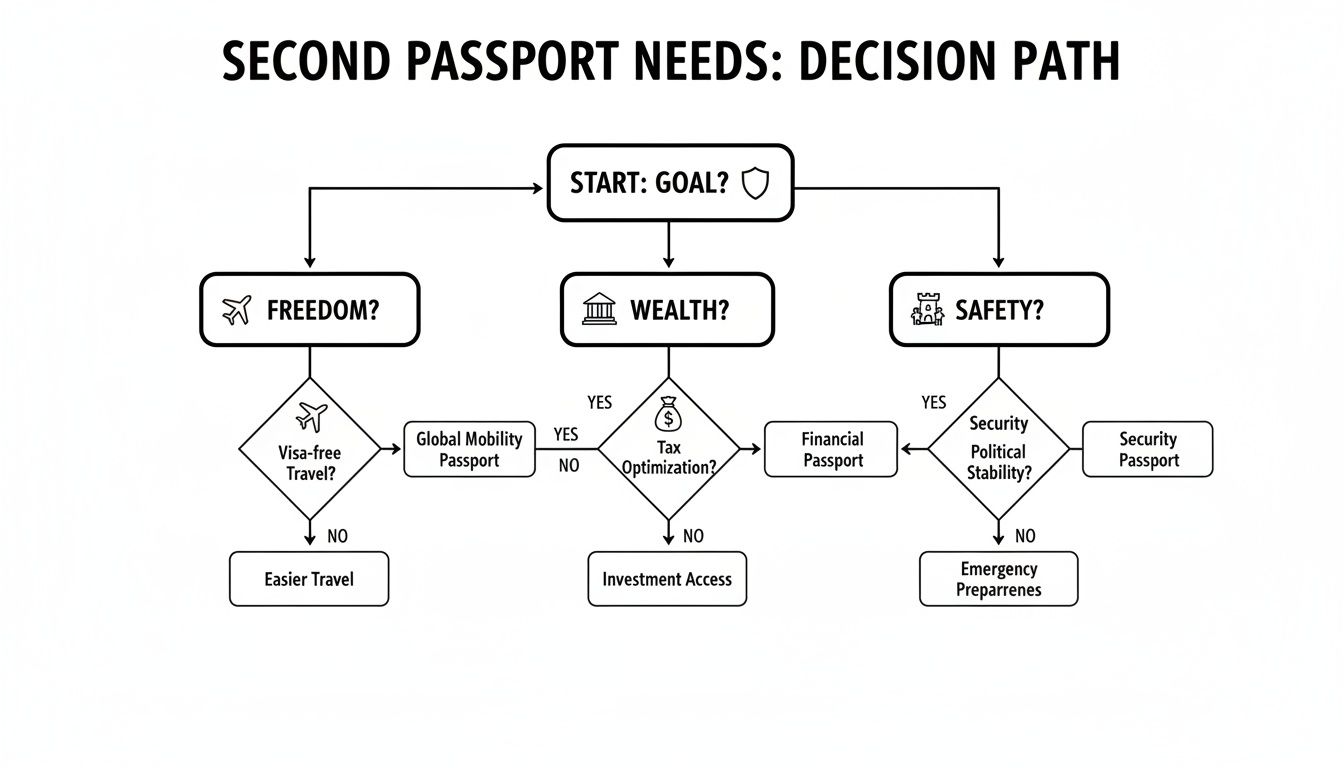
As this decision path shows, the “best” route is entirely personal. It hinges on whether your main driver is enhancing personal freedom, protecting your wealth, or securing your family’s safety. Each goal points to a different strategy, underscoring why a tailored approach is absolutely critical.
The Fast Track Through Citizenship by Investment
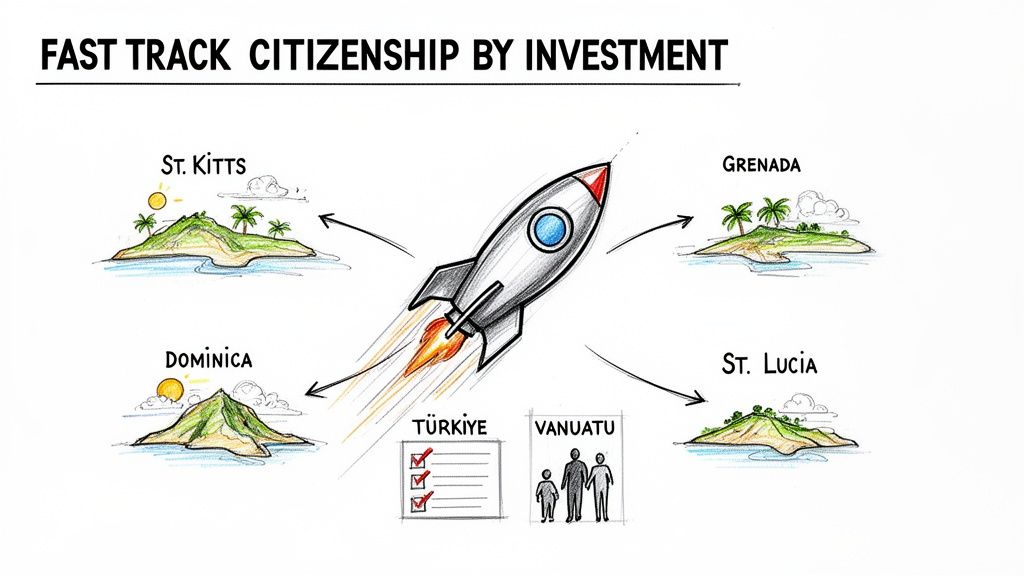
For the individual who measures time in opportunity cost, Citizenship by Investment (CBI) programs are the most direct path to a second passport. These aren’t murky backroom deals; they’re legitimate, government-legislated pathways designed to attract foreign capital in exchange for full citizenship.
The process is remarkably efficient and predictable. Critically, it doesn’t require you to uproot your life to fulfill residency requirements. It’s a straightforward transaction: a qualifying investment leads to a new passport in months, not years. Think of it less like “buying a passport” and more like acquiring a powerful strategic asset.
The Caribbean Programs: A Comparative Look
The Caribbean is the epicenter of the CBI world, home to several long-standing and reputable programs. While they might seem similar on the surface, the small differences can have a massive impact on your global strategy.
Let’s break down the “big four”:
-
St. Kitts & Nevis: The original pioneer. Running since 1984, this program sets a high standard for due diligence and is one of the most respected names in the industry. Its longevity gives clients a sense of stability that newer programs can’t match.
-
Grenada: This is the strategic powerhouse. Beyond a solid visa-free travel list, Grenada holds the ultimate trump card—its citizens can apply for the U.S. E-2 Investor Visa. This unique treaty makes it the top choice for entrepreneurs who need to live and operate in the United States.
-
Dominica: Known for its rigorous due diligence and cost-effective real estate options, Dominica has built its reputation on integrity. It offers a reliable and well-regarded program for those who prioritize a secure and transparent process above all else.
-
St. Lucia: One of the newer Caribbean options, St. Lucia stands out for its flexibility. It offers multiple investment avenues, including government bonds, and its competitive pricing makes it an attractive contender for a wide range of applicants.
It’s a common mistake to choose a CBI program based solely on the minimum donation amount. The real value is often in strategic advantages, like Grenada’s E-2 treaty access or a country’s diplomatic relationships—factors not reflected on the initial price tag.
Beyond the Caribbean Core Options
While the Caribbean is popular, other jurisdictions offer compelling alternatives with their own unique benefits. Two of the most prominent are Türkiye and Vanuatu, each catering to a completely different set of priorities.
Türkiye: A Gateway to East and West
Türkiye’s CBI program is anchored in real estate. An investor and their family can gain citizenship by purchasing property valued at $400,000 or more. The country’s strategic location, straddling Europe and Asia, provides a unique commercial and cultural advantage.
For business owners, a Turkish passport can open up markets in both regions. The investment itself isn’t just a sunk cost; it can generate rental income, and the property can be sold after a three-year holding period, offering a potential return on your initial outlay.
Vanuatu: The Need for Speed
When the primary objective is getting a passport in hand as fast as humanly possible, Vanuatu is in a class of its own. It boasts the fastest processing timeline in the world, with approvals often granted in as little as 30 to 60 days.
This speed is invaluable for clients facing urgent geopolitical or personal situations. The investment is a straightforward government donation, making the process simple and predictable. It’s the definitive solution when time is the most critical factor.
The global landscape of CBI is constantly shifting. Citizenship by Investment programs currently provide the fastest route to getting a second passport, with Vanuatu often processing applications in under 60 days for a $130,000 donation. Other strong contenders like Grenada offer not just speed but also strategic access to the US E-2 investor visa—a crucial tool for entrepreneurs. These established programs have issued hundreds of thousands of passports over the last two decades, solidifying their role as essential tools for global mobility and wealth protection. You can read more about the leading passport investment countries and discover your options.
Navigating this world requires careful consideration of the cost, the rigor of due diligence, the rules for including family, and the long-term strategic value of the passport itself. Working with a government-accredited partner isn’t just recommended—it’s essential to ensure the process is smooth, compliant, and ultimately successful.
Unlocking Your Ancestry with Citizenship by Descent
Forget high-stakes investments for a moment. One of the most powerful and surprisingly affordable routes to a second passport might already be hiding in your family tree. Citizenship by Descent is exactly what it sounds like: claiming a passport from a country because of your ancestral roots. It’s about turning your family history from a collection of stories into a real, tangible asset for global freedom.
This path is especially common for European nations that saw huge waves of emigration, like Ireland, Italy, and Poland. If you have a parent, grandparent, or in some cases even a great-grandparent from one of these countries, you might already be eligible. The game here isn’t about writing a big check; it’s about meticulous documentation.
The Genealogical Paper Chase
Successfully claiming citizenship by descent is all about evidence. You need to build an unbroken paper trail that proves, without a doubt, your link to the ancestor who qualifies you. This is a detail-oriented mission that demands both patience and precision.
Your entire case will be built on a foundation of vital records:
- Birth Certificates: For you, your parent/grandparent, and the ancestor in question.
- Marriage Certificates: To show the lineage was legally passed down.
- Death Certificates: Where applicable, to complete the family picture.
- Naturalization Records: This is the make-or-break document. You must prove your ancestor did not renounce their original citizenship before the next person in your direct line was born.
Every single document has to be the official, government-issued version. On top of that, you’ll almost certainly need them to be apostilled—a type of international certification that validates the document for use in another country.
Navigating the Consular Maze
Once you’ve assembled your dossier of documents, the next step is dealing with the consulate or embassy of the country you’re applying to. Be prepared for a long wait. These applications are notorious for backlogs, and timelines of one to three years are perfectly normal.
They will scrutinize every piece of paper. Any small inconsistency—a misspelled name, a mismatched date—can lead to major delays or even an outright rejection. This is where getting professional guidance can be the difference between success and failure, ensuring every detail is nailed down before you submit.
Citizenship by Descent isn’t a shortcut; it’s a legal claim based on your heritage. Success hinges on impeccable documentation and a deep understanding of the specific country’s nationality laws, which can be surprisingly complex and subject to change.
How Legislative Shifts Can Open New Doors
Nationality laws aren’t set in stone. Governments change them, and sometimes those changes create massive new opportunities for a second passport, almost overnight. Just look at Canada’s recent overhaul of its citizenship laws.
Imagine getting a Canadian passport just because of your family history. On December 15, 2025, Bill C-3 was passed, tearing down the old “first-generation limit” on passing down citizenship. This single change is expected to restore citizenship rights to hundreds of thousands of “Lost Canadians” scattered across the globe.
This legislative shift suddenly makes Canada a major player in the second passport world, tapping into a diaspora of potentially up to 1 million people. With a Canadian passport offering visa-free access to over 185 destinations, it’s an incredibly valuable asset for any global entrepreneur. You can learn more about how Canada’s legal changes are impacting global mobility.
Managing Your Financial and Legal Obligations
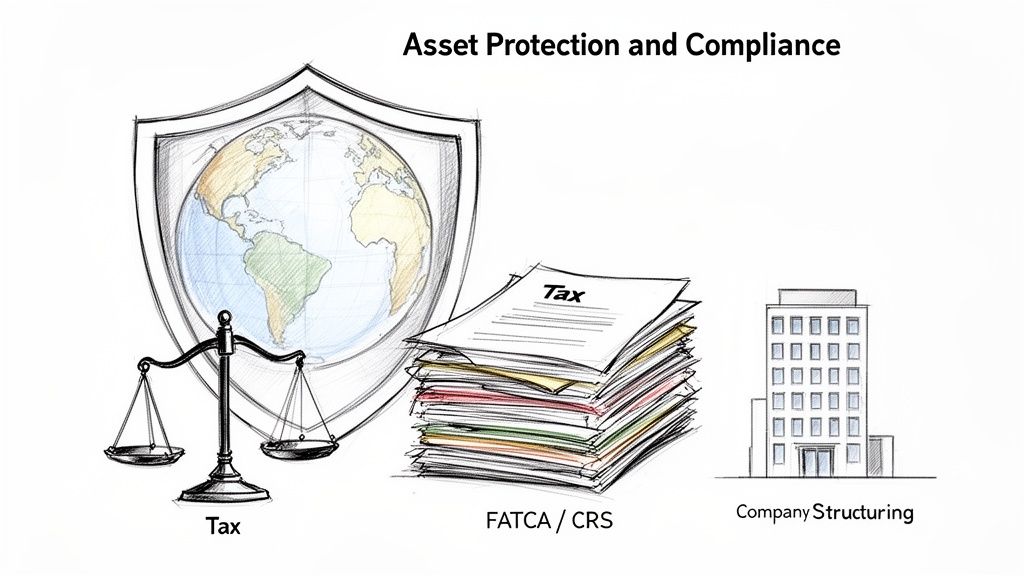
Securing a second passport is a huge win, but it’s not the finish line. It’s the starting pistol for the real race: managing the complex financial and legal duties that come with dual citizenship. This is the point where your new passport shifts from being a travel document into the cornerstone of a serious wealth protection strategy.
Ignoring these obligations is a rookie mistake I’ve seen far too often, and it can wipe out every benefit you just worked so hard to gain. The global financial system is now built on transparency and compliance. Holding multiple citizenships puts you right in its crosshairs, so you have to be proactive.
This means getting a handle on your tax residency, reporting obligations, and asset structures. If you don’t, you risk frozen accounts, massive penalties, and legal nightmares that destroy the very freedom you were trying to achieve in the first place.
Navigating Global Compliance Standards
For U.S. citizens, the biggest hurdle is, without a doubt, the Foreign Account Tax Compliance Act (FATCA). This law forces foreign banks and financial institutions to report on the holdings of their U.S. clients directly to the IRS. Your new passport doesn’t change this one bit. As long as you hold U.S. citizenship, you’re on the hook for worldwide taxation and reporting.
For everyone else, the equivalent is the Common Reporting Standard (CRS). This is a massive information-sharing pact between over 100 countries. The moment you open a bank account with your new passport, that information will almost certainly be shared with the tax authorities where you reside.
Your new passport changes your identity, but it doesn’t automatically change your tax residency. You must take deliberate steps to establish a new tax home and properly declare your status to financial institutions to avoid compliance issues.
The key is to use your new citizenship to legitimately establish tax residency in a low- or zero-tax jurisdiction. This isn’t about hiding; it’s about legally aligning your financial life with your new global status. Proper planning here is non-negotiable.
Structuring Your Assets for Privacy and Protection
Once you have a solid compliance plan, you can finally use your second citizenship to build a truly robust asset protection structure. This is where you move beyond personal bank accounts and start using specialized legal entities to hold and manage your wealth. These tools create a critical layer of separation between you and your assets.
Here are the most effective structures we use with clients:
- Offshore Companies: Setting up a company in a place like the UAE or Panama allows you to do business and hold assets with enhanced privacy and much better tax treatment. Your new citizenship makes it far easier to act as director and shareholder without triggering immediate red flags.
- Trusts: This is the classic wealth protection tool for a reason. It legally separates the ownership of assets from the beneficial ownership. By placing assets into an irrevocable trust, you can shield them from creditors, lawsuits, and political turmoil back home.
- Foundations: These are especially popular in civil law jurisdictions like Panama. A private interest foundation acts like a hybrid of a trust and a corporation. It holds assets for a specific purpose or for beneficiaries you name, offering incredible protection and confidentiality.
By structuring your wealth this way, you create a defensive wall that is incredibly difficult for outsiders to penetrate. This is a critical step for anyone learning how to get a second passport for asset protection. If you want to dive deeper, our expert guide to offshore bank account opening is a must-read, as it’s a foundational piece of this strategy.
Your second passport is the key that unlocks all these powerful options. It gives you the legal standing and credibility needed to establish these structures in premier financial hubs, turning a simple document into a powerful tool for preserving your wealth for generations to come.
Your Second Passport is Just the Beginning
Getting a second passport isn’t the finish line; it’s the starting block for a much bigger strategy. This isn’t something you figure out by reading a few articles online. It requires a real-world plan built by operators who understand that every decision must be tied to your specific goals for wealth preservation and global freedom.
A truly bulletproof plan doesn’t stop once the new passport is in your hand. In fact, that’s when the real work starts. The next step involves building the sophisticated legal and financial structures that must accompany your new citizenship.
From Application to Global Structure
Our firm handles the entire process, from start to finish. We begin by digging deep into your objectives to find the right jurisdiction, then we manage the complex application process, ensuring every single detail is handled with precision.
But we don’t stop there. Our focus is on what comes after you get the passport:
- Financial Architecture: We help you open the right international bank accounts and set up compliant corporate structures that align with your new citizenship status.
- Asset Armor: This involves creating legal shields, like trusts or foundations, to protect your wealth from lawsuits, creditors, and other unforeseen risks.
- Tax Residency: We guide you in legally establishing tax residency in a more favorable jurisdiction. This is a critical step that most people get wrong.
This complete approach turns what is often a complicated and overwhelming journey into a clear, actionable plan. It’s not just about getting a second passport; it’s about knowing how to use it as a powerful tool for your future.
For example, a client might use their new passport to establish a foothold in South America. Securing Paraguay’s residency program can be a smart, strategic piece of a much larger diversification puzzle.
Your second citizenship is the key that unlocks a new world of possibilities for asset protection and financial privacy. The true value is realized when it is seamlessly integrated into a bespoke, multi-jurisdictional strategy.
We are committed to confidential, compliant, and efficient execution. I invite you to schedule a private consultation to start building your personal roadmap and ensure your path to global mobility is both secure and successful.
Second Passport Q&A
When you’re exploring how to get a second passport, a lot of practical questions come up. Here are the answers to the most common queries we get from clients just starting their journey.
How Long Does The Entire Process Take?
The timeline really depends on the path you take.
Citizenship by Investment (CBI) is by far the fastest route. In most cases, you can have a new passport in hand within 3-6 months after submitting your application. Some programs, like Vanuatu’s, are even quicker and can be wrapped up in less than 60 days.
On the other hand, residency-to-citizenship programs, often called “Golden Visas,” are a long-term play. You’re typically looking at 5-10 years of maintaining legal residency before you’re even eligible to apply for a passport.
Citizenship by Descent is somewhere in the middle. It usually takes 1-3 years, but this can vary a lot based on consular processing times and how complex your family’s historical records are to track down and verify.
Will I Have To Renounce My Current Citizenship?
In almost all cases, no. The vast majority of countries with CBI programs, as well as those that grant citizenship through ancestry, have no problem with you holding multiple citizenships. You get to keep your original passport.
That said, it’s absolutely critical to check the laws in both your current country and your target country. While most are fine with it, a few nations do have restrictions. Confirming this is a non-negotiable step in our due diligence process.
What Happens If My Application Is Rejected?
A rejection is rare when you have proper guidance, but it can happen. It’s almost always due to incomplete paperwork, failing the very strict background checks, or any kind of misrepresentation on the application.
This is precisely why professional pre-screening is so crucial. We work with you to find and fix any potential red flags before you ever submit, ensuring your application is bulletproof.
If a rejection were to happen, most programs have a formal appeal process. We’d be right there with you, guiding you through every option to get the situation sorted out.
At Protect Your Wealth, we turn this complicated journey into a clear, straightforward plan for your future. We handle everything with complete confidentiality, compliance, and efficiency from start to finish. Schedule a private consultation today to build your personal roadmap.


