


Opening a non-resident US bank account is your financial gateway to the world's largest economy. For any entrepreneur, investor, or digital nomad operating on a global scale, a US account isn't just an advantage—it's the core infrastructure you need to compete. While the process can feel complex, it's absolutely achievable when you have the right strategy and documentation in hand.
Why You Need a US Bank Account as a Non-Resident
Let's be direct: for most international operators, a US bank account is a non-negotiable requirement. It’s the foundational piece for doing business, investing, or even just managing funds inside the United States. Without one, you're effectively shut out from the key financial systems that American businesses and consumers use every day.
The most immediate roadblock you'll hit is with payment gateways. If you're running an e-commerce store, you can forget about using premier US-based processors like Stripe or Shopify Payments. They simply won't send payouts to a non-US account, making it impossible to effectively sell to American customers.
Differentiating Personal and Business Needs
The path you take will depend entirely on your end goal. Are you an individual looking to hold personal savings in USD, or are you building a global company? The requirements and options for a personal account are vastly different from those for a corporate one.
-
Personal Accounts: These are for individuals and are notoriously difficult for non-residents to open remotely. Banks almost always require an Individual Taxpayer Identification Number (ITIN) and often want to see you in person. They’re best suited for managing personal investments or funds.
-
Business Accounts: These are tied to a US legal entity, like an LLC or a C Corporation. This route is often far more straightforward for non-residents because the bank's "customer" is the US-based company, which dramatically simplifies their compliance burden.
The most reliable path for most non-resident entrepreneurs is to first establish a US business entity. This creates a clear, legitimate connection—or "nexus"—to the United States that banks understand and prefer.
To help you see where you stand, here’s a quick overview of the essential documents you’ll need to prepare.
Key Requirements for Your US Bank Account at a Glance
This table summarizes the essential documentation and entity types for non-residents seeking a US bank account, helping you quickly assess your readiness.
| Requirement Type | For Personal Accounts | For Business Accounts |
|---|---|---|
| Identification | Foreign Passport | Founder’s Foreign Passport |
| US Tax ID | ITIN (Individual Taxpayer ID) | EIN (Employer Identification Number) |
| US Address | Proof of a physical US address (often a major hurdle) | Registered Agent address for the US company |
| Legal Entity | Not applicable | US LLC or C Corporation formation documents |
| Initial Deposit | Varies, but often required | Varies, but typically required |
Getting these documents in order is the first and most critical step. Without them, your application won't even be considered.
More Than Just a Place for Money
Beyond basic transactions, a US bank account acts as a powerful signal of credibility. It shows potential partners, clients, and suppliers that you have a tangible financial presence in the country. This simple fact builds trust and can unlock better business relationships and opportunities you wouldn't get otherwise.
For individuals, it can also be the first step toward building a US credit history. Once you have an established bank account, you may eventually become eligible for US credit cards from issuers like American Express, opening up a new world of rewards and financial tools.
Ultimately, getting a non-resident US bank account is about gaining access and creating opportunity. It allows you to operate seamlessly within the US financial ecosystem, cutting down on high international transfer fees and positioning yourself or your business for serious growth. With the right preparation, this goal is well within reach.
Your Essential Document Checklist
Getting a U.S. bank account as a non-resident hinges on one thing above all else: perfect preparation. Before you even start comparing banks, you absolutely must have your documents in order.
Walking into a branch or filling out an online form without the right paperwork is the single fastest way to get rejected.
Think of it this way: U.S. banks, especially in today's tight regulatory environment, are incredibly risk-averse. Your job is to hand them a file so complete and professional that it leaves no room for questions or doubt. This isn't just about having some ID; it's about having the exact documents they require.
Let's break down precisely what you need to have ready.
Core Identification and Address Verification
First up is the standard Know Your Customer (KYC) documentation. The bank needs to confirm who you are and where you live. This sounds simple, but it’s where many non-residents stumble right out of the gate.
For your identity, an unexpired foreign passport is the gold standard. It is non-negotiable. While a driver's license from your home country might work as a secondary ID, your passport is the primary document they will demand. Make sure it's in good shape with at least six months of validity left.
Next, you need to prove your foreign address. This is a common point of failure. The bank must see an official document that connects your name to your physical address in your home country.
Documents they will typically accept include:
- A recent utility bill (water, electricity, gas) from the last 2-3 months.
- A recent statement from a reputable bank or credit card company in your country.
- A valid driver's license that clearly shows your current address.
A critical mistake we see all the time is providing documents that are too old or where the name and address don't perfectly match the application. Even a small mismatch is an immediate red flag for a compliance officer.
The Decisive Factor: Your US Taxpayer ID
While your passport and address proof are foundational, the single most critical document for opening a non resident us bank account is a U.S. Taxpayer Identification Number (TIN). For Americans, this is their Social Security Number (SSN). For you, it will be an ITIN or an EIN.
Without one of these numbers, most reputable banks won't even talk to you. They are legally required to report any interest earned to the IRS, and they can't do that without a TIN.
ITIN for Individuals
An Individual Taxpayer Identification Number (ITIN) is for personal use. It’s designed for foreign individuals who have a U.S. tax filing requirement but can't get an SSN. If your goal is a personal account for holding U.S. dollars or making investments, you will almost certainly need an ITIN.
Getting an ITIN is a process in itself. It involves filing a Form W-7 with the IRS, which can take 2 to 4 months to process. You have to factor this significant waiting period into your timeline. You can find out more in our detailed guide on how to get an ITIN number as a non-resident. Working with a Certified Acceptance Agent (CAA) can often speed this up and reduce the risk of errors.
EIN for Businesses
An Employer Identification Number (EIN) is the business equivalent of an SSN. It's the tax ID for a corporate entity, like an LLC or C Corporation. For entrepreneurs, this is by far the most powerful key for unlocking U.S. banking.
When you form a U.S. company (like a Wyoming LLC), you can apply for an EIN from the IRS. Once your company has an EIN, the bank sees the U.S. entity as its primary customer, not you as a foreign individual. This dramatically simplifies their compliance burden and makes them far more willing to open an account.
Better yet, an EIN application for a non-resident founder typically takes only a few weeks—significantly faster than the ITIN process. This makes the corporate route a much more efficient path for most business owners.
Once your documents are in order, you face a critical fork in the road: how will you actually open the account? Your decision boils down to two main paths — the traditional, in-person visit to a U.S. bank branch or the modern, digital onboarding route.
This isn't just a choice of convenience. The path you take will define your banking relationship, the fees you encounter, and the services you can access. Let's break down the real-world trade-offs of each option.
The Traditional In-Person Approach
Walking into a brick-and-mortar bank on U.S. soil is the old-school method. For many, it still feels like the most legitimate and secure way to establish a banking footprint. This route means booking an appointment, flying to the U.S., and sitting down with a real person.
The main upside here is building a direct relationship. Major banks like Bank of America or Chase are often more comfortable with non-residents who make the effort to show up, particularly in international hubs like Miami, New York, or Los Angeles. That face-to-face meeting can be the difference-maker for a hesitant compliance officer.
But this approach comes with serious logistical hurdles and costs. You have to factor in flights, hotels, and time away from your business—all with no guarantee of success.
A crucial tip from our experience: Always call the specific branch you plan to visit beforehand. Policies for non-residents can change dramatically from one branch to another, even within the same bank. Get confirmation they handle these accounts before you even think about booking a flight.
Some banks are known to be more open to non-residents than others. While nothing is set in stone, we've found that the larger, internationally-focused players are your best bet.
- Bank of America: Often seen as one of the more approachable banks for non-residents, but they'll almost always require a U.S. address and an ITIN or EIN.
- Chase: As the biggest bank in the U.S., they have the infrastructure but can be very strict. They tend to favor high-net-worth clients or established businesses.
- Citibank: Thanks to its global footprint, Citibank is very familiar with foreign clients. However, they often steer you toward premium accounts with high minimum deposit requirements.
This path makes the most sense for those setting up a significant U.S. corporate presence or high-net-worth individuals who want the comfort and full service of a traditional banking relationship.
The Rise of Remote and Digital Banking
For most modern entrepreneurs, flying to the U.S. is a non-starter. This is where remote banking solutions have been a complete game-changer for anyone needing a non resident us bank account.
Digital-first banks and specialized fintech platforms were built to serve a global clientele. They've stripped down the onboarding process, letting you apply from anywhere in the world with your documents and an internet connection.
This flowchart breaks down which U.S. tax ID you’ll need for your application—a vital first step for either the remote or in-person route.
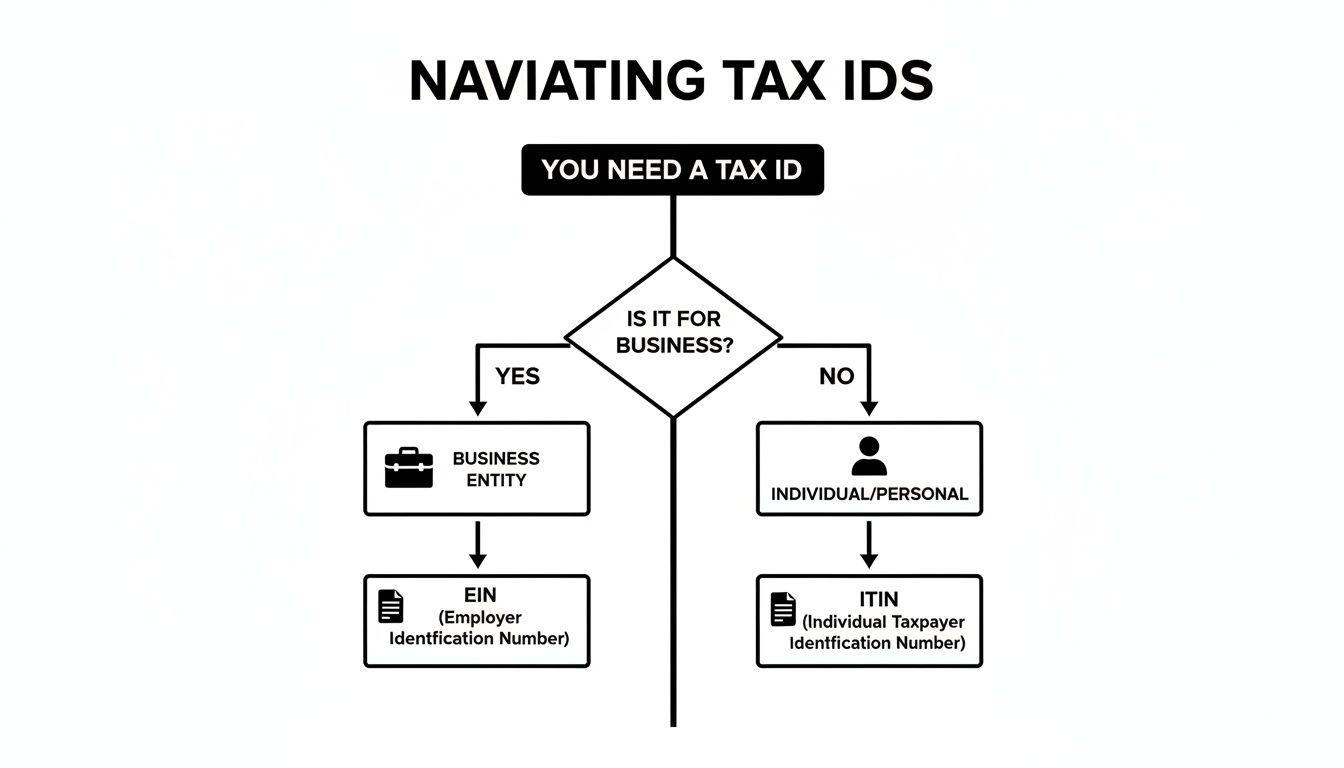
As you can see, the decision is straightforward: an EIN is for business activities, while an ITIN is typically for personal banking needs. This distinction is key to preparing the right paperwork.
A few platforms dominate this space:
- Mercury: Built specifically for startups and e-commerce businesses. They offer FDIC-insured accounts and make it incredibly simple to open an account remotely once you have a U.S. company and an EIN.
- Wise (formerly TransferWise): While not technically a bank, Wise offers multi-currency account details, including a U.S. account and routing number. It’s a fantastic tool for getting paid by clients or marketplaces like Stripe.
- Relay: Another strong option for small businesses, Relay provides no-fee checking accounts and a clean online banking interface designed for remote management.
The overwhelming advantage here is speed and convenience. You can get an account up and running in days, not weeks, all without leaving your desk. These platforms also shine when it comes to integrating with accounting tools like Xero or QuickBooks.
It’s critical, however, to understand what you’re getting. Many of these are financial technology companies that partner with FDIC-insured banks, not chartered banks themselves. Your money is safe, but the customer service and range of products might differ from what a traditional bank offers. We cover this in-depth in our guide to fintech accounts vs. traditional banks.
This remote path is perfect for e-commerce sellers, SaaS founders, consultants, and digital nomads who need efficiency above all else. It's the most direct way to get a functional U.S. business account without the travel and hassle.
In-Person vs Remote Bank Account Opening
To help you decide, here’s a quick side-by-side look at how the two primary pathways compare. Each has distinct advantages depending on your goals and resources.
| Feature | In-Person Opening (Traditional Banks) | Remote Onboarding (Digital Banks/Fintech) |
|---|---|---|
| Convenience | Low. Requires travel to the U.S. and in-person appointments. | High. Can be done from anywhere in the world online. |
| Speed | Slow. Can take weeks to schedule and complete. | Fast. Often completed in a few days. |
| Account Type | Full-service personal and business accounts (checking, savings, credit, loans). | Primarily business checking accounts. Limited personal options. |
| Relationship | Direct, personal relationship with a banker and physical branch access. | Digital-only. Customer service is via chat, email, or phone. |
| Success Rate | Not guaranteed. Can be rejected at the branch level. | High, provided all documentation is correct. |
| Ideal For | High-net-worth individuals, large corporations, those needing complex banking services. | E-commerce sellers, SaaS founders, consultants, digital nomads. |
Ultimately, there is no single "best" option—only the one that best fits your business model and operational needs. For most modern global entrepreneurs, the efficiency of remote onboarding is hard to beat.
The Corporate Route Through a US Company
For the vast majority of international entrepreneurs, trying to open a personal account from abroad is an uphill battle. The most reliable and efficient path to securing a non-resident US bank account is to go corporate.
By forming a U.S. company, you fundamentally change your relationship with the bank. Instead of approaching them as a foreign individual—a high-risk proposition in their eyes—you are now a U.S. business entity. This simple shift provides the domestic connection and legitimacy that American banks require.
Why Forming a US Company Is a Game-Changer
Creating a U.S. entity, like a Limited Liability Company (LLC) or a C-Corporation, isn't just a bureaucratic hoop to jump through; it's a critical strategic move. The company acts as a legal and financial shield between you and the U.S. market.
First, it gives you instant credibility. A registered U.S. company with an official business address signals to banks and payment processors that you are a serious, established operator. This is often the single most important factor in getting your application approved.
Second, it provides vital liability protection. An LLC separates your personal assets from your business debts—an essential safeguard for any entrepreneur, especially when operating in the notoriously litigious U.S. market.
The core principle is simple: Banks are far more comfortable doing business with a U.S. company they can easily verify and regulate, rather than an unknown individual located thousands of miles away.
This route transforms a difficult personal request into a standard business procedure.
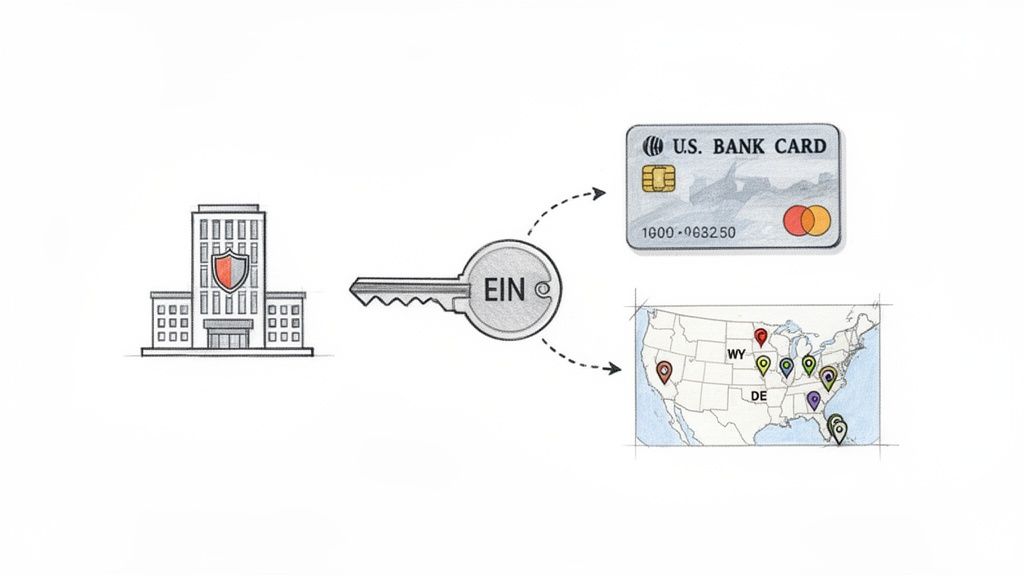
The EIN: Your Master Key to US Banking
Once your company is formed, the next step is obtaining an Employer Identification Number (EIN) from the IRS. The EIN is a unique nine-digit number assigned to businesses operating in the United States. Think of it as a Social Security Number for your company.
This number is the master key that unlocks the entire U.S. financial system for your business. When you apply for a bank account with your company's formation documents and its EIN, you are giving the bank's compliance department exactly what it needs. They can use the EIN to report any interest earned to the IRS, satisfying one of their primary legal obligations.
For a non-resident founder, getting an EIN is also much faster than applying for a personal ITIN, often taking just a few weeks. This speed makes it the preferred path for entrepreneurs eager to get their U.S. operations up and running.
Popular States for Non-Resident Incorporation
While you can form a company in any of the 50 states, a few stand out as exceptionally friendly to international founders thanks to their business-centric laws and minimal red tape.
The two most popular choices are:
- Wyoming: Famous for its strong privacy protections, low annual fees, and lack of state corporate income tax. It's an ideal choice for e-commerce sellers, consultants, and holding companies that don't need a physical U.S. presence.
- Delaware: The gold standard for businesses that plan to seek venture capital funding. Its deep, well-established corporate law and prestigious Court of Chancery make it the top choice for serious startups and large corporations.
For most non-residents who simply need a vehicle to open a bank account, Wyoming often presents the most straightforward and cost-effective solution. However, forming a U.S. company also comes with important responsibilities. To better understand what’s required, you can learn more about the often-forgotten tax obligations for non-resident LLCs in our detailed guide.
Case Study: An E-Commerce Seller's Success
To see how this works in practice, consider a European e-commerce entrepreneur selling handmade goods to a U.S. audience.
The Problem: Her sales were growing, but she couldn't access Stripe because she lacked a U.S. bank account. She was losing customers and paying exorbitant fees to receive money through clunky, alternative payment methods.
The Solution:
- Company Formation: She formed a Wyoming LLC through a specialized service, with the entire process handled remotely.
- EIN Application: With her new LLC's formation documents, she applied for and received an EIN from the IRS in just over three weeks.
- Remote Bank Onboarding: Using her LLC documents, EIN, and personal passport, she applied online for a business account with Mercury, a digital banking platform built for startups.
- Account Approval: Her account was approved in less than 48 hours.
The Result: She immediately received a U.S. routing and account number. She connected this to Stripe, unlocked U.S. payment processing, and saw a 30% increase in sales conversion within two months just by offering a seamless checkout experience. The corporate route gave her the exact tools she needed to compete effectively in the U.S. market.
Staying Compliant and Avoiding Common Pitfalls
Securing your non resident us bank account is a huge milestone, but your work isn't done. In fact, the real work is just beginning. Keeping that account open, active, and in good standing requires a clear understanding of your ongoing compliance and tax duties.
Navigating this new terrain means playing by the rules that govern international banking. Your U.S. bank is bound by strict federal regulations designed to fight financial crime and ensure tax transparency. As a foreign account holder, you are now squarely inside that system.
Understanding Global Reporting Standards
There are two acronyms you absolutely must know: FATCA and CRS. They are the twin pillars of global financial transparency, and they directly impact your U.S. bank account.
-
FATCA (Foreign Account Tax Compliance Act): This is a U.S. law that compels foreign banks to report on the accounts of their U.S. taxpayer clients to the IRS. While aimed at U.S. citizens abroad, it created a worldwide system of financial information exchange that U.S. banks are very much a part of.
-
CRS (Common Reporting Standard): Think of this as the global version of FATCA, developed by the OECD. Over 100 countries have agreed to automatically exchange bank account information every year. Your U.S. bank will report your account details to the IRS, which might then share that data with the tax authority in your country of residence.
The takeaway is simple: there’s no such thing as a "hidden" U.S. account. Your bank will report your balance and any income it generates to the proper authorities. Assume total transparency.
The Critical W-8 Forms Demystified
Soon after your account is open, the bank will send you a Form W-8. This isn't a suggestion; it's a mandatory IRS certification of your foreign status. Getting this right is non-negotiable.
You'll most likely encounter one of two versions:
-
Form W-8BEN: This is the form for individuals. When you sign it, you are certifying under penalty of perjury that you are not a U.S. person. This is what allows you to claim treaty benefits to get a reduced tax withholding rate on U.S.-sourced income like dividends.
-
Form W-8BEN-E: This is the far more complex version for entities like an LLC or corporation. It requires you to correctly classify your business under FATCA rules. Mistakes here are incredibly common and can trigger a painful 30% backup withholding on certain payments.
Failing to submit your W-8 form—or filling it out incorrectly—is one of the quickest ways to get your account restricted or slapped with punitive tax withholding. Treat this form with the priority it deserves.
Common Mistakes That Get Accounts Frozen
Beyond the paperwork, certain transaction behaviors can set off alarms with a bank’s anti-money laundering (AML) software. Banks are legally required to file Suspicious Activity Reports (SARs) for anything that looks like illicit activity.
Steer clear of these common pitfalls that can trigger an account review or, worse, a freeze:
- Unusual Transaction Patterns: A sudden, large wire transfer from a high-risk jurisdiction with no clear explanation is a major red flag. Always be prepared to document the source of significant incoming funds.
- Structuring Deposits: Making several small cash deposits just under the $10,000 reporting threshold is a textbook structuring attempt. Modern AML systems are built specifically to catch this.
- Failing to Update Documents: If the passport or ID you used to open the account expires, your account can be frozen without warning. Be proactive and send your bank updated documents long before the old ones expire.
- Business Mismatch: Running high-volume business transactions through a personal account is a direct violation of the account's terms. Banks will flag this quickly and may shut down the account. Make sure your activity matches the account type you opened.
Operating your non resident us bank account smoothly comes down to transparency and proactive communication. Be ready to provide documentation for your transactions and keep your personal and corporate details up-to-date. By staying on top of compliance, you protect the valuable financial tool you worked so hard to get.
Frequently Asked Questions
Even with a clear roadmap, the finer details of U.S. banking for non-residents can seem daunting. These are the specific, recurring questions we hear from entrepreneurs every day. Here are the straight answers you need to finalize your strategy and move forward.
This is your quick-reference guide to clearing those final hurdles. We’ll cut through the confusion so you can get your U.S. bank account open with confidence.
Can I Open A US Bank Account Without An ITIN Or SSN?
This is the big one. For a personal bank account at a major bank like Chase or Bank of America, the answer is almost always no. They are built around individual tax identification for compliance, making an ITIN or SSN a non-negotiable requirement.
But for a business account, the story is completely different. By forming a U.S. entity, like a Wyoming LLC, you create a powerful alternative. The company gets its own Employer Identification Number (EIN), which serves as its tax ID. This allows you to open a business account in the company's name, completely bypassing the need for a personal ITIN. Fintechs like Mercury are specifically designed for this exact scenario.
In short: For a personal account, you’re stuck without an ITIN. For a business account, a U.S. company with an EIN is the key. This is the most reliable and proven path for international entrepreneurs.
Which State Is Best For Forming An LLC To Open A Bank Account?
Two states are the clear front-runners for non-resident founders: Wyoming and Delaware. The right choice hinges on your long-term ambitions, but for banking access, both are excellent.
- Wyoming: This is our go-to recommendation for e-commerce sellers, consultants, and online businesses. It offers incredible privacy, no state corporate income tax, and minimal annual fees. For the straightforward goal of opening a bank account, its simplicity and cost-effectiveness are unmatched.
- Delaware: If you plan on raising venture capital, Delaware is the gold standard. Its corporate law structure and prestigious Court of Chancery are what U.S. investors expect to see. Choosing Delaware signals that you’re serious about attracting major investment.
For the primary purpose of securing a non resident us bank account, Wyoming is almost always the faster and more economical route.
Do I Need A US Address To Open A Non Resident Account?
This is a common myth that stops people in their tracks. You do not need a personal U.S. residential address. Banks will accept your verified foreign home address for all personal details on the application.
However, your U.S. company must have a U.S. address. This is a legal requirement fulfilled by hiring a Registered Agent. Your Registered Agent provides a physical address in the state where your company is formed, which is used to receive official mail and legal notices. This is the business address you will use on your bank application.
How Long Does The Entire Process Take?
The timeline depends heavily on which path you take and, critically, on government processing times. Here’s a realistic breakdown:
- Company Formation: An LLC can be formed in just a few business days.
- EIN Application: Getting an EIN from the IRS is the main bottleneck. For non-residents, this currently takes several weeks.
- Bank Account Opening: Once your company is formed and you have the EIN, this final step is incredibly fast. With the right remote banking partners, approval can come in as little as 24-48 hours.
All told, you should budget for a 4-8 week process from start to finish. The EIN application is the wild card that dictates most of the timeline.
Navigating these steps is precisely where expert guidance becomes critical. At Protect Your Wealth, we build seamless, compliant pathways for entrepreneurs to access the U.S. financial system. We manage everything—from company formation and EIN applications to fast-tracking remote bank account opening with our trusted partners. If you're ready for a proven, end-to-end solution, book a consultation with us today.


