


The real reasons for opening an offshore bank account boil down to a few key advantages: serious asset protection, greater financial privacy, smart tax planning, and critical currency diversification. For individuals and businesses operating on a global scale, these benefits aren't just conveniences; they're essential tools for protecting wealth from local risks while opening up the world of international finance.
Why High Net Worth Individuals Bank Offshore
When people hear "offshore banking," their minds often jump to spy movies and clandestine dealings. The reality is far more practical and, frankly, a lot less dramatic. An offshore bank account is simply a financial account you hold in a country where you don't reside. It’s a fundamental part of modern wealth management for global entrepreneurs, serious investors, and high-net-worth individuals.
This isn't about hiding money. It's about stability and opportunity. Think of it as diversifying your financial foundation beyond the reach of a single country's political whims and economic turbulence. Just like you wouldn’t bet your entire retirement on one stock, keeping all your cash in one currency, under one set of laws, is a high-stakes gamble.
Core Strategic Advantages
The decision to bank offshore is a proactive move toward financial resilience and freedom. The most powerful benefits come from placing your assets in a stable, well-regarded jurisdiction with a rock-solid rule of law.
This creates a powerful combination of advantages that are almost impossible to find within any single domestic banking system. The key pillars are:
- Ironclad Asset Protection: Build a legal fortress around your wealth to shield it from frivolous lawsuits, aggressive creditors, or political instability back home.
- Enhanced Financial Privacy: Operate within jurisdictions known for their strong banking privacy laws, keeping your financial affairs confidential.
- Strategic Tax Efficiency: Legally optimize your global tax position by using compliant international structures.
- Valuable Currency Diversification: Hold your wealth in multiple currencies to hedge against inflation and protect yourself from volatile exchange rates.
- Seamless Global Access: Effortlessly manage international business deals, investments, and personal finances without the usual cross-border friction.
- Superior Financial Services: Get access to sophisticated investment products and personalized private banking services that simply aren't available through your local bank.
To put it simply, these are the core reasons why offshore banking has become a cornerstone of modern wealth strategy.
Key Offshore Bank Account Benefits at a Glance
The table below breaks down these core benefits, offering a clear summary of the strategic advantages that an offshore account provides.
| Benefit | Strategic Advantage |
|---|---|
| Asset Protection | Creates a legal barrier against domestic lawsuits and economic instability. |
| Financial Privacy | Leverages strong banking confidentiality laws in stable jurisdictions. |
| Tax Efficiency | Enables compliant strategies to legally reduce overall tax burdens. |
| Currency Diversification | Mitigates risks from inflation and exchange rate fluctuations at home. |
| Global Access | Simplifies international payments, investments, and business operations. |
| Premium Services | Unlocks access to sophisticated investment opportunities and private banking. |
Each of these benefits works together to build a more robust and flexible financial future, insulated from the risks concentrated in any single country.
What Does Offshore Banking Actually Mean?
To really grasp the benefits of an offshore bank account, you have to get past the Hollywood stereotypes. Forget the briefcases full of cash and secret mountain lairs. At its core, an offshore bank account is simply a financial account held in a country where you don’t live.
It’s just like diversifying a real estate portfolio. You wouldn’t buy ten houses on the same street, right? A local economic downturn could be devastating. In the same way, keeping all your cash in one country’s banking system ties your wealth to its political, economic, and legal risks. Offshore banking is the financial equivalent of buying property in a different, more stable neighborhood.
From Secrecy to Strategy
Years ago, some jurisdictions built their entire brand on absolute, iron-clad banking secrecy. That world is gone. Today’s international banking landscape is less about hiding assets and more about strategically positioning them. It’s a completely legitimate tool for anyone who operates globally, from international business owners to digital nomads.
This major shift came from new global standards like the Common Reporting Standard (CRS), which created automatic information sharing between tax authorities. This has made tax evasion nearly impossible for anyone from a participating country.
The result is a system where compliance and legitimacy come first. Reputable international banks now compete by offering stability, sophisticated services, and access to global markets—not secrecy.
This evolution has turned one of the main benefits of an offshore bank account into gaining access to a more stable and advanced financial system.
Understanding the Different Jurisdictions
Not all offshore jurisdictions are the same. They exist on a spectrum, and each offers a unique mix of advantages. It helps to think of them in two main groups:
- International Financial Centers (IFCs): These are the major league players—highly transparent, well-regulated hubs like Singapore, Hong Kong, and Luxembourg. They attract global capital by offering incredible political stability, a strong rule of law, and access to world-class investment products.
- Traditional Privacy Havens: Places like the Cayman Islands or certain Caribbean nations still provide very strong privacy protections. But today, they operate completely within international compliance frameworks, making them ideal for asset protection structures, not for hiding wealth.
Choosing the right jurisdiction is all about your specific goals. Are you prioritizing asset protection, investment growth, or just operational ease for a global business?
Modern Features and Accessibility
The most defining part of modern offshore banking is how accessible it has become. The days of needing to fly to a remote island are over. Today, premier international banks offer everything you’d expect and more:
- Remote Account Opening: You can often open a full-featured account right from your office through secure online portals.
- Multi-Currency Accounts: This is a game-changer. You can hold, send, and receive funds in dozens of currencies without getting hit by forced conversions and terrible exchange rates.
- Advanced Digital Banking: Manage your finances worldwide with sophisticated online platforms and mobile apps that give you 24/7 control.
These features have turned offshore banking from a niche tool for the super-rich into a practical necessity for anyone with international financial interests. The real benefit today is having a powerful, global financial platform right at your fingertips.
Protecting Your Assets from Local Risks
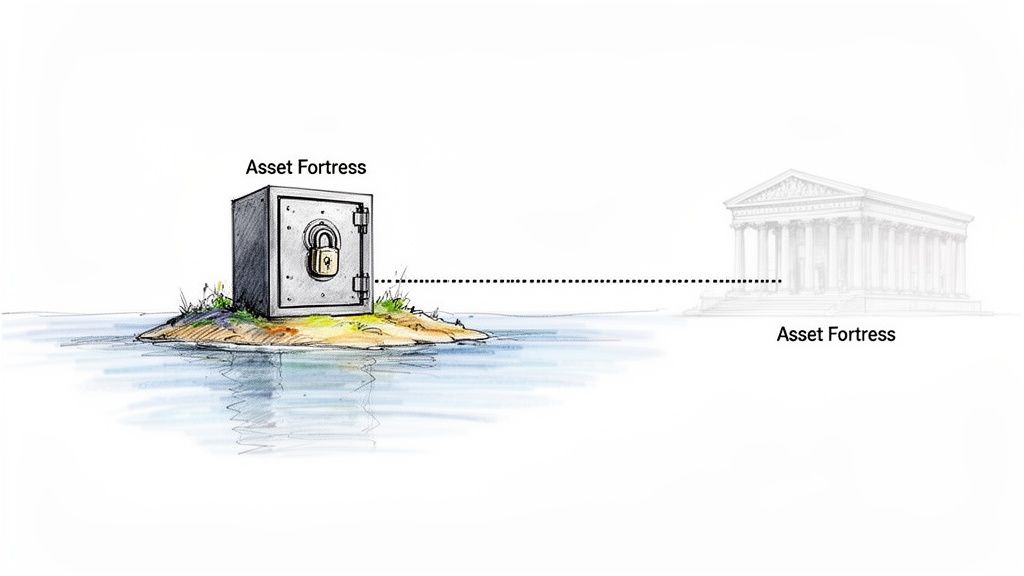
One of the most powerful reasons to open an offshore bank account is to build a financial fortress around your wealth. This isn't about hiding anything; it's a strategic move to place your assets within a jurisdiction that has a stronger, more predictable legal system than your own.
Think of your domestic assets like a house on a busy street—exposed and vulnerable to local risks. An offshore account is the equivalent of moving those assets into a secure, private vault located in an entirely different country.
This simple act of separation creates a formidable legal barrier. It makes your wealth significantly harder for domestic adversaries to reach because the assets are no longer subject to the immediate jurisdiction of your local courts. That can be a game-changer during unexpected legal or financial turmoil.
Shielding Wealth from Domestic Threats
The core idea behind asset protection is simple: make it legally difficult, time-consuming, and expensive for someone to seize your wealth. Placing assets in a stable offshore jurisdiction does exactly that by removing them from the direct reach of your home country's legal system.
A court judgment from your home country isn't automatically enforceable somewhere else. A creditor would have to start brand-new, costly legal proceedings in the offshore jurisdiction—a place that often has laws specifically designed to protect account holders. The process can be so intimidating that it stops frivolous or predatory lawsuits before they even start.
An offshore account acts as a circuit breaker. It disconnects your wealth from immediate local risks, giving you time, leverage, and a stronger defensive position when faced with aggressive creditors or unexpected legal challenges.
This protective barrier is incredibly effective against several common threats:
- Aggressive Creditors: If a business fails or personal debt becomes an issue, offshore assets are far more challenging for creditors to pursue.
- Frivolous Lawsuits: The high cost and complexity of international litigation can shut down opportunistic legal claims designed for a quick settlement.
- Unstable Political Climates: For anyone living in a country with an unpredictable government, an offshore account can safeguard wealth from capital controls, unjust seizure, or sudden political shifts.
Jurisdiction Is Your First Line of Defense
The strength of your financial fortress depends entirely on where you build it. A reputable jurisdiction for asset protection will have a long history of political and economic stability, a robust and independent judiciary, and specific laws that favor depositor security.
Countries like Switzerland, Singapore, and certain Caribbean nations are well-regarded for these very reasons. They offer a predictable legal environment where the rule of law is absolute, ensuring the rules governing your assets won’t change overnight based on political whims. This peace of mind is one of the most significant benefits of true jurisdictional diversification.
The effectiveness of this strategy is well-documented. A revealing study from Dartmouth, analyzing data from the Offshore Leaks Database, found a clear pattern. Global elites from countries with a weaker rule of law strategically parked 70% to 90% of their offshore assets in jurisdictions known for high privacy and strong asset protection laws, effectively insulating themselves from domestic legal and political risks.
Ultimately, this strategy isn't just about protecting what you have now; it's about preserving your financial legacy. By carefully selecting a stable jurisdiction, you ensure that your wealth remains secure, no matter what happens back home. For those seeking a deeper understanding, check out our guide on practical strategies for wealth protection.
Gaining Global Financial Flexibility
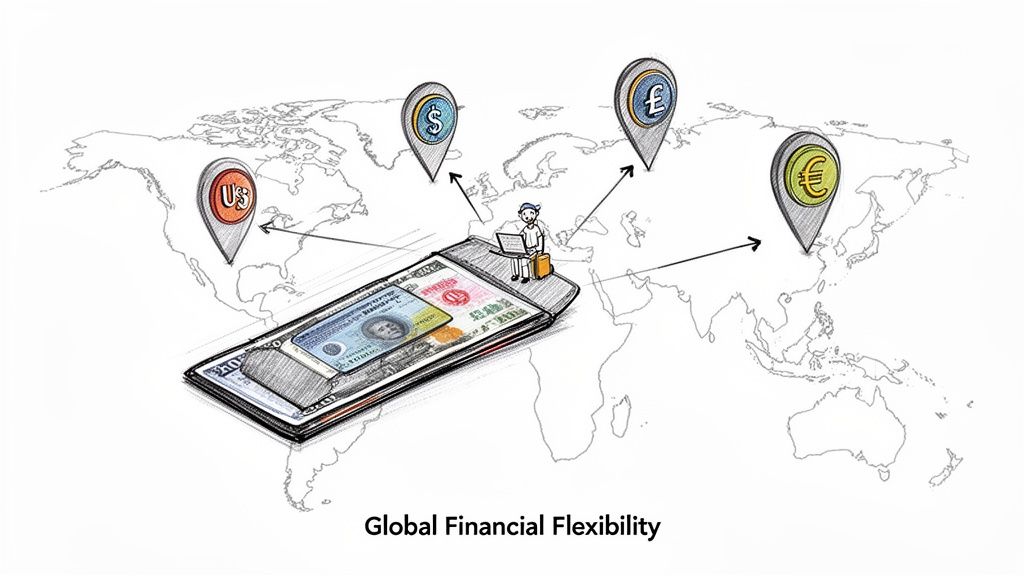
In an increasingly connected world, your financial life shouldn’t be trapped within a single country's borders. One of the most powerful offshore bank account benefits is the ability to break free from domestic financial walls and operate on a truly global scale. This isn’t just about convenience; it’s about strategic financial freedom.
Think about it: what happens if your entire net worth is held in one currency, and that currency suddenly loses 10% of its value due to inflation or a political crisis? Your purchasing power is crushed overnight. An offshore account is your best defense, acting as a powerful hedge by letting you hold funds in multiple stable currencies like the US Dollar, Swiss Franc, or Euro.
This strategy is known as currency diversification, and it's a cornerstone of preserving wealth. It ensures that a downturn in one economy doesn't drag your entire financial position down with it. Instead of being a passive victim of your home country's monetary policy, you take active control.
Empowering a Global Lifestyle
For digital nomads, international entrepreneurs, and expats, this kind of flexibility is a total game-changer. An offshore account with multi-currency capabilities removes all the friction from a cross-border life.
Imagine receiving a payment from a client in London in British Pounds, paying a supplier in Singapore in Singapore Dollars, and holding your long-term savings in Swiss Francs—all from one centralized platform. You’re operating seamlessly across different economic zones, avoiding forced currency conversions and the outrageous fees domestic banks love to charge for international transfers. More of your money stays where it belongs: in your pocket.
Holding assets in multiple currencies isn't just an investment strategy; it's a lifestyle enabler. It provides the financial stability and operational agility needed to thrive, no matter where you are in the world.
This level of control and efficiency is simply impossible when you’re tethered to a single domestic banking system.
Choosing a Hub for Global Mobility
The jurisdiction you choose is critical and will determine the level of flexibility you can achieve. Different financial centers offer unique advantages, and the right choice depends on your specific goals. Singapore and the Isle of Man are two excellent examples, each providing a stable and reliable platform for international finance.
Here’s a quick look at what these leading jurisdictions offer:
| Feature | Singapore | Isle of Man |
|---|---|---|
| Global Reputation | A premier Asian financial center known for stability and innovation. | A well-established Crown Dependency with strong UK ties and a history of financial excellence. |
| Currency Strengths | Access to major global currencies with a focus on Asian markets. | Strong in holding GBP, EUR, and USD, making it ideal for European and US business. |
| Banking Services | World-class private banking, sophisticated investment products, and cutting-edge digital platforms. | Renowned for personalized service, wealth management, and corporate banking solutions. |
| Regulatory Environment | Highly regulated and transparent, offering a secure environment for assets. | Compliant with international standards while maintaining strong depositor protection laws. |
Diversification and global mobility are premier offshore bank account benefits, especially as remote work and geopolitical instability become the new normal. Banking statistics show that off-balance-sheet foreign exchange obligations are immense—nearing $10.7 trillion in on-sheet debt—which is how major players effectively hedge against currency risks. For individuals, offshore multi-currency wallets and instant global payments are what make a flexible, international lifestyle possible. You can find more insights in these global banking statistics from the Bank for International Settlements.
Smart Tax Planning Strategies
Smart tax planning is more than just a box to tick—it’s a cornerstone of sophisticated wealth management. One of the biggest advantages of an offshore bank account is the ability to structure your finances in a way that’s both fully compliant and incredibly efficient. This has nothing to do with hiding assets or illegal evasion. It’s about using legitimate international structures to legally reduce your tax burden.
When you step outside your home country's financial system, you unlock a world of strategic options. Think about it: a local business is stuck with one set of tax rules. A multinational corporation, on the other hand, can legally position resources and profits across different jurisdictions to optimize its tax outcome. An offshore structure gives you—the individual or entrepreneur—access to that same level of strategic thinking.
This approach gives you far greater control over your capital, letting you keep more of your hard-earned money to reinvest, expand your business, or secure your family’s future.
How International Structures Reduce Tax Burdens
The secret to these tax benefits isn't about finding shady loopholes. It's about using established, legal entities in low-tax or even zero-tax jurisdictions—foundational pillars of international finance. The objective is to legally separate your assets from your personal tax residency in a manner recognized by global authorities.
Two of the most common and powerful structures include:
- International Holding Companies: By setting up a company in a jurisdiction like the UAE or the Cayman Islands, you can hold investments, real estate, or intellectual property. Profits and capital gains can then accumulate inside that company tax-free or at a very low rate. This allows your wealth to compound significantly faster than if it were taxed each year in your home country.
- Trusts and Foundations: These are powerful legal tools that let you transfer ownership of assets to a separate legal entity. They are especially effective for estate planning, allowing wealth to pass to the next generation with minimal tax friction. A jurisdiction like Panama is well-known for its private and protective foundations.
The core principle here is tax deferral. By holding assets inside a properly structured international entity, you typically only create a taxable event in your home country when you decide to bring the profits home. This puts you in the driver's seat, giving you total control over the timing and amount of your tax liabilities.
Remaining Compliant in a Transparent World
It’s absolutely critical to understand that using an offshore account for tax planning demands strict compliance with international law. We live in an era of transparency. Global standards like the Common Reporting Standard (CRS) mean that financial information is automatically shared with your home country’s tax authority. The days of hiding assets are long gone.
The modern, intelligent approach is built on full transparency and compliance. You work with experts to create a structure that is 100% legal and fully declared. The tax savings don't come from secrecy; they come from the legitimate use of the legal and tax frameworks that different countries offer.
Offshore bank accounts unlock this potential for tax optimization through legitimate international structuring. The Tax Justice Network's Financial Secrecy Index shows how major financial hubs handle immense capital flows, allowing high-net-worth individuals to compliantly minimize exposure to high-tax home countries. You can see how different jurisdictions stack up with these insights from the Tax Justice Network.
Ultimately, the goal is to align your financial structure with your international business and lifestyle goals. For a deeper dive, learn more about how to legally reduce your tax burden with international structures. When done correctly, you can achieve remarkable financial efficiency while operating completely within the law.
Navigating Compliance and Legal Rules
Let’s be clear: while the benefits of an offshore bank account are huge, they don’t exist in a vacuum. There’s a strict framework of international rules you need to understand, and this isn’t just a good idea—it’s non-negotiable.
This isn't the shadowy, unregulated world you see in the movies. Modern offshore banking operates in a highly transparent environment designed to stop criminals. Think of it like getting a driver's license in a foreign country. You get the freedom to drive there, but first, you have to learn their traffic laws. Offshore banking gives you incredible financial flexibility, but it comes with a firm responsibility to play by the rules.
Getting this right from the start ensures your strategy is both powerful and 100% compliant. These regulations are in place to keep the global financial system secure and stop it from being used for money laundering or tax evasion. For anyone with legitimate goals, they are just a standard part of doing business.
Understanding Global Transparency Rules
The age of total banking secrecy is long gone. Today, two major agreements form the backbone of global financial transparency, and you absolutely must know how they work. These systems ensure that financial information is automatically shared between countries to enforce tax compliance.
- Foreign Account Tax Compliance Act (FATCA): This is a U.S. law that forces foreign banks to report the holdings of their American clients directly to the IRS. If you're a U.S. citizen or resident, any offshore bank you use will identify you and report your account details. It's that simple.
- Common Reporting Standard (CRS): Developed by the OECD, CRS is basically the global version of FATCA. Over 100 countries have signed on to automatically exchange bank account information every year. This gives tax authorities a clear view of their residents' assets, no matter where they are held.
What does this mean for you? Your home country’s tax authority will know about your offshore accounts. This is precisely why tax optimization is achieved through smart, legal structuring—not by trying to hide your money.
Full transparency is the foundation of modern offshore banking. The goal is not to hide, but to structure. Compliance with FATCA and CRS is non-negotiable and is a standard operational procedure for any reputable international bank.
Knowing this upfront lets you build a fully declared, compliant structure that still accomplishes your financial goals, without the risk.
The Role of AML and KYC Checks
When you apply for an offshore account, you'll run into two acronyms over and over again: AML and KYC. Banks take these checks very seriously, and they are a mandatory part of opening an account at any legitimate institution.
Anti-Money Laundering (AML) refers to all the laws and procedures designed to stop criminals from washing their dirty money through the financial system. Banks are on the front lines of this fight and are legally required to monitor and report any suspicious activity.
To meet their AML duties, banks conduct Know Your Customer (KYC) checks. This is the due diligence where they confirm who you are and assess any potential risks. You should be prepared to provide detailed documents, including:
- Proof of Identity: A notarized copy of your passport.
- Proof of Address: A recent utility bill or bank statement.
- Source of Funds Declaration: Paperwork showing where your money came from (e.g., business profits, investment statements, an inheritance).
- Bank Reference Letter: A simple letter from your current bank confirming you’re a client in good standing.
This might feel a bit invasive, but it's actually a great sign. A bank with lazy or weak KYC procedures is a massive red flag—it’s likely attracting shady characters and, eventually, the unwanted attention of regulators. Strong compliance checks are the mark of a stable, well-managed bank that protects both its integrity and your money.
How to Open Your First Offshore Bank Account
Let’s get practical. Moving from theory to action, opening an offshore bank account is a lot more straightforward than most people imagine. Forget the spy movie clichés—it’s not about secret handshakes, it's about organized paperwork and a clear plan.
The whole journey hinges on preparation and understanding exactly what your chosen bank and jurisdiction need from you.
The first, and most important, decision you'll make is picking the right jurisdiction. This isn't a one-size-fits-all choice; it has to line up perfectly with your goals. Are you laser-focused on bulletproof asset protection, or do you need a dynamic hub for international business and investments? Different places excel at different things.
Choosing Your Jurisdiction
First, get clear on your main objective. For example, a business owner who needs fast, reliable global payments might find a major financial center like Singapore or Hong Kong to be the perfect fit.
On the other hand, someone whose priority is long-term wealth preservation might gravitate toward a historically stable and private jurisdiction like Switzerland or the Cayman Islands.
Do your homework and weigh these factors:
- Political and Economic Stability: The bedrock of any safe jurisdiction is a predictable government and a strong, resilient economy.
- Legal Framework: Look for countries with a solid rule of law and specific statutes that protect depositors' funds.
- Banking Reputation: Stick with jurisdictions known for their well-regulated, high-quality financial institutions. You want reliability, not risk.
This flowchart lays out the core compliance steps every applicant goes through, no matter where they decide to bank.
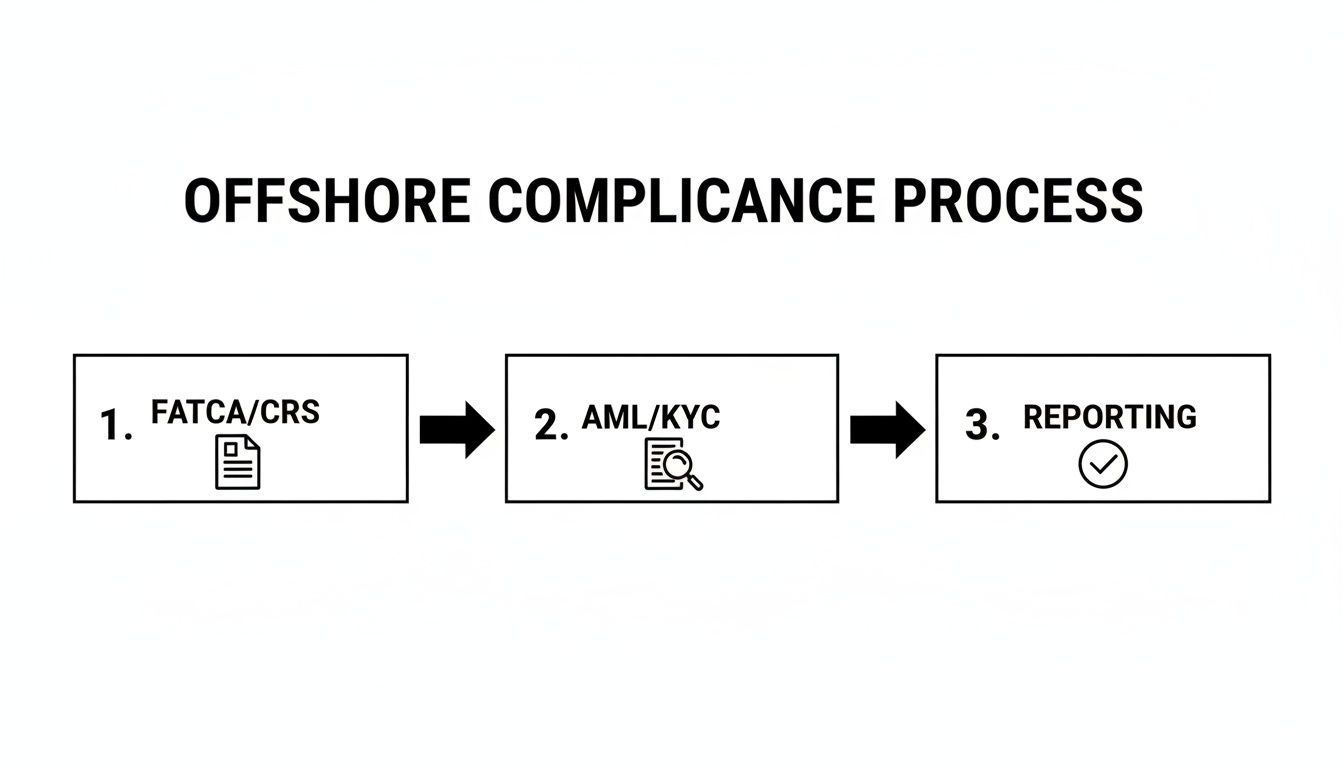
As you can see, international reporting standards, bank due diligence, and final compliance checks are universal. These steps are in place to maintain the integrity of the entire global financial system.
Preparing Your Documentation
Once you’ve zeroed in on a jurisdiction and a specific bank, the next step is to get your documents in order. International banks are legally required to conduct thorough Know Your Customer (KYC) checks to fight money laundering and other financial crimes.
While the exact list can vary slightly from bank to bank, you can bet you'll need these four things:
- Certified Copy of Your Passport: This needs to be notarized to officially verify your identity.
- Proof of Residential Address: A recent utility bill or a bank statement usually works, as long as it's less than three months old.
- Bank Reference Letter: This is a simple letter from your current bank stating that you’ve been a client in good standing for a certain period.
- Source of Funds Declaration: You have to show where the money you're depositing came from. This could be salary slips, statements showing business profits, or documents from the sale of an investment.
Having all of this prepared and certified ahead of time is the single best way to speed up your application.
The Application and Timeline
With your complete document package ready, you can start the application itself. Many top-tier international banks now let you open an account remotely, so you can get everything done online without ever leaving home.
How long does it take? The timeline can range from just a few days to several weeks, depending on the bank’s internal workload and the complexity of your situation. Being well-prepared is what separates a smooth, quick process from a frustratingly slow one. For a look at how fast it can be, check out our guide on how to open an offshore bank account in Panama in 3 days.


