


An offshore registered company is simply a legal business set up in a foreign country—one different from where its owners live or where its main operations are based. Think of it as establishing a digital headquarters in a global business hub to unlock specific advantages you can't get back home.
Demystifying the Offshore Registered Company
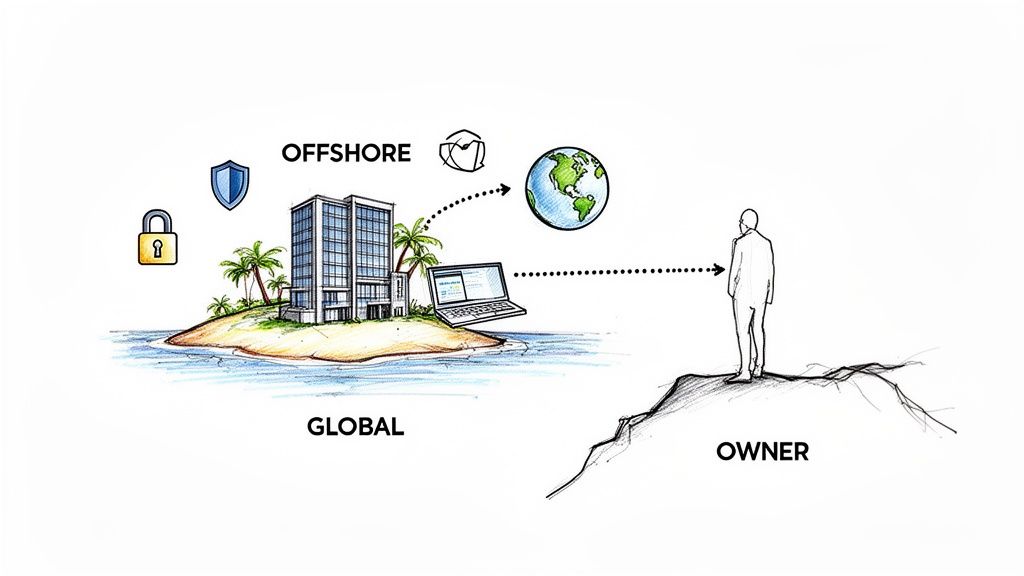
Forget the outdated myths of shadowy dealings and secret accounts. A modern offshore company is a legitimate and powerful tool for global entrepreneurs and investors. It’s not about hiding money; it's about structuring your assets and business in a smarter, more secure, and private way, all within the lines of international law.
The motivations today are purely strategic. For instance, an e-commerce entrepreneur living in Europe can register a company in a jurisdiction like the UAE to manage worldwide sales, open international bank accounts, and benefit from a more favorable corporate tax environment on foreign-earned profits. This isn't tax evasion. It's legal and intelligent tax optimization.
Key Motivations for Offshore Company Registration
At its core, an offshore company serves several key purposes for a business owner or investor. We've summarized the main drivers in the table below to show why this has become such a standard tool for building a resilient international presence.
| Motivation | Primary Benefit for Business Owners |
|---|---|
| Asset Protection | Creates a legal “corporate veil” between personal wealth and business liabilities, shielding assets from lawsuits and creditors. |
| Tax Optimization | Legally reduces a company’s tax burden by using low or zero corporate tax rates on foreign income, freeing up capital for growth. |
| Enhanced Privacy | Protects personal information by keeping shareholder and director details out of public registries, ensuring confidentiality. |
| Global Operations | Simplifies international trade, investment, and capital flow with a neutral, stable base for cross-border business. |
These objectives are about building a more efficient and protected structure for your international business activities, not about concealment.
The Four Pillars of an Offshore Strategy
Let’s break down those core benefits. The entire strategy behind using an offshore registered company rests on four main pillars:
- Asset Protection: It creates a strong legal barrier between your personal wealth and business liabilities. Think of this “corporate veil” as a fortress, shielding your assets from domestic lawsuits, aggressive creditors, or economic instability in your home country.
- Tax Optimization: By incorporating in a jurisdiction with low or zero corporate taxes on foreign income, you can legally minimize your company’s tax bill. This frees up significant capital that can be reinvested to fuel growth.
- Enhanced Privacy: Many offshore jurisdictions offer greater confidentiality and don’t publish shareholder and director information online for everyone to see. This protects high-profile individuals while ensuring full compliance with mandatory government reporting behind the scenes.
- Global Operations: An offshore company is your ticket to seamless international trade, investment, and capital management. It gives you a neutral, stable home base for cross-border transactions and opens the door to world-class global banking systems.
An offshore structure is like having a passport for your business. It grants you access to international markets, diverse banking options, and a regulatory environment designed to support global commerce, all while providing a protective layer for your assets.
A Modern, Highly Regulated Industry
The offshore world has changed dramatically. Today, legitimacy and transparency are non-negotiable. International regulations like the Common Reporting Standard (CRS) ensure that tax authorities automatically exchange financial information, making the secrecy of the past impossible.
This shift toward a compliance-first environment has cemented the role of the offshore registered company as a respectable tool for legitimate business. The global offshore company registration market was valued at US$27,060 million and is projected to hit US$41,530 million by 2031, a clear sign of its growing importance. You can find more details about these market growth projections on reports.valuates.com.
Unlocking Core Benefits: Asset Protection and Tax Efficiency
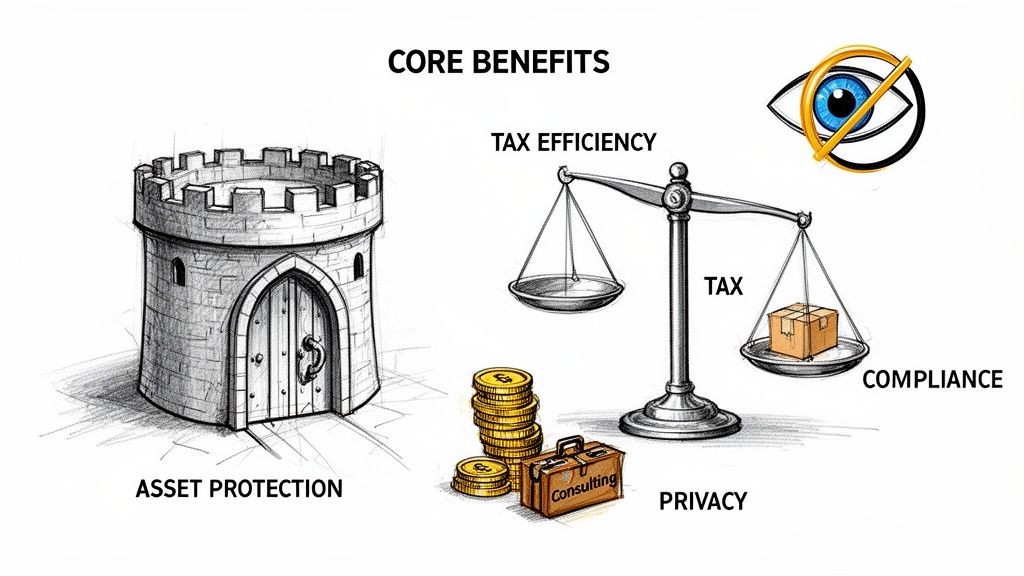
For any serious international entrepreneur or investor, an offshore registered company offers a powerful set of strategic advantages. These benefits aren’t just about saving money; they’re about creating a secure, efficient, and private structure for your global activities.
The strategy stands on three core pillars: robust asset protection, legal tax optimization, and enhanced operational privacy. Understanding how these elements work together is the first step toward building a resilient international business foundation.
Build Your Financial Fortress with Asset Protection
At its heart, the most fundamental benefit of an offshore company is its ability to build a legal fortress around your wealth. It does this by creating what’s known as a “corporate veil”—a clear legal separation between your personal assets and your business’s liabilities.
Think of it this way: your personal wealth (your home, savings, investments) is in one secure vault. Your business operations, with all their inherent risks, are in a completely separate one. If a lawsuit, creditor, or economic downturn hits your business, the corporate veil prevents that trouble from ever reaching your personal vault. This legal segregation is a cornerstone of modern wealth preservation.
An offshore company acts as a legal firewall. It contains business-related risks within the corporate structure, ensuring that a professional setback doesn’t escalate into a personal financial catastrophe.
This isn’t about hiding assets; it’s about intelligently structuring them to slash your risk. By placing a legal barrier between different parts of your financial life, you create a much more stable and predictable environment for growth. You can learn more about how to protect your wealth with our detailed guide on practical strategies and proven solutions.
Achieve Legal Tax Efficiency
Let’s be very clear: there’s a world of difference between illegal tax evasion and legal tax optimization. An offshore registered company is a tool for the latter, allowing you to structure your business in a way that legally minimizes its corporate tax obligations on foreign-earned profits.
Imagine an e-commerce entrepreneur based in a high-tax country. By establishing an offshore company in a zero-tax jurisdiction like the British Virgin Islands (BVI) or Seychelles, the company itself pays 0% corporate tax on income generated from international customers. This frees up a huge amount of capital that can be reinvested into marketing, inventory, or product development, accelerating growth at a pace that would be impossible back home.
For many high-net-worth individuals, this kind of optimization can slash liabilities by 20-40% when relocating income streams offshore. Jurisdictions like Seychelles are particularly popular, offering 0% tax on foreign income and rapid incorporation for under $1,500—ideal for agile businesses.
Enhance Your Privacy and Confidentiality
In an age where data is everywhere, privacy has become a priceless asset. Many offshore jurisdictions offer a far higher degree of confidentiality than domestic registries simply by not making shareholder and director information publicly available online.
This privacy is a critical shield for high-profile individuals, family offices, or anyone who prefers to keep their business affairs out of the public eye. It prevents competitors, journalists, or malicious actors from easily accessing sensitive personal information.
But this privacy doesn’t mean secrecy from the authorities. Under global standards like the Common Reporting Standard (CRS), your company’s financial information is still reported to the relevant tax authorities. This ensures you remain fully compliant while protecting your personal details from public view—the perfect balance between confidentiality and regulatory responsibility.
Navigating Global Compliance and Regulations
The world of the offshore registered company has changed completely. Gone are the days of quiet bank accounts and minimal questions. Today’s environment is built on robust international regulations designed to create transparency and shut down illegal activities.
This isn’t a bad thing. In fact, this shift has solidified the role of offshore structures as powerful, legitimate tools for international business.
Think of these new rules not as obstacles, but as the established “rules of the road” for global commerce. When you know how to navigate them correctly, they ensure your structure is secure, sustainable, and taken seriously by banks and authorities worldwide. The key is understanding the pillars of this new compliant era.
The Rise of Automatic Information Exchange
One of the biggest game-changers is the Common Reporting Standard (CRS). Developed by the OECD, CRS is basically an agreement for the automatic sharing of financial account information between the tax authorities of participating countries. Over 100 jurisdictions, including pretty much every major financial center, are on board.
What this means in practice is simple: if you are a tax resident of Spain and have a bank account for your offshore company in Singapore, the Singaporean bank will automatically report the account details back to the Spanish tax authority. This system has effectively drawn a line under old-school banking secrecy for tax purposes. Full compliance and proper reporting are no longer optional.
CRS creates a global web of financial transparency. It guarantees that tax authorities have a clear picture of their residents’ offshore activities, reinforcing the fact that an offshore registered company is a tool for legal tax optimization, not evasion.
Proving Your Company is a Real Business
Another critical piece of the puzzle is Economic Substance Requirements (ESR). Pushed by both the OECD and the European Union, these rules were put in place to combat “shell companies”—entities that exist only on paper with no real business activity in their home jurisdiction.
To comply with ESR, an offshore registered company involved in certain activities (like holding intellectual property or finance and leasing) must prove it has genuine substance. This usually involves demonstrating:
- Core Income-Generating Activities (CIGA): The main business activities must actually happen within the jurisdiction.
- Adequate Physical Presence: This could mean having a real office, employees, and sufficient operating expenses in the country.
- Directed and Managed Locally: Board meetings should take place in the jurisdiction with a quorum of directors who are physically present.
In short, ESR forces your company to be a legitimate, functioning business, not just a mailbox. The exact requirements change depending on the jurisdiction and what your company does, which is why expert guidance is crucial to meet the rules without building a structure that’s more complex than you need.
The Importance of Good Legal Standing
Beyond these major frameworks, simply keeping your company in good legal standing is a constant operational demand. An offshore registered company can be “struck off” the official register for basic failures, like not paying its annual government fees or failing to file the right paperwork.
For instance, in a place like Cyprus, a company that gets struck off can be restored, but it’s often a complicated and expensive process that might even require a court order. Such a simple administrative slip-up can get your bank accounts frozen and bring your operations to a screeching halt.
This is why proactive compliance management is so vital for the long-term health of your offshore structure. Working with a specialist ensures these deadlines are never missed, keeping your company active and fully compliant year after year.
How to Choose the Right Offshore Jurisdiction
Picking the right jurisdiction for your offshore registered company is the single most important decision you’ll make in this entire process. It’s not about finding the “best” place in the world, but about finding the one that perfectly fits your business goals, risk tolerance, and how you actually plan to operate.
Think of it like choosing a vehicle. A Ferrari is exciting but totally impractical for a big family. An SUV is safe and spacious but isn’t built for speed. It’s the same with offshore jurisdictions. One prized for its iron-clad banking system might come with higher costs, while another known for fast and simple setups might carry less prestige. Your job is to match the vehicle to your specific journey.
Evaluate Political and Economic Stability
First things first: stability. You’re building a corporate structure that you want to last for years, maybe decades. Placing it in a jurisdiction with a volatile political scene or a shaky economy is just asking for trouble.
Long-term stability is the foundation for everything else. It ensures your assets are safe, the legal rules of the game remain predictable, and your business won’t be derailed by sudden political chaos or regulatory surprises. Look for countries with a proven track record of political neutrality and consistent economic policy, like Switzerland, Singapore, or the UAE. They’ve built their reputations on being a safe harbor for international business.
Compare Legal Systems and Tax Policies
A jurisdiction’s legal system will have a huge impact on how your company is governed and how any disputes are handled. Most of the top offshore hubs operate under Common Law (like the UK, BVI, and Hong Kong), which is generally seen as more flexible and business-friendly than Civil Law systems.
Of course, tax policies are just as important. While many people hear “offshore” and think “zero tax,” the reality is much more nuanced. You need to look at the full picture:
- Corporate Income Tax: Does the jurisdiction tax income earned outside its borders? Places like the BVI and Seychelles, for example, have a 0% rate on foreign profits.
- Withholding Taxes: Will you be taxed on dividends, interest, or royalties you pay out of the country?
- VAT or Sales Tax: Could your business activities accidentally trigger local sales taxes?
The Asia-Pacific region is a major player in the offshore market, with hubs like Hong Kong and Singapore leading the way. Singapore is great for startups thanks to specific tax exemptions, while Hong Kong offers low tax rates and a world-class legal system. For entrepreneurs who are more budget-conscious, jurisdictions like Belize and Seychelles offer attractive packages with setup costs as low as $800–$1,500 and 0% corporate tax on offshore income.
To give you a clearer picture, here’s a quick comparison of some popular options.
Comparing Top Offshore Jurisdictions
| Jurisdiction | Typical Use Case | Tax on Foreign Income | Privacy Level | Compliance Burden |
|---|---|---|---|---|
| BVI | Holding Company, Asset Protection | 0% | High | Low to Moderate |
| Singapore | International Trade, Tech Startups | 0% (Territorial) | Moderate | High |
| UAE | Global Business Hub, E-commerce | 0% (Free Zones) | Moderate | Moderate to High |
| Hong Kong | Gateway to China, Financial Services | 0% (Territorial) | Moderate | Moderate |
| Seychelles | Cost-Effective Holding, Startups | 0% | High | Low |
This table is just a starting point. The best choice always depends on your specific circumstances and long-term goals.
Analyze Reputation and Banking Access
A jurisdiction’s international reputation is everything. If you set up in a location that’s on international blacklists or seen as non-compliant, you’re setting yourself up for a world of pain. You’ll struggle to open bank accounts, process payments, and even sign contracts with reputable partners.
A jurisdiction’s reputation becomes your company’s reputation. Choosing a well-respected financial center like Singapore or the UAE lends instant credibility and opens doors to premier global banking and investment opportunities.
This leads directly to banking access—a critical piece of the puzzle for any offshore registered company. The ability to open a stable, multi-currency corporate bank account is a make-or-break factor. A cheap, fast incorporation is worthless if you can’t get the banking you need to actually run your business.
For a deeper dive, check out our guide on the best jurisdictions for offshore bank accounts. Each jurisdiction has different banking strengths, and matching them to your business needs from day one is the key to success.
The Setup Process: From Paperwork to Operations
Bringing an offshore registered company to life isn’t about shady backroom deals. It’s a structured, methodical project with clear steps that take you from initial strategy to day-to-day business. Understanding this roadmap demystifies the whole journey and sets the right expectations from the start.
The process doesn’t even begin with paperwork—it starts with a strategic conversation. This is the foundation, ensuring the structure you build is perfectly aligned with your goals, whether that’s asset protection, international trade, or holding investments. It’s here you and your advisor will nail down the right jurisdiction and corporate structure for your specific needs.
Gathering Your Due Diligence Documents
Once the strategy is clear, the next phase is collecting your due diligence documents. This is a non-negotiable step, thanks to global Anti-Money Laundering (AML) and Know Your Customer (KYC) rules. Banks and registered agents are legally required to know who they’re working with.
You’ll almost always need to provide:
- Proof of Identity: A certified copy of your passport.
- Proof of Address: A recent utility bill or bank statement, typically less than three months old.
- Professional Reference: A letter from a lawyer or accountant confirming you’re in good standing.
- Business Plan: A simple overview of what the company will do.
Having these documents ready to go is the secret to a smooth, fast setup. In my experience, delays at this stage are the number one reason an incorporation gets bogged down.
From Incorporation to Corporate Reality
With your due diligence approved, the formal incorporation kicks into gear. This is where your service provider handles all the technical steps, which are surprisingly quick in most offshore jurisdictions.
The sequence is pretty straightforward:
- Company Name Reservation: Your chosen name is checked for availability and locked in with the corporate registry.
- Preparing Incorporation Files: The key documents—the Memorandum and Articles of Association—are drafted to outline the company’s purpose and internal rules.
- Filing with the Registry: All the paperwork is submitted to the official government registrar.
- Receiving Corporate Documents: Once approved, you get the official Certificate of Incorporation, share certificates, and other legal documents. This part usually takes just a few business days.
The paperwork itself is often the fastest part of the entire process. The real work lies in the strategic planning beforehand and the operational steps that come after—especially when it comes to banking.
The Critical Step: Opening a Bank Account
Getting your incorporation documents is a great milestone, but your offshore registered company isn’t truly operational until it has a bank account. Frankly, this is often the most difficult part of the whole endeavor. Banks are under immense regulatory pressure and have become incredibly selective.
Success here depends on presenting a clean, compliant, and professional case. Banks want to see a legitimate business with a clear purpose, transparent ownership, and a low-risk profile. Having a professional introducer who already has relationships with the banks can dramatically increase your chances of getting approved. For a deeper dive, you can learn more about offshore bank accounts in 2025 and what it takes to get one opened.
Finally, with your company formed and your bank account active, the focus shifts to ongoing maintenance. This means paying annual government and registered agent fees to keep your company in good legal standing, ensuring it doesn’t get struck off the registry.
Why Partnering With a Specialist Is Crucial
Trying to set up an offshore company on your own or through a cheap online agent is like performing your own dental surgery. You might find the tools online, but the lack of expertise creates enormous risks that often lead to failed structures, frozen bank accounts, or serious legal penalties.
The world of international finance is not a DIY project. It’s a complex ecosystem where professional guidance is the single most critical investment you can make.
The path to a successful international structure is full of nuances that automated platforms and basic formation agents simply can’t handle. Their job is transactional—to file paperwork. They won’t advise you on how your chosen jurisdiction interacts with your home country’s tax laws or whether its banking system truly fits your business model.
Beyond Formation Agents: Holistic Advisory
A true specialist provides a fundamentally different service. They act as your strategic architect, not just a paper-pusher. This distinction is the key to long-term success and security.
A holistic advisor ensures every component of your global strategy works together seamlessly. This includes:
- Integrated Banking: Using established relationships with banks in over a dozen countries to ensure your company gets the account it needs, not just the one that’s easiest to apply for.
- Strategic Jurisdiction Selection: Drawing on deep experience across 50+ jurisdictions to match your specific business—whether it’s e-commerce, consulting, or asset holding—with the ideal legal and financial environment.
- Future-Proofing Compliance: Proactively managing your structure to keep it compliant with evolving international rules like CRS and Economic Substance Requirements.
This comprehensive approach prevents the common disasters that DIY attempts create. For example, a cheap setup might land you with a company in a blacklisted jurisdiction, making it impossible to open a bank account or transact with major partners.
Partnering with a specialist firm isn’t an expense; it’s insurance against catastrophic failure. It ensures your offshore company is not only established correctly but remains secure, compliant, and effective for years to come.
An experienced advisor moves beyond theory and provides a clear roadmap based on real-world operational knowledge. They know which banks are friendly to specific industries, how to present your case for the highest chance of approval, and how to structure your affairs to legally optimize your global footprint.
This level of insight turns a complex, high-stakes process into a clear, manageable project. By investing in professional guidance from the start, you aren’t just buying a company; you are securing a robust foundation for sustained international growth and peace of mind.
Frequently Asked Questions
Even the best-laid plans come with questions. It’s a natural part of moving into the international space. Here are some of the most common queries we get from clients, with direct, no-nonsense answers.
Can I Run an Offshore Company From My Home Country?
Absolutely. In fact, this is how most people do it. You can be the director and shareholder of an offshore company and manage it from anywhere in the world.
The catch? You have to be extremely careful about tax residency and the rules around corporate management and control. If you conduct too much business from home, you could accidentally create a taxable presence there, defeating the whole purpose. This is where expert advice isn’t just helpful—it’s essential.
Is It Still Possible to Get a Secret Bank Account?
No. The days of the secret, anonymous Swiss bank account are long gone. That’s a relic of old spy movies.
Global transparency rules, especially the Common Reporting Standard (CRS), legally force banks to identify the ultimate beneficial owners of every account. They then automatically report this data to the relevant tax authorities. Your financial affairs gain a strong layer of privacy from the public, but full transparency with governments is now mandatory.
What Happens If I Don’t Pay the Annual Renewal Fees?
Forgetting to pay your annual government and registered agent fees is a serious mistake. Your company will lose its good legal standing, which is like having an expired driver’s license—you can’t legally operate.
Eventually, the corporate registry will just “strike off” the company from its records. This can get messy fast. Bank accounts can be frozen, you won’t be able to sign contracts, and you could even become personally liable for the company’s debts. It’s possible to reinstate a struck-off company, but it’s a complicated and expensive headache you’re better off avoiding.
How Much Does It Cost to Set Up an Offshore Company?
Costs can vary wildly. It really depends on the jurisdiction you choose and how much support you need.
A straightforward incorporation in a cost-effective jurisdiction like Seychelles might start around $1,500. On the other hand, a more sophisticated structure in a premium financial hub like Singapore or the UAE will cost significantly more. Don’t just look at the initial setup cost; you have to factor in annual renewal fees and the professional fees for proper advisory and bank account opening support.
A common pitfall is choosing a provider based on the lowest price tag. The real value is in the expert guidance that ensures your structure actually works, is fully compliant, and won’t cause expensive problems for you down the road.
At Protect Your Wealth, we don’t just register companies. We build complete, compliant international structures supported by premier banking relationships. If you’re ready to create a solid foundation for your global future, contact us to design your bespoke asset protection plan.


