


Protecting your assets from lawsuits isn't some luxury reserved for the ultra-rich anymore. It's a fundamental necessity for anyone who has built something worth losing. The strategy is simple: legally structure your personal and business assets to make them a frustrating, difficult, and expensive target for creditors and litigants.
This proactive legal shielding is your first and best defense in a world where a lawsuit can come out of nowhere.
Why Asset Protection Is No Longer Optional

Let’s be blunt: success attracts lawsuits. The more you build, the bigger the target on your back becomes. In today’s litigious world, waiting for a threat to appear on your doorstep is a strategy that’s already failed. Proactive legal shielding is the only reliable way to defend against claims that can spring from any corner of your life.
These threats can come from a disgruntled employee, a business deal gone sideways, a personal injury claim on a property you own, or even a messy divorce. The risk isn't just about losing in court. Even a frivolous lawsuit can drain your finances with staggering legal fees and pull your focus away from what really matters—growing your wealth.
The Sheer Volume of Legal Attacks
The scale of litigation, especially in the United States, is a serious wake-up call. The U.S. is home to about 80% of the world's lawyers, and a new civil lawsuit gets filed roughly every 30 seconds. This environment makes protecting your assets from lawsuits a core component of any serious financial plan.
Just look at the recent trends. In 2025, while the raw number of securities class action filings actually dropped, the potential financial damage for investors skyrocketed. The Maximum Dollar Loss Index (MDL Index), which measures market capitalization loss from these suits, hit an astonishing $2.86 trillion—a 75% increase from the previous year. Much of this came from tech and AI-related filings, proving how fast new industries create new liabilities.
The reality is that anyone can sue you for anything at any time. A strong asset protection plan makes you an unattractive target. It pushes potential litigants to settle for a reasonable amount or, even better, just walk away.
Modern Risks Demand Modern Defenses
The liability landscape is always shifting. Beyond the usual business disputes, new frontiers of risk are emerging that can put everything you own in jeopardy.
Key areas of growing concern include:
- Digital Liabilities: Conflicts over data privacy, cybersecurity breaches, and intellectual property are becoming more common and far more expensive.
- AI-Driven Conflicts: As artificial intelligence is integrated into business, we're seeing unprecedented legal challenges arise from the consequences of AI-driven decisions.
- Personal and Vicarious Liability: Your personal wealth can be at risk from the actions of others—like a car accident involving a family member or an incident at one of your rental properties. You might be interested in our detailed breakdown of common threats to your personal and business assets.
Failing to separate your personal wealth from these business and life risks is like leaving the front door of your house wide open. This guide will show you how to legally and ethically lock that door, establishing the urgent 'why' before we dive into the 'how' of building your fortress.
Domestic vs International Protection Strategies
When it comes to protecting your assets, you have two main arenas to play in: domestic and international. The right choice isn't about picking one over the other; it’s about understanding which tools to use for which threats.
Domestic strategies are your home-ground defense. They’re built within your own country’s legal system and are essential for managing everyday risks.
The Foundation of Domestic Protection
For any serious business owner or investor, the first and most critical step is creating legal separation between your business and personal assets. This is non-negotiable.
The most common tool for this is the Limited Liability Company (LLC). When you place a business or a rental property inside an LLC, you build a legal firewall. If a tenant sues over a slip-and-fall, the lawsuit is generally contained to the assets within that specific LLC, keeping your family home and personal savings out of the line of fire.
Another tool, the Family Limited Partnership (FLP), can be used to transfer assets to relatives while you maintain control. It makes life difficult for creditors, who often can only get a "charging order" — giving them rights to your distributions, but not control over the assets themselves.
The entire philosophy behind domestic protection is segregation. You're building compartments to contain liability. If a fire starts in one area, it doesn't burn down your entire financial house.
Where Domestic Strategies Fall Short
Here’s the catch: all domestic tools operate under the authority of domestic courts. A persistent creditor and a U.S. judge can, and often do, find ways to tear down those firewalls. This is especially true when the stakes are high.
Even the more advanced Domestic Asset Protection Trusts (DAPTs), available in states like Nevada or South Dakota, aren't foolproof. While they offer stronger protections by allowing you to create an irrevocable trust for your own benefit, their power is not recognized nationwide. A judge in New York simply might not care about the protections offered by a Nevada DAPT, citing the U.S. Constitution's "Full Faith and Credit Clause."
The Shift to International Structures
This is precisely where international strategies become essential. When you’re facing the threat of major litigation or want the highest level of privacy and deterrence, moving your assets offshore changes the entire game.
An international structure physically moves your assets beyond the reach of U.S. court orders. A judge can demand you repatriate funds from a Cook Islands trust, but the foreign trustee will simply refuse, pointing to their own country's laws. This creates an immediate legal and financial roadblock that is incredibly expensive for creditors to overcome. More often than not, they are forced to give up or settle for a tiny fraction of their claim.
The need for this level of protection is growing. In 2025, risks from cybercrime and intellectual property disputes are expected to explode, with 61% of top legal experts flagging them as major litigation drivers. With the median settlement value soaring to $17 million in 2025, as reported by CommonsLLC.com, having a structure that can withstand that kind of pressure is no longer optional for high-net-worth individuals.
Comparing Domestic and International Asset Protection Tools
To truly understand the difference, let’s compare the most common structures. Each has its place in a well-designed plan, offering different levels of protection, privacy, and cost.
| Strategy | Protection Level | Privacy | Typical Use Case |
|---|---|---|---|
| LLC | Good | Low | Separating individual business assets or real estate properties. |
| DAPT | Better | Moderate | U.S. residents in DAPT-friendly states looking for an extra layer. |
| International Trust | Highest | High | High-net-worth individuals facing significant liability risk. |
| International Foundation | Highest | Highest | Securing assets for generational wealth transfer and maximum privacy. |
This table shows a clear hierarchy. While LLCs are an excellent first step, only international structures provide the near-impenetrable defense needed against aggressive, high-stakes litigation.
Of course, moving to an international strategy means navigating complex tax and reporting requirements. This isn't a DIY project; it demands expert knowledge to ensure everything remains fully legal and compliant. Our guide on cross-border tax planning for entrepreneurs dives deeper into these critical considerations.
Ultimately, the smartest asset protection plans don’t choose between domestic and international. They layer both—using domestic LLCs for day-to-day operations and a powerful international trust or foundation as the ultimate shield.
How to Build Your Asset Protection Blueprint
Theory is one thing, but turning it into a real, functioning shield for your wealth is where the work begins. A proper asset protection plan isn't a single product you buy off the shelf; it's a custom-built, multi-layered blueprint designed around your specific life and business.
The first step is always the most critical: a brutally honest audit of your vulnerabilities. You can't defend against threats you haven't identified. This isn't just about making a list of what you own. It's about mapping out every potential source of liability.
Are you a real estate investor with a portfolio of rental properties? Each one is a potential slip-and-fall lawsuit waiting to happen. Do you run a successful business? You’re exposed to everything from employee disputes to intellectual property claims. Understanding these distinct risks is the foundation of protecting what's yours.
This diagram shows the basic concept in action—placing a legal shield between a threat and your assets.
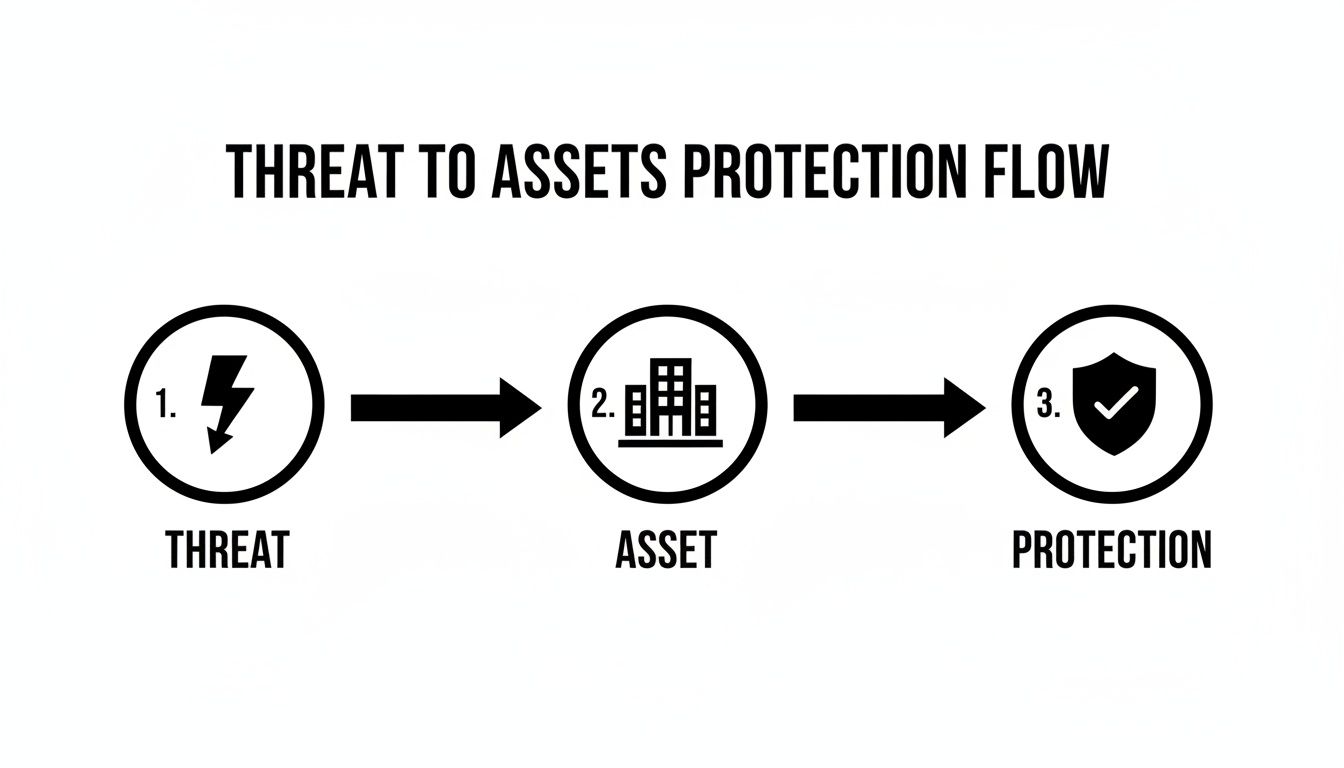
The key takeaway is that real protection isn’t a reaction. It's a pre-emptive structure that neutralizes threats long before they can ever touch your assets.
The Art of Asset Segregation
Once you've mapped your risks, the next move is asset segregation. Think of it as building legal firewalls between your different assets and liabilities. The goal is simple: ensure a fire in one area can't burn down the whole village.
For instance, a savvy entrepreneur would never hold their family home, valuable business inventory, and the company's trademarks all under their personal name. That’s a catastrophic and entirely avoidable mistake.
A much smarter approach involves partitioning those assets into separate legal pockets:
- The Family Home: This could be held jointly with a spouse or, even better, placed in a specialized trust to shield it from business creditors.
- Business Inventory: This should be owned by the operating company itself, likely a dedicated LLC, isolating it from your personal life.
- Intellectual Property: The brand names, patents, and copyrights could be held in an entirely separate entity—an IP holding company—which then licenses their use back to the operating business.
Now, if the operating company gets sued, the creditor can only go after the assets within that specific LLC. The lawsuit is contained. Your home and your priceless IP remain completely untouched.
Isolating Liability With Holding Companies
To take this a step further, many sophisticated investors and entrepreneurs use a holding company structure to achieve true liability isolation. This strategy is especially powerful when you own multiple businesses or high-value properties.
Imagine you own three separate LLCs: a software company, a small restaurant chain, and a commercial building. Instead of owning them directly, you would establish a parent holding company—often an LLC itself—that owns each of the three operating businesses.
This structure delivers two massive advantages:
- Containment: A lawsuit against the software company is trapped within that single entity. The restaurant chain and the commercial real estate are completely insulated from the legal battle.
- Centralized Control: The holding company allows you to manage everything and receive profits from all your ventures in one place, while keeping the liabilities neatly separated in their own compartments.
This transforms your financial world from one large, vulnerable target into a series of small, fortified, and independent units.
The core principle is simple but powerful: never hold high-risk assets (like an operating business) and safe assets (like your personal savings or home) in the same legal pocket. Segregating them is your first line of defense.
The Critical Element of Timing
There is one rule in asset protection that is absolute and non-negotiable: you must act before a problem arises. Trying to set up these structures when a lawsuit is already on its way is a fatal error.
Courts have a powerful legal doctrine known as "fraudulent conveyance" or "fraudulent transfer." If you move assets into an LLC or trust with the obvious intent of hiding them from a known creditor, a judge can simply unwind the entire transaction and seize the asset anyway.
This is why timing is everything. Effective asset protection is a "fair weather" activity. The shields must be raised when the skies are clear. Building your blueprint now—when there are no legal storms on the horizon—ensures that if a threat does appear, your structures are seasoned, legally sound, and ready to do their job. This isn't about hiding money; it's about smart, legal, and proactive financial architecture.
Exploring Advanced Protection With Offshore Structures
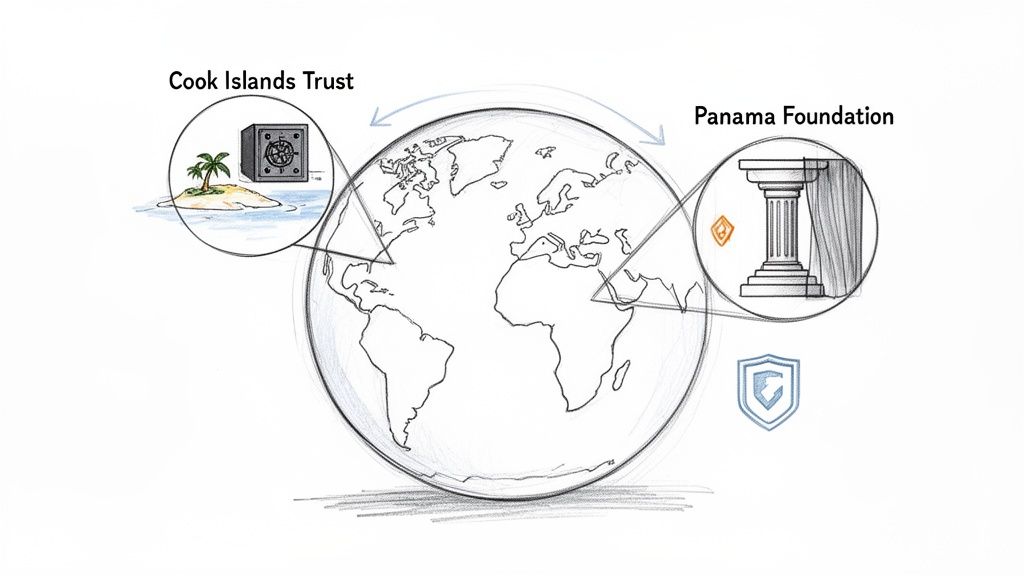
When domestic strategies aren't enough to give you peace of mind, it’s time to look at the gold standard of asset protection. For those facing serious litigation threats, international structures offer a level of security that tools in your home country simply can't replicate. They are specifically designed to stop lawsuits cold.
Two of the most powerful and battle-tested instruments in this arena are the Cook Islands Trust and the Panama Private Interest Foundation. Understanding how these work is the key to grasping the highest level of protecting assets from lawsuits.
The Cook Islands Trust: A Legal Fortress
The Cook Islands Trust is widely considered the most formidable asset protection vehicle on the planet. Its power doesn't come from secrecy, but from its unique legal DNA, which has been specifically engineered over decades to defeat creditors.
When you transfer assets into a Cook Islands Trust, they are no longer legally yours. They belong to the trust and are managed by a licensed trustee in the Cook Islands. This fundamental change in ownership creates an immediate and massive obstacle for any potential lawsuit.
Here’s what makes it so incredibly effective:
- Non-Recognition of Foreign Judgments: A court in your home country can order you to bring assets back, but a Cook Islands court will flatly ignore that order. A creditor is forced to start their case all over again from scratch in the Cook Islands—a prohibitively expensive and difficult process.
- Impossible Burden of Proof: To prove a fraudulent transfer in the Cook Islands, a creditor must show beyond a reasonable doubt that your transfer was made with the specific intent to defraud that particular creditor. This is the same standard of proof as a U.S. criminal trial, making it almost impossible to win.
- Extremely Short Statute of Limitations: A creditor has a tiny window—usually one to two years from the transfer date—to challenge it in a Cook Islands court. After that, the assets are permanently and irreversibly secured.
Imagine a surgeon who lives with the constant threat of malpractice claims. By placing her retirement savings into a Cook Islands Trust before any claim ever arises, she effectively walls off those assets from a future U.S. lawsuit. A litigant would have to spend hundreds of thousands of dollars just to attempt a case in the Cook Islands, with virtually no chance of succeeding. This pressure forces most to abandon the claim or settle for pennies on the dollar.
The Panama Private Interest Foundation: A Hybrid Powerhouse
While trusts are a familiar concept in common-law countries like the U.S. and UK, civil-law jurisdictions often use a different but equally potent tool: the foundation. The Panama Private Interest Foundation is a standout because it cleverly blends the best features of both a trust and a corporation into one hybrid structure.
Unlike a trust, which is a legal agreement, a Panama Foundation is a distinct legal entity, much like an LLC. It has no owners or shareholders. Instead, a Foundation Council manages it according to the rules you—the founder—set out in its charter.
This structure provides immense confidentiality and control. You can even appoint yourself or a trusted advisor to a supervisory role, similar to a trust protector, to oversee the foundation's activities and ensure your wishes are followed precisely.
The key benefits of a Panama Foundation are clear:
- Ironclad Confidentiality: The names of the founder and beneficiaries are not part of any public record, which adds an exceptional layer of privacy.
- Complete Asset Segregation: Assets transferred to the foundation become its legal property. This separates them completely from your personal estate and shields them from your creditors.
- Tailored Flexibility and Control: The foundation's rules can be written to your exact specifications, giving you the power to dictate how assets are managed and distributed for generations to come.
These international tools are not about hiding money. They are about strategically placing your wealth within a legal jurisdiction that is fundamentally designed to protect it from unjust seizure. By understanding the distinct advantages of structures like the Cook Islands Trust, you can make informed decisions. You can explore a deeper explanation by checking out our guide on what a trust is and how it works.
Choosing the Right Asset Protection Partner
An asset protection plan is just a theory until it's properly built. The real work—and where most plans fail—is in the execution. This immediately brings up two critical questions for anyone serious about protecting their wealth: "What will this really cost?" and, more importantly, "Who can I trust to get it right?"
The world of asset protection is flooded with advisors, from boutique experts to online document mills that promise cheap, fast solutions. Be warned: choosing the wrong partner is often worse than doing nothing at all. A poorly built structure will collapse the moment it's challenged in court, leaving you completely exposed.
Decoding the Costs of Protection
Let's get straight to the point. The investment required for a lawsuit-proof structure depends entirely on the complexity, jurisdiction, and level of expertise involved. Here’s a realistic look at what you should expect to invest:
- Basic Domestic Structures: A simple domestic LLC, when set up correctly with a professionally drafted operating agreement, can range from a few hundred to a couple of thousand dollars.
- Advanced Domestic Trusts (DAPTs): For a more resilient Domestic Asset Protection Trust, expect setup fees to land between $5,000 and $20,000, plus ongoing annual administrative costs.
- Sophisticated International Structures: A premier international trust (like a Cook Islands Trust) or a Panama Foundation is a serious investment in your financial security. Initial costs typically run from $20,000 to $60,000+, with annual trustee and maintenance fees.
These aren't just fees for paperwork. You are paying for the legal strategy, jurisdictional expertise, and deep compliance knowledge needed to make a structure impenetrable. With the financial stakes of litigation constantly rising, this becomes a critical business decision. While lawsuit filings might fluctuate, settlement amounts keep climbing. For instance, a 2025 report revealed that U.S. securities settlements shot up by 14%, and massive settlements of $100 million or more reached a five-year high. You can review the numbers in Broadridge's comprehensive 2025 report on global class actions.
Vetting Your Advisory Firm: A Checklist
Finding a genuine partner—not just a document seller—is the most important step. A real expert acts as a long-term advisor, guiding you through setup, maintenance, and any future challenges. Use these questions to cut through the noise and identify the true professionals.
- What is your direct experience with [specific jurisdiction]? You need to hear about their established, on-the-ground relationships with trustees, bankers, and lawyers in places like the Cook Islands, Panama, or Nevis. A firm without these direct connections is a huge red flag.
- How do you handle compliance and reporting? A legitimate firm will be upfront and clear about tax obligations, such as IRS forms 3520/3520-A for foreign trusts. If they get vague or dismissive about compliance, run.
- Can you provide a clear, itemized fee structure? Demand total transparency. You must know all setup costs and recurring annual fees before you begin. There should be no hidden charges.
- What is your process if a structure is legally challenged? This is where experience shows. They should have a battle-tested protocol for responding to legal threats and be able to explain exactly how they coordinate with foreign trustees to defend the structure.
Key Insight: Avoid any provider who promises "total secrecy" or suggests you can ignore tax reporting. Real asset protection works within the law, prioritizing compliance. The goal is legal deterrence, not illegal concealment.
Understanding Timelines and Expectations
Finally, you need to have realistic expectations. Building a fortress doesn't happen overnight.
- Domestic LLCs: These are relatively quick and can often be established within a week or two.
- International Trusts & Foundations: This is a much more involved process. Expect it to take 4 to 8 weeks to fully establish the structure and open the necessary bank accounts.
This timeline reflects the meticulous due diligence, compliance checks, and legal drafting required for a structure designed to withstand intense legal pressure. Rushing the process with a cheap provider is a formula for disaster. Investing the time and resources to work with a vetted, experienced firm is the only way to ensure your asset protection plan delivers the real security you need.
Common Questions About Protecting Your Assets
As you start looking into asset protection, it’s completely normal to have questions—and even a bit of skepticism. Many of these strategies can seem complicated, but they’re built on solid legal principles. Here, we’ll cut through the noise and give you direct answers to the most common questions we hear.
Is Asset Protection Just Hiding Money From Taxes?
This is the number one myth, and the answer is a firm no. Legitimate asset protection has absolutely nothing to do with illegal tax evasion or hiding money.
Proper asset protection involves legally and transparently arranging your wealth to shield it from future, unknown lawsuits or creditors. A compliant plan actually requires careful reporting to tax authorities like the IRS. The goal isn't to hide your assets, but to make them a legally difficult and unattractive target for anyone who might try to sue you.
True asset protection operates in the daylight. It's about building legal fortresses, not hiding in financial shadows. Compliance is the foundation that makes the entire structure defensible when it matters most.
Any so-called "strategy" that suggests hiding income or avoiding tax compliance isn't asset protection. It's a crime that will fall apart under scrutiny, leaving you and your assets in a worse position than when you started.
When Is It Too Late to Protect My Assets?
The best time to set up your asset protection plan was yesterday. The second-best time is right now, while the waters are calm. To be effective, these structures must be in place long before a lawsuit even appears on the horizon.
If you try to move assets after a claim has been made or you're aware of a creditor, a court can undo the transfer. This is known as a "fraudulent conveyance," and judges use it to reverse any moves that look like a last-minute attempt to evade a debt. While a few crisis-mode options might exist, they are far less powerful and more expensive than proactive planning.
Will I Lose Control of Assets in a Trust?
This is a common fear, but the answer is not at all. Modern asset protection trusts are specifically engineered to let you (the grantor) maintain significant influence over your assets without holding direct legal ownership—which is the key to their protective power.
For example, many international trusts include the role of a "trust protector." You can appoint yourself or a trusted advisor to this position, giving you the power to:
- Oversee the trustee and ensure they act according to your wishes.
- Veto or approve major decisions, like asset sales or distributions.
- Fire and replace the trustee if you’re not satisfied with their performance.
This structure lets you steer the ship and direct how the trust is managed, all while keeping the assets legally separated from you and safe from creditors.
Is This Only for Billionaires?
While the world’s wealthiest have used these strategies for generations, robust asset protection is no longer just for billionaires. It has become essential for successful entrepreneurs, doctors, real estate investors, and anyone with a net worth they want to pass on to their family.
The plans are completely scalable to your specific situation.
- A simple domestic LLC structure can be a great, low-cost starting point for many.
- Advanced international options become more relevant as your wealth and potential risks increase.
You don't need a nine-figure net worth to benefit from legally protecting what you've worked so hard to build.
Ready to create a plan that fits your unique situation? At Protect Your Wealth, we specialize in crafting bespoke legal asset protection and international tax strategies for entrepreneurs and high-net-worth individuals like you. Book a consultation today and let our team of experts build your financial fortress.


