


For the right kind of U.S. citizen, Puerto Rico is a completely legal, IRS-sanctioned tax haven. This isn’t about stashing money in some shadowy bank account; it's about making a strategic move to a U.S. territory where the tax code is designed to reward you. By following the rules, Americans can achieve a 0% tax rate on capital gains and a 4% corporate tax on eligible income—all while keeping their U.S. passport.
Is Puerto Rico a Real Tax Haven for Americans?
When you hear "tax haven," you probably imagine secret accounts and murky Caribbean islands. Forget that picture. Puerto Rico’s system is transparent, legitimate, and fully integrated with U.S. law.
Think of it less as a hiding spot and more like a strategic relocation on steroids. It's similar to moving from high-tax California to zero-tax Texas, but the benefits for your business and investment income are exponentially greater.
This isn't some accidental loophole. The island's tax structure is a deliberate economic incentive program, fully supported by Congress, designed to attract capital and entrepreneurs. The entire framework is built around Act 60, a law that bundles previous incentives (like the well-known Acts 20 and 22) into one powerful package.
Who Benefits from the Puerto Rico Tax Haven Strategy
These incentives aren't for everyone. They are specifically designed for high-income individuals and business owners who are willing and able to genuinely move their life and business operations to the island. The people who see the biggest benefits are:
-
Entrepreneurs and Service-Based Business Owners: If you run a consulting firm, software company, marketing agency, or another remote service business, you can slash your corporate tax rate from 30%+ on the mainland to a flat 4% in Puerto Rico.
-
Investors and Traders: For active traders of stocks, crypto, or other assets, this is a game-changer. You can get a 0% tax rate on all capital gains you realize after becoming a resident.
-
High-Net-Worth Individuals: Anyone with significant investment income from dividends and interest can also qualify for a 0% tax rate on that income after establishing bona fide residency.
The results speak for themselves. Between 2012 and 2019, roughly 4,500 individuals and businesses made the move, drawn by the promise of massive tax savings. This wave of migration, mostly from the U.S. mainland, cemented the island's status as a premier destination for wealth and entrepreneurship. You can read the full report on Time.com to learn more about this trend.
Of course, unlocking these benefits means you have to play by the rules and meet the strict bona fide residency requirements, which we'll cover in detail. But for those ready to make a genuine move, the financial upside is simply unmatched anywhere else in the United States.
Unlocking the Power of Puerto Rico’s Act 60
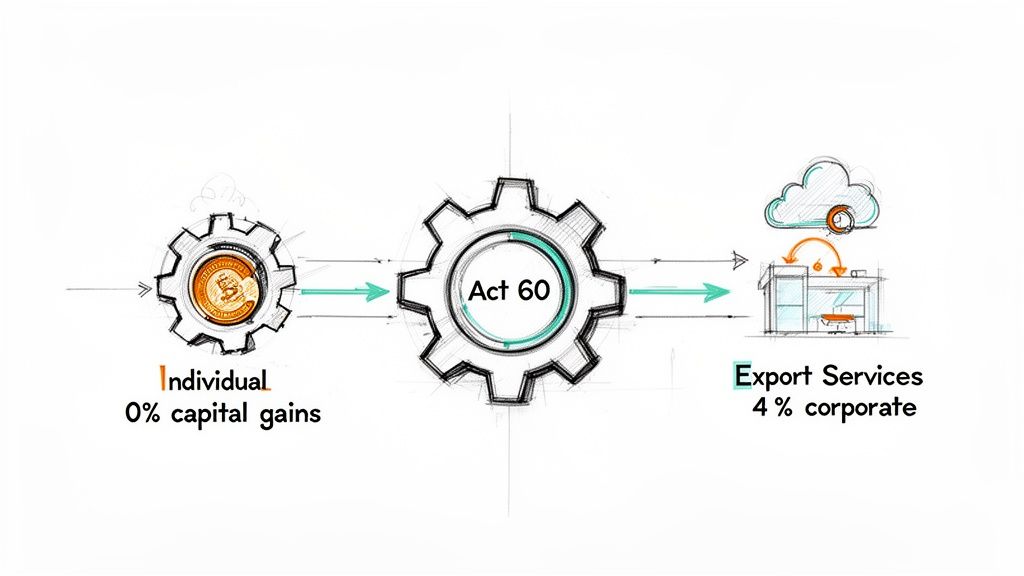
The legal engine that makes Puerto Rico a legitimate tax haven for Americans is called Act 60, the Incentives Code. This isn't some shady loophole; it's a public, deliberate economic strategy designed to draw capital, successful entrepreneurs, and high-value businesses to the island.
Act 60 brought together more than a dozen different tax decrees into a single, powerful piece of legislation. For investors and business owners, two parts stand out: the Individual Resident Investor incentive and the Export Services incentive. Understanding how these two work in tandem is the key to unlocking the massive financial upside of a move to Puerto Rico.
The Individual Resident Investor Incentive: 0% Tax on Passive Income
Picture yourself as an active trader or an investor whose portfolio spins off major dividends and capital gains. Back on the U.S. mainland, your short-term gains are getting hit with taxes as high as 37%, while long-term gains and qualified dividends face up to 20%—and that’s before you add state taxes.
The Individual Resident Investor incentive, which you might know by its old name, Act 22, completely erases that tax burden for new residents of Puerto Rico.
Once you become a bona fide resident, this incentive grants a 100% tax exemption—that’s a 0% tax rate—on all your Puerto Rico-sourced passive income. This covers interest, dividends, and any capital gains you realize after you’ve officially moved.
This is an absolute game-changer. Whether you're a crypto trader cashing out millions in gains or an investor living off a substantial stock portfolio, the savings are staggering. Instead of watching a huge chunk of your profits vanish to the IRS, you keep it all, ready to be reinvested or used however you wish.
The Export Services Incentive: A 4% Corporate Tax Rate
The second pillar of Act 60 is the Export Services incentive, formerly known as Act 20. This program is tailor-made for service-based businesses that are run from Puerto Rico but serve clients anywhere else in the world.
This incentive locks in a flat 4% corporate tax rate on all eligible export service income. To put that into perspective, a standard U.S. C-corporation starts with a 21% federal tax, and state taxes can easily push the combined rate past 30%.
The list of eligible businesses is long and covers most modern, location-independent companies:
- Digital marketing and advertising agencies
- Software-as-a-Service (SaaS) providers
- Management and financial consulting firms
- Architects and engineers
- Call centers and remote corporate support services
This structure allows entrepreneurs to slash their company's tax liability, freeing up incredible amounts of capital for growth, hiring, and personal wealth.
Putting It All Together for Maximum Impact
The real magic happens when you stack these two incentives. Let's take a consultant in New York earning $1 million a year through her U.S. S-Corp. After she pays federal, state, and city taxes, she might be lucky to take home $550,000.
Now, watch how her entire financial picture transforms with a move to Puerto Rico:
- Establish Residency: First, she becomes a bona fide resident of Puerto Rico.
- Form a PR Company: She sets up a new Puerto Rican company for her consulting business, which qualifies for the Export Services incentive.
- Pay Corporate Tax: Her new company pays a flat 4% corporate tax on its $1 million profit. That’s just $40,000.
- Distribute Profits: The remaining $960,000 is paid out to her as a shareholder dividend. Because she is a bona fide resident benefiting from the Individual Resident Investor incentive, this dividend is taxed at 0%.
Her total tax bill plummets from over $450,000 in New York to a mere $40,000 in Puerto Rico. This is exactly how the island operates as a premier tax haven for U.S. citizens. You follow the rules, establish genuine roots on the island, and reap the rewards of a system built to attract you.
This powerful strategy is fully backed by U.S. federal law, specifically IRC Section 933, which exempts Puerto Rico-sourced income from U.S. federal taxes for the island’s bona fide residents. Instead, they fall under local tax law, where rates can go up to 33%—a number that becomes almost entirely irrelevant for anyone correctly using the Act 60 incentives. You can discover more insights about Puerto Rico's unique tax position at ITEP.org.
How to Become a Bona Fide Resident of Puerto Rico
Securing Puerto Rico’s tax incentives comes down to one critical, non-negotiable step: you must become a bona fide resident of the island. This isn't just about buying a property and flying in for holidays. It's about fundamentally relocating your life and proving to the IRS that Puerto Rico is, without a doubt, your new home base.
The IRS uses three specific tests to determine if your move is legitimate. You have to pass all three. Think of it as building a defense; if even one part of your story doesn't hold up under scrutiny, the entire structure—and your tax savings—could fall apart.
The Presence Test: Your Time on the Island
This is the most straightforward test, a simple matter of counting days on a calendar. The IRS wants to see that you are physically spending a significant amount of time in Puerto Rico. To satisfy this, you must meet one of these conditions in a tax year:
- The 183-Day Rule: Be physically present in Puerto Rico for at least 183 days. This is the cleanest, most defensible path and the one we recommend for most clients.
- The 549-Day Rule: Spend a total of 549 days in Puerto Rico over three years (the current year and the two before it), with a minimum of 60 days on the island each year.
- No Significant U.S. Connection: Spend no more than 90 days in the U.S. and prove you don’t have a "significant connection" there.
- No Tax Home Elsewhere: Have no tax home outside Puerto Rico and no closer connection to another country.
For simplicity and to leave no room for argument, the 183-day rule is the gold standard. It creates a clear, documented record of your commitment to living on the island.
The Tax Home Test: Where You Earn Your Living
Next, your tax home must be in Puerto Rico. This isn't about where your house is; it's about where your economic life is centered. Your main office, your primary place of business, and the nerve center of your income-generating activities must all be on the island.
This is a make-or-break requirement for entrepreneurs and service professionals. Claiming Act 60 benefits for your export services company while still running operations from a mainland office or spending your workdays in the U.S. is a red flag that will instantly disqualify you. Your business must genuinely operate from Puerto Rico.
Shifting your tax home means your professional world moves with you. It’s where your main duties are performed. For those with complex international businesses or U.S. tax ties, getting this right is crucial. For example, non-resident aliens may need to understand other compliance aspects, and our guide on how to get an ITIN number can provide clarity on related U.S. tax obligations.
The Closer Connection Test: Where Your Life Is Centered
The final test is the most subjective and often the most challenging. The Closer Connection Test requires you to prove that your personal life—your family, social circles, and daily routines—is more deeply rooted in Puerto Rico than anywhere else. It’s the difference between being a visitor and being a resident.
This is where you build a compelling, evidence-backed narrative that Puerto Rico is truly your home. The IRS will examine a wide range of factors to see where the center of your life really is.
Actionable Steps to Prove Your Closer Connection:
- Official Documents: Get a Puerto Rican driver's license. Register to vote in Puerto Rico.
- Financial Presence: Open and actively use local bank accounts for your day-to-day life.
- Personal Assets: Move your most valuable and sentimental belongings—art, family heirlooms, even your pets—to your home on the island.
- Community Ties: Join a local church, gym, or country club. Get to know your neighbors and build a social life.
- Family Relocation: If you have a spouse and children, they should move with you. Enroll your kids in a local school.
- Local Professionals: Use local doctors, dentists, lawyers, and accountants for your personal needs.
Each of these steps adds another layer of evidence, solidifying your status as a bona fide resident and making your tax position unassailable.
Your Step-by-Step Implementation Roadmap
Making the move to Puerto Rico is a serious undertaking, but it's a well-trodden path if you follow a clear roadmap. This isn't a race. It’s a deliberate strategy to legally realign your finances and establish a new life on the island.
From your first consultation to receiving the official tax decree, the entire process usually takes about three to six months. This can change depending on how complex your finances are and how quickly government agencies are moving at the time.
Step 1: Consult with Experts
Before you pack a single box, your first move is strategic planning. You need to sit down with a team of legal and tax professionals who live and breathe Act 60. This is where the blueprint for your new financial life gets drawn up.
Your advisors will analyze your income streams, investments, and business operations to design the right corporate structure. The goal is simple: full compliance and maximum benefit from Puerto Rico’s tax incentives.
Step 2: Form Your Puerto Rican Company
Once the strategy is set, the first practical step is forming a new Puerto Rican business entity. This company will be the engine for your export services, making you eligible for that powerful 4% corporate tax rate.
This isn't a paper company. It must be properly established and registered in Puerto Rico, and it will become the operational heart of your business on the island, handling contracts, invoices, and payroll. A properly set-up company is critical for meeting the substance requirements of the law.
Step 3: Submit the Act 60 Application
With your new company formed, it's time to file the official application for your Act 60 tax decree. This is a detailed package submitted to the Puerto Rican government outlining your business plan, your financial situation, and your commitment to becoming a resident.
Think of the application as a formal contract between you and the government. It locks in your tax benefits for 15 years, with a potential for renewal, so meticulous attention to detail is non-negotiable.
Step 4: Relocate to the Island
After the application is in, the physical move begins. This is more than just forwarding your mail; it’s about shifting your entire center of gravity to Puerto Rico. You'll find a home, move your family, and truly start your life as a new resident.
This physical transition is a cornerstone of satisfying the bona fide residency rules, particularly the "Closer Connection Test." The government wants to see you are genuinely living there, not just visiting.
Step 5: Document Your Bona Fide Residency
Living in Puerto Rico is one thing; proving it is another. From your first year onward, you must carefully track your days on the island to meet the Presence Test.
The three core residency tests are visualized below.
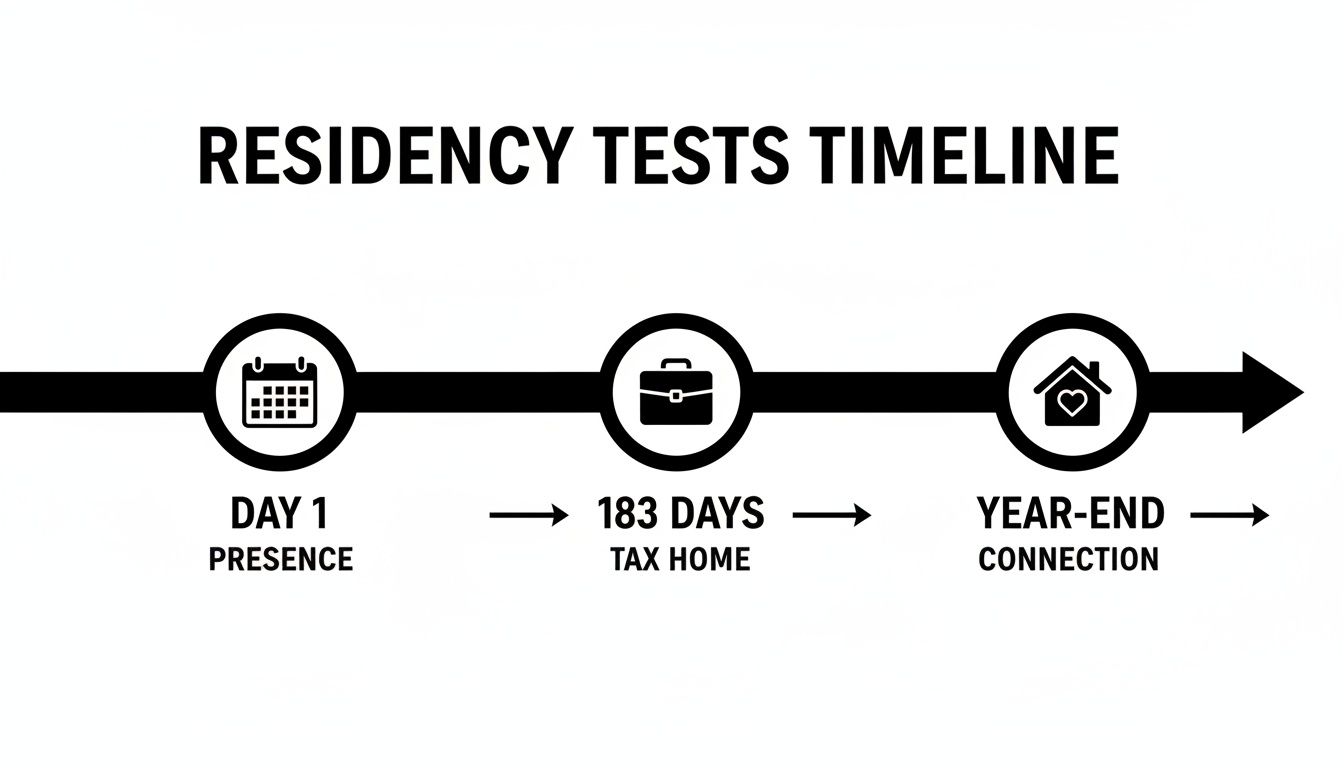
This shows that meeting the Presence, Tax Home, and Closer Connection tests isn’t a one-time checklist. It’s an ongoing commitment. For those managing finances across jurisdictions during this period, our guide on how to get a US bank account for non-residents can be an indispensable tool.
Step 6: Handle Your Tax Filings
At the end of your first year, you'll face a new tax filing reality. You will file a Puerto Rican income tax return for your local income, alongside specific US tax forms that account for your move and worldwide income.
The key document here is IRS Form 8898, which is your official declaration to the IRS that you have become a bona fide resident of Puerto Rico. You get this one right, and it cements your new tax status.
Real-World Tax Savings Scenarios
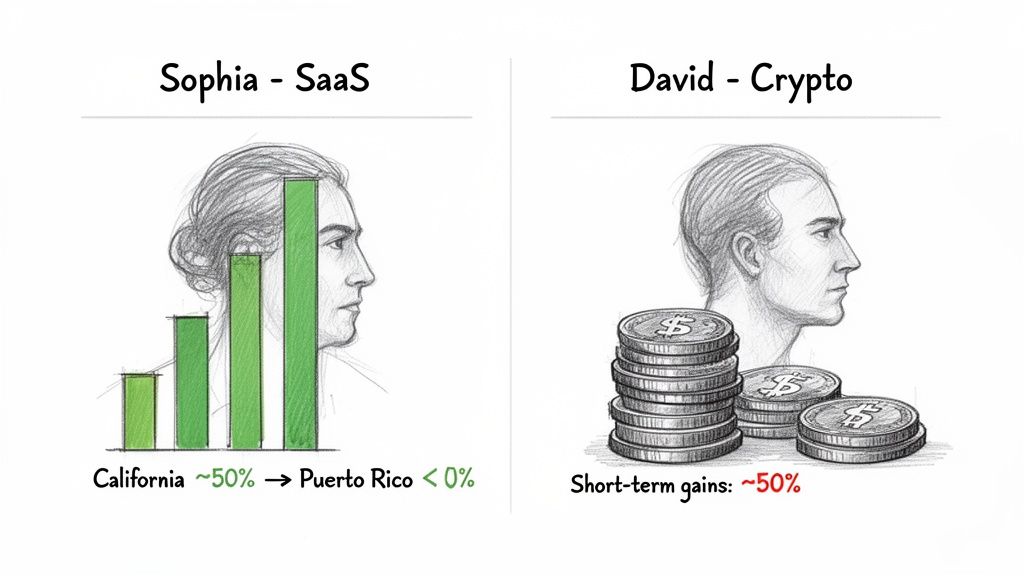
The theory behind Puerto Rico’s tax incentives sounds great, but what does it actually look like on your bank statement? The numbers can be abstract until you see them applied to a real-world business or investment portfolio.
Let's move past the percentages and look at the real-dollar impact. We’ll walk through two common scenarios to show just how powerful this strategy is when properly executed. For many entrepreneurs and investors, this is the "aha" moment.
H3: Case Study One: Sophia the SaaS Founder
Meet Sophia. She's the founder of a highly successful SaaS company based in California, generating $5 million in annual profit. Operating in a high-tax state, her tax bill is staggering.
Between the 21% federal corporate tax and California's state and personal income taxes, Sophia’s effective tax rate on that business income approaches 50%. Nearly half of her hard-earned profit is gone before she ever sees it.
- Total Profit: $5,000,000
- Approximate Combined Taxes (Federal + CA): $2,500,000
- After-Tax Take-Home: $2,500,000
Now, let's change the equation. Sophia establishes bona fide residency in Puerto Rico and relocates her export-focused business to the island to qualify for Act 60.
Under the Export Services incentive, her company’s net income is now taxed at a flat 4%. When she pays herself the remaining profits as a dividend, the Individual Resident Investor incentive kicks in, reducing her personal tax on that distribution to 0%.
Her new financial reality is a world apart.
- Total Profit: $5,000,000
- Puerto Rico Corporate Tax (4%): $200,000
- Personal Tax on Dividend: $0
- After-Tax Take-Home: $4,800,000
By making one strategic move, Sophia puts an extra $2.3 million in her pocket every single year. This isn't a loophole; it's the direct, intended outcome of Puerto Rico’s economic development laws.
To put this into perspective, here is a direct comparison of Sophia's annual tax burden in California, a lower-tax state like Florida, and Puerto Rico.
Annual Tax Liability SaaS Founder With $5M Profit
| Jurisdiction | Corporate/Business Tax | Personal/Capital Gains Tax | Total Tax Liability | Annual Savings vs. CA |
|---|---|---|---|---|
| California | $1,050,000 (21% Fed) | $1,440,000 (37% Fed + 13.3% CA) | $2,490,000 | $0 |
| Florida | $1,050,000 (21% Fed) | $1,461,500 (37% Fed) | $2,511,500 | -$21,500 |
| Puerto Rico | $200,000 (4% Act 60) | $0 (Act 60) | $200,000 | $2,290,000 |
The numbers speak for themselves. The savings aren't just incremental—they fundamentally change the financial trajectory of the business and its owner.
H3: Case Study Two: David the Crypto Investor
Next, consider David, an active crypto trader living in New York. He has a phenomenal year, realizing $2 million in short-term capital gains. In New York, those gains are taxed as ordinary income, pushing him straight into the highest federal and state tax brackets.
His tax bill is absolutely brutal. The combined federal, state, and city taxes eat up nearly half of his trading profits, with an effective rate of around 48%.
- Total Short-Term Gains: $2,000,000
- Approximate Combined Taxes (Federal + NY): $960,000
- After-Tax Profit: $1,040,000
Now, imagine David had the foresight to establish bona fide residency in Puerto Rico before he realized those gains. Under the Individual Resident Investor incentive, any capital gains from assets acquired after becoming a resident are taxed at a clean 0%.
- Total Short-Term Gains: $2,000,000
- Puerto Rico Capital Gains Tax: $0
- After-Tax Profit: $2,000,000
With one move, David saves $960,000 in a single tax year. This total elimination of tax on investment gains is precisely what makes the island a true haven for traders and serious investors.
H3: The Costs in Perspective
Of course, these benefits don’t come for free. The incentives require an annual $10,000 donation to a local non-profit and the purchase of a home on the island.
But when you weigh these compliance costs against annual tax savings that can easily run into the hundreds of thousands or even millions, the math is simple. They are the price of admission to what is arguably the most powerful tax-advantaged jurisdiction available to U.S. citizens.
Common Questions About Puerto Rico's Tax Incentives
Even with the best planning, the decision to move your life and business to a new jurisdiction will always bring up tough questions. Getting clear, practical answers is the only way to move forward with confidence.
Here are the most common concerns we hear from entrepreneurs and investors considering the move to Puerto Rico.
Can I Still Travel Back to the US?
Absolutely. The 183-day presence test is a floor, not a ceiling. Think of it as your minimum commitment. This leaves you with up to 182 days each year to travel to the mainland for business, see family, or take a vacation without putting your residency status at risk.
The real test isn't about being chained to the island; it's about proving that your life's "center of gravity" has genuinely shifted to Puerto Rico. Your travel patterns just need to back up the story that you are a Puerto Rican resident who travels, not a U.S. resident trying to game the system. Meticulous records of your time on and off the island are non-negotiable.
What About My Pre-existing Capital Gains?
This is where a lot of people get tripped up. The 0% tax on capital gains only kicks in for appreciation that happens after you officially become a bona fide resident of Puerto Rico.
For any assets you owned before the move—stocks, crypto, real estate, your business—the gains you've already accumulated are still on the hook for U.S. capital gains tax if you sell them within 10 years of relocating. This is a crucial 10-year look-back rule designed to stop people from just hopping over to the island to cash out on years of U.S.-based growth tax-free.
Let's say you own stock you bought for $100,000, and it's worth $500,000 the day you become a Puerto Rican resident. That $400,000 in built-in gain is now earmarked by the IRS. If you sell that stock three years later for $700,000, the first $400,000 is taxed by the U.S. The additional $200,000 of growth that occurred while you were a resident, however, is taxed at 0% in Puerto Rico.
This makes strategic timing and careful asset planning absolutely vital.
Is the IRS Cracking Down on This?
You've probably seen headlines about the IRS increasing its scrutiny of the program. That's true, but it’s critical to understand what they are actually targeting. The IRS is cracking down on non-compliance, not the strategy itself.
The incentives under Act 60 are written directly into U.S. law, specifically under IRC Section 933. When executed correctly, the strategy is 100% legal and defensible. The audits you hear about are focused on people who cut corners—those who fail the bona fide residency tests, maintain a "closer connection" to the mainland, or simply have shoddy documentation.
In a way, this increased enforcement just proves how important it is to get professional guidance. As long as you follow the rules to the letter, keep perfect records, and genuinely build your life in Puerto Rico, you're operating well within the law. This is exactly where expert implementation separates a successful, tax-efficient move from a failed and very costly one. Certain business structures can add layers of complexity, so it's wise to understand things like Controlled Foreign Corporation rules to ensure you remain fully compliant.
Navigating the complexities of Act 60 and the IRS bona fide residency tests requires precision and expertise. At Protect Your Wealth, we build and implement compliant, turnkey strategies to ensure your move to Puerto Rico is both seamless and secure. Schedule your confidential consultation today.


