


At its core, a residency by investment program is a straightforward arrangement: a country offers a residence permit to foreign nationals in exchange for a significant investment into its economy. These investments often take the form of real estate purchases, business ventures, or direct contributions.
For high-net-worth individuals and their families, these programs are a proven fast-track to global mobility.
Your Global Access Pass to a New Lifestyle
Imagine holding a single key that unlocks doors to new countries, giving you the freedom to live, work, and invest where you see the most opportunity. This is the real promise of residency by investment programs. They aren't just transactions; they are strategic tools that act as a 'global access pass' for those seeking greater personal and financial freedom.
In a world that feels increasingly uncertain, these programs add a powerful layer of security and diversification to your life. This isn't just about getting a new address—it's about building a resilient international footprint.
Understanding the Core Value
At its heart, residency by investment is about creating options. It's a strategic move that secures a safe, stable alternative for your family and your assets. Think of it as a premium insurance policy against the economic volatility, political instability, or even lifestyle limitations you might face at home.
For entrepreneurs and investors, the value is especially clear. A second residency can unlock:
- Expanded Business Opportunities: Gain direct access to new markets, more favorable business climates, and robust international banking systems.
- Enhanced Lifestyle Quality: Enjoy a higher standard of living, better education for your children, and access to world-class healthcare.
- Greater Mobility: For many, the most immediate benefit is visa-free travel within an entire region, like Europe's Schengen Area.
- Tax Optimization: A new residency can become the cornerstone of a sophisticated international tax strategy, potentially lowering your overall tax burden.
Residency Versus Citizenship: A Critical Distinction
It’s crucial to understand that residency and citizenship are not the same thing. While both fall under the umbrella of investment migration, they grant different rights and demand different levels of commitment.
Residency by investment gives you the right to live in a country and enjoy many of the benefits locals do, but you remain a citizen of your home country. Citizenship, on the other hand, makes you a full national of the new country, granting you a passport and the right to vote.
Many residency by investment programs are designed as a deliberate, structured pathway toward eventual citizenship. After meeting certain physical presence and integration requirements over several years, a resident can often apply for naturalization.
This makes these programs an excellent first step for those with long-term global ambitions. This guide is designed to help you navigate the landscape of residency options to make an informed, strategic decision that aligns perfectly with your wealth protection and lifestyle goals.
Choosing Your Investment Pathway
Securing a second residency isn't a one-size-fits-all transaction; it's a major strategic decision. The path you take has to line up with your long-term financial goals, your comfort with risk, and how hands-on you want to be. The world of residency by investment programs offers several distinct routes, each with its own character.
Think of it like choosing a vehicle for a cross-country trip. A rugged 4×4 is perfect for exploring backcountry trails, but it’s not the best choice for a smooth highway commute. In the same way, the right investment pathway depends entirely on your personal and financial destination. Let's break down the most common options to find your perfect fit.
The Real Estate Route: A Tangible Asset
For many investors, buying property is the most straightforward and popular pathway. This route involves purchasing qualified residential or commercial real estate in the host country, giving you a tangible asset you can live in, rent out for income, or watch appreciate over time.
It’s an intuitive way to meet a program's requirements while building a physical connection to your new country of residence. Programs like Greece’s Golden Visa have long been built around real estate, with minimums historically starting at €250,000 in certain areas. This approach is ideal for those who want a physical home base or an asset they can actually see and touch.
The Business Investment Route: For The Entrepreneur
If you're an active entrepreneur looking to expand your global footprint, the business investment route offers a much more hands-on approach. This pathway requires you to either start a new business that creates local jobs or invest in an existing company within the host country.
This isn't a passive investment; it's about active participation in the local economy. It’s best suited for individuals who want to establish a real commercial presence, hire staff, and contribute directly to economic growth. It demands more engagement, but the business and personal rewards can be significant. To see how this works in practice, check out our guide on using an LLC with residency in Malta.
The Passive Investment Route: Bonds and Donations
For those who value a clean, hands-off process, passive investments are an excellent choice. This pathway usually comes in one of two forms:
- Purchasing Government Bonds: You essentially lend money to the government for a set period (often 5 years), after which your principal is returned. It's a low-risk, predictable investment.
- Making a Non-Refundable Donation: You contribute directly to a national development fund, supporting public projects like infrastructure or education. This is often the fastest and simplest option.
This passive approach is the "set it and forget it" of residency by investment. It's designed for maximum efficiency, letting you secure residency without the headaches of managing property or running a business.
This pathway is perfect for busy investors who prioritize speed and simplicity. While a donation is a sunk cost, it often represents the quickest path to a residence permit with minimal ongoing obligations.
To make these options clearer, the table below gives you a side-by-side comparison of the different investment routes.
Comparing Residency Investment Pathways
| Investment Pathway | Typical Minimum Investment | Asset Type | Best For Investors Who… |
|---|---|---|---|
| Real Estate Purchase | €250,000 – €500,000+ | Tangible (Property) | Want a physical asset, potential rental income, and a personal connection to the country. |
| Business Investment | €350,000 – €1,000,000+ | Active (Company Equity) | Are entrepreneurs seeking to expand operations, create jobs, and actively engage in the local economy. |
| Government Bonds | €500,000 – €2,000,000+ | Financial (Debt Instrument) | Prefer a low-risk, passive investment with a predictable capital return after a set term. |
| Capital Contribution | €100,000 – €250,000+ | Non-Refundable Donation | Prioritize speed, simplicity, and a straightforward process without ongoing management duties. |
Each of these pathways offers a legitimate route to residency, but the “best” one is entirely dependent on your personal circumstances, from your financial strategy to your long-term lifestyle goals.
Comparing Top Residency by Investment Programs
With so many countries rolling out the red carpet for investors, picking the right residency program can feel overwhelming. The key is to look past the flashy headlines and investment minimums. You need to ask what you really want—is it fast-track access to the EU, a tax-friendly hub for your business, or simply a stable Plan B for your family?
Let’s break down some of the world’s leading jurisdictions. I’ll give you a practical, no-nonsense comparison to show you what makes each of these top-tier options tick.
Greece: The Schengen Area Powerhouse
The residency world has been turned on its head recently, with Greece’s Golden Visa program rocketing to the top of the Henley & Partners Global Residence Program Index. With a score of 73 out of 100, it knocked Portugal off a throne it held for nine straight years.
So, what’s the appeal? For a real estate investment starting at just €250,000 in certain areas, you get a renewable five-year residency permit. Crucially, there are zero physical stay requirements to keep it, you can include your family, and you get visa-free travel across the entire Schengen Area. For more details, you can check out the full investment migration report.
- Minimum Investment: Starts at €250,000 for real estate in select regions.
- Processing Time: Usually 4-6 months.
- Key Benefit: No minimum stay to maintain residency, plus full Schengen Area access.
Portugal: A Proven Pathway to EU Citizenship
For years, Portugal’s Golden Visa was the gold standard, and it’s still a fantastic choice for anyone with their eye on the ultimate prize: an EU passport. While the rules have changed—you can no longer buy residential property in Lisbon or Porto to qualify—the program offers solid alternatives through investment funds, donations, or business creation.
Portugal’s real strength lies in its clear, achievable path to citizenship. After five years of residency and passing a basic Portuguese language test, you can apply for a passport. That’s one of the most straightforward timelines in the entire EU.
United Arab Emirates: The Global Business Hub
The UAE, and Dubai in particular, has masterfully positioned itself as a magnet for global entrepreneurs and investors. If you’re looking for a modern, tax-efficient business environment, this is it. The Golden Visa program offers long-term residency for up to 10 years across various investment routes.
This chart shows where investors typically put their money for these types of programs.

As you can see, real estate is a tangible and popular choice, but business and financial investments offer serious flexibility depending on your profile.
The UAE program is perfect for those who prioritize a zero-income-tax jurisdiction, world-class infrastructure, and a strategic location bridging East and West. It doesn’t give you regional mobility like an EU visa, but as a standalone base for global business, it’s hard to beat.
Panama: The Americas Gateway
For investors focused on the Americas, Panama’s Qualified Investor Visa is a clear winner. It’s one of the fastest routes to permanent residency in the world, often approved in as little as 30 days. The country’s dollarized economy also provides a stable financial environment, making it a powerful hub for both business and wealth preservation.
Panama’s program is built for speed and efficiency. It grants permanent residency from day one, with no complex renewal processes and minimal physical presence required to maintain it.
This program is an excellent choice if you need a foothold in Latin America, access to a robust banking sector, and a territorial tax system—meaning your foreign-sourced income isn’t taxed. While Panama is a fantastic regional hub, those seeking opportunities further afield might want to explore alternatives. For instance, you can check out our guide to Paraguayan residency for another strong option in South America.
Choosing the right program is all about matching your personal and financial goals with what each country does best. Whether your priority is EU mobility, tax optimization, or just pure speed, there’s a residency program out there built for you.
Navigating Critical Decision Factors
Choosing the right residency program is about much more than comparing investment minimums. This is a life-altering decision, and it demands a strategic look at several critical, often overlooked, factors. The best residency by investment programs don’t just align with your finances; they have to fit your lifestyle, family structure, and long-term ambitions.
Think of it like choosing a business partner. You wouldn’t just look at their initial capital contribution. You’d dig deep into their reliability, their long-term vision, and how well they integrate with your existing plans. The same level of due diligence applies here, and it’s what helps you sidestep common and costly mistakes.
Speed and Quality of Processing
The time it takes to get an approval can be a make-or-break factor, especially when you have urgent business or family needs. Some programs are notoriously slow, bogged down in bureaucracy, while others are built for efficiency. But it’s not just about speed—it’s about the quality and predictability of the process. A clear, transparent system is always a sign of a well-managed program.
According to the Henley Residence Program Index, some countries are standout performers. Five nations—Hungary, Panama, South Korea, Spain, and Thailand—earned a perfect score for processing time and quality. Panama’s Qualified Investor Visa, for example, can grant permanent residency in as little as 30 days for investments starting at $300,000 in real estate. The program also offers instant family inclusion and has no physical stay requirements, making it exceptionally efficient for entrepreneurs focused on Latin American expansion. You can see how these top-tier programs stack up by checking out the official index publication.
Physical Stay Requirements
This is one of the most crucial details to get right. The physical presence requirement—the minimum number of days you must spend in the country each year to keep your residency—can range from zero to over six months.
- Minimal Stay Programs: Jurisdictions like Greece, the UAE, and Panama require very little or no time on the ground. These are ideal if you’re looking for a “Plan B” residency or visa-free travel benefits without uprooting your current life.
- Significant Stay Programs: Other programs, particularly those with a clear path to citizenship, may require you to spend a substantial amount of time in the country. They are essentially asking you to make it your primary home.
Your choice here directly impacts your lifestyle and, just as importantly, your tax obligations. Failing to meet physical stay requirements can lead to losing your residency status, so it’s vital to choose a program that fits your real-world travel and living patterns.
Family Inclusion Policies
For most investors, this is a family affair. It’s absolutely essential to understand how a program defines a “dependent.” A spouse and minor children are almost always included, but the rules for older children, parents, or even unmarried partners can vary wildly.
You need to check the fine print to see if you can include:
- Adult children (and up to what age they qualify)
- Dependent parents or grandparents
- Unmarried partners
Some programs are far more generous and flexible than others. A program that lets you bring multiple generations under a single family application offers enormous long-term value and peace of mind.
Pathway to Citizenship
Is a second passport your ultimate goal? If so, you have to evaluate the long-term potential for naturalization. Not all residency programs are created equal in this regard. Some offer a clear, legally defined pathway to citizenship after a set number of years. Others make the process difficult, uncertain, or practically impossible.
You need to analyze the total residency period required (like the five years in Portugal), any language proficiency tests, and other integration requirements. If citizenship is the end game, prioritize countries with a proven and straightforward naturalization process for their residents. This kind of foresight ensures your initial investment actually serves your ultimate ambition.
Integrating Residency into a Holistic Wealth Strategy
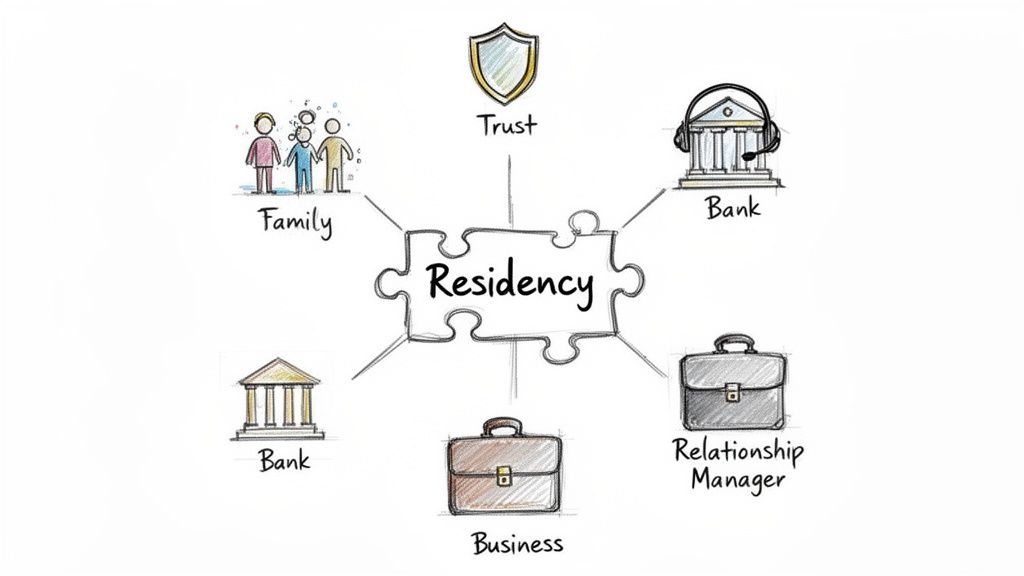
Securing a second residency is a huge step forward, but it’s not the final move on the chessboard. Treating residency by investment programs as a standalone solution is like buying a high-performance engine but never building the car around it. To truly unlock its power, your new residency must become the core of a complete wealth protection framework.
This means looking far beyond the application process itself. A proper strategy connects your new residency status to every other critical part of your financial life, making sure each component works in perfect harmony. The goal is a resilient, compliant, and durable global structure that protects not just your freedom of movement, but your entire legacy.
Building Your Coordinated Framework
A truly integrated approach means coordinating several specialist areas at once. This is where a dedicated relationship manager becomes your quarterback, acting as the single point of contact to ensure no detail is missed during implementation. This coordinated effort is built on several key pillars working in concert.
These pillars include:
- Legal Asset Protection: Using powerful structures like international trusts or foundations to shield your assets from frivolous lawsuits, creditors, and other unforeseen threats, legally separating them from you personally.
- International Tax Optimization: Structuring your financial affairs to align with the tax laws of your new jurisdiction. When done right, this can significantly and legally reduce your global tax burden. You can dive deeper into the fundamentals of cross-border tax planning in our guide.
- Global Banking Solutions: Establishing secure banking relationships in stable, reputable financial hubs. This diversifies your liquid assets and gives you the tools to conduct international business smoothly and efficiently.
By synchronizing these elements, your residency becomes the cornerstone of a fortified global strategy. It’s no longer just a travel document but a central component of a well-architected plan designed for stability and growth.
This is how a simple residence permit transforms into a dynamic tool for comprehensive wealth preservation, ensuring every decision you make reinforces your long-term financial security and freedom.
Frequently Asked Questions
When you start exploring the world of residency by investment, a lot of questions pop up. It’s completely natural. Here are some clear, straightforward answers to the most common queries we get from investors like you. The goal here is to cut through the noise and give you the confidence to take the next step.
How Long Does a Residency Permit Last and Is It Renewable?
Most residency permits aren’t granted for life right out of the gate. Think of it as an initial trial period. Typically, you’ll get a permit valid for anywhere from two to five years.
But don’t worry, these are almost always renewable. To keep your residency active, you just have to continue holding the qualifying investment and play by the program’s rules, which might include spending a certain amount of time in the country. Over time, sticking with the program often opens a direct path to permanent residency.
Can I Include My Family in a Residency Application?
Yes, absolutely. This is one of the biggest draws of these programs—they are built for families. Almost every single one is designed to include your immediate relatives.
You can typically bring your spouse and dependent children along on the same application. Many programs have also become much more flexible about who counts as a “dependent,” often including:
- Unmarried children, sometimes up to age 25 or even 30, as long as you can show they are financially dependent on you.
- Dependent parents and, in some cases, grandparents of either you or your spouse.
This turns a personal move into a complete solution for your family’s global mobility and long-term security.
What Is the Difference Between Residency and Citizenship?
This is a critical distinction to understand. Residency by investment gives you the legal right to live, work, and access services in another country. You gain incredible benefits, but you remain a citizen of your home country.
Citizenship by investment, on the other hand, makes you a full national of the new country, complete with a passport. Here’s a simple way to think about it: residency is the key to the house, while citizenship is the deed to the property itself.
Many residency programs are designed as a stepping stone. After holding your residency for a few years and meeting certain conditions (like physical presence or basic language skills), you often become eligible to apply for naturalization and get that second passport.
What Are the Most Common Due Diligence Requirements?
The best residency by investment programs protect their integrity fiercely. That means every single applicant goes through a serious background check. This isn’t just red tape; it’s what preserves the value and reputation of the program for everyone.
You’ll need to be ready with detailed documentation covering a few key areas:
- A Clean Criminal Record: You must provide official police clearance certificates from your country of birth and any other country where you’ve lived for more than a few months.
- Proof of Legal Source of Funds: This is where the real detail comes in. You have to prove, with evidence, that your investment capital was earned legally. This could be from business profits, property sales, an inheritance, or your salary.
- Personal Documentation: This includes the basics like birth certificates, marriage certificates, and passports to verify your identity and confirm your family relationships.
Passing these checks is the foundation of a successful application. There are no shortcuts.
Navigating the complexities of residency, asset protection, and international tax requires expert coordination. At Protect Your Wealth, we build integrated strategies that align your global mobility with a fortified wealth structure. To start crafting your personalized plan, contact us today.


