


Forget the old cliché of "buying a passport." Think of second citizenship by investment as something far more strategic: a direct investment in global freedom for yourself and your family.
This is a completely legitimate, government-sanctioned process. In exchange for a significant economic contribution—like a real estate purchase or a donation to a national development fund—a country grants you and your family full citizenship.
Unlocking Global Freedom Through Strategic Investment
At its heart, a second citizenship is the ultimate Plan B in a world that’s becoming more unpredictable by the day. It’s a powerful tool for high-net-worth individuals, providing a safe harbor for your family and assets if political or economic storms gather back home. This isn't about leaving your roots behind; it's about adding a powerful layer of security and expanding your horizons.
Imagine your business opportunities no longer being shackled by your passport's visa restrictions. Picture the freedom to live, work, or study in a new country with a better quality of life or a much friendlier tax environment. This is the tangible, real-world advantage a second passport delivers.
Why Pursue a Second Citizenship?
The reasons for seeking a second passport are as diverse as our clients, but they almost always circle back to a few core benefits. These programs are also designed for efficiency, often taking months instead of the decade or more required for traditional naturalization.
To put it simply, citizenship by investment programs offer a fast-track solution to some of life's biggest challenges. Below is a quick summary of what you stand to gain.
Key Benefits of Citizenship by Investment at a Glance
| Benefit Category | Description & Impact |
|---|---|
| Enhanced Global Mobility | Gain visa-free or visa-on-arrival access to over 140 countries, including the UK and Europe’s Schengen Area. No more endless visa applications. |
| Asset Protection | A second passport opens doors to international banking and global markets, shielding your wealth from local economic shocks and currency devaluation. |
| Family Security | Most programs are inclusive, allowing you to add your spouse, children, and sometimes even parents or grandparents to the same application. |
| Tax Optimization | Many host countries offer highly attractive tax laws, with no capital gains, inheritance, or worldwide income tax. A game-changer for financial planning. |
These benefits come together to create a comprehensive strategy for personal and financial resilience in the 21st century.
By making a defined economic contribution to a host country, investors can secure full legal citizenship for themselves and their families. This is a legitimate pathway recognized by sovereign nations to attract foreign direct investment and boost their economies.
The Process and Its Integrity
It's critical to understand that this isn't a simple transaction. Reputable governments go to great lengths to protect the integrity and value of their citizenship. This is done through rigorous due diligence and compliance checks on every single applicant.
You will undergo extensive background verification to prove the legality of your funds and confirm you have a clean personal record. This strict vetting is what maintains the power and international respect of the passport you receive.
As you explore this option, our detailed guide on how to get a second passport offers a deeper dive into the specific steps involved. This framework ensures that only qualified, reputable individuals are granted citizenship, safeguarding the program for everyone.
Comparing the Top Citizenship Programs Worldwide
When you start exploring a second citizenship, you’ll quickly realize not all programs are created equal. They differ enormously in cost, speed, and the sheer power of the passport you get at the end. The options generally fall into a few key categories, each designed for very different strategic goals.
Think of it this way: are you looking for a fast, reliable escape hatch—a solid Plan B? Or are you aiming for the absolute gold standard in global access and prestige, even if it takes more time and money? There’s no single "best" option, only the one that best fits your objectives.
The Caribbean Gold Standard: Speed and Efficiency
For decades, the Caribbean nations have been the pioneers in the citizenship by investment world. Countries like St. Kitts & Nevis, Grenada, and Dominica offer some of the most streamlined and efficient programs on the market.
If you need a powerful second passport fast, the Caribbean is almost always the first place we look. These programs are built for speed, allowing a family to secure their new citizenship in as little as three to six months. For clients facing uncertainty or time-sensitive opportunities, this rapid turnaround is a massive advantage.
The investment usually takes one of two forms: a straightforward donation to a national development fund or a real estate purchase in an approved project. The real estate route costs more upfront but gives you a tangible asset with the potential to recoup your capital after a mandatory hold period, typically five years.
A Closer Look at Dominica: A Prime Example
Dominica’s program is a perfect showcase of the Caribbean model's appeal. Over the last decade, Caribbean nations have successfully processed tens of thousands of applications, and Dominica has been a standout performer.
Between 2015 and 2024, the country issued an impressive 49,619 passports from over 20,210 applications, maintaining an extremely low rejection rate. It consistently scores high marks, hitting 80% in the 2024 CBI Index, thanks to its unmatched processing speed of just 3-4 months and accessible investment minimums starting at $200,000.
With a Dominican passport, you gain visa-free access to over 140 countries, including the EU Schengen Area, the UK, Hong Kong, and Singapore. It's a powerful tool for global mobility.
European Prestige: The Path to EU Citizenship
Now, let’s shift gears to the top tier: European programs. While direct, immediate citizenship options in the EU are virtually non-existent now, pathways that begin with residency—like the one Malta historically offered—set the benchmark for prestige.
These programs demand a much higher financial commitment and a lot more patience. Timelines often stretch from 12 to 36 months, and sometimes longer.
So, what’s the trade-off for the higher cost and longer wait? The ultimate prize: full European Union citizenship.
An EU passport isn't just a travel document; it's a key that unlocks the right to live, work, and study in any of the 27 EU member states. For families seeking access to world-class education, premier healthcare, and boundless business opportunities across a whole continent, this is a game-changer.
The investment structures here are more complex, often requiring a mix of a non-refundable contribution, a real estate investment, and sometimes a government bond purchase. The due diligence is also intensely rigorous, reflecting the immense value and rights that come with an EU passport. Though direct CBI is rare, a route like Spain's residency by investment can be a smart, strategic first step toward eventual European citizenship.
To help visualize these differences, here’s a straightforward comparison:
Comparing Major Citizenship by Investment Program Types
| Feature | Caribbean Programs (e.g., Dominica, St. Kitts) | European Programs (e.g., Malta – Pre-Closure) |
|---|---|---|
| Minimum Investment | Starts at $100,000 – $200,000 | Often €700,000+ |
| Processing Timeline | 3-6 months | 12-36+ months |
| Primary Benefit | Speed, cost-effectiveness, strong global mobility | Full EU rights (live, work, study anywhere in the EU) |
| Investment Structure | Donation or real estate purchase | Complex mix of donation, real estate, and/or bonds |
| Due Diligence | Thorough but streamlined | Exceptionally rigorous and lengthy |
| Ideal For | Investors needing a fast, reliable “Plan B” | HNWIs prioritizing ultimate freedom and access within the EU |
This table makes the core trade-off clear: Caribbean programs offer incredible speed and value, while European routes deliver the highest level of freedom and long-term security.
Hybrid Programs: Strategic Geographic Advantages
Finally, some programs don’t quite fit the Caribbean or EU mold but offer unique strategic advantages. Turkey is the best example of a “hybrid” option.
Turkey’s program is built around a simple real estate investment, requiring a property purchase of at least $400,000. The process is also quite efficient, with citizenship typically granted in about eight months.
The real power of a Turkish passport comes from its unique geopolitical position as a bridge between Europe and Asia. More importantly for many investors, Turkish citizens are eligible to apply for the E-2 investor visa to the United States—a benefit that most other CBI programs simply cannot offer.
Ultimately, choosing the right program comes down to a clear-eyed assessment of your personal goals. By carefully weighing the trade-offs between cost, speed, and the benefits you need most, you can find the citizenship that best secures your future.
The Critical Role of Due Diligence and Compliance
Legitimate citizenship-by-investment programs aren’t just a transaction; they’re built on a foundation of international trust and security. That foundation is held up by one non-negotiable process: due diligence.
Think of due diligence as the ultimate quality control for a country offering its citizenship. It’s an exhaustive, multi-layered investigation designed to protect the integrity of the program, the host nation’s reputation, and the long-term value of your new passport. Without it, the whole system would lose credibility, and the visa-free travel benefits would quickly disappear.
What Does Due Diligence Actually Involve?
This isn’t just a simple background check. It’s a deep dive that scrutinizes every part of an applicant’s history and financial standing. The goal is simple: ensure that only reputable, law-abiding individuals who pose no security risk are welcomed as new citizens.
This investigation is handled by the country’s Citizenship by Investment Unit (CIU), often with help from specialized international firms. The process always includes:
- Source of Funds Verification: You must provide undeniable proof that your investment capital was acquired legally. This means detailed documentation of your business activities, investments, and income sources.
- Criminal Record Checks: Global databases like Interpol and other law enforcement agencies are scoured to confirm a clean criminal record. Any past issues can mean immediate disqualification.
- Global Sanctions and Watchlists: Your name is checked against international sanctions lists to ensure you are not a politically exposed person (PEP) or linked to illicit activities.
- Identity and Document Verification: All personal documents—birth certificates, passports, marriage certificates—are meticulously verified for authenticity.
This infographic shows the general hierarchy of CBI programs, where the stringency of due diligence often lines up with the tier.
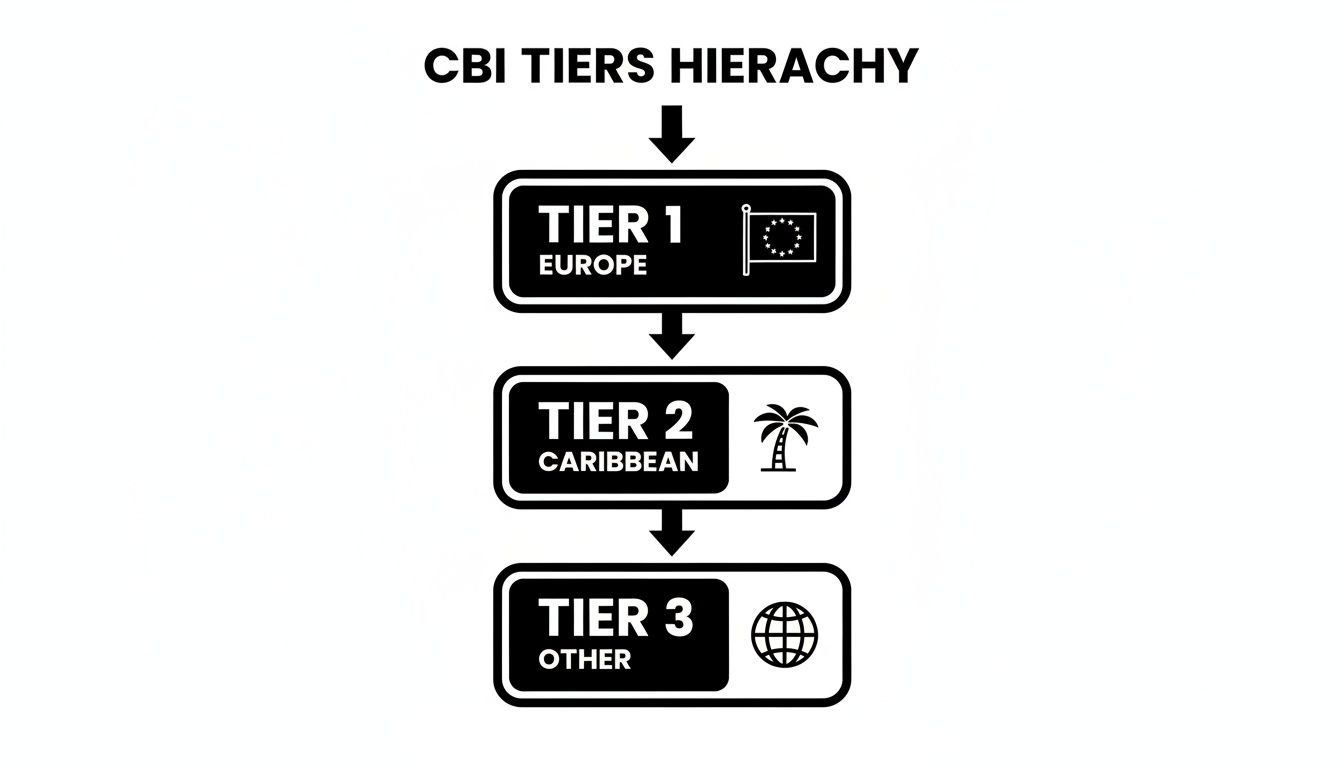
As you can see, European programs sit at the top with their rigorous checks, followed by the well-established Caribbean options and other global programs, each with its own specific compliance framework.
Why Perfect Compliance Is Non-Negotiable
In the world of CBI, there is zero room for error. A single missing document, an unclear financial statement, or a tiny inconsistency can raise a red flag and grind your entire application to a halt. Government review boards are trained to be skeptical; their job is to find reasons to say no.
An incomplete or poorly prepared application is almost guaranteed to be rejected, costing you significant time and non-refundable government fees. This is exactly why trying to navigate this complex process alone is such a major risk.
Every successful application is a story of meticulous preparation and flawless compliance. The government’s primary concern is protecting its global standing, and it achieves this by enforcing the strictest due diligence standards on every single applicant without exception.
This strict enforcement is precisely what gives your new citizenship its power. It assures other countries that your passport was earned through a legitimate and secure process.
The Advisor’s Role in Ensuring Success
A specialized advisor acts as your compliance officer and project manager, making sure every detail is handled correctly. Their expertise is crucial for spotting potential issues long before they can derail an application.
An experienced advisor will:
- Conduct Preliminary Vetting: Before you even commit to a program, a good firm runs its own internal due diligence to catch any potential red flags. This saves you from applying to a program where you’re unlikely to succeed.
- Build a Flawless Application: They guide you in gathering and organizing the extensive paperwork needed to prove your source of funds and personal history, presenting it in a clear, compliant format that government agents can easily verify.
- Liaise with Government Bodies: They act as your official point of contact with the CIU, professionally managing all communications and responding to any requests for more information quickly and correctly.
Ultimately, a perfectly documented, compliant application is the only path to successfully obtaining a second citizenship by investment. The due diligence process isn’t a hurdle to overcome—it’s the critical feature that safeguards your investment and guarantees the enduring value of your new global identity.
Understanding the Costs, Timelines, and Investment Options
When high-net-worth individuals start exploring a second citizenship, two questions always come up first: “How much will this cost?” and “How long will it take?” The answers aren’t simple, as the options range from fast, cost-effective solutions to premium, long-term strategic investments. Getting a handle on this landscape is the first step to choosing the right path for you and your family.
The financial side of a second citizenship goes well beyond the headline investment amount. Think of it like buying a premium property—the sticker price is just the start. The total cost includes a number of mandatory fees that every applicant has to cover to keep the process moving forward successfully.
Deconstructing the Total Cost
To build a realistic budget, you need to account for several critical components. The main investment is the biggest chunk, of course, but the other fees are just as important and completely non-negotiable. Missing any of them can put your entire application at risk.
Here’s a typical breakdown of what you can expect to pay:
- The Main Investment: This is your core economic contribution. It can be as low as $100,000 for a donation to a Caribbean development fund or climb north of €700,000 for a top-tier European program.
- Government Processing Fees: These are standard administrative charges the host country’s Citizenship by Investment Unit (CIU) collects to manage your application.
- Due Diligence Fees: This is a big one. These fees pay for the deep, multi-layered background checks on you and any family members on the application. Expect these to run from $5,000 to $10,000 per person.
- Professional Advisory Fees: This is what you pay the specialized firm that guides you through the entire maze, making sure every detail is perfect and giving you the best shot at success.
If you don’t factor in these extra costs from the start, you’re setting yourself up for a nasty surprise down the line. A good advisor will always give you a clear, all-inclusive quote right from the beginning.
Choosing Your Investment Pathway
Once you have a clear picture of the total costs, the next big decision is how you want to make your main investment. Most programs give you two or three distinct routes, and each one comes with its own financial logic and risk profile.
1. The Donation Route (Non-Refundable Contribution)
This is the most direct and often the fastest option. You make a one-time, non-refundable donation straight to a government fund used for national development—think new schools, hospitals, or infrastructure.
- Pros: Lower upfront cost, very simple process, and usually the quickest path to a passport.
- Cons: The money is gone for good. It’s a sunk cost.
2. The Real Estate Investment
This is a popular alternative. You buy a property in a government-approved real estate project and have to hold onto it for a required period, usually 3 to 7 years. After that, you’re free to sell it.
- Pros: You end up with a tangible asset that could generate rental income and appreciate in value. You can get your initial capital back after the holding period.
- Cons: The initial investment is much higher, and you’ll have property taxes and maintenance fees to deal with.
3. Government Bonds
This is a less common option but is available in a few countries. It involves buying interest-free government bonds. Like real estate, it’s a recoverable investment—you hold the bonds for a set term (often five years) and then get your capital back.
- Pros: It’s a low-risk, recoverable investment without the headaches of owning and managing property.
- Cons: Your capital is locked up for years without earning you a single dollar in returns.
The choice between a donation and real estate is a strategic one. A donation is a pure expense you pay for speed and simplicity. Real estate is a capital investment that bundles citizenship with a potential financial return.
Timelines: From Application to Passport
The time it takes to get your second citizenship by investment is just as varied as the cost. Caribbean programs are built for speed, often delivering a passport in just 3 to 6 months. This quick turnaround is perfect for anyone needing a solid Plan B in a hurry.
European programs, on the other hand, require a lot more patience. Take Malta, which has dominated the investment migration world for a decade, landing the top spot in the 2025 Global Citizenship Program Index for the 10th year in a row. Its prestige comes from incredibly high standards, with contributions often exceeding €600,000 and processing times that average 12 to 36 months. This longer journey reflects the immense value of gaining full EU citizenship. You can discover more insights about these program rankings from Henley & Partners’ latest report.
Ultimately, the right choice boils down to your priorities. Do you need speed and efficiency, or are you willing to invest more time and capital for bigger long-term rewards? While citizenship programs are one path, many of our clients also explore the options in our guide on residency by investment programs, which can often serve as a powerful stepping stone to full citizenship.
How a Specialized Advisor Streamlines Your Journey
Trying to get a second citizenship by investment on your own is like navigating a maze of international law blindfolded. It’s a world of dense paperwork, strict government protocols, and compliance hurdles that can trip up even the sharpest investor. One wrong move can mean months of delays or, even worse, a flat-out rejection.
This is exactly where a specialized advisory firm becomes your most critical asset. They aren’t just paper-pushers; they’re your personal strategists, project managers, and compliance experts, all in one. Their job is to turn a bureaucratic nightmare into a clear, predictable, and successful process.
From Strategy to Flawless Execution
The first thing a great advisor does is get to the heart of why you’re doing this. Are you chasing global mobility for your business? A safe harbor for your family? Or a strategic tool for asset protection and lower taxes? They start with your goals and work backward to find the perfect citizenship program for you.
Once a program is selected, the real work begins—building an application that is bulletproof. This goes far beyond just collecting documents.
A top-tier advisor acts as the master architect of your application file. They know every question a government reviewer will ask and build a case so compelling and perfectly documented that it leaves zero room for doubt.
This hands-on approach includes:
- Preliminary Due Diligence: Before your application ever reaches the government, a good firm runs its own internal checks. This allows them to spot and fix potential red flags early, massively boosting your odds of success from the start.
- Source of Funds Narrative: They help you build a crystal-clear, verifiable story of how you built your wealth, proving the legitimacy of your investment capital beyond any question.
- Document Perfection: Every single piece of paper, from birth certificates to business records, is authenticated, translated if needed, and formatted exactly as the country’s Citizenship by Investment Unit (CIU) demands.
Navigating Government Channels and Ensuring Success
Maybe the most vital role an advisor plays is acting as your professional go-between with government agencies. They speak the “language” of the CIU and have the relationships needed to keep things moving. This direct line is priceless when an official asks for a clarification or an extra document, preventing minor queries from turning into major delays.
The value here isn’t just about convenience—it’s about results. An application that arrives perfectly prepared and submitted by an accredited agent signals to the government that you are a serious, pre-vetted candidate. It immediately sets your file apart from the sloppy, self-prepared applications that often trigger suspicion.
A specialized firm makes sure every stage is executed perfectly:
- Strategic Program Selection: Matching your goals with the program that offers the best return—whether that’s speed, cost, or passport strength.
- Meticulous Application Assembly: Building an airtight case file that anticipates and satisfies the intense scrutiny of government reviewers.
- Proactive Government Liaison: Handling all official communications, responding to queries on your behalf, and keeping the application on track.
- Holistic Integration: Making sure your new citizenship works seamlessly with your existing wealth structures, tax strategies, and long-term family plans.
Ultimately, hiring a specialized advisor for your second citizenship isn’t an extra cost—it’s an investment in certainty. Their expertise saves you an incredible amount of time and stress while maximizing your chances of success, turning a complex goal into a reality.
Frequently Asked Questions About Citizenship by Investment
Navigating the world of second citizenship can bring up a lot of questions. This section cuts through the noise and provides direct, clear answers to the most common queries we hear from potential applicants. The goal is to give you the essential information you need to move forward with confidence.
Can You Really Buy Citizenship?
This is the biggest misconception out there. No legitimate country sells citizenship or passports over the counter. The process is a strategic investment, not a retail purchase.
You make a significant, legally defined economic contribution—whether to a national development fund, the real estate market, or government bonds. In exchange, and only after you pass a rigorous vetting process, the country grants you citizenship. Think of it less like a transaction and more like a partnership. Your investment helps fuel the host country’s economy, and in return, you’re welcomed as a new citizen with all the rights that come with it.
What Is the Difference Between Second and Dual Citizenship?
While people often use these terms interchangeably, there’s a subtle but important legal distinction.
- Second Citizenship is a simple statement of fact. It just means you hold passports from two different countries.
- Dual Citizenship is a formal legal status. It means both countries officially recognize you as their citizen, granting you full rights and obligations in both nations at the same time.
Most modern CBI programs result in recognized dual citizenship. However, the critical step is to check the laws of your home country. Some nations require you to renounce your original citizenship when you acquire a new one, while many others fully permit holding multiple passports without issue.
Can My Family Get Citizenship Too?
Absolutely. This is one of the most powerful advantages of nearly every citizenship by investment program. A single application can typically cover you, the main investor, and your direct dependents.
Most programs are designed to secure a future for your entire family, not just you. This often includes your spouse, minor children, and in many cases, financially dependent adult children (often up to age 29), parents, and even grandparents over a certain age.
Each family member will, of course, have to pass their own due diligence checks, and adding them will increase the overall cost. But it’s a far more streamlined and efficient path than having each person apply on their own.
Will I Have to Pay Taxes in My New Country?
This is a critical question, and the answer isn’t a simple yes or no. Acquiring a second citizenship doesn’t automatically make you a tax resident. Tax residency is usually determined by factors like how much time you spend in a country each year, not just the passport you hold.
Many popular CBI nations, especially in the Caribbean, have built highly favorable tax environments. They often feature:
- No tax on worldwide income: You’re only taxed on money earned inside that country.
- No capital gains tax: Profits from your investments are yours to keep.
- No inheritance or wealth tax: Your estate can be passed down to your heirs without being taxed away.
This opens up significant opportunities for intelligent tax planning. Still, you can’t forget your obligations to your original country. U.S. citizens, for example, are taxed on their global income no matter where they live. A specialized advisor is essential to build a compliant strategy that integrates your new citizenship with your financial goals.
What Are the Most Common Reasons for an Application to Be Rejected?
Legitimate CBI programs actually have a very low rejection rate for applications submitted through accredited agents. That’s because any serious red flags are usually caught during a preliminary check. When rejections do happen, they almost always stem from a failure in the due diligence process.
The most common deal-breakers are:
- Failure to Prove Source of Funds: You must provide a crystal-clear, documented trail showing your investment capital was earned legally. Any gaps or fuzzy explanations will bring the process to a halt.
- A Criminal Record: Even minor offenses from your past can be grounds for disqualification. Every applicant undergoes extensive background checks with international law enforcement agencies like Interpol.
- Providing False Information: Any attempt to mislead, omit, or hide information on your application is a guaranteed rejection. It will likely get you permanently banned from applying again.
- Being on a Sanctions List: If you’re on any international sanctions or watchlists, you are automatically ineligible.
Flawless transparency and meticulous documentation are non-negotiable. The entire system is designed to filter out any applicant who cannot meet these strict global standards.
At Protect Your Wealth, we specialize in guiding high-net-worth clients through the complexities of global mobility and asset protection. If you are ready to explore how a second citizenship can secure your family’s future and expand your global freedom, our team is here to build your personalized strategy.
Discover your options at https://www.protectyourwealth.com.


