
You’re probably looking at Dubai for one of three reasons. Your home jurisdiction has become unpredictable. Your current company structure no longer fits how you earn, bank, or travel. Or you’ve realized that “international” on paper means very little if your business still depends on one tax authority, one banking corridor, and one residency base.
That’s where setting up a business in dubai freezone stops being a generic incorporation exercise and starts becoming a strategic move. Done properly, a Dubai free zone company can serve as an operating hub, a holding layer, a residency anchor, and a cleaner gateway for cross-border banking. Done badly, it becomes an expensive certificate that struggles to open accounts, fails substance reviews, and forces a restructure you could have avoided at the start.
Most public guides focus on how fast you can get a license. Discerning clients need to focus on something else. What the entity will do. How the licence reads to a bank. Whether the office tier matches visa and substance needs. Whether the structure still works once corporate tax, ESR, KYC, and CRS reporting enter the picture.
Why a Dubai Free Zone is a Strategic Tool for Global Entrepreneurs
A founder based in London sells digital services to clients in Europe and Asia, holds surplus cash in a personal account, and invoices through a company in a high-tax country that no longer matches how the business operates. In that situation, a Dubai free zone company can do more than issue invoices. It can create a cleaner operating base, support residency planning, and separate business risk from personal wealth, if the structure is built properly from the start.
That is the strategic case for setting up in a Dubai free zone. The company should fit into a wider cross-border plan, not sit on its own as a low-cost registration exercise.
The headline benefits are familiar. Free zones allow 100% foreign ownership, full profit repatriation, and zero personal income tax. Setup costs are also often lower than mainland options, according to Engel & Völkers’ Dubai business setup cost overview. But discerning entrepreneurs rarely choose Dubai on price alone.
They choose it because the UAE can serve several functions at once. It offers a commercially credible jurisdiction, a residency base with international mobility value, and a company format that banks usually understand better than a pure offshore vehicle. For owners restructuring away from a single home-country tax and banking dependency, that combination matters.
Used well, a free zone company can strengthen three parts of an international plan.
- Business separation: Revenue-generating activity moves into a dedicated company in a jurisdiction built for cross-border trade, which helps separate operating risk from personal affairs.
- Asset protection positioning: The company can sit under or alongside a broader holding and protection structure, provided ownership, reporting, and control are documented coherently.
- Banking and mobility planning: A UAE entity with a credible activity, sensible office solution, and consistent shareholder profile often gives banks and immigration authorities a clearer story to assess.
I have seen this work well for consultants, online operators, traders, and holding structures. I have also seen founders incorporate too quickly, then discover the licence wording is weak for banking, the office package does not support their visa plan, or their tax residence position outside the UAE was never addressed.
That is where many setups fail. The company exists on paper, but the surrounding framework does not support it.
A free zone company does not, by itself, eliminate tax in another country. It does not override controlled foreign company rules, permanent establishment risk, beneficial ownership disclosure, or the question of where management and control sit. It also does not guarantee account opening. Banks want a credible business model, traceable source of funds, and a structure that makes commercial sense.
For that reason, the primary objective is not getting the certificate fast. It is building a company that still works once banking due diligence, corporate tax analysis, CRS reporting, and substance questions start.
If the goal is broader tax efficiency and asset protection rather than simple incorporation, this guide to UAE company setup strategies for international entrepreneurs gives the wider context. Dubai works best when the entity, the owner’s residency, and the banking file support the same story.
Choosing Your Strategic Foundation The Right Free Zone and License
A founder sets up in the cheapest free zone he can find, gets the certificate quickly, and then discovers the licence does not match how money will flow through the business. The bank asks questions he cannot answer cleanly. The tax analysis becomes messy. The company now needs amendments before it can do the job it was formed to do.
I see this pattern often.
Dubai free zones are not interchangeable. A low entry cost may look efficient at the incorporation stage, but the wrong zone can create friction in banking, visa planning, office requirements, and future restructuring. As noted earlier, pricing varies widely across the market. That matters less than fit.

General-purpose zones versus ecosystem-driven zones
Some free zones work well because they are flexible, cost-aware, and relatively straightforward for service businesses. Others carry more weight because of their industry focus, regulatory familiarity, or commercial reputation.
General-purpose zones usually suit:
- Consultants and solo founders who need a straightforward service or consultancy licence
- Digital businesses with limited physical infrastructure needs
- Holding structures where administrative simplicity matters
- International firms testing a UAE base before committing to larger substance
Sector-specific zones deserve attention when the business depends on industry credibility. Commodities, logistics, media, and regulated activities often benefit from a zone that counterparties, compliance teams, and banks already understand. That does not fix a weak application, but it can reduce explanation risk.
Licence type defines how your company will be understood
Founders often treat the licence as an admin step. It is not. It is part of the compliance file that banks, tax advisers, counterparties, and sometimes foreign authorities will use to assess what the company does.
If the licence says consultancy but the company receives software revenue, payment processing income, trading income, or holding income, questions start immediately. Those questions are not minor. They affect account opening, transaction monitoring, and the credibility of the wider structure.
The application process itself is usually manageable. The strategic issue is choosing an activity description that reflects the true revenue model and still fits the free zone's permitted categories. Binderr’s guide to UAE free zone company formation and banking alignment is useful on this point because it highlights how often banking friction starts with poor activity selection, not poor paperwork.
Banks do not read intent. They read the licence, the counterparties, the invoices, and the source of funds story.
That matters even more if the company is part of a broader asset protection or tax planning structure. A free zone entity that cannot explain its commercial purpose clearly is a weak vehicle, no matter how tax-efficient it looked on paper.
How to assess the choice properly
Use a commercial filter, not a marketing one.
| Decision point | What actually matters |
|---|---|
| Free zone selection | Whether the zone fits the real activity, office model, and expected banking profile |
| Licence category | Whether it matches actual revenue, not the cheapest available option |
| Shareholder profile | Whether the ownership mix is likely to trigger extra KYC review |
| Future staffing | Whether visas for employees or family members will be needed soon |
| Cross-border use | Whether the entity will be used for invoicing, asset holding, contracts, or banking relationships |
This is the stage where experienced founders save time and money by asking harder questions early. What will this company invoice for? Who will pay it? Which bank should be comfortable with that profile? Will the structure still make sense if profits accumulate, if a second shareholder comes in, or if the owner changes tax residence later?
Cheap setup is often expensive correction
The first invoice, first bank application, and first compliance review expose weak planning fast.
A low-cost package can become expensive if it leads to licence amendments, office upgrades, additional immigration changes, or a banking file that has to be rebuilt from scratch. That is why the decision should be made against three coordinated factors:
- Revenue model
- Target banking profile
- Residency and operational plan
If those three points do not align, the free zone is probably wrong, even if the sales package looks attractive. Founders who want the wider structural context before choosing a jurisdiction should review these UAE company setup strategies for international entrepreneurs.
A stronger selection standard
Choose the free zone and licence that can withstand scrutiny after incorporation, not just get approved quickly.
That means the activity should match real commercial behaviour. The zone should fit the level of substance the business may need to show. The company should be understandable to a bank officer, a tax adviser, and a foreign compliance team without long explanations.
That is the standard worth using.
Architecting Your Company Structure and Physical Presence
Once the zone and licence logic are correct, the next question is structural. Not branding. Not logo design. Structure.
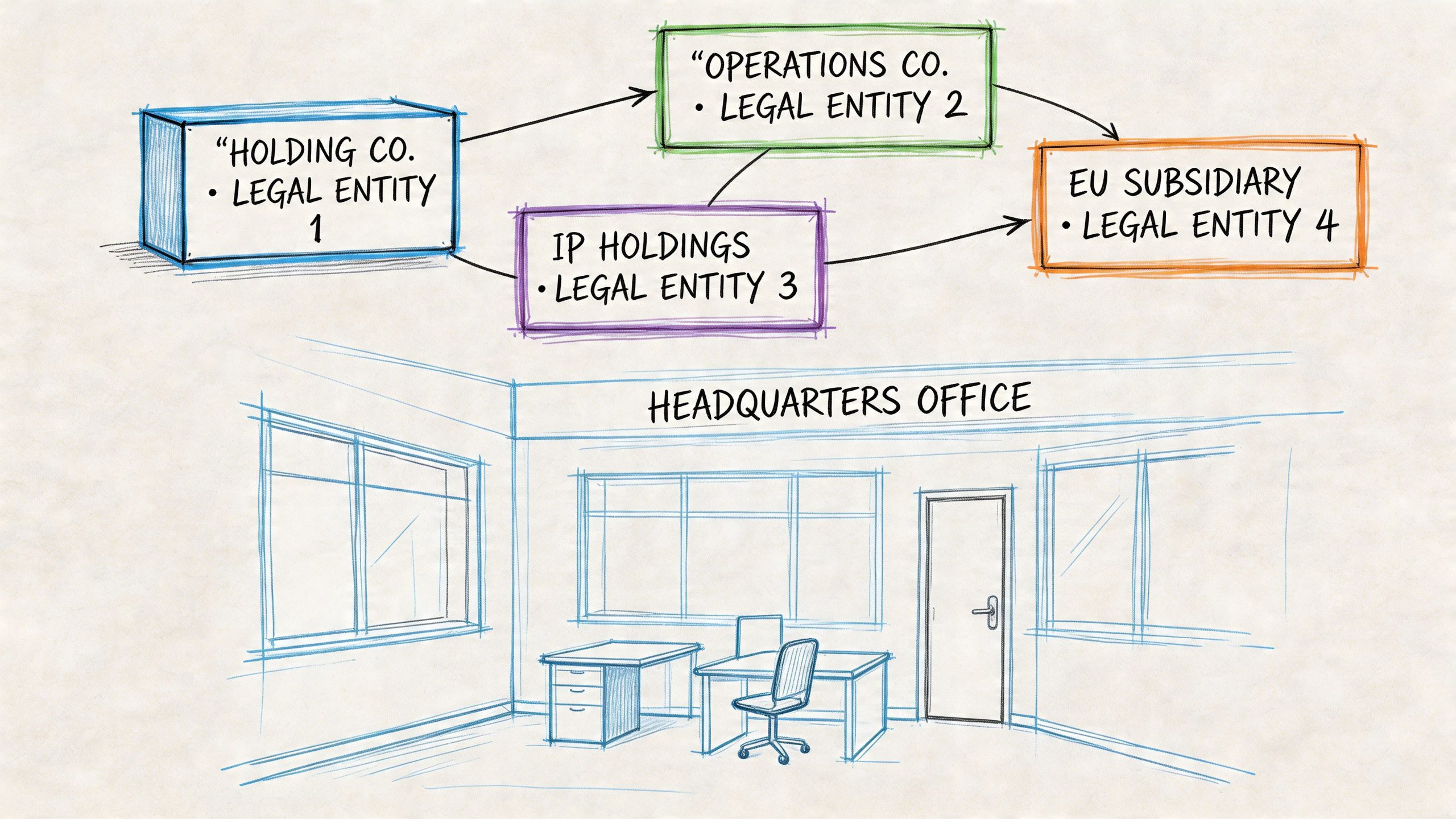
In practice, most entrepreneurs setting up a business in dubai freezone will choose between a Free Zone Establishment (FZE) for a single shareholder and a Free Zone Company (FZC) for multiple shareholders. That distinction sounds minor, but it affects governance, ownership planning, succession, and how cleanly the entity fits into a larger wealth structure.
FZE or FZC depends on control and succession
An FZE is usually the cleaner option when one beneficial owner controls the company and wants simplicity. It works well for solo advisory firms, independent consultants, digital operators, and some holding structures where one person retains control.
An FZC makes more sense where there are:
- Multiple founders with negotiated ownership rights
- Family office arrangements involving more than one principal
- Investment structures where equity will be allocated among partners
- Future transfer plans where ownership changes are expected
The wrong choice here doesn’t always break the setup. It can, however, make later amendments more cumbersome than they needed to be.
Share capital is usually not the real issue
Many founders still assume they need heavy paid-up capital evidence to proceed. In several free zones, that’s not the practical bottleneck. The more important issue is whether the entity can show a coherent business purpose and supporting file.
That matters even more for holding and international service structures. If your company exists to own shares, hold contracts, receive consulting income, or coordinate cross-border invoicing, your documents, internal logic, and office selection need to support that purpose.
A free zone company used for asset protection still needs to look like a real company. The more strategic the structure, the more carefully the basics must be documented.
Office choice is a strategic lever
The office is where many entrepreneurs default to the cheapest available option without thinking through the consequences.
In Dubai free zones, the office tier directly affects visa capacity. A flexi-desk typically allows 1 to 2 visas, while executive offices allow 3 to 5+ visas. Choosing the right office tier upfront can reduce total setup timelines by 20% to 30% by avoiding later reprocessing, according to Alpha Equity’s guide on Dubai free zone office strategy and visa scaling.
What the office really does
It serves three separate functions.
- Licensing requirement: You need registered premises within the free zone framework.
- Visa capacity tool: The office determines how many residence visas the company can support.
- Substance signal: It helps demonstrate that the company has a real operating footprint.
Those are not interchangeable. A founder may think a flexi-desk is enough because the business is fully remote. That may be true for a one-person consulting firm with no dependents and no hiring plan. It may be completely wrong for a company expected to support a spouse, staff hires, or stronger substance evidence later.
Match the office to the next stage, not just today
A practical approach looks like this:
- Flexi-desk if you’re a solo founder, need lean overhead, and only require minimal visa allocation
- Executive office if you expect additional visas, meetings, stronger optics for banking, or a more credible operating footprint
- Warehouse or larger facility if the business involves storage, logistics, or industrial activity
What doesn’t work is choosing the smallest package and assuming upgrades are frictionless. They aren’t. Office reclassification often means extra paperwork, revised facility documents, and waiting cycles that interrupt momentum.
Substance starts with small decisions
For international entrepreneurs using Dubai as part of a tax and asset protection plan, the office is one of the first places where substance becomes real instead of theoretical.
If your company will hold assets, invoice internationally, or support tax residency planning, then the physical presence must make sense relative to what the company claims to do. That doesn’t always require a large office. It does require consistency.
The Execution Phase Licensing and Immigration
A well-planned Dubai Free Zone setup usually starts to break down here, not because the rules are unusually complex, but because this is the point where every earlier decision gets tested against actual forms, approvals, and immigration records. If the company narrative, licence activity, office package, and shareholder documents line up, the process is usually straightforward. If they do not, the file starts attracting questions that later affect visas, banking, and tax position.
Stage one name activity and initial approval
The first real judgment call is not the trade name. It is the activity selection.
Free zones may allow multiple activities under one licence package, and some also offer relatively fast post-approval issuance and bundled visa allocations with separate establishment card and visa processing costs, as outlined in SPCFZ’s guide to Dubai business setup, licensing bundles, timelines, and visa mechanics. The strategic point is not how many activities you can add. It is whether those activities support one credible business model.
A founder who combines software development, management consultancy, and general trading just because the package permits it often creates a profile that is harder to defend later. Banks ask why the company does three different things. Tax advisors ask where management and control actually sit. Compliance teams ask for contracts that match the licence. A tighter activity scope usually gives a cleaner result.
The file itself should be simple and internally consistent:
- Passport copies that are clear, current, and identical across all submissions
- Application forms that use the same spelling, role descriptions, and ownership details throughout
- Business summary or plan written in plain commercial language
- NOC where required, especially if the applicant already holds a UAE-sponsored status
A short business plan is fine. A vague one is not. The authority wants to see what the company will do. The bank will later want to see the same story reflected in contracts, invoices, and counterparties. That consistency is one of the foundations of a usable structure, especially if the company is part of a broader asset protection or tax residency plan.
Stage two incorporation and licence issuance
Once the authority clears the file, the company documents, lease paperwork, and trade licence are issued. This part is often treated as the finish line by first-time founders. It is only the legal birth of the entity.
What matters at this stage is document accuracy. Shareholding percentages, manager details, activity wording, lease terms, and signatures need to be right the first time. Correcting errors after issuance is possible, but every correction introduces delay, extra cost, and new questions from the next institution that reviews the file.
I have seen founders push for speed here and accept generic wording just to get the licence issued. That usually saves a few days and costs them weeks later. If the licence says one thing, the website says another, and the bank application says a third, the company looks manufactured rather than operational.
Stage three immigration and residency sequence
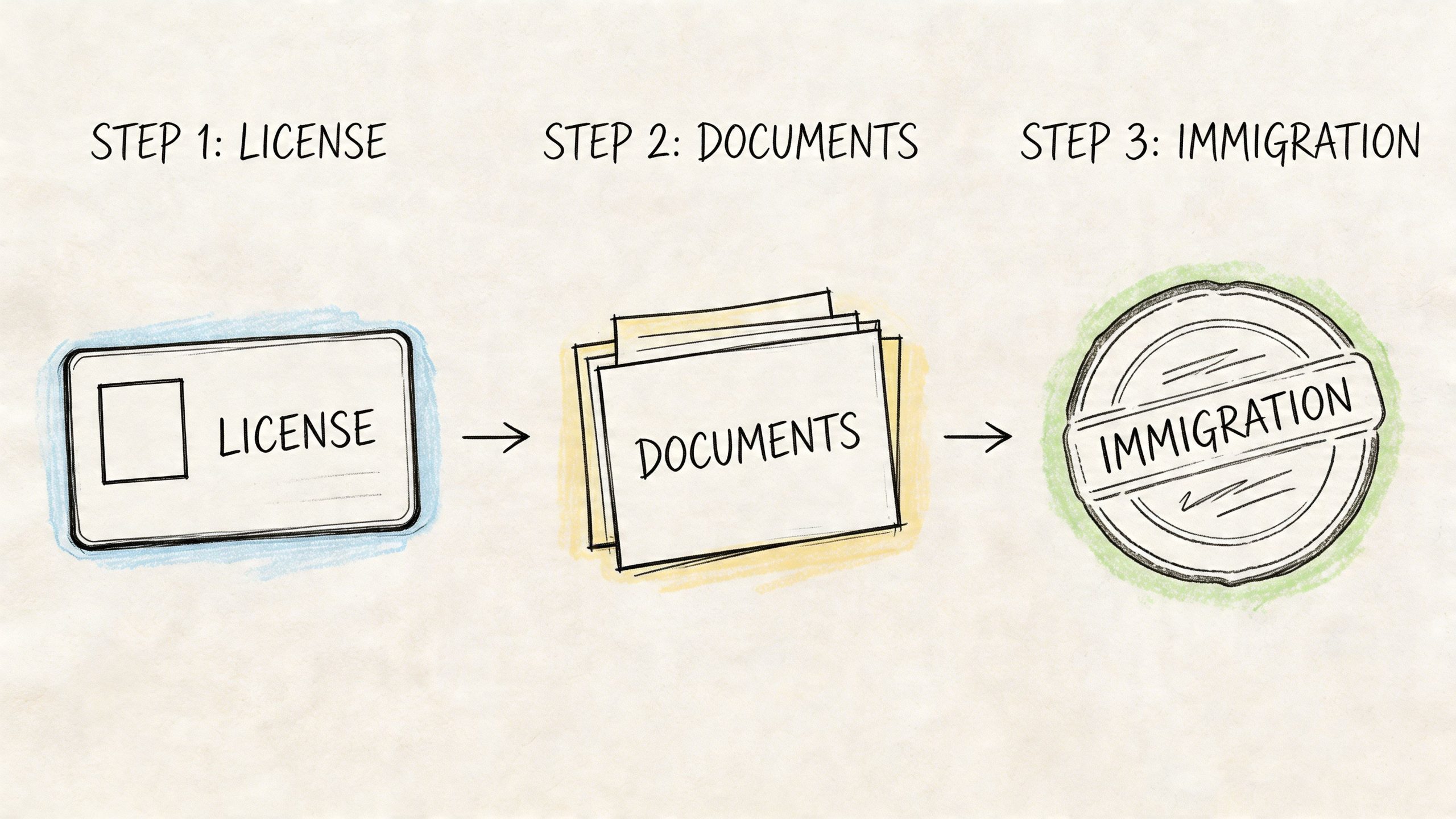
After the licence is issued, immigration processing turns the company from a paper vehicle into something the founder can use on the ground. The order matters because each step depends on the prior one being properly recorded.
The usual sequence is:
- Establishment card issuance
- Entry permit or in-country status adjustment
- Medical test
- Emirates ID biometrics
- Residence completion and visa issuance
Founders who try to compress this by booking appointments before the company file is fully active often create their own delays. Immigration systems are procedural. If one step has not been updated correctly, the next step stalls.
This part also has wider strategic implications. If the plan includes personal tax residency, family relocation, or a second layer of mobility outside the founder’s home country, the visa process should be designed with that end use in mind. A practical starting point is this guide on how to get residency in Dubai through the right setup route.
What usually causes delays
The same problems show up repeatedly.
- Name mismatches between passport, application, and supporting records
- Unclear prior visa history, especially during a switch from employment or dependent status
- Licence activity that does not match the stated business model
- Visa expectations that exceed the office package or facility allocation
- Missing shareholder or manager documents, especially in multi-owner structures
The last point is underestimated. A single missing signature or inconsistent passport copy can hold up an entire file, which matters if the founder is timing the move around school enrollment, tax-year deadlines, or contract commencement dates.
The real objective during execution
The goal is to produce a company that works under scrutiny.
That means the licence, immigration profile, office arrangement, and ownership records need to support one believable commercial story. A company used for international invoicing, asset holding, or residency planning cannot afford contradictions in its formation file. Fast incorporation has limited value if the structure later struggles with visa processing, bank onboarding, or tax residency evidence.
Disciplined sequencing protects more than time. It protects the integrity of the whole structure.
Activating Your Business Banking Tax and Ongoing Compliance
A Dubai Free Zone company proves its value after incorporation, not at the moment the licence is issued.
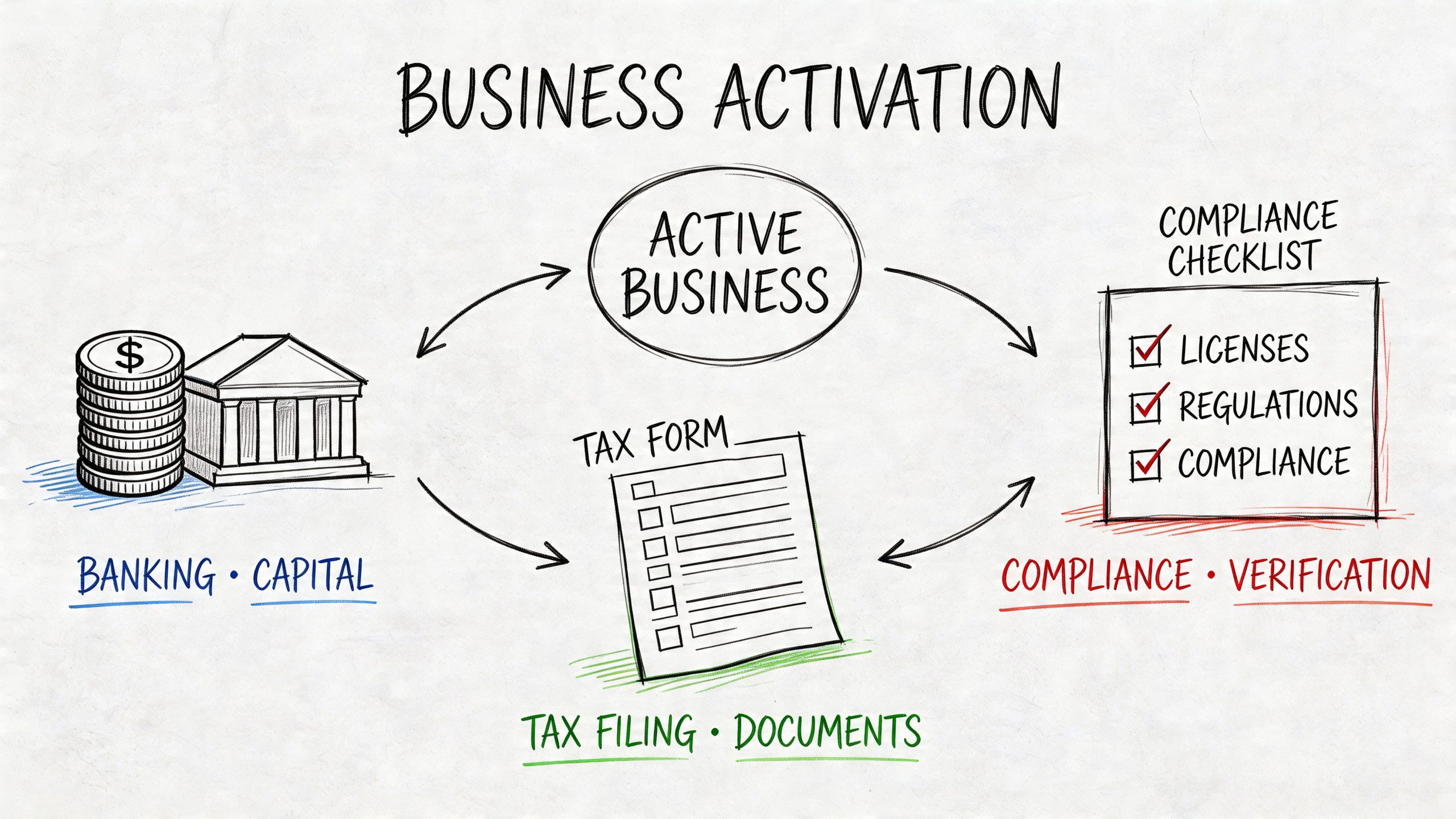
The test starts when the structure meets a bank’s compliance team, a tax filing deadline, a payment processor review, or an audit request. At that stage, the company has to function as a credible operating business, not just a formation package. That is what separates a useful international platform from a fragile one.
Banking exposes the weak points first
Banking is usually the first serious filter. It forces the founder to answer a basic question. Does the company’s commercial story hold together under scrutiny?
UAE banks will test the logic of the structure. A digital business with non-resident owners, light physical presence, cross-border clients, and generic licence wording will face more questions than a founder expects. That does not mean the application will fail. It means the file has to be prepared properly.
The usual review points are predictable:
- What the company sells
- Who the customers are
- Which countries funds will come from
- Why the UAE is the correct base for the business
- Whether contracts, invoices, and licence activity match
- Who ultimately owns and controls the company
Weak files usually fail for ordinary reasons. Vague consulting descriptions, inconsistent source-of-funds records, unclear beneficial ownership, and no sensible explanation for using Dubai are common examples. Banks are not looking for perfection. They are looking for coherence.
I generally advise founders to build the banking file before the licence is issued. The licence, company summary, expected transaction profile, counterparty list, and source-of-wealth explanation should support the same commercial narrative. If those pieces are assembled later, the founder often ends up trying to retrofit substance into a structure that was designed only to get approved by the Free Zone.
For founders who need more than a local operating account, the banking plan should also cover foreign currency access, reserve banking options, and institutions outside the UAE. Specialist support with offshore bank account opening for international structures is often part of that work, especially where the Dubai entity sits inside a wider asset protection or international tax plan.
Tax efficiency depends on how the company operates
A Free Zone company can still be highly tax-efficient. The benefit is conditional.
The practical question is not whether the UAE offers a favorable regime. It does. The practical question is whether your company has been set up and run in a way that supports that treatment. If the business claims Free Zone advantages, its activity, management, records, and income profile need to support that claim. That is where many founders get caught. They spend time on the incorporation and very little on the operating evidence.
As noted in the UAE federal business guidance on Free Zone companies, the framework includes Economic Substance Regulation obligations and corporate tax rules, including the 9% corporate tax rate that can apply to non-qualifying income, depending on how the company earns and reports its revenue: UAE guidance on starting a business in a free zone.
That has direct consequences for structure design. A company used for international services, licensing, holding functions, or regional trading needs to show where decisions are made, where contracts are managed, what activity is carried out from the UAE, and whether the income being booked in the entity matches the licensed activity. This demonstration is fundamental to achieving genuine tax efficiency and asset protection. A company that cannot defend its business purpose or substance is a weak holding vehicle and a weak operating vehicle.
Ongoing compliance is what preserves the structure
Well-run Free Zone companies do a few things consistently. They keep proper books. They invoice in line with the licensed activity. They maintain records that show who manages the company and how decisions are made. They renew licences, visas, and registrations on time. They also keep evidence of real activity, whether that is office use, contracts, staff, service delivery records, or counterpart correspondence.
None of this is complicated. It does require discipline.
The trade-off is straightforward. Founders who optimize only for low setup cost often create a company that is harder to bank, harder to defend for tax purposes, and less useful for residency or long-term international planning. Founders who build the file correctly from the start usually spend more upfront, but they get a structure that can survive compliance reviews and support broader goals such as wealth preservation, cross-border mobility, and cleaner global reporting.
What usually goes wrong
The problems are repetitive because the incentives are repetitive. Founders are encouraged to form quickly, keep costs low, and sort out the details later. Later is when banking and tax issues appear.
| Weak practice | What it triggers |
|---|---|
| Generic licence wording | Extra banking questions and supplier friction |
| Minimal office with ambitious claims | Substance concerns |
| Unclear source of funds | Delayed or rejected account opening |
| Cross-border activity with poor records | Tax and reporting risk |
| Treating renewals as admin only | Compounding compliance issues |
Free Zones are efficient jurisdictions with rules, records, and increasingly serious compliance expectations. Used properly, a Dubai Free Zone company can support tax efficiency, ring-fence risk, and improve international mobility. Used casually, it becomes difficult to bank and difficult to defend.
Advanced Strategies Common Pitfalls and Your Next Steps
A Dubai free zone company becomes much more valuable when it is not the entire strategy.
For high-net-worth entrepreneurs, family offices, and location-independent operators, the primary opportunity is integration. The UAE entity can function as the operating company, invoicing hub, holding layer, or residency anchor inside a wider structure that may also include a trust, foundation, foreign holding company, or US-facing entity. The details vary, but the principle stays the same. Each layer should do one job clearly.
A common example is separating ownership from operations. The Dubai company handles commercial activity, contracts, and regional presence. Another jurisdiction may hold underlying shares or long-term assets. In some cases, a US layer becomes relevant for payment processors, merchant access, financing relationships, or credit-building. None of that should be done casually. It has to be coordinated so beneficial ownership, reporting, and tax treatment remain coherent across jurisdictions.
Banking and US access require planning
Many digital and e-commerce founders hit a wall. They set up the company correctly enough to get the license, then discover the bottleneck is banking.
In Q1 2026, the UAE Central Bank rejected 40% of Free Zone corporate account applications due to KYC gaps. At the same time, getting a US ITIN and bank account through a Dubai entity has an 85% success rate with proper structuring, and businesses that fail to handle the US side correctly can face 30% US withholding tax, according to the Dubai free zone banking and ITIN guide referenced here.
Those numbers matter because they expose the difference between setup and usability.
A founder may technically own a UAE company and still be unable to operate efficiently if they can’t secure:
- a compliant UAE corporate account,
- a payment-friendly US banking route where needed,
- proper tax forms for US-source flows,
- and a file that satisfies both local and cross-border KYC expectations.
Common mistakes that cost time and flexibility
The pattern is predictable.
- Buying based on ads instead of structure: Social media packages usually optimize for headline price, not for banking or tax durability.
- Choosing a vague activity to save money: Cheap licences often become expensive once banks ask what the business does.
- Ignoring substance until renewal season: By then, founders are trying to reverse-engineer evidence instead of building it from the start.
- Assuming remote means invisible: Digital businesses still leave a compliance trail through invoices, counterparties, payment processors, and tax forms.
- Treating immigration separately from corporate planning: Visa needs affect office choice, which affects substance, which affects the broader profile.
- Using one entity for everything: Operations, investments, holdings, and personal asset ownership often work better when separated.
What tends to work better
Astute entrepreneurs usually take the opposite approach.
They define the company’s role before incorporation. They choose the licence based on actual revenue. They prepare a banking narrative before the bank asks for one. They decide whether the company is an operating firm, a holding vehicle, or a residency-supporting structure, then build around that role.
They also avoid overbuilding. A clean, credible structure usually performs better than an elaborate arrangement with too many entities and no operational logic behind them.
If the structure can’t be explained clearly to a bank, an auditor, or a tax advisor in another jurisdiction, it probably isn’t ready.
A sensible next-step framework
Before moving ahead, pressure-test these questions:
- What is the exact role of the Dubai company? Operating entity, holding company, regional office, or residency anchor.
- Where will the company bank first? UAE only, or UAE plus international backup.
- What income will flow through it? Services, trading, royalties, holdings, or mixed activity.
- What substance will support that income? Office, management, staff, contracts, and UAE-based execution.
- How does it fit your personal tax position? Corporate structuring never replaces personal tax residency analysis.
- Will you need US access? If yes, the company should be planned with that in mind from the beginning.
The right Dubai free zone setup is not the one that looks cheapest on day one. It’s the one that still works when you need a bank account, renew visas, defend substance, receive international payments, and connect the entity to the rest of your wealth structure.
If you want a Dubai free zone company that effectively works inside a broader asset protection, tax optimization, and global mobility plan, speak with Protect Your Wealth. They help entrepreneurs and high-net-worth clients design compliant cross-border structures, coordinate UAE company formation, banking pathways, residency planning, and the international layers that most setup agents ignore.