


Let's get one thing straight right from the start: Spain does not have a direct citizenship by investment program. This is the single most common misconception I see.
Instead, what Spain offers is a residency-by-investment path known as the Golden Visa. It's an excellent program, but it's the first step on a long journey, not an instant ticket to a Spanish passport.
The Reality of Spanish Citizenship Through Investment
Many high-net-worth clients come to me looking for a fast-track Spanish passport, similar to what they've heard about in the Caribbean. But Spain's system is built on a completely different philosophy. It’s not a simple transaction where an investment directly buys you citizenship.
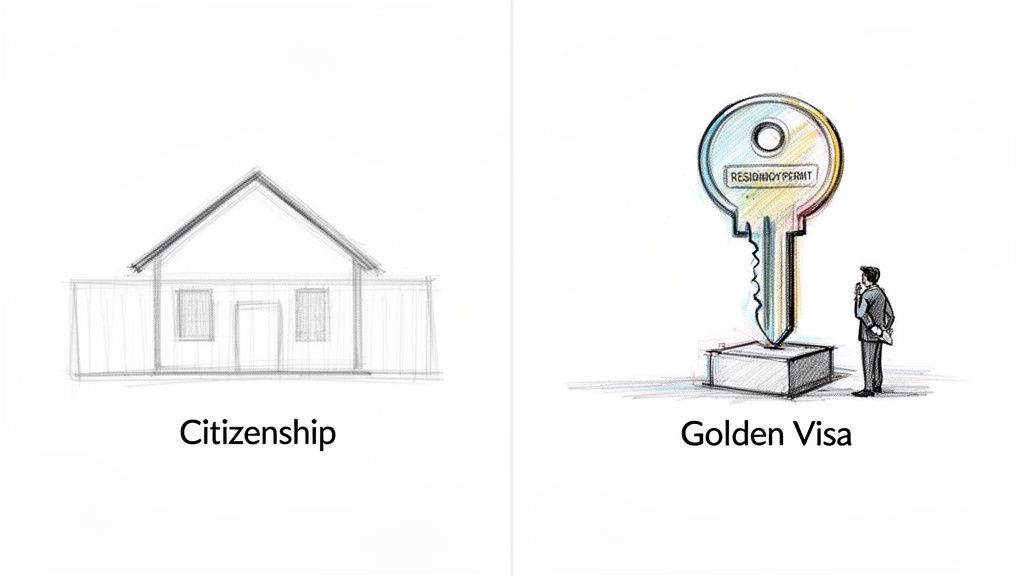
Think of it this way: your investment gets you the key to a beautiful rental property (your residency permit), not the deed to the house itself (citizenship). This key lets you live, work, and enjoy Spain, but owning the house comes much, much later.
Understanding the Residency-First Approach
Spain's system is designed to attract investors who are genuinely committed to building a future in the country, not just those looking for a quick passport of convenience. The path is intentionally gradual: from temporary residency to permanent residency, and only then to potential citizenship.
The Golden Visa is your strategic entry point. It's the most crucial first step, but success hinges on understanding that citizenship is a distant goal achieved through sustained legal residency, not an immediate perk of your investment.
Getting this distinction right from day one is critical for your planning. It sets realistic expectations and allows us to build a viable, long-term strategy that actually works.
What This Means for Investors
For you as an investor, this residency-first model means the focus shifts from a one-off financial transaction to a more involved process of establishing and maintaining real ties to Spain. The journey isn't a sprint; it's a marathon with several distinct stages.
To give you a clear picture, I've broken down the path from your initial investment to potential naturalization in this table.
Spain's Path to Citizenship: An Overview
| Stage | What It Is | What It Is NOT | Typical Timeline |
|---|---|---|---|
| Golden Visa | A long-term residency permit granted for a qualifying investment. | An instant Spanish passport or citizenship. | 2–3 months to obtain |
| Temporary Residency | The right to live, work, and travel in Spain and the Schengen Area. | Permanent status. Requires renewals. | Initial permit, then renewals up to 5 years |
| Permanent Residency | A more stable status after 5 years of continuous legal residency. | Full citizenship with voting rights. | After 5 years of residency |
| Citizenship | Full Spanish nationality, granting an EU passport. | A guaranteed right. It requires application and approval. | After 10 years of total legal residency |
This multi-year process demands patience and careful, forward-thinking planning. Unlike direct citizenship programs where a passport can be in your hands within months, the Spanish route is a long-term commitment. Understanding this from the outset is essential to ensure your goals align with what Spain truly offers.
How Spain's Golden Visa Program Works
Let's clear up a common misconception right away: Spain's Golden Visa is a residency program, not an instant passport scheme. Think of it as the strategic entry point—the key that unlocks the door to long-term residency, which then puts you on the decade-long path toward potential Spanish citizenship.
The program is built with several investment channels to suit different financial strategies, but one route stands out as the overwhelming favorite.
The most popular option by a long shot is real estate investment. The rule is simple and clear: invest a minimum of €500,000 in Spanish property. This can be one home, multiple apartments, or even commercial spaces, as long as the combined value hits that half-million-euro mark.
But property isn't the only game in town. Spain offers several other avenues for high-net-worth individuals to secure their residency.

Exploring All Investment Avenues
While property grabs the headlines, other qualifying investments provide flexibility for investors with different portfolio structures. Understanding these alternatives is crucial for aligning the Golden Visa with your bigger financial picture.
These alternative routes include:
- Capital Transfer: Deposit a minimum of €1,000,000 into a Spanish bank account.
- Company Shares: Invest at least €1,000,000 in the shares of active Spanish companies.
- Government Bonds: Purchase €2,000,000 in Spanish government debt.
- Business Project: Launch a business in Spain that is deemed of "general interest." This usually means it creates jobs, drives technological innovation, or has a major socioeconomic impact. There's no fixed minimum investment here; it’s evaluated case-by-case.
No matter which path you choose, the investment must be maintained for at least the first five years to keep your residency permit active and renewable.
The True Cost of Real Estate Investment
Circling back to the popular real estate route, that €500,000 figure is just the starting line. It's critical to factor in the additional transaction costs, which can significantly bump up your total outlay.
A common mistake investors make is underestimating ancillary costs. A realistic budget should account for an additional 10-15% of the property's value to cover all taxes and fees, ensuring a smooth and fully funded transaction.
Here’s a quick breakdown of what to expect beyond the purchase price:
- Property Transfer Tax (ITP): For resale properties, this regional tax typically runs from 6% to 10% of the purchase price, depending on the autonomous community.
- Value Added Tax (VAT) & Stamp Duty (AJD): Buying a new property directly from a developer? You'll pay 10% VAT plus a stamp duty (AJD) of around 1.5%.
- Legal Fees: A good lawyer is non-negotiable. Budget around 1-2% of the property value for their services, which include due diligence and contract reviews.
- Notary and Land Registry Fees: These official fees usually add another 0.5% to 1% of the property price.
This means a €500,000 property could easily require a total cash outlay of €550,000 to €575,000.
Investor Behavior and Market Hotspots
Following the money offers some powerful insights. Historically, major hubs like Madrid and Barcelona, along with sunny coastal areas like the Costa del Sol, have been magnets for Golden Visa investors. They offer strong property markets and an undeniable lifestyle appeal.
Recent data paints an even clearer picture. Catalonia has become the undisputed epicenter of Golden Visa activity, accounting for a third of all national approvals. The region issued 1,248 golden visas since 2020, pulling in nearly €827 million in investment.
Within Catalonia, Barcelona was the star, capturing 98% of those approvals. And while the minimum investment is €500,000, the 2024 average spend hit €662,000, with some investors putting in over €4 million. You can dig deeper into these regional golden visa investment patterns on imidaily.com.
This trend shows a clear willingness among applicants to go well beyond the minimum to secure premium assets, highlighting the program's appeal to serious, high-capital investors.
Mapping Your Journey From Residency To Citizenship
Getting a Spanish Golden Visa is a fantastic first step, but it’s crucial to see it for what it is: the starting line, not the finish. Your investment buys you a residency permit, which is the key that unlocks the door to Spain. But the path to a Spanish passport is a long-haul game—a structured, multi-stage marathon that demands patience and a real long-term commitment.
This isn’t a quick, transactional shortcut to a new passport. It’s a gradual process of putting down roots. Think of it like building a house. Your Golden Visa is the foundation—solid and essential—but the walls, roof, and the rest of the home are built year by year through continuous legal residency.
The Initial Residency and Renewal Cycles
Your journey starts with the first residency permit. If you apply from inside Spain, you’ll typically get a card valid for three years. If you apply from a Spanish consulate back home, you'll first get a one-year visa, which you then convert into a three-year residency card once you arrive.
To keep your residency active, you simply have to renew it. After that first period is up, you can apply for a five-year renewal. The main requirement here is dead simple: you must still hold the original investment that got you the visa. For Golden Visa holders, this phase is incredibly flexible because there’s no minimum stay requirement to keep the permit valid.
Here’s the critical distinction you need to grasp: there’s a massive difference between maintaining residency and qualifying for citizenship. The Golden Visa’s flexibility lets you keep your permit without living in Spain, but the path to a passport demands you actually make Spain your home.
This flexibility is a huge perk for global investors who aren't ready to move full-time just yet. But it’s also a common trap. Many investors mistakenly assume this minimal presence is enough for the whole journey, and that’s a costly mistake.
From Permanent Residency to Naturalization
The first major milestone on your path toward a Spanish passport is getting permanent residency. You can apply for this after you’ve held legal and continuous residency for five years. This is where "effective residency" becomes non-negotiable. To qualify, you generally can’t have been outside of Spain for more than ten months total during that five-year stretch.
Once you’ve secured permanent residency, the final leg of the journey begins: applying for citizenship through naturalization. The standard timeline for this is ten years of legal and effective residency.
That ten-year clock starts ticking the day you got your very first residency card. To cross the finish line, you need to prove you have real ties to the country. This means:
- Physical Presence: Showing you’ve genuinely lived in Spain for at least 183 days a year for most of those ten years.
- Cultural Integration: Passing two exams—the DELE A2 for Spanish language skills and the CCSE, which tests your knowledge of Spain's constitution, society, and culture.
- Clean Record: You must have a clean criminal record, both in Spain and in your original home country.
The Dual Citizenship Hurdle
One of the biggest roadblocks is Spain’s tough stance on dual citizenship. For most investors, including those from the US, UK, and China, becoming a Spanish citizen means you have to formally renounce your original nationality.
There are a few exceptions for citizens of Ibero-American countries, Andorra, the Philippines, Equatorial Guinea, and Portugal. For everyone else, it’s a massive, often heart-wrenching decision. This requirement shows just how deep the commitment Spain expects. It's a final, decisive step that transforms you from a resident investor into a full-fledged Spanish national. While many other countries offer more flexible residency-by-investment programs, understanding this specific roadmap is essential for anyone serious about a Spanish passport.
Who Is Investing In Spain And Why?
To really understand Spain's residency-by-investment landscape, you have to look at who's actually putting their money down and why. When you dig into the data, you start to see clear patterns emerge, moving beyond generic advice to show how different nationalities use the Golden Visa for entirely different reasons.
The program has drawn a global crowd, but investors from a few key countries have consistently made up the bulk of applicants. Looking at these trends isn't just an academic exercise; it's about seeing where you fit and learning from the strategies—and successes—of those who came before you. This kind of market intelligence is what helps you build a smart approach.
Contrasting Investment Strategies: American vs. Chinese Investors
Historically, Chinese and American investors have been two of the most dominant groups, but their philosophies couldn't be more different. This contrast is a fantastic case study in the program's flexibility and how it can be molded to fit radically different goals.
Chinese investors have long led the pack in sheer volume of applications. American investors, on the other hand, show up in smaller numbers but have consistently deployed far more capital. This reveals two distinct strategic paths:
- The High-Volume Approach (Chinese Model): This strategy focuses on securing residency for as many family members as possible, often by meeting the minimum investment thresholds. The main driver here is typically mobility, access to European education for children, and having a safe haven, rather than chasing high-return financial plays.
- The High-Capital Approach (American Model): American investors tend to make much larger individual investments. For them, the motivation is often about acquiring significant assets in a stable EU economy, making a lifestyle change, or diversifying their wealth for the long term.
The key takeaway here is that there's no single "best" way to use the program. It all comes down to your personal and financial objectives. Are you trying to maximize mobility for your family, or are you focused on parking your wealth in a prime European asset?
Thinking through these patterns helps you get crystal clear on your own priorities before you even think about committing capital.
A Data-Driven Look at Applicant Demographics
The numbers themselves tell a fascinating story. By volume, Chinese investors have historically owned Spain's Golden Visa program, securing a total of 1,302 visas. In 2024 alone (between January 1 and November 20), they made up nearly half of all applicants, receiving 473 out of 942 visas. But that volume doesn't paint the full financial picture.
American investors, despite receiving only 113 visas historically, poured a massive €1.6 billion into Spain between 2018 and 2022. That's more than double the €768 million contributed by Chinese investors during the same period—a perfect illustration of the high-capital strategy in action. Following these two giants, Russians were the second-largest group with 521 total approvals, while Iran and the UK trailed with 124 and 123 visas, respectively. You can find more details on how these visa application trends have shifted on imidaily.com.
This timeline gives you a bird's-eye view of the major milestones on the long road from residency to a potential Spanish passport.

As you can see, getting the initial residency card is the quick part. Achieving permanent status and eventual citizenship is a marathon, not a sprint, requiring a multi-year commitment to the country.
Market Reactions to Program Changes
Investor behavior is also a direct reflection of government policy. When the Spanish government announced in December 2024 that the Golden Visa program would be terminated on April 3, 2025, it set off a firestorm of interest, especially from American nationals.
Applications from the U.S. shot up by 200%. This mad dash was driven by affluent Americans trying to lock in Spanish residency before the window slammed shut for good. The data showed applications had already tripled by June 2024 and only accelerated after the official termination date was published on January 3, 2025. It’s a classic example of how quickly savvy investors move when a valuable opportunity is about to disappear.
Holistic Wealth And Tax Planning For Spanish Residency
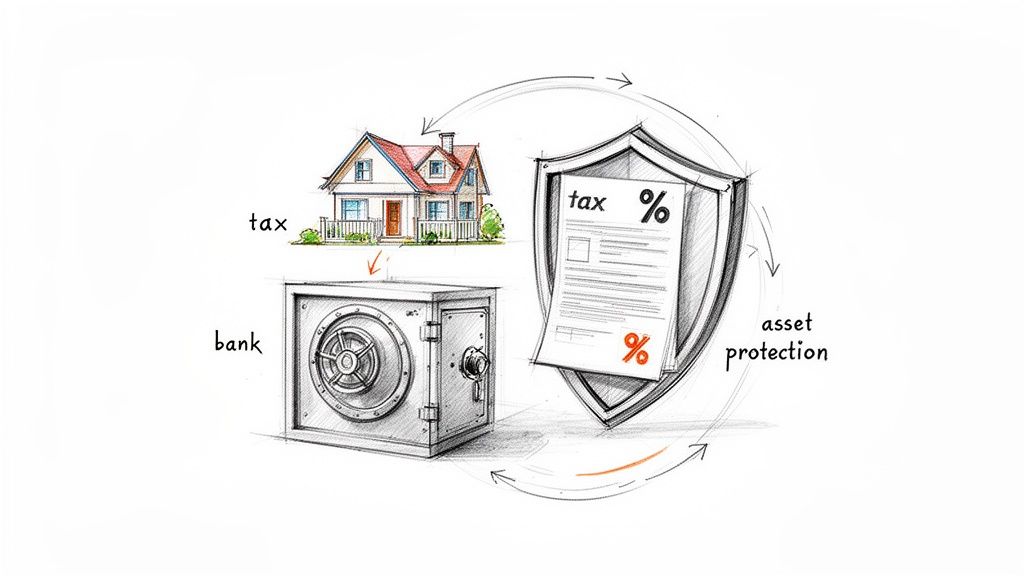
Getting a Spanish Golden Visa isn't just about paperwork; it's a major financial move that will send ripples through your entire global asset structure. Failing to plan for this shift is like building a luxury villa on an uninspected foundation—the risks are hidden, but they can be catastrophic.
This is where holistic planning becomes non-negotiable. It means looking beyond the visa application and strategically weaving your new residency status into your broader wealth management, tax, and legacy goals. This isn't just about protecting what you already have; it's about structuring your affairs to thrive in your new European base.
Understanding Spanish Tax Residency
The first concept you absolutely must get right is tax residency. Just holding a Golden Visa doesn't automatically make you a Spanish tax resident.
The real trigger is your physical presence. Spend more than 183 days in Spain during a single calendar year, and the Spanish tax authorities will generally consider you a tax resident. Once you cross that line, Spain gains the right to tax your worldwide income, gains, and wealth. This is a profound change that requires sharp, proactive management.
The 183-day rule is the bright line that separates a non-resident investor from a full Spanish taxpayer. Understanding its implications before you move is the single most important step in protecting your global wealth.
Get this wrong, and you could face unexpected and massive tax bills on assets you hold all over the world.
Key Tax Considerations For Investors
For new residents, several parts of the Spanish tax system need your immediate attention. Smart, proactive planning here can dramatically lower your exposure and optimize your financial structure for your new life.
Here are the key areas to address:
- Income Tax (IRPF): As a tax resident, you're on the hook for Spain's progressive income tax on your global earnings. In some regions, this can climb to nearly 50%.
- Wealth Tax (Patrimonio): Spain is one of the few EU countries still levying a wealth tax. It's an annual tax on your net worldwide assets, though generous regional allowances can sometimes soften the blow.
- Capital Gains Tax: Profits from selling assets, like stocks or property, are typically taxed at rates from 19% to 28%.
Navigating these rules demands a custom-built strategy. For certain qualified individuals, special tax regimes can be a game-changer. For example, you can learn how to pay zero tax on foreign income with Spain's Beckham Law in our detailed guide, which breaks down this popular option for high-earning expats.
Practical Steps For A Smooth Financial Transition
Beyond pure tax strategy, a successful move to Spain involves several practical financial moves. Think of these as the bedrock of your new life—get them right, and you'll operate smoothly from day one. Get them wrong, and you'll be buried in administrative headaches.
1. Opening a Spanish Bank Account
This is not optional. You’ll need a local bank account for everything—managing your investment, paying taxes, setting up utilities, and handling daily life. To open one, you’ll first need a Spanish identification number (NIE), which is one of the first documents you'll secure in the process.
2. Conducting Property Due Diligence
If you go the real estate route, rigorous due diligence is everything. Your legal team must verify the property title, check for any debts or liens (which a buyer inherits in Spain), and confirm all planning permissions are in order. Skipping this is a recipe for disaster.
3. Navigating the Process for Family Members
The Golden Visa is great for families, covering your spouse, dependent children, and even dependent parents. But remember, each family member needs their own application, complete with a meticulously prepared set of documents. A coordinated approach ensures everyone gets residency together, preventing the delays and chaos that come with piecemeal applications.
A proper financial and legal plan ties all these threads together. It turns the journey to Spanish residency from a series of disconnected tasks into a single, coherent strategy designed to protect and grow your wealth for years to come.
Exploring Your Next Steps And Strategic Alternatives
So, where do you go from here? The most important thing to understand is that Spain’s Golden Visa is a residency permit, not a direct passport. Getting that Spanish citizenship is a long-term play—it’s a marathon that demands patience and the right advice, not a quick transaction.
Your first step should always be a confidential chat to map out your personal and financial goals. This is where we figure out your eligibility, set realistic timelines, and make sure your investment strategy aligns with your larger plans for global mobility and protecting your wealth. A custom-built plan isn't a luxury; it's essential for getting this right.
Consider Your Alternatives
A smart strategy always looks at the whole picture. Spain has its perks, no doubt, but other EU countries have compelling residency and citizenship programs that might be a better fit for what you need right now. For instance, places like Greece, Malta, and Portugal all have different investment levels and timelines to consider.
Smart investors weigh multiple jurisdictions. The goal isn't just to gain residency but to select the program that offers the optimal blend of lifestyle, financial benefit, and long-term security for your family.
Programs like the Portugal Golden Visa offer a different structure and a popular pathway to an EU passport, which just goes to show how important it is to compare your options.
Ultimately, the best choice comes down to your specific circumstances. We encourage you to contact our team to build a tailored plan that secures your future, whether that’s in Spain or another top-tier jurisdiction. Your quest for Spain citizenship by investment starts with making an informed first move.
Frequently Asked Questions
When it comes to investment residency, the details matter. Here are some straightforward answers to the most common questions we get from clients looking at Spain.
Can My Family Join Me On The Golden Visa?
Absolutely. The Spanish Golden Visa is designed with families in mind, letting you bring your immediate family with you. This is a huge advantage for anyone planning to build a life in Europe, not just secure a visa.
The program typically covers:
- Your spouse or legal partner.
- Dependent children under 18.
- Dependent children over 18 who are full-time students and still rely on you financially.
- Your dependent parents or your spouse's dependent parents.
Each person needs their own application, complete with documents proving their relationship to you and their financial dependence. We always handle these as a single, coordinated submission to make sure everyone’s residency gets approved together, smoothly and without any hitches.
How Much Time Must I Spend In Spain To Keep My Residency?
This is where a lot of people get confused, and it’s a critical distinction. To simply renew your Golden Visa, the time requirement is almost zero—you just have to visit Spain at least once during your residency period. It’s incredibly flexible.
However, if your end game is permanent residency or citizenship, that flexibility disappears. To qualify for permanent residency after five years, or Spanish citizenship after ten, you have to prove that Spain is your actual home. That means "effective and continuous residency"—no long absences of more than a few months per year.
The Golden Visa's low physical presence rule is for keeping the permit alive. The path to citizenship is completely different and requires a real commitment to living in Spain. The standard benchmark for this is at least 183 days per year, which also triggers tax residency.
What Are The Tax Implications Of Spanish Residency?
Becoming a resident of Spain will have major tax consequences, and this demands careful planning before you make the move. If you spend more than 183 days in Spain within a single calendar year, you’re almost always considered a tax resident.
Once you cross that line, you're liable for Spanish taxes on your worldwide income, assets, and capital gains. The key taxes to know about are the progressive income tax (IRPF), a national wealth tax (Patrimonio), and inheritance tax.
Spain does have some special tax regimes, like the famous 'Beckham Law,' which can provide a favorable flat tax rate on Spanish-sourced income for a limited time. But given the complexity, getting professional tax advice isn't just a good idea—it's essential to structure your finances correctly from day one.
At Protect Your Wealth, we build custom-made global mobility and asset protection strategies for clients who demand precision. Our expertise ensures your move toward Spanish residency is seamless, compliant, and perfectly aligned with your bigger financial picture. Contact us for a confidential consultation to explore what's possible.


