


For any international entrepreneur serious about the American market, getting a US bank account for non residents isn't just another item on the to-do list. It's the master key. This single step unlocks everything from seamless payments to building a financial history, fundamentally changing how you operate in the world's biggest economy.
Why a US Bank Account Is a Strategic Asset
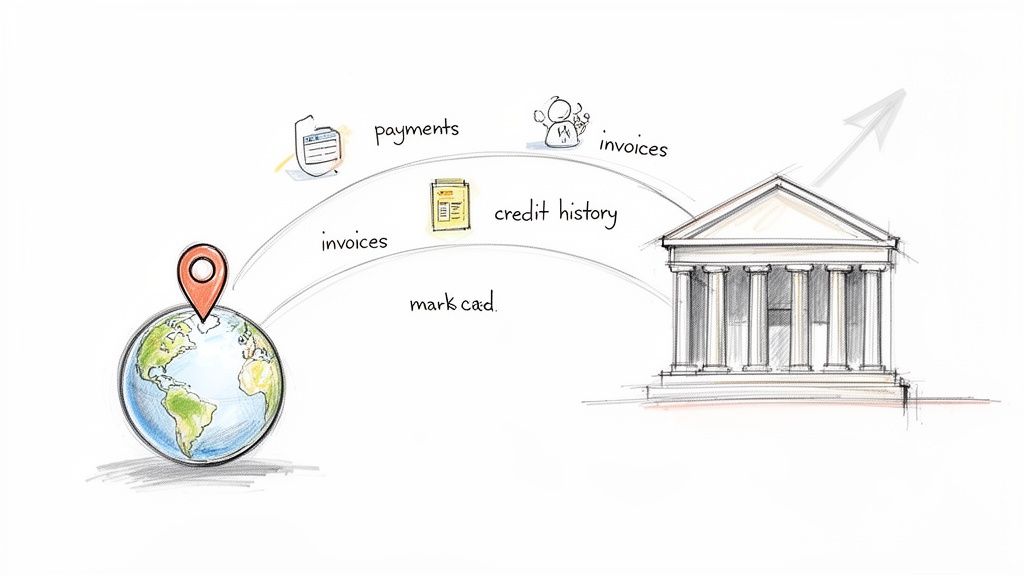
Think of a US bank account as the central nervous system for your American operations. It's the financial backbone connecting you to clients, suppliers, and critical business tools. It shifts you from being an outsider looking in to a fully integrated player in the US market.
Without it, you're constantly fighting friction—painful currency conversion fees, delayed payments, and a subtle lack of credibility with American partners who are used to simple, domestic transactions.
Unlocking Essential Business Infrastructure
Let's get practical. Modern online businesses run on tools like Stripe and PayPal. These aren't just convenient; they're essential. The problem is, many of these platforms impose stricter rules—or outright refuse service—to businesses operating with non-US bank accounts.
A proper, US-domiciled bank account tears down these walls instantly. You get an ACH routing number and an account number, the gold standard for domestic money movement in the States. This simple detail lets you:
- Accept Payments Seamlessly: No more jumping through hoops. Integrate directly with major US payment processors without the headaches or higher fees.
- Pay US-Based Talent and Suppliers: Send funds via ACH, which is almost always faster and dramatically cheaper than slow, expensive international wire transfers.
- Boost Your Cash Flow: Get paid by US clients faster. The money hits your account quickly, without getting lost in the international banking maze for days.
Building Credibility and a Financial Footprint
When you send an invoice from a foreign bank, it sends a clear signal: you're an outsider. It might seem small, but this can create hesitation or a perception of risk for your American customers. Invoicing from a familiar US bank tells them you're established and committed to the market.
Even more importantly, this is your first step toward building a real financial footprint in the US. A business checking account doesn't directly build your credit score, but it creates a verifiable transaction history with an American financial institution. That relationship becomes priceless when you eventually want to apply for business loans, credit lines, or corporate credit cards. You can learn more about how to access American credit in our detailed guide for international entrepreneurs.
Opening a US bank account is one of the highest-leverage moves an international founder can make. It’s not just about holding dollars. It’s about plugging your entire business directly into the American economic engine, giving you the legitimacy and operational speed that an international account simply can't provide.
This banking history is the foundation you'll build on. It's the bedrock for a strong credit profile—a non-negotiable asset for anyone trying to scale a business in the competitive US landscape.
Your Eligibility and Account Options
Before you start filling out applications, you need a clear strategy. Getting a US bank account for non residents isn't about just finding a bank—it's about understanding which path is actually open to you. Your eligibility is everything.
Let's be blunt: trying to open a personal US bank account from your home country without a US address or Social Security Number (SSN) is almost impossible. Traditional banks have strict in-person rules and demand proof of US residency. You might find a few workarounds online, but they're unreliable and definitely not built for running a serious business.
For global entrepreneurs, there's a much more direct and powerful route: setting up a US company.
The Corporate Account Advantage
When you form a US entity, like a Limited Liability Company (LLC) or a C-Corporation, you completely change the game. You're no longer applying as a foreign individual facing immense scrutiny. Instead, you're applying as a legitimate, US-based business.
This simple shift opens doors that are firmly shut to non-resident individuals. The bank’s conversation with you is no longer about your personal residency status. It's about your registered American company. This is exactly why for 99% of international founders, a corporate account isn't just the best option—it's the only real one.
Think of it from the bank's perspective. Their biggest concerns are compliance and risk. A registered US business with an official Employer Identification Number (EIN) from the IRS is a known, verifiable entity. An individual living abroad? From a compliance standpoint, that’s a much bigger question mark.
You Don't Need to Fly to the US
One of the most persistent myths is that you have to physically be in the United States to open a business bank account. For decades, that was true, but the rise of financial technology has completely rewritten the rules of the game.
Today's digital banks and financial platforms are built from the ground up for remote founders. They use robust, online-only verification systems that satisfy all Know Your Customer (KYC) and Anti-Money Laundering (AML) regulations without you ever stepping foot in a physical branch. The entire process, from application to funding, can be done from your home office, anywhere in the world.
The Non-Negotiable Requirements
While the process is more accessible than ever, a few core requirements are absolute deal-breakers. Don't waste your time looking for ways around these—they are fundamental to any legitimate US banking application.
- A Registered US Business Entity: You must have an officially formed LLC or C-Corp in good standing. Your company's formation documents are the first thing any bank will ask to see.
- An Employer Identification Number (EIN): This is your business's unique tax ID number, issued by the IRS. It's the corporate version of a Social Security Number, and it's mandatory.
- A Valid Government-Issued Passport: As the business owner, you will need to provide a clear, valid copy of your passport to verify your identity.
The challenges non-residents face aren't new; they're a well-known hurdle in the US financial system. Historically, foreign-born non-citizens have been about 60% as likely to have a bank account as native-born citizens. This gap reveals systemic issues that go beyond simple paperwork. But the good news is that the corporate route effectively closes that gap for entrepreneurs. You can read more about these systemic issues in the Federal Reserve's findings on financial inclusion barriers for non-citizens.
By understanding these realities from the start, you can focus your energy on the one strategy that actually works: forming a US entity to unlock the full power of American banking, no matter where you are in the world.
Assembling Your Essential Documents
Think of your application for a US bank account for non residents as building a case for yourself. Every document is a piece of evidence that proves your business is real, you are who you say you are, and you’re someone the bank wants to work with.
A single missing document or a poorly scanned passport can bring the whole process to a dead stop. Getting this right isn't just about ticking boxes; it’s about presenting a professional package that makes the bank's decision to approve you an easy one.
The Foundation: Your US Company Documents
First things first, you need to prove your US company actually exists and is in good standing. This is the absolute bedrock of your application and it’s non-negotiable. Without a registered US entity, you simply won’t be able to open a business bank account remotely.
You'll need clean, high-quality digital copies of your official formation documents. These can vary a bit depending on the state and your business structure, but they generally include:
- Articles of Organization (for an LLC): The core document filed with the state that officially created your Limited Liability Company.
- Certificate of Incorporation (for a C-Corp): The equivalent document for a corporation, confirming its legal establishment.
- Operating Agreement or Bylaws: While this is an internal document, many banks now ask for it. Why? They want to see the ownership structure and understand who runs the company. Make sure it clearly lists all owners (members or shareholders).
Pro Tip: Any owner holding 25% or more of the company needs to be ready to provide their personal ID. This is a federal requirement for banks to identify all "beneficial owners" as part of their anti-money laundering checks. Don't get caught unprepared.
The All-Important Tax Identification Numbers
Once your company is formed, the next layer of legitimacy comes directly from the IRS. These federal ID numbers are mandatory—they signal to the bank that your business is recognized for US tax purposes.
Employer Identification Number (EIN)
This is arguably the most critical document after your company formation papers. An EIN is basically a Social Security Number for your business. You must provide the official confirmation letter from the IRS, which is typically Form CP 575. A classic mistake is just typing the number into the application form. Banks need to see the actual letter to verify it.
Individual Taxpayer Identification Number (ITIN)
This is where a lot of international founders get stuck. Is an ITIN absolutely required to open a business bank account? Usually, no. For most modern online business accounts, your company’s EIN and your foreign passport are enough.
But an ITIN is a powerful strategic tool. It’s a tax processing number for foreign nationals who have a US tax filing requirement but can’t get an SSN. Its real value, however, goes way beyond taxes. An ITIN is the key that unlocks your personal financial life in the US, allowing you to build credit history, apply for personal loans, and get those premium US credit cards.
While it’s not mandatory for day one, getting an ITIN is a crucial step for anyone serious about long-term integration into the US financial system. If that's your goal, you can learn more about the process of getting an ITIN number in our guide.
Proving Who You Are: Personal ID and Address
The final piece of the puzzle is you—the person behind the business. The requirements here are simple, but you have to follow them to the letter.
Valid Government-Issued Passport
This is the gold standard for identity verification. Make sure your passport isn’t expired and that you have a high-quality, color scan of the main photo page. It has to be crystal clear, with no glare or cut-off corners. Some banks are now asking for a "selfie" of you holding the passport to confirm it's really you.
Proof of Foreign Address
You do not need a US residential address. The bank needs to verify where you actually live in your home country. This is a common stumbling block for applicants.
The document you provide must:
- Clearly show your full name and home address.
- Be recent (usually dated within the last 90 days).
- Come from an official source.
Good examples include a recent utility bill (electricity, water), a bank statement from your local bank, or official government correspondence. Mobile phone bills are often rejected, so don't even try. If the document isn't in English, you'll likely need to get it professionally translated.
To make it crystal clear, here’s a simple checklist comparing what you'll need for a corporate account versus a personal one.
Required Documents for US Bank Account Opening
| Document | Required for Corporate Account | Required for Personal Account | Key Considerations & Tips |
|---|---|---|---|
| Passport | ✅ | ✅ | Must be valid (not expired). A high-resolution color scan is essential. |
| Proof of Foreign Address | ✅ | ✅ | Must be recent (under 90 days). Utility bills or bank statements work best. |
| Company Formation Docs | ✅ | ❌ | Articles of Organization (LLC) or Certificate of Incorporation (C-Corp). |
| EIN Confirmation Letter | ✅ | ❌ | The official IRS letter (CP 575) is required, not just the number. |
| ITIN or SSN | ❌ (Usually) | ✅ | An ITIN is highly recommended for long-term financial access in the US. |
| Operating Agreement/Bylaws | ✅ (Often) | ❌ | Clearly lists all owners with 25%+ stake. Have it ready just in case. |
As you can see, opening a corporate account has a few more moving parts, but it’s entirely manageable with the right preparation. The key is to have everything organized and ready to go before you even start the application.
Choosing Between Remote and In-Person Banking
One of the biggest shifts for international founders looking to get a US bank account for non residents has been the move away from mandatory in-person visits. Today, you can get it all done remotely, and this isn’t just about convenience—it’s a game-changer that has unlocked the American market for entrepreneurs everywhere.
Understanding the difference between the old way and the new way is the key to picking the right strategy for your business.
Not long ago, opening a US bank account meant booking a flight. You’d have to schedule appointments, land in the US, and sit down with a banker at a big institution like Chase or Bank of America. While there’s something to be said for a face-to-face meeting, it’s expensive, eats up valuable time, and frankly, is becoming obsolete for most businesses.
Now, the model is all about digital efficiency. Fintech platforms and a new breed of online banks have built their entire onboarding process to be handled from anywhere on the planet. This remote-first approach is now the standard for countless global founders.
The Traditional In-Person Approach
Walking into a physical bank branch still holds some appeal. If you’re launching a complex business, dealing with significant seed funding, or have unique operational needs, that in-person meeting can be worth it. It’s a chance to explain your vision directly and build a rapport with a branch manager who could become a valuable ally.
But be warned, this path is often full of frustrating roadblocks.
- Inconsistent Policies: Branch policies are all over the place. One banker might know exactly how to handle non-resident applications, while another just a few miles away could turn you down flat because they’ve never seen one before.
- High Opportunity Cost: The money and time you pour into flights, hotels, and meetings add up fast—with zero guarantee of walking away with an open account.
- Strict Documentation: Traditional banks are notoriously rigid. They often demand proof of a US address, something most remote founders simply don’t have.
For a deeper look into how these legacy institutions stack up, check out our guide comparing fintech accounts vs. traditional banks for non-residents.
Embracing the Remote Banking Revolution
The rise of digital-first platforms like Mercury, Relay, and Wise Business has completely changed the game. These aren’t just banks with a website; they are technology companies offering banking services, and that distinction is everything. Their entire system is built from the ground up for a global, remote-first customer.
This remote approach gives you two massive advantages: speed and accessibility. The whole process is digital, from submitting your application to verifying your identity.
The core strength of the remote model is predictability. You follow a clear, defined digital process that was specifically built for international founders. There’s no guesswork and no relying on the discretion of a single branch employee.
The journey is incredibly streamlined. You upload your documents through a secure portal, and the platform runs its Know Your Customer (KYC) and Anti-Money Laundering (AML) checks using advanced digital tools. This usually includes a quick “liveness” check—think a selfie or short video to confirm you are who your passport says you are.
This infographic breaks down the essential document flow for a remote application.

As you can see, the whole process is anchored on official documents that prove your business is legitimate and properly registered in the US.
Making the Right Choice for Your Business
So, how do you decide? It really comes down to your specific business needs and your long-term goals.
| Aspect | In-Person Banking (Traditional) | Remote Banking (Fintech) |
|---|---|---|
| Convenience | Low; requires travel to the US. | High; accessible from anywhere. |
| Speed | Slow; can take weeks or months. | Fast; often approved in days. |
| Requirements | Often stricter; may ask for US address. | Clear and standardized for non-residents. |
| Fees | Higher monthly fees and wire costs. | Lower or no monthly fees. |
| Best For | Complex, high-value businesses needing a personal relationship manager. | Most e-commerce, SaaS, and online service businesses. |
For the vast majority of international entrepreneurs, the remote path is not just easier—it’s smarter. It saves you critical time and money that is much better spent growing your company. By using modern financial technology, you can get your US bank account set up and start doing business in the American market in weeks, not months.
Understanding Your Tax and Compliance Obligations
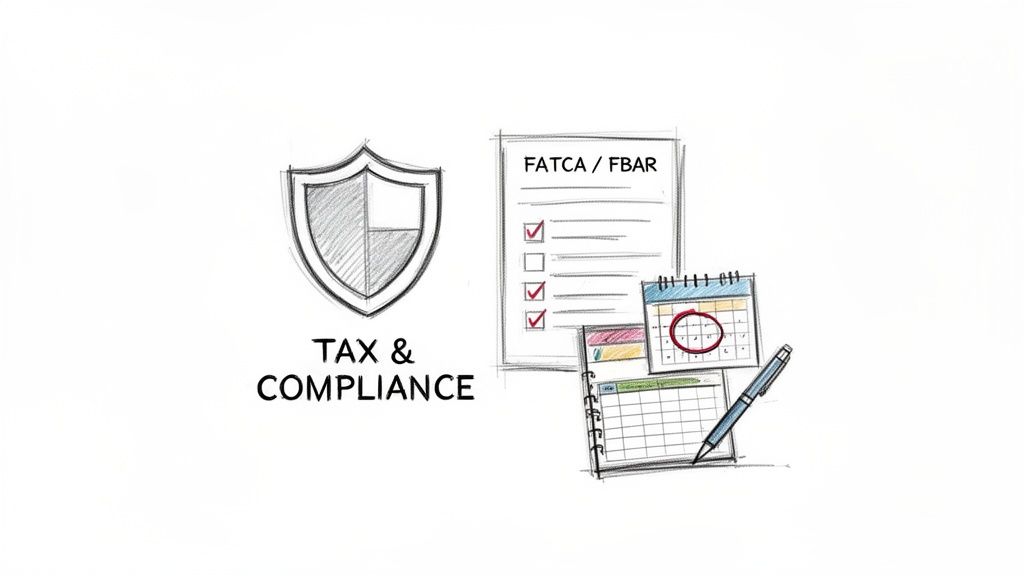
Getting your US bank account for non residents open is a major win, but it’s not the finish line. It’s actually the starting point of your official relationship with the US financial system. Staying on the right side of tax and reporting laws isn't just a good idea—it’s absolutely essential for keeping your business and finances secure.
Let’s be clear: ignoring these rules can lead to harsh penalties, frozen accounts, or even outright closure. The US government, especially the IRS, has a very long reach when it comes to financial reporting. Your new bank account puts you squarely on their radar, so being proactive about compliance is the only strategy that works.
Demystifying FATCA
The Foreign Account Tax Compliance Act (FATCA) is the first major piece of legislation you need to get familiar with. While it was designed to target US citizens hiding money abroad, it directly impacts non-residents with US accounts. When you open your account, the bank will have you complete a Form W-8BEN (for individuals) or W-8BEN-E (for businesses).
This form is your official declaration that you are a foreign person for tax purposes. It certifies your status to both the bank and the IRS, exempting you from US tax withholding on certain types of income. Filling this out correctly is your first critical compliance step.
The FBAR Reporting Threshold
Another key regulation is the Report of Foreign Bank and Financial Accounts (FBAR). This one trips a lot of people up. It might seem odd since you have a US account, but it often applies to non-residents who also have accounts back home or in other countries.
If you are considered a "US person" for tax purposes—perhaps due to spending significant time in the country—and the total value of your foreign financial accounts exceeds $10,000 at any time during the year, you have to file an FBAR. It's a common point of confusion that can lead to massive penalties if you miss it.
Understanding your filing requirements isn't optional. The IRS and FinCEN have robust information-sharing agreements with countries all over the world. Thinking they won't find out is an outdated and incredibly risky gamble.
This level of oversight has ramped up significantly. The entire regulatory environment for non-resident U.S. bank accounts has changed, especially with how easily government agencies can access financial data. For instance, recent moves by agencies like USCIS to require digital-only payments have helped build huge, centralized databases of immigrants' financial information. You can read more about these trends in this in-depth analysis of government financial oversight.
Staying Ahead of Deadlines
Compliance is all about knowing what to file and when. Missing a deadline can trigger automatic penalties, so getting these dates on your calendar is a must.
- W-8 Forms: These are typically valid for three years. Your bank should notify you when it's time to resubmit, but ultimately, it’s on you to make sure it gets done.
- FBAR (FinCEN Form 114): The deadline is usually April 15, but there's an automatic extension to October 15.
- Tax Returns (if applicable): If your US business generates what's known as Effectively Connected Income (ECI), you'll need to file a US tax return (like Form 1120-F). Deadlines here can vary, so getting professional advice is non-negotiable.
Managing these duties from day one gives you peace of mind. It ensures your access to the US banking system stays open and secure, so you can focus on what really matters—growing your business.
Common Questions About US Banking for Non-Residents
Even with the best game plan, founders always have a few specific questions. It’s completely normal. Let's tackle some of the most common ones we hear, clearing up any confusion so you can move forward with confidence.
Timelines and Costs
The first thing everyone wants to know is how long it all takes. Setting up a US company and bank account remotely isn't an overnight affair, so it’s smart to plan ahead.
First, you'll need to form your US company and get your Employer Identification Number (EIN) from the IRS. This part of the process usually takes 1-3 weeks. Once that's done, the bank has its own review and verification steps, which typically add another 3-7 business days.
And what about the cost? This is where modern fintech platforms have completely changed the game. Compared to old-school legacy banks, their fee structures are a huge advantage for global businesses. Many of the best online banks for non-residents offer:
- No monthly maintenance fees, saving you a significant amount each year.
- Far more competitive wire transfer costs, which is a must for any international company.
- No minimum balance requirements, giving your business much more cash flow flexibility.
Do I Really Need an ITIN Right Away?
This is a big one. For most modern fintech business accounts, the simple answer is no. Your company's EIN is usually all you need to get your business account up and running.
However, an Individual Taxpayer Identification Number (ITIN) becomes absolutely critical if you want to open a personal US bank account. More importantly, it's the only way to start building a US credit history. Think of it this way: the EIN is for your business, but the ITIN is the key to your personal financial life in the US.
Is Getting a US Credit Card Actually Possible?
Finally, the million-dollar question: can a non-resident actually get a US credit card? Yes, absolutely. But it’s a journey, not a sprint, and it requires a bit of patience and the right strategy.
Your US bank account is the foundation, but the ITIN is the key that unlocks the door to American credit. Without it, you can't build the personal credit history that lenders need to see.
Once you have your bank account and your ITIN, the path usually starts with a secured credit card. This allows you to establish a consistent payment history. After a few months of responsible use, you'll be in a strong position to apply for more premium, unsecured credit cards.
Navigating company formation, ITIN applications, and bank introductions can be a maze of paperwork and bureaucracy. This is where Protect Your Wealth comes in. We handle the entire process, using our official partnerships to ensure a smooth, efficient, and headache-free setup. Get in touch with us to start building your US financial foundation today.


