


The question comes up all the time: can a non-resident really open a US business bank account without an SSN or even setting foot in the country? The short answer is yes. Thanks to modern banking platforms, global entrepreneurs now have a clear path to get fully banked remotely, as long as you have a registered US business entity (like an LLC) and an Employer Identification Number (EIN).
Why a US Bank Account Is Your Ticket to the Global Market
Trying to run a global business without a US bank account is like trying to enter the world's largest stadium without a ticket. It’s the one essential piece that grants access to the massive American market, lending your venture immediate legitimacy and trust.
For countless international founders, this isn't a luxury; it's a necessity.
Imagine an e-commerce entrepreneur from Spain building a successful Shopify store. They're gaining real traction with US customers, but their growth suddenly hits a wall. The reason? Major US payment gateways like Stripe and platforms like Amazon refuse to pay out to their foreign bank account. All their hard-earned revenue is now trapped, and they can't reinvest it back into the business.
This is a story I've seen play out again and again. Without a US business bank account, a non-resident founder is crippled by serious operational hurdles.
Overcoming the Traditional Barriers
Historically, opening a US account remotely was next to impossible. Traditional banks like Chase or Bank of America have strict, non-negotiable requirements that stop foreign founders dead in their tracks.
These roadblocks almost always include:
- A Social Security Number (SSN): Most non-residents simply don't have one.
- An in-person visit: Flying to the US just to open an account is expensive and impractical.
- A US residential address: Another requirement most international entrepreneurs can't meet.
These rules made US banking an exclusive club. But the landscape has changed dramatically. The rise of fintech banking platforms has forged a new, accessible path for ambitious founders worldwide. These modern solutions were built to serve the unique needs of non-resident business owners.
The core challenge isn't a lack of desire, but a lack of access. The modern solution for a non-resident isn't fighting the old system, but embracing the new one built specifically for them.
This guide cuts through the noise and outdated information. We'll acknowledge the hurdles still in place but focus entirely on the proven, remote strategies that work today. You'll learn exactly how to navigate the process—from forming your US company and getting your tax ID to choosing the right banking partner.
Securing your financial foothold in the United States is more achievable now than ever before.
Forming Your US Business Entity the Right Way
Before you can even think about a US business bank account as a non resident, you need a legal foundation. This isn't optional; it's a hard requirement. Without a properly registered US business entity, any bank application you submit will be rejected on the spot.
For thousands of international founders, the Limited Liability Company (LLC) has become the structure of choice. It offers a powerful combination of personal liability protection and favorable tax treatment for non-residents, making it almost purpose-built for this scenario. An LLC creates a legal wall between your personal assets and your business liabilities—an essential shield for any serious entrepreneur.
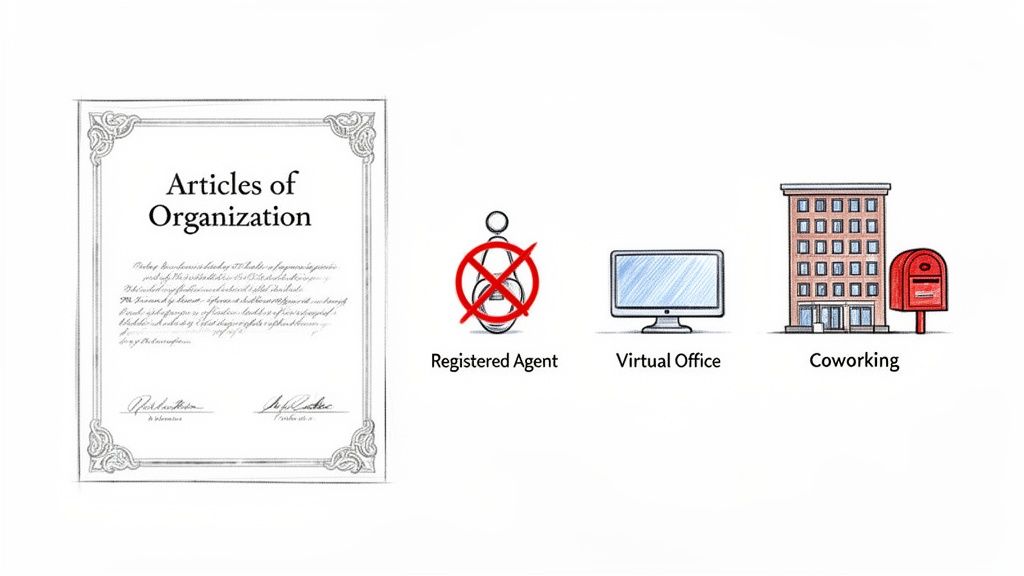
Your LLC officially comes into existence when you file your Articles of Organization with a specific state. Think of this as your company’s birth certificate.
Choosing the Right State for Your LLC
The state you choose to form your LLC in has real consequences. While you can technically incorporate in any of the 50 states, a couple stand out for their advantages for non-resident owners. The two most common choices are Wyoming and Delaware, and they serve very different purposes.
Wyoming: This state is famous for its low costs and impressive privacy features. The annual fees are minimal (currently just $60), and it permits "nominee" services to enhance owner anonymity. For most e-commerce sellers, consultants, and online service providers, Wyoming hits the sweet spot of affordability and protection.
Delaware: Known as the “gold standard” for corporate law in the US, forming in Delaware carries a certain prestige. Its Court of Chancery is world-renowned for efficiently handling business disputes, making it the default choice for startups planning to raise venture capital or go public. That prestige comes at a cost, with annual franchise taxes starting at $300.
For the vast majority of non-residents who just need an entity to open a bank account and run an online business, Wyoming is almost always the more practical and cost-effective route. The corporate infrastructure of Delaware is usually overkill unless you have firm plans to seek major US investment.
The Role of a Registered Agent
Every single US LLC is required by law to have a Registered Agent in its state of formation. This is a person or company whose job is to receive official legal mail and state notices on behalf of your business. It’s a mandatory role designed to ensure your company has a physical point of contact in the state.
However, here’s where many international founders make a critical, and often fatal, error: using their Registered Agent's address on a bank application.
Warning: Never use your Registered Agent's address as your primary business address for banking. Banks know these addresses and using one is one of the fastest ways to get your application automatically denied.
Banks see a Registered Agent address as a massive red flag. It tells them the business has no real operational presence in the US, making it look like a "ghost" company. This instantly triggers their internal risk and compliance alarms. You must provide an address that suggests genuine business activity.
Fortunately, there are a few compliant and effective alternatives:
- A Virtual Business Address: Services like Clevver or iPostal1 provide you with a unique, physical street address and mail management services.
- A Coworking Space: A membership with a provider like WeWork or Regus often includes the option of a dedicated business address.
These options demonstrate a more substantial US presence and are far more likely to satisfy the bank's strict Know Your Customer (KYC) checks. It’s a small but wise investment that can make all the difference for a non-resident founder.
Getting Your EIN: The Key to Unlocking US Banking
With your US business entity formed, the next critical step is getting your federal tax identification number. This is a common point of confusion for non-resident founders, who often get tripped up by two acronyms: EIN and ITIN. Let's get straight to the point—only one is absolutely required to open your US business bank account as a non-resident.
That number is the Employer Identification Number (EIN). It’s essentially a Social Security Number for your business, a unique nine-digit code the IRS uses to identify your LLC or corporation. No bank will even look at your application without one. It’s non-negotiable.
The Non-Negotiable Step: Applying for Your EIN
As a founder without a Social Security Number (SSN), you can't use the instant online IRS application. Instead, you'll need to apply using Form SS-4, "Application for Employer Identification Number." While this sounds bureaucratic, it's a standard and well-trodden path.
You have two ways to submit the form:
- By Fax: This is the method we recommend for nearly all our international clients. You simply complete Form SS-4 and fax it directly to the correct IRS service center.
- By Mail: This is an option, but we strongly advise against it. The processing time is significantly longer, and it introduces unnecessary delays.
Once the form is sent, you need to be realistic about the timeline. The IRS officially states a processing time of around four business days for fax applications, but for non-residents, that's rarely the case.
You should budget for 2-4 weeks to receive your EIN confirmation letter, known as the CP 575 notice. This document is gold; you’ll need to provide a copy to every bank you approach.
Demystifying the ITIN: Is It Required?
Now, this brings us to the Individual Taxpayer Identification Number (ITIN). An ITIN is a tax processing number issued to foreign individuals who have US tax filing obligations but can't get an SSN. Here's the distinction that saves our clients a lot of headaches:
You do not need an ITIN to get an EIN for your business. You also do not need one to open a business bank account with most modern banks and fintechs.
This is a crucial point. For the specific goal of opening a US business bank account as a non-resident, your LLC formation documents and your EIN are what matter. Banks like Mercury and Relay were built specifically to onboard international founders with just a passport and these two key business documents. While regulations have definitely tightened since 2018, these platforms have made remote, EIN-only approvals a reality.
So when does an ITIN actually matter?
An ITIN is for you, the individual, if you need to file a personal US tax return. More importantly for ambitious founders, it's a powerful tool for building a US financial footprint. An ITIN is the key to establishing a personal credit history in the US, which in turn opens the door to American credit cards and personal loans.
For many of our clients at Protect Your Wealth, getting an ITIN is a strategic move we plan for after the business bank account is secured and operational. If that’s part of your long-term plan, you can learn more about how to get an ITIN number and its benefits. For now, however, your focus should be singular: get that essential EIN.
Choosing Your Bank: Fintech Innovators vs. Traditional Giants
This is a critical decision point. The banking partner you choose will define how you operate, receive payments, and scale your US venture. Your options fall into two distinct worlds: modern fintech platforms and old-school, brick-and-mortar banks.
For most non-residents I speak with, the right path becomes obvious very quickly.
Why Traditional Banks Are a Non-Starter
Let's talk about the big names you know: Wells Fargo, Bank of America, Chase. These institutions are household names in the US, but for a foreign founder, their doors are almost always locked shut.
I’ve seen countless entrepreneurs waste time and money trying to make it work. Attempting to open an account, whether online or in-person, almost always ends in rejection because of their rigid, outdated requirements.
These banks typically demand things you simply don't have:
- An in-person visit to a US branch. This is an immediate deal-breaker for most global entrepreneurs.
- A Social Security Number (SSN). You won’t have one, and getting an ITIN just for this purpose is an unnecessary and complex detour.
- Proof of US residency, like a utility bill in your name at a US address.
Trying to force your way through this system is a frustrating, expensive exercise that rarely succeeds. The real solution lies with the financial technology sector.
The Fintech Advantage for Non-Residents
Fintech platforms aren’t banks themselves; they are technology companies that partner with chartered, FDIC-insured banks. They were built from the ground up to serve a global, digital-first clientele.
Their entire onboarding system is designed for a founder just like you—someone with a US LLC and an EIN but living in London, Singapore, or Dubai. They have perfected their "Know Your Customer" (KYC) process to verify foreign passports and company documents entirely online.
For a non-resident, this isn't just a convenience—it's the only practical way forward. The decision tree is simple, and it always starts with getting the right tax ID for your business entity.
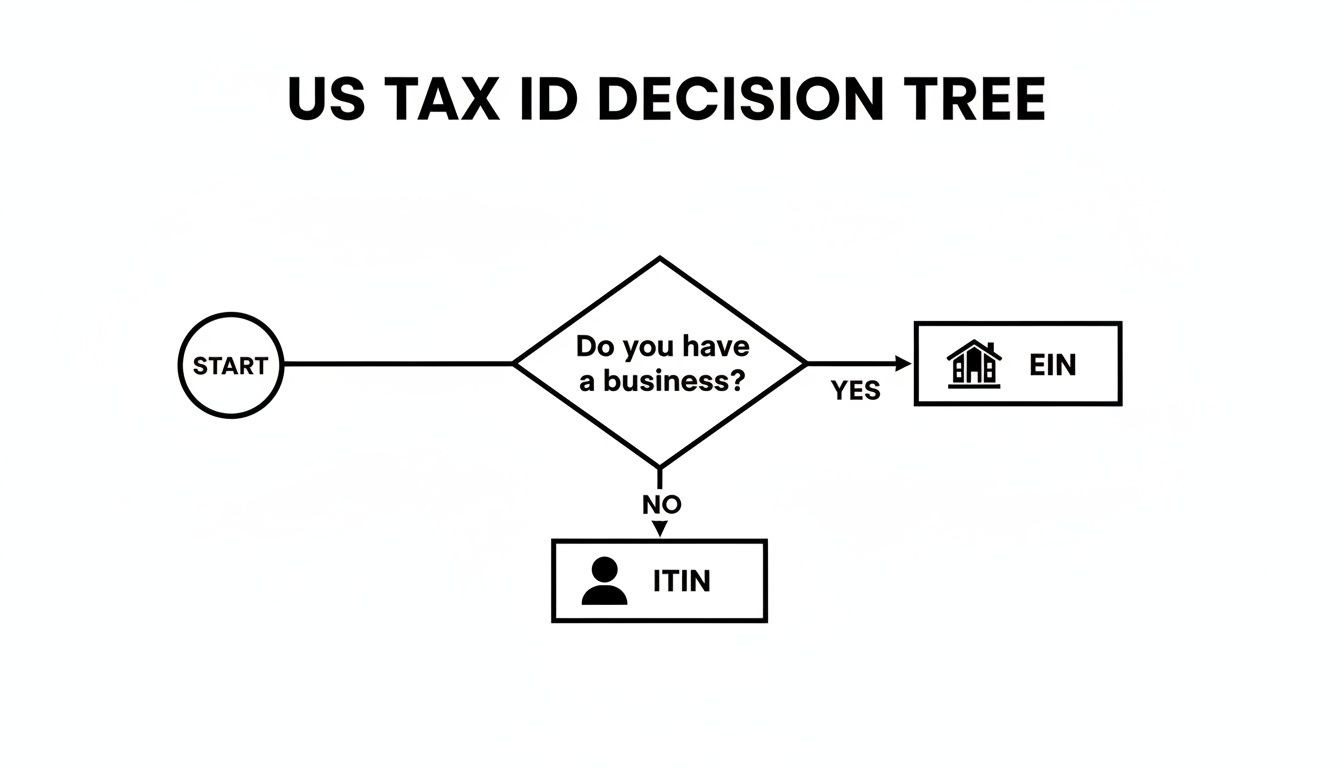
As you can see, the EIN is the essential key that unlocks the door to these modern banking platforms.
Comparing Top US Banks for Non-Residents (2026)
Choosing the right platform isn't about finding the "best" one, but the best fit for your specific business model. An Amazon seller has very different banking needs than a SaaS founder.
To simplify your choice, here’s a breakdown of the leading options we recommend to our clients.
| Bank/Platform | Best For | Approval Difficulty | Key Requirements | FDIC Insurance | Monthly Fee |
|---|---|---|---|---|---|
| Mercury | Tech Startups & SaaS | Medium | EIN, Formation Docs, Passport, Business Website | Yes, up to $5M | $0 |
| Relay Financial | E-commerce & Agencies | Medium | EIN, Formation Docs, Passport, Operational Details | Yes, up to $3M | $0 |
| Wise Business | Freelancers & Global Payments | Easy | Basic Personal/Business Info, Passport | No (EMI License) | $0 (one-time setup fee) |
These fintechs have become the default choice for a reason. Mercury is a favorite in the startup world, known for its clean interface and powerful features like free wires and virtual cards. Relay is a game-changer for e-commerce sellers, allowing up to 20 separate checking accounts to organize income streams and expenses.
Wise Business, while technically not a bank, is often the easiest entry point. It provides US account details perfect for receiving payments from Stripe or Amazon and excels at low-cost international transfers.
Expert Insight: The most successful founders we work with don't just pick a bank; they pick a financial partner that aligns perfectly with their cash flow, customer base, and growth plans.
This is more than just a passing trend. Traditional banks are actively making it harder for non-residents, cementing fintech's role as the only viable solution. The ability to open a real, US-domiciled bank account remotely with just your company documents and a passport is what makes the entire US business ecosystem accessible.
For a deeper dive into this exact comparison, we’ve put together a full guide on fintech accounts vs. traditional banks. Making the right choice here is the foundation for your financial success in the US.
Staying Compliant and Building Your US Financial Future
Securing your US business bank account as a non-resident is a monumental achievement, but it's the starting line, not the finish. The real work begins now—maintaining compliance to protect your account and using it as a launchpad for genuine financial growth in the American market.
Your first priority is staying on the right side of US regulations. Banks are under immense pressure to monitor accounts for suspicious activity, and those owned by non-residents are scrutinized even more closely. Sudden freezes or closures are a real risk, but they are almost always preventable.
Maintaining Good Standing with Your Bank
Banks and modern fintechs alike use automated systems that flag unusual behavior. To avoid triggering an account review or freeze, you need to operate your account like the legitimate US business it is.
A few key practices will keep you in the clear:
- Avoid large, unexplained inbound transfers. A sudden $100,000 wire from a personal account in a high-risk country with no explanation is a massive red flag. Always have invoices or contracts ready to justify large transactions.
- Don't use the account for personal expenses. Your business account is for business. Commingling funds looks unprofessional at best and can create serious tax and legal headaches.
- Maintain clear, professional transaction records. Use your accounting software to keep your books clean from day one. This demonstrates responsible financial management and will save you immense trouble later.
In short, treat your US business account with the professionalism it deserves. This isn't just a place to park cash; it's a vital operational tool that requires careful management.
Navigating US Tax and Reporting Obligations
This is the area that trips up more non-resident founders than any other. Having a US LLC and bank account creates specific reporting duties, even if you owe $0 in US taxes.
A common misconception is that if your foreign-owned LLC has no "US-sourced income," you have no obligations. This is dangerously incorrect.
The IRS requires all foreign-owned single-member LLCs to file Form 5472 and a pro-forma Form 1120. This is purely an informational return to report transactions between the LLC and its foreign owner. The penalty for failing to file starts at $25,000.
This is not a tax you pay; it is a reporting requirement you must fulfill. Ignoring it can lead to severe financial penalties and complications that could jeopardize your entire US operation. Engaging a US tax professional who specializes in international issues is a non-negotiable investment.
From Bank Account to Financial Footprint
With compliance handled, you can now focus on the exciting part: growth. Your US bank account is the foundation upon which your entire US financial future is built. It’s the key that unlocks access to the American credit system.
This transition from a simple transaction tool to a strategic asset is a critical milestone for any ambitious international entrepreneur.
Recent trends show just how vital this step is. As the number of non-resident US LLCs surges to an estimated 500,000 annually, fintechs like Mercury and Relay now handle billions in payouts for founders. Meanwhile, Wise facilitates transfers across over 200 countries. This entire ecosystem, from receiving Amazon payouts to building a credit history, starts with that initial, compliant bank account.
Building US Credit as a Non-Resident
Once your account has a healthy transaction history, you can begin building a US business credit profile. This is separate from your personal credit and is tied directly to your EIN.
Here’s how it typically unfolds:
- Start with a secured business credit card. Many banks offer these cards, where you put down a security deposit (e.g., $1,000) which then becomes your credit limit.
- Use it responsibly. Make small, regular purchases for your business and—critically—pay the balance in full every single month.
- Monitor your credit reports. Your responsible usage will be reported to business credit bureaus like Dun & Bradstreet, Experian, and Equifax.
Over time, this disciplined activity builds a powerful track record of reliability. This simple step is transformative. For a deep dive into this journey, check out our guide on how to access American credit as an international entrepreneur.
A positive credit history eventually allows you to apply for unsecured business credit cards (like from American Express), get higher credit limits, and even qualify for business loans from US lenders. This is how a simple checking account evolves into an engine for financing your growth, giving you access to capital that would be impossible to secure otherwise.
Frequently Asked Questions About US Banking for Non-Residents
We get these questions from international founders every single day. Getting your US business bank account set up is a critical step, but it’s surrounded by myths and bad advice. Here are the straight answers you need to navigate the process with confidence.
Can I Really Open an Account Without an SSN or ITIN?
Let’s clear this up right away: Yes, you absolutely can. This is a huge point of confusion for international founders, but the reality is simple. An SSN or ITIN is a personal tax ID, not a business requirement for banking.
The one non-negotiable item you need is an Employer Identification Number (EIN) for your US company. This is your business's federal tax ID, and it's the primary identifier banks care about. Modern fintechs are built for this exact scenario, using your foreign passport and company documents for their Know Your Customer (KYC) checks.
What Is the Most Common Reason for Application Rejection?
The single biggest reason applications get denied is, by far, a bad business address. It's an instant red flag that gets your application automatically rejected by a bank's compliance systems.
Banks are legally required to verify a legitimate physical business location. They actively blacklist addresses associated with:
- P.O. Boxes
- Most mail forwarding services
- The generic address of your Registered Agent
Using one of these is the fastest way to fail. You need a real street address from a quality virtual office provider, a coworking space, or a leased office. This isn't just a detail—it's a signal of legitimacy.
A strong, verifiable business address isn't just a box to check—it's the first signal you send to a bank that you are a serious, legitimate enterprise. Don't let this simple detail derail your entire application.
How Long Does the Entire Process Take?
From start to finish—forming your company to having a functional bank account—you should realistically budget for 3 to 6 weeks. While some parts are quick, others require patience.
Here's a typical timeline:
- Forming the LLC: This is fast. Depending on the state, it can take just a few business days to a week.
- Obtaining the EIN: This is the longest wait. As a non-resident applying for an EIN with Form SS-4, expect the IRS to take 2 to 4 weeks to process it and mail your confirmation letter (CP 575).
- Bank Account Application: Once you have your EIN, the final step is incredibly quick. Applying online with a modern banking platform takes minutes, with approvals usually granted in 1 to 5 business days.
Do I Pay US Taxes with a US LLC and Bank Account?
This is a critical question, and the answer hinges on where your income comes from. If your LLC is foreign-owned and generates no "US-Sourced Income"—meaning you have no US staff, offices, or significant operations on the ground—then you generally owe $0 in US income tax.
However, owing no tax does not mean you have no IRS filing obligations. This is a crucial distinction. A foreign-owned LLC is still required to file informational returns, specifically Form 5472, to disclose transactions with its foreign owner. Failure to file this form comes with a staggering $25,000 penalty. Always work with a tax professional who specializes in international compliance.
Navigating the complexities of global finance requires expert guidance. At Protect Your Wealth, we specialize in creating compliant, privacy-centric financial structures for entrepreneurs like you. From forming your US entity to securing your bank account and building credit, we provide a complete, fast-tracked solution. Learn more about how we can accelerate your entry into the US market.


