


The idea of a world without income tax isn't just a fantasy; for strategic entrepreneurs and high-net-worth individuals, it's a financial reality. While the question 'what countries have no income tax?' seems simple, the answer reveals a complex landscape of territorial systems, non-domicile regimes, and specific residency requirements that must be carefully evaluated.
True tax optimization is not merely about finding a jurisdiction with a '0%' sticker. It's about understanding the complete financial picture. This includes analyzing other critical fiscal policies such as:
- Value-Added Tax (VAT) or Goods and Services Tax (GST)
- Corporate income and withholding taxes
- Wealth, property, and inheritance taxes
- Social security contributions and other mandatory levies
This guide moves beyond surface-level lists to provide a detailed roadmap for 2026. We will evaluate the top jurisdictions based on their legal frameworks, banking stability, residency pathways, and practical suitability for serious asset protection and wealth growth. We will dissect the pros, cons, and hidden costs of each location, offering actionable intelligence to help you structure your affairs for maximum efficiency.
Crucially, we'll address global compliance standards like the Foreign Account Tax Compliance Act (FATCA) and the Common Reporting Standard (CRS). Understanding these obligations is essential to ensure your structure is not only efficient but also fully compliant with international law. This article provides the practical details needed to make informed decisions about your financial future.
1. United Arab Emirates – Comprehensive No Income Tax Framework
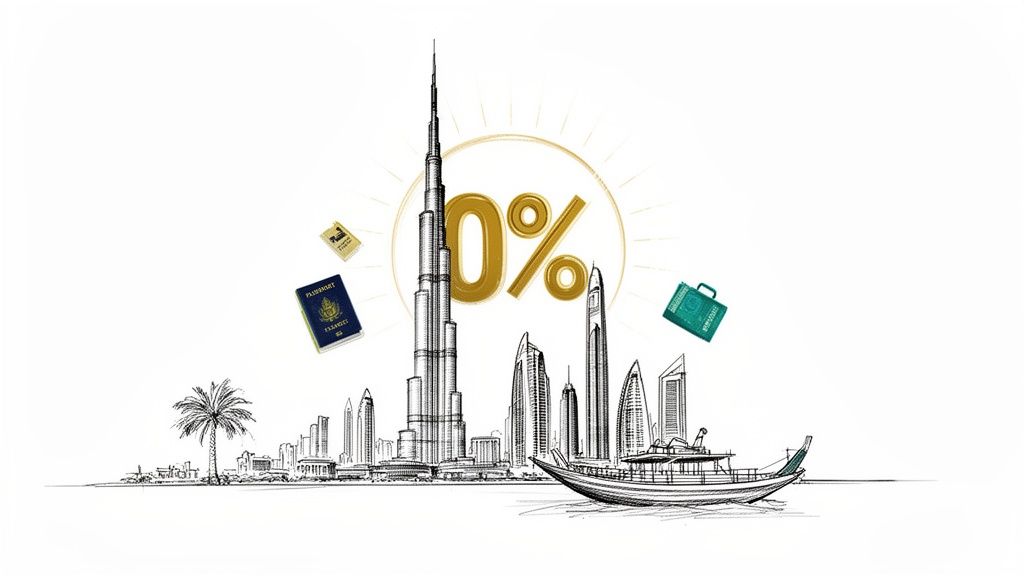
The United Arab Emirates (UAE) stands out as a premier destination for those asking what countries have no income tax. Its system is built on a complete absence of personal income tax, capital gains tax, and withholding tax for residents and most businesses operating within its borders. This straightforward tax policy, combined with a world-class infrastructure and strategic global location, makes it a powerful hub for both individuals and corporations.
For residents, all salaries, wages, and other forms of personal income are received tax-free. This benefit applies to income earned both within the UAE and, in many cases, from foreign sources, depending on the individual's home country tax rules. The UAE's approach extends to a favorable corporate tax environment, where businesses established in designated "free zones" can often achieve a 0% corporate tax rate on qualifying income, creating a highly attractive base for international operations.
Why Choose the UAE?
The UAE's appeal extends beyond just the absence of income tax. Its robust banking system, extensive network of Double Taxation Avoidance Agreements (DTAAs), and multiple residency pathways offer a complete package for wealth management and business structuring.
- Example 1: E-commerce Entrepreneur: An online retailer moves their base to the Jebel Ali Free Zone (JAFZA) in Dubai. They secure a residency visa, pay 0% personal and corporate income tax on their global profits, and benefit from the UAE's advanced logistics infrastructure.
- Example 2: Family Office: A high-net-worth family establishes a foundation in the Dubai International Financial Centre (DIFC) to manage global assets. This structure provides asset protection, succession planning, and operates within a tax-neutral environment.
Key Insight: The UAE's value is not just in what it doesn't tax (income) but also in what it does offer: a modern legal framework, political stability, and a high-quality lifestyle that attracts global talent and capital.
Actionable Steps for Implementation
- Secure Residency: Engage an immigration specialist to determine the best visa path, such as the Golden Visa for investors, property ownership, or establishing a free zone company. This is the foundational step to becoming a tax resident.
- Structure Your Business: For entrepreneurs, establishing a company in a free zone like DIFC, ADGM, or DMCC is critical. This decision dictates your corporate tax obligations and the scope of business activities you can conduct.
- Plan for Other Taxes: While income is tax-free, the UAE has a 5% Value Added Tax (VAT) and various municipal and import duties. Factor these into your financial planning and ensure your business is registered for VAT if turnover exceeds the threshold.
- Maintain Records: Keep meticulous records of your income sources. This documentation is vital to prove your tax residency in the UAE and protect your zero-tax status from challenges by tax authorities in other countries.
2. Monaco – Exclusive Tax Haven for Residents
Monaco is a globally recognized destination for individuals asking what countries have no income tax. The principality offers its residents a complete exemption from personal income tax, capital gains tax, and wealth tax, a policy established in 1869. This longstanding tax-friendly environment, combined with its legendary security, Mediterranean lifestyle, and proximity to major European cities, makes it a magnet for the world's ultra-high-net-worth.
For qualifying residents, all income earned locally and internationally is free from Monegasque tax. The key to this benefit lies in securing official residency, which involves proving sufficient financial self-sufficiency and acquiring or renting property. It's important to note that French nationals are a notable exception; due to a bilateral treaty, they generally remain subject to French income tax even when residing in Monaco.

Why Choose Monaco?
Monaco's allure is its combination of fiscal benefits with an exclusive, secure, and highly stable living environment. The principality offers a sophisticated banking sector, political stability, and a prime location on the French Riviera, making it a premier base for managing personal wealth and international business interests.
- Example 1: Professional Athlete: A non-EU tennis star establishes residency in Monaco. Their substantial prize money and global endorsement income are not subject to any local income tax, allowing for maximum capital preservation during their peak earning years.
- Example 2: International Financier: The head of a family office relocates to Monaco, establishing a base to manage global investments. They benefit from the 0% personal income tax rate, proximity to European financial centers, and the high-quality lifestyle.
Key Insight: Monaco’s value proposition is its exclusivity and security. The high barrier to entry ensures a community of like-minded individuals, while the zero-tax policy on personal income provides an unmatched foundation for wealth preservation in the heart of Europe.
Actionable Steps for Implementation
- Secure Financial Standing: The first step is to open a Monaco bank account and deposit a substantial sum, typically at least €500,000, to prove financial self-sufficiency to the authorities.
- Acquire or Rent Property: You must demonstrate you have accommodation by either purchasing a property or leasing one for a minimum of 12 months. The real estate market is highly competitive and expensive, requiring significant capital.
- Engage Specialized Advisors: Work with a Monaco-based legal and immigration advisor. They are essential for navigating the residency application process, which includes a formal interview to assess your ties to the principality.
- Plan for Social Contributions: While there is no income tax, residents are often required to make social security contributions. Understand these obligations and how they apply to your specific situation, especially if you are self-employed or run a local business.
3. Cayman Islands – Premier Offshore Financial Center
The Cayman Islands are a top-tier jurisdiction for those asking what countries have no income tax, particularly within the financial services sector. The territory levies no direct taxes on residents or corporations, meaning there is no income tax, capital gains tax, or wealth tax. This zero-tax framework is paired with a world-class legal system based on English common law, making it a stable and predictable environment for complex international financial structuring.
This approach attracts a significant amount of global capital, as the country provides a tax-neutral platform for international investment funds, insurance companies, and corporate holding structures. While the cost of living and establishing residency can be high, the benefits for qualifying individuals and businesses are substantial. The jurisdiction's commitment to regulatory compliance, including adherence to global standards like FATCA and CRS, adds to its credibility as a legitimate financial center.
Why Choose the Cayman Islands?
The Cayman Islands' appeal lies in its specialized infrastructure for the global financial industry. Its sophisticated banking, legal, and corporate administration services create an ideal ecosystem for managing international assets and business operations. The absence of direct taxation allows capital to be pooled and deployed globally with great efficiency.
- Example 1: Hedge Fund Manager: A fund manager establishes a Cayman Islands Exempted Company to serve as the investment fund. This structure allows investors from various countries to pool capital in a tax-neutral vehicle, with taxation occurring in their home jurisdictions upon distribution.
- Example 2: International Holding Company: A multinational corporation uses a Cayman Islands entity to hold its international subsidiaries. This centralizes ownership, simplifies cross-border transactions, and consolidates dividends in a jurisdiction with no corporate or withholding taxes.
Key Insight: The Cayman Islands' primary function is not just to offer a zero-tax environment for residents but to serve as a tax-neutral hub for global finance, enabling efficient capital flow for international funds, insurance, and corporate structures.
Actionable Steps for Implementation
- Engage a Licensed Service Provider: You cannot form a Cayman entity directly. You must work with a licensed and regulated law firm or corporate service provider in the Cayman Islands to establish and administer your structure.
- Define a Clear Business Purpose: Cayman entities are best used for international business and investment activities. Document the specific purpose, such as acting as an investment fund or a holding company for non-US assets.
- Establish Banking Relationships: A key component is setting up the right financial accounts. You can find more information about the benefits of an offshore bank account to complement your Cayman structure.
- Budget for Annual Compliance: Factor in the significant ongoing costs for administration, annual government fees, and mandatory compliance reporting under FATCA and CRS. Maintain meticulous records of beneficial ownership to meet regulatory demands.
4. Bahamas – Growing Caribbean Tax Haven
The Bahamas solidifies its position on the list of what countries have no income tax with a straightforward and highly attractive fiscal policy. For residents, there is no personal income tax, no capital gains tax, and no inheritance tax. This clear-cut approach, combined with its strategic proximity to North America and an accessible investor residency path, makes it a prime location for entrepreneurs and individuals seeking both a tax-neutral environment and a desirable Caribbean lifestyle.
The country's tax system is primarily funded through a Value Added Tax (VAT), stamp duties on transactions, and property taxes. This consumption-based model means that residents are taxed on what they spend, not what they earn. This structure is particularly beneficial for remote workers, digital entrepreneurs, and consultants who serve international clients, as their income remains untaxed within The Bahamas.
Why Choose The Bahamas?
The appeal of The Bahamas lies in its simplicity and accessibility. The path to residency is well-defined, and its location offers convenient travel to the United States and Canada, making it a practical choice for North American business owners and remote professionals looking for a new tax base.
- Example 1: Digital Entrepreneur: An e-commerce founder from Canada relocates to Nassau. By obtaining residency through investment, their global business profits are no longer subject to Canadian income tax, and they pay 0% personal income tax in The Bahamas.
- Example 2: Remote Consultant: A US-based freelance consultant serving international clients moves to The Bahamas. They can operate their business from the islands, enjoy a high quality of life, and legally eliminate their personal income tax burden on earnings.
Key Insight: The Bahamas offers a powerful combination of a true zero-income-tax regime and an uncomplicated residency process, making it an excellent entry point for those new to international tax planning.
Actionable Steps for Implementation
- Secure Residency: Explore the Economic Permanent Residency program, which typically requires a significant real estate investment. Engage a local legal expert to navigate the application process smoothly.
- Establish Physical Presence: To solidify your tax residency and defend it against challenges from your home country, you must document at least 183 days of physical presence in The Bahamas annually.
- Plan for Other Taxes: Understand the local tax landscape beyond income. Factor in the 10% VAT on most goods and services and the varying rates of property tax, especially if you plan to invest in real estate.
- Open Local Bank Accounts: Establish banking relationships in The Bahamas as soon as possible. This not only facilitates local life but also helps demonstrate your substantive ties to the country for tax residency purposes.
5. Singapore – Strategic Asia-Pacific Hub with Favorable Tax Incentives
While Singapore is not a zero-tax jurisdiction, it earns its place on this list for its highly strategic territorial tax system. This system is especially beneficial for high-net-worth individuals and entrepreneurs looking for answers to what countries have no income tax on foreign-sourced income. For tax residents, income earned and kept outside of Singapore is generally not subject to Singaporean tax. This policy, combined with its political stability and status as a global financial center, makes it an elite hub for wealth management and Asian business operations.
Under its territorial system, only income sourced within Singapore or remitted into the country is taxed. Local income is subject to a progressive tax rate, but foreign-sourced income that remains in offshore accounts is exempt. This distinction is critical for international entrepreneurs and investors who can structure their affairs to keep significant portions of their global earnings outside Singapore's tax net, all while enjoying the benefits of residency in a world-class city-state.
Why Choose Singapore?
Singapore's primary advantage lies in its blend of a reputable, well-regulated environment with a tax system that rewards global income generation. Its extensive network of over 80 Double Taxation Avoidance Agreements (DTAAs), robust banking secrecy laws, and sophisticated financial services sector create a complete package for structuring international wealth and business.
- Example 1: Hedge Fund Manager: A fund manager relocates to Singapore, establishing tax residency. They manage a Cayman Islands fund with global investments. The management and performance fees are paid to an offshore entity and kept outside Singapore, remaining tax-free.
- Example 2: Tech Entrepreneur: An entrepreneur establishes their family office and personal residency in Singapore. Their startup, incorporated in the BVI, generates revenue across Southeast Asia. As long as these profits are not remitted to Singapore, they are not taxed there.
Key Insight: Singapore offers a "best of both worlds" scenario: the credibility and stability of a high-tax jurisdiction with the tax efficiency of a territorial system, making it ideal for those who need a premium, reputable base for their Asian operations.
Actionable Steps for Implementation
- Establish Tax Residency: Secure a valid residency permit, such as an Employment Pass or EntrePass, and spend sufficient time in the country (typically 183 days a year) to be considered a tax resident. This is the cornerstone of accessing the foreign-sourced income exemption.
- Structure Income Sources: Work with a tax advisor to clearly delineate between Singapore-sourced and foreign-sourced income. For example, structure service contracts so that work is performed and payment is received outside of Singapore.
- Use Separate Bank Accounts: Maintain separate bank accounts for foreign-sourced income that you do not intend to remit to Singapore. This segregation provides clear proof to the Inland Revenue Authority of Singapore (IRAS) that the funds have not been brought into the country.
- Plan for Local Taxes: If you earn income in Singapore, be prepared for the progressive personal income tax rates (up to 24%). Also, factor the Goods and Services Tax (GST) into your business planning and operations.
6. Hong Kong – International Financial Center with Tax Efficiency
While not a zero-tax jurisdiction in the strictest sense, Hong Kong earns its place on lists of what countries have no income tax due to its territorial tax system. This system taxes only income that arises in or is derived from Hong Kong. Properly structured foreign-sourced income remains completely tax-free, making it a powerful financial hub for international business and wealth management.
For individuals, this means that salaries, profits, and investment returns generated from activities outside of Hong Kong are not subject to its salaries tax. This principle applies even if you are a resident. The key is the source of the income, not the residency of the recipient. This unique framework, combined with its strategic position as a gateway to mainland China and its world-class financial infrastructure, makes Hong Kong a premier choice for global entrepreneurs and investors.
Why Choose Hong Kong?
Hong Kong’s appeal lies in its sophisticated legal system, a stable currency pegged to the US dollar, and its role as a major international banking center. It provides a tax-efficient base for managing cross-border operations, especially those involving the broader Asian market.
- Example 1: Finance Professional: An international banker moves to Hong Kong to manage Asian operations for a European bank. While their Hong Kong-sourced salary is taxed at a low rate (capped at 15%), their personal investment portfolio held and managed offshore generates income that is not subject to Hong Kong tax.
- Example 2: Regional Headquarters: An entrepreneur establishes a Hong Kong entity as a regional headquarters to penetrate the Chinese market. Profits generated from their manufacturing operations in mainland China, which are paid to the Hong Kong parent company as dividends, are not taxed in Hong Kong.
Key Insight: Hong Kong's territorial tax system offers a form of "tax-free" status for foreign income without requiring a complete absence of local business activity, making it ideal for those who need a legitimate and prestigious base for Asia-Pacific operations.
Actionable Steps for Implementation
- Determine Income Source: The most critical step is to clearly delineate between Hong Kong-sourced and foreign-sourced income. Engage a tax advisor to structure your employment contracts and business activities to ensure income from outside the territory is correctly classified.
- Establish Corporate Entities Strategically: Create separate corporate entities for your Hong Kong-based activities and your international operations. This segregation provides a clear paper trail for tax authorities and simplifies compliance.
- Plan Property Acquisitions: Be mindful of Hong Kong’s high Stamp Duty on property transactions. Factor these substantial costs into any decision to purchase real estate for personal or business use.
- Manage Residency Status: While foreign income is untaxed for residents, structuring your affairs to maintain non-resident status (spending less than 180 days in the territory) can offer additional planning benefits in certain complex scenarios.
7. Malta – EU Tax Optimization with Residency Freedom
Malta presents a unique proposition for individuals wondering what countries have no income tax, especially those seeking a base within the European Union. While not a zero-tax country in the traditional sense, its "non-domicile" (non-dom) tax regime effectively eliminates tax on foreign-sourced income that is not brought into Malta. This system, combined with full EU membership and Schengen Area access, offers a strategic blend of high-level tax efficiency and first-world lifestyle benefits.
Under the non-dom system, a tax resident who is not domiciled in Malta is only taxed on income arising in Malta and on foreign income that is remitted to the country. Foreign-sourced capital gains are entirely exempt from Maltese tax, even if remitted. This creates a powerful framework for international entrepreneurs, investors, and retirees who can structure their affairs to keep the majority of their income and wealth outside of Malta, thus legally avoiding taxation on it.
Why Choose Malta?
Malta’s appeal lies in its ability to provide EU residency and a Mediterranean lifestyle without the high tax burden typical of other member states. It is particularly attractive for those who need a European base for business or personal reasons but earn their income globally.
- Example 1: EU Entrepreneur: A German tech entrepreneur establishes residency in Malta. Their company, based in Ireland, pays dividends to their international bank account. As long as these funds are not remitted to Malta, they remain tax-free, while the entrepreneur enjoys freedom of movement throughout the EU.
- Example 2: Cryptocurrency Investor: A blockchain investor moves to Malta, known for its friendly crypto regulations. They realize significant capital gains from their global crypto portfolio. Since these are foreign-source capital gains, they are not subject to Maltese tax, even if the funds are brought into the country.
Key Insight: Malta offers a "best of both worlds" solution: the prestige and access of an EU residency combined with a tax system that can legally reduce an individual's effective tax rate on foreign income to zero.
Actionable Steps for Implementation
- Secure Residency: Obtain a residence permit through one of Malta’s programs, such as the Malta Permanent Residence Programme (MPRP) or by demonstrating financial self-sufficiency. Engaging a local advisor is crucial for this step.
- Establish Tax Residency: Upon arrival, immediately register as a tax resident to start the clock on your non-dom status. This involves spending a sufficient amount of time in the country (typically 183 days) or proving it is your primary place of abode.
- Structure Income Sources: Work with a tax professional to segregate your income streams. Ensure that business profits, investment returns, and other income are generated and held outside Malta to benefit from the remittance-based system.
- Manage Remittances Carefully: Meticulously track any funds transferred into Malta. Only remit what is necessary for living expenses, as these amounts will be subject to taxation. Keep foreign capital gains and income in separate offshore accounts. For a deeper analysis of this structure, learn more about Malta as a hidden tax haven inside the European Union.
8. Seychelles – African Tax Haven with Limited Economy
The Seychelles is a well-known answer to the question of what countries have no income tax, particularly for offshore business activities. This African island nation offers a territorial tax system where income sourced outside its borders is completely tax-free for residents and international business companies (IBCs). This creates a simple, low-cost environment for specific corporate structuring needs.
For individuals who become tax residents, there is no tax on foreign-sourced income, capital gains, or wealth. The primary advantage lies in its corporate offerings, where an IBC can be established quickly and operate with 0% corporate tax on its global profits. This setup, however, is best suited for passive activities due to the country's limited local banking and business infrastructure.
Why Choose Seychelles?
Seychelles' appeal is rooted in its simplicity, speed, and cost-effectiveness for creating holding structures. It offers high levels of privacy and minimal administrative burdens, making it an efficient jurisdiction for certain international business functions.
- Example 1: Intellectual Property Holding: A software development firm establishes a Seychelles IBC to hold its patents and trademarks. The company licenses this IP to operating companies worldwide, and the royalty income accumulates in the Seychelles entity completely tax-free.
- Example 2: Passive Investment Vehicle: A group of international investors forms a Seychelles company to hold a portfolio of global stocks and bonds. All dividends and capital gains from the investments flow to the company without being subject to local taxation.
Key Insight: Seychelles excels as a jurisdiction for passive holding companies, offshore trusts, and IP management. Its value is in its straightforward, low-maintenance corporate framework rather than as a base for active business operations.
Actionable Steps for Implementation
- Engage a Registered Agent: Formation of a Seychelles IBC must be done through a licensed corporate service provider. They will handle the entire incorporation process, which is often completed within a few days.
- Define the Company's Purpose: Clearly structure the entity for passive holding activities, such as receiving royalties, dividends, or managing a global investment portfolio. This focus avoids complications related to local substance requirements.
- Establish Banking Relationships: Work with your agent to open a corporate bank account. Given the limited local options, this often involves establishing an account in another jurisdiction like Mauritius, Singapore, or Switzerland that is accustomed to working with Seychelles entities.
- Pay Annual Fees: Ensure timely payment of annual government and registered agent fees to maintain the company's good standing. Also, budget for business license fees (ranging from SCR 5,000 to over SCR 50,000) if any local activity is anticipated.
9. Mauritius – African Growth Hub with Tax Treaties
Mauritius offers a strategic advantage for those asking what countries have no income tax on foreign income. It operates on a territorial tax system, meaning residents are typically taxed only on income sourced from within Mauritius or remitted to the country. This creates an opportunity for properly structured foreign-source income to remain completely tax-free, positioning Mauritius as a premier financial hub for Africa and beyond.
The system is particularly effective for individuals and corporations that can segregate their income streams. By holding offshore assets through Mauritian-domiciled entities like a Global Business Company (GBC), it is possible to receive foreign dividends, interest, and capital gains without incurring Mauritian tax, provided the funds are not brought into the country. This structure, combined with Mauritius's extensive network of Double Taxation Avoidance Agreements (DTAAs), makes it an exceptional base for international investment and trade.
Why Choose Mauritius?
Mauritius combines its favorable tax system with a stable, pro-business regulatory environment and a sophisticated banking sector. Its value lies in its ability to serve as a secure and tax-efficient gateway for investments into Africa and Asia, offering both asset protection and operational substance.
- Example 1: Investment Fund Manager: A private equity firm establishes a GBC in Mauritius to manage investments across Africa. Dividends and capital gains from these investments flow into the Mauritian company tax-free, and the extensive treaty network reduces withholding taxes in the source countries.
- Example 2: Digital Nomad: A software consultant obtains an Occupation Permit and becomes a tax resident. They invoice their international clients through a separate foreign company and only remit the funds needed for living expenses to Mauritius. The unremitted foreign income remains outside the Mauritian tax net.
Key Insight: Mauritius is not a zero-tax country in the traditional sense, but its territorial system offers a functionally tax-free environment for foreign income. Its strength is its robust legal framework and vast tax treaty network, providing legitimacy and tax efficiency.
Actionable Steps for Implementation
- Obtain Residency: The first step is to become a tax resident. This can be achieved through real estate investment, an Occupation Permit (for professionals or investors), or by demonstrating substantial presence in the country.
- Establish the Right Corporate Structure: Engage a local corporate service provider to set up a Global Business Company or an Authorized Company. This entity will be crucial for holding foreign assets and receiving international income without triggering local tax liabilities.
- Segregate Income and Assets: Maintain clear separation between your local and foreign financial affairs. Use distinct bank accounts for income remitted to Mauritius versus income held offshore to simplify tax reporting and compliance.
- Leverage Tax Treaties: Consult with a tax advisor to understand how Mauritius's DTAAs can minimize withholding taxes on dividends, interest, and royalties from other countries. This is a key component of optimizing your global tax position.
10. Cross-jurisdiction Summary & Key Takeaways
Understanding what countries have no income tax is only the first step; successful implementation requires a holistic view of the common patterns, risks, and strategic considerations that apply across all zero-tax jurisdictions. This summary synthesizes the key themes from the countries listed, offering a framework for making an informed decision that aligns with your financial and personal goals.
The most critical pattern is that no country is truly "tax-free." Governments generate revenue through other means, such as Value Added Tax (VAT), consumption taxes, import duties, stamp duties, or significant fees for residency and business incorporation. Furthermore, achieving tax residency is not a paper exercise; it demands genuine physical presence and establishing legitimate ties to the new country to defend against challenges from your home country's tax authorities.
Why a Cross-Jurisdiction View is Essential
A global perspective prevents tunnel vision. Focusing on a single country's tax benefits without comparing its broader framework can lead to costly mistakes. For example, a country might offer 0% income tax but have an unstable banking system or a limited network of tax treaties, creating unforeseen complications for international business or wealth management.
- Example 1: The Misstep of Ignoring Exit Taxes: A US citizen moves to the Cayman Islands to eliminate income tax but fails to account for the US exit tax upon renouncing citizenship. This oversight results in a massive, unexpected tax liability on their unrealized capital gains.
- Example 2: The Residency Mismatch: An entrepreneur establishes a company in Vanuatu for its tax benefits but continues to spend most of their time in their high-tax home country. Their home country's tax authority successfully challenges their non-resident status, subjecting their global income to domestic taxation.
Key Insight: The best zero-tax strategy is not just about choosing a country; it's about building a defensible, multi-jurisdictional plan that considers your citizenship, business operations, asset locations, and long-term lifestyle goals.
Actionable Steps for Implementation
- Define Your Primary Goal: Are you seeking a lifestyle change, a corporate headquarters, or an asset protection haven? Your primary motivation will determine which jurisdiction's strengths are most relevant.
- Conduct a "Substance" Audit: Evaluate your ability to meet the physical presence requirements (typically 183+ days) and establish genuine ties, like renting a home, opening local bank accounts, and obtaining a local driver's license.
- Analyze the "Other" Taxes: Create a detailed financial model that accounts for VAT, property taxes, import duties, and any other consumption-based taxes in your target countries. Compare this to your current tax burden for a true cost-benefit analysis.
- Seek Expert Guidance: A successful transition is a complex legal and financial process. Engage with specialists who understand the nuances of cross-border tax planning to ensure your structure is compliant, resilient, and fully optimized.
Top 10 No-Income-Tax Countries Comparison
| Jurisdiction | Implementation complexity | Resource requirements | Expected tax outcome | Ideal use cases | Key advantages |
|---|---|---|---|---|---|
| United Arab Emirates | Medium — visa sponsorship or investment; free‑zone setup straightforward | Moderate–High — investment/property for visas, banking, VAT compliance | Zero personal income tax on UAE‑sourced income; corporate largely zero for small profits; 5% VAT; recent corporate tax for some businesses | Regional HQ, e‑commerce, fintech, digital nomads, family offices | No personal income tax, free zones, strong banking/treaty network, multiple residency paths |
| Monaco | High — stringent vetting and residency approval process | Very High — substantial real estate and living cost requirements (€500k+ property) | Zero personal income tax for qualifying residents; worldwide income exemption | Ultra‑high‑net‑worth individuals, family offices, prestige residency | Complete income tax exemption, EU access, strong privacy and elite services |
| Cayman Islands | High — licensed providers required; strong compliance regime | High — setup, administration, ongoing audit and service costs | Zero personal, corporate and capital gains tax for many entities; subject to FATCA/CRS reporting | Hedge funds, insurance, holding companies, family offices | Premier offshore financial services, robust legal structures, global banking links |
| Bahamas | Low–Medium — investor residency relatively accessible and fast | Moderate — BSD 250k+ investment, physical presence, banking setup | Zero personal, corporate and capital gains tax for residents; VAT (~7.5%) and other transaction taxes apply | Digital entrepreneurs, remote workers, North American relocations, investors | Quick residency path, lower entry cost than some havens, proximity to North America |
| Singapore | Medium–High — strict PR/visa rules and business compliance | High — significant investment for investor schemes; high living and property costs | Favorable treatment for foreign‑sourced income for tax residents; 17% corporate tax; GST 8% | APAC HQ, family offices, multinationals, fintech and IP holding | Stable, transparent regime; extensive tax treaties; gateway to Asia and strong IP/corporate law |
| Hong Kong | Medium — residency/structure needed to use remittance/territorial basis | Moderate–High — visa/employment requirements, business presence, living costs | Remittance/territorial basis: foreign‑sourced income can be exempt; 16.5% profits tax and progressive salaries tax on Hong Kong‑sourced income | Finance professionals, China‑market access, regional headquarters, trading firms | Territorial taxation, strong finance infrastructure, legal certainty and China gateway |
| Malta | Medium — non‑dom regime requires property/rental thresholds and documentation | Moderate–High — property purchase or rental commitment (~€500k+) and corporate setup | Non‑dom can exempt foreign income; domestic corporate tax 35% (refunds possible); VAT 6% | EU‑based entrepreneurs, family offices, crypto/fintech seeking EU base | EU/Schengen access, accessible non‑dom options, European legal framework |
| Seychelles | Low — rapid company formation and simple IBC framework | Low — low registration/renewal fees but limited banking options | Zero personal tax and zero corporate tax for many offshore companies; limited domestic utility | Passive holding companies, trusts, IP holding, low‑cost offshore structures | Fast, inexpensive formation; low maintenance for passive structures |
| Mauritius | Medium — treaty and territorial structuring required for benefits | Moderate — business establishment, investment or property, compliance costs | Territorial system: zero or reduced tax on properly‑sourced foreign income under treaties; domestic tax typically 15% | African gateway structures, treaty‑based holdings, investment vehicles | Extensive tax‑treaty network, favorable for Africa‑focused operations, territorial advantages |
| Cross‑jurisdiction summary | Varies — often Medium–High due to substance and reporting rules | Varies — include VAT/GST, property, compliance and admin costs | Potential tax reduction when structured correctly but increased CRS/BEPS and substance obligations | Comparative planning, multi‑jurisdiction structuring, risk mitigation | Enables selection of best fit by balancing tax benefits, treaties and compliance; emphasizes professional advice |
From Theory to Action: Building Your Compliant, Tax-Efficient Future
Discovering what countries have no income tax is an exciting first step, but it's just the beginning of a complex journey. As we've explored, the path to genuine tax efficiency is not a simple matter of picking a destination from a list. The true value lies in understanding the intricate details behind each zero-tax framework and building a strategy that aligns with your specific personal, financial, and business objectives.
The notion of a "tax-free" life is often oversimplified. Jurisdictions like the UAE and Monaco offer incredible benefits for residents, but they come with significant residency requirements and lifestyle considerations. Financial centers such as the Cayman Islands and the Bahamas provide powerful corporate structuring tools, yet they demand strict adherence to economic substance and global reporting standards. The key takeaway is that 'no income tax' is never a synonym for 'no rules' or 'no costs'.
Key Considerations Before You Act
Moving forward requires a shift in perspective, from simply identifying a location to designing a resilient, compliant, and defensible international structure. Here are the critical action points to consider based on the insights from this article:
- Define Your "Why": Are you a digital nomad seeking residency freedom, an entrepreneur optimizing corporate profits, or a high-net-worth family focused on asset protection and succession planning? Your core motivation will dictate which jurisdictions are even viable. A strategy for a tech founder in Dubai is fundamentally different from one for a retiree in Malta.
- Assess the True Cost: A zero-percent income tax rate is attractive, but you must calculate the all-in cost. This includes residency application fees, real estate investments or leases, corporate setup and maintenance costs, professional advisory fees, and the impact of other taxes like VAT, property taxes, or social security contributions.
- Understand Your Compliance Burden: Your citizenship and past residency matter. U.S. citizens, for instance, are taxed on their worldwide income regardless of where they live. You must also account for automatic information exchange under the Common Reporting Standard (CRS) and FATCA. A failure to correctly manage these reporting duties can negate any tax benefits and lead to severe penalties.
- Match the Jurisdiction to Your Operations: Where does your business actually generate value? An e-commerce business might find a structure in the UAE or Hong Kong ideal, while an investment holding company could be better suited for the Cayman Islands. Economic substance laws mean your corporate structure must have a genuine connection to its jurisdiction.
The Pitfall of a DIY Approach
Navigating this world of international tax, residency law, and corporate structuring without expert guidance is a critical error. The stakes are simply too high. A seemingly small mistake in a residency application, a poorly structured corporate entity, or a missed compliance filing can trigger unforeseen tax liabilities, frozen bank accounts, or legal challenges in multiple countries.
The real work is not just in the planning but in the flawless execution. It involves coordinating legal experts, tax advisors, and incorporation agents across several jurisdictions, ensuring every piece of your financial puzzle fits together perfectly. This is a full-time job that requires deep, practical experience.
The gap between knowing what countries have no income tax and successfully building a life or business within one is immense. At Protect Your Wealth, we bridge that gap with proven, actionable strategies, not just information. We provide turnkey, compliant structures for high-net-worth individuals, handling everything from residency and bank accounts to corporate and trust formation. To transform your plan into a protected reality, schedule a confidential consultation with our international specialists today.


