


So, what exactly is a holding company?
Think of it less as a typical business and more like a master control center. A holding company doesn’t actually produce goods or offer services. Instead, its primary job is to own a controlling stake in other companies, which we call subsidiaries.
It’s like being the conductor of an orchestra—you don't play an instrument yourself, but you direct all the individual musicians to create a unified, powerful performance. This structure is a cornerstone of strategic wealth management.
What a Holding Company Does
At its heart, a holding company is all about ownership. Its day-to-day business isn't manufacturing, sales, or client services. Its business is the business of owning and managing controlling interests in other operational companies.
This setup is an incredibly popular and effective strategy for high-net-worth individuals and entrepreneurs who want to consolidate their assets, protect them from risk, and improve their overall tax position. The parent company simply needs to own enough voting stock in its subsidiaries to control their management, all without getting involved in their daily grind. You can find more examples of major financial holding companies to see this structure in action.

To make this concept clearer, let's look at the core characteristics of a holding company.
Holding Company at a Glance
This table breaks down the essential features and functions in a simple format.
| Characteristic | Description |
|---|---|
| Primary Activity | Owns a controlling interest (stocks, assets) in other companies (subsidiaries). |
| Operational Role | Generally does not engage in day-to-day business operations. |
| Core Purpose | To centralize control, protect assets, and optimize tax and financial strategies. |
| Legal Structure | A separate legal entity (often an LLC or corporation) from its subsidiaries. |
| Risk Profile | Insulated from the direct liabilities and debts of its individual operating subsidiaries. |
This structure is designed for control and protection, not direct commercial activity.
Visualizing the Structure
Let’s imagine you own three distinct businesses: a thriving real estate agency, a innovative software firm, and a chain of boutique retail stores. Each one operates on its own and, more importantly, carries its own set of risks. If the real estate agency gets hit with a major lawsuit, the assets of your other two businesses could suddenly be on the line.
Now, picture creating a new holding company that owns the majority of shares in all three. The holding company sits at the top, with your three businesses operating as subsidiaries underneath it. This instantly creates a legal "firewall" between each company. A crisis in one subsidiary is contained and doesn't automatically endanger the others or the parent company itself.
The Key Benefits of This Approach
This parent-subsidiary relationship is far more than just a box on an organizational chart; it's a powerful framework built to achieve specific financial and legal objectives. We'll be diving deep into how this structure delivers advantages that are difficult, if not impossible, to achieve otherwise.
By separating ownership from operations, a holding company provides a powerful mechanism for shielding assets, centralizing control, and creating significant tax efficiencies. It transforms a collection of individual ventures into a coordinated and resilient portfolio.
The core benefits we will unpack include:
- Liability Protection: Isolating risk within each subsidiary to protect the entire group's assets from a disaster in one corner of your portfolio.
- Centralized Control: Streamlining the management of multiple businesses under a single, unified strategy.
- Tax Efficiency: Optimizing your tax position by strategically managing how capital and profits move between the parent and its subsidiaries.
Grasping these foundational ideas is the first step to understanding why holding companies are such an essential tool in modern wealth and asset protection.
It's one thing to know what a holding company is, but it's another thing entirely to grasp its strategic power. This isn't just another layer of corporate paperwork; it's a powerful tool used by sharp entrepreneurs and investors to protect assets, improve efficiency, and build lasting wealth.
Let's break down the core functions that make this structure so effective.
The single most important benefit is asset protection through liability isolation. A holding company creates a legal firewall between its different businesses, effectively containing risk within each individual company. This separation is crucial for protecting the health of your entire enterprise from a crisis breaking out in one corner.
Imagine you own a construction company, a property management firm, and a tech startup. The construction business, by its very nature, carries a high risk of lawsuits. Without a holding company, a single, expensive lawsuit against your construction firm could jeopardize the assets of your other two businesses—and even your personal wealth.
Creating a Financial Fortress
By placing each business into its own separate entity under a holding company, you create distinct legal "silos." Now, if the construction subsidiary gets sued, the legal fallout is confined to that specific company. The assets held by the holding company and your other subsidiaries are shielded. This containment strategy is essential for anyone operating in multiple sectors or high-risk industries.
A holding company effectively builds watertight compartments in your financial ship. If one compartment takes on water, the others remain sealed and afloat, preventing a single leak from sinking the entire vessel.
This principle of liability isolation is a cornerstone of sophisticated asset protection. It gives entrepreneurs the freedom to chase new, riskier ventures without putting their stable, profitable businesses on the line. It ensures the success of your entire portfolio isn't held hostage by the performance of its most volatile part.
Centralized Control and Governance
Beyond just protection, a holding company offers a powerful way to achieve centralized control and streamlined management. Instead of juggling different management teams and conflicting strategies across multiple businesses, the holding company acts as the command center.
This centralized oversight lets you implement a single, unified vision. Key decisions and strategic functions can be managed from the top, ensuring all your businesses are pulling in the same direction.
- Strategic Direction: The holding company’s board can set the overarching strategy for all subsidiaries, making sure they work together toward a common goal.
- Capital Allocation: You can easily move capital from a cash-rich subsidiary to one with high growth potential, all without needing complex external financing.
- Shared Services: Administrative functions like legal, accounting, and HR can be centralized. This cuts redundant costs and creates powerful economies of scale.
This structure simplifies how you govern your assets, making it far easier to manage a diverse business portfolio from a single, strategic viewpoint.
Tax Optimization and Financial Efficiency
One of the most compelling reasons to use a holding company is for significant tax optimization. This structure allows you to strategically move funds between your companies in a highly tax-efficient way. For example, dividends can often pass from a subsidiary up to the parent company with little to no tax owed.
This financial flexibility is a game-changer. Profits from one successful business can be used to fund a new venture or offset losses in another, all managed neatly under the holding company umbrella. This ability to finance internally reduces your reliance on outside debt and gives you far greater control over your own capital. On top of that, by choosing a favorable jurisdiction for your holding company, you can often benefit from lower corporate tax rates and advantageous international tax treaties.
Simplifying Estate Planning and Ownership Transfer
Finally, a holding company makes wealth transfer and estate planning dramatically simpler. Ownership of multiple businesses gets consolidated into a single asset: the shares of the holding company. This makes passing ownership to your heirs, new investors, or business partners a much cleaner and more straightforward process.
Instead of navigating the complex legal and administrative maze of transferring ownership for each individual company, you only need to transfer the shares of the parent. This not only streamlines the process but also provides a clear, organized framework for succession planning, ensuring a smooth transition of control and preserving your legacy for the next generation.
Exploring Different Types of Holding Companies
Once you grasp the basic idea of a holding company, the next step is realizing they aren't all cut from the same cloth. Each type is designed for specific strategic goals, and picking the right one is absolutely critical to hitting your financial targets.
The two main structures you'll come across are the pure holding company and the mixed holding company. Understanding the distinction is the key to building an effective strategy for asset protection and growth.
Let's break down what makes each one unique.
The Pure Holding Company
A pure holding company is the most classic and straightforward version. Its one and only job is to own a controlling interest in other companies—its subsidiaries. That's it. It doesn't manufacture products, sell services, or run any business operations of its own.
Think of it as a highly specialized portfolio manager for businesses. It exists solely to own shares, intellectual property, or other assets, provide high-level oversight to its subsidiaries, and collect income like dividends from them. This clean separation is its greatest strength, as it insulates the parent company from the daily operational risks of the businesses it holds.
- Key Characteristic: Exists only to own and manage subsidiary companies and assets.
- Primary Benefit: Maximizes liability protection by creating a clear legal and operational wall between the parent and its operating businesses.
- Ideal For: Entrepreneurs and investors whose primary goal is ironclad asset protection, risk isolation, and simplified management of a diverse portfolio.
This structure creates the strongest possible "firewall." A lawsuit or financial disaster in one subsidiary has no legal path to touch the holding company or any of its sister subsidiaries.
The Mixed Holding Company
A mixed holding company, sometimes called an operating-holding company, wears two hats. Just like a pure one, it owns controlling stakes in other businesses. But—and this is the key difference—it also runs its own business operations and generates its own revenue.
Imagine a successful software company that, over time, acquires a data analytics firm and a cybersecurity startup. The original software company is now a mixed holding company. It continues to develop and sell its own software while also acting as the parent to its new subsidiaries. For those looking at more advanced strategies, understanding how different legal entities can work in concert is vital. You can dive deeper by reading our detailed guide on what is a trust and how it works.
This model is incredibly common. Many large corporations that grow by acquiring other companies naturally fall into this structure. They stick with their original core business while expanding their market footprint by owning other complementary—or even completely different—companies.
A mixed holding company is like a team captain who also actively plays in the game. It directs the team (the subsidiaries) while also contributing directly to the final score (its own operational revenue).
This diagram shows how a holding company sits at the top, shielding assets and centralizing control.
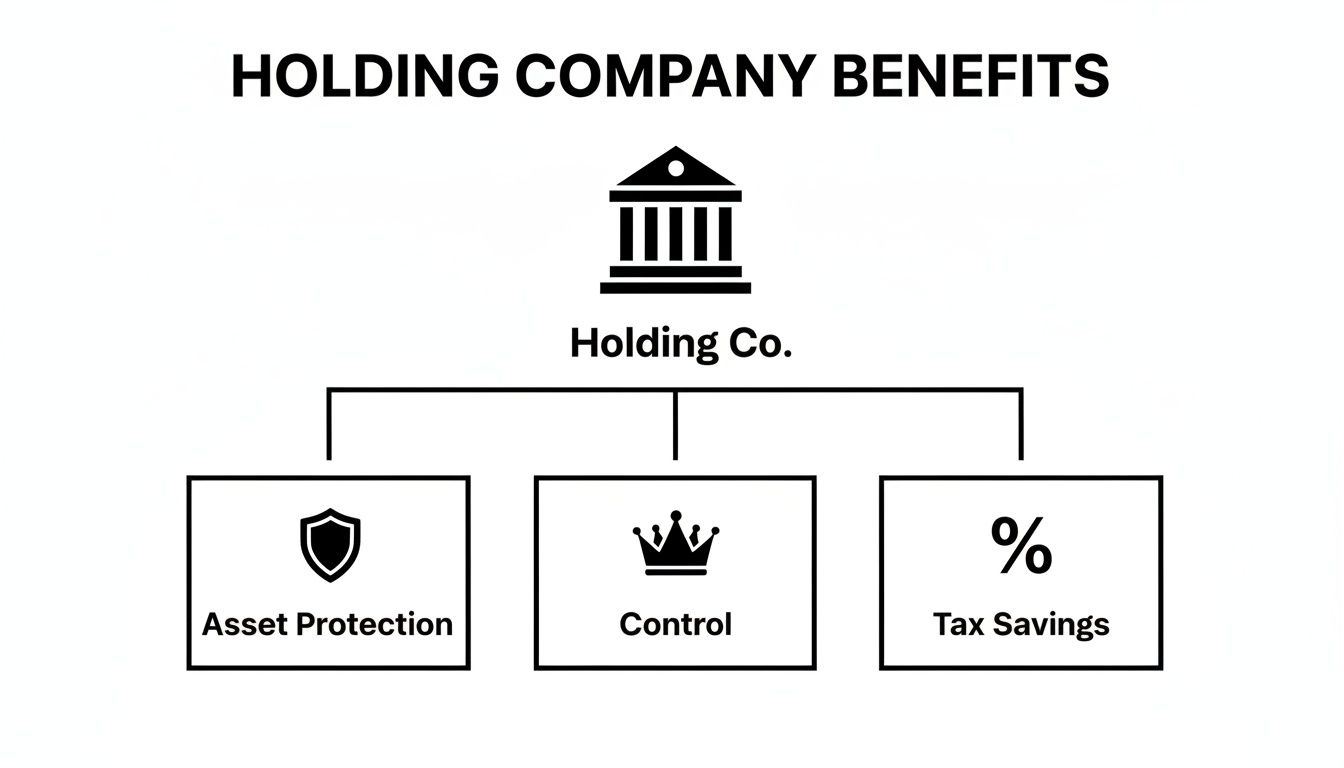
The image perfectly illustrates the core benefits—asset protection, centralized control, and tax savings—which are fundamental advantages of both pure and mixed structures.
Which Structure Is Right For You?
Choosing between a pure and mixed holding company comes down to your specific goals, your appetite for risk, and your long-term vision. To make this decision clearer, the table below offers a direct, side-by-side comparison to help guide the conversation with your advisors.
Comparison of Holding Company Types
| Structure Type | Primary Function | Best For |
|---|---|---|
| Pure Holding Co. | Owns controlling shares in subsidiaries; does not conduct its own business. | Maximizing asset protection and isolating risk between different ventures. |
| Mixed Holding Co. | Owns subsidiaries while also running its own separate business operations. | Companies that expand through acquisition while maintaining their original core business. |
Ultimately, the right choice is the one that gives you the control you need while delivering the robust protection your assets deserve.
How Global Giants Use Holding Company Structures
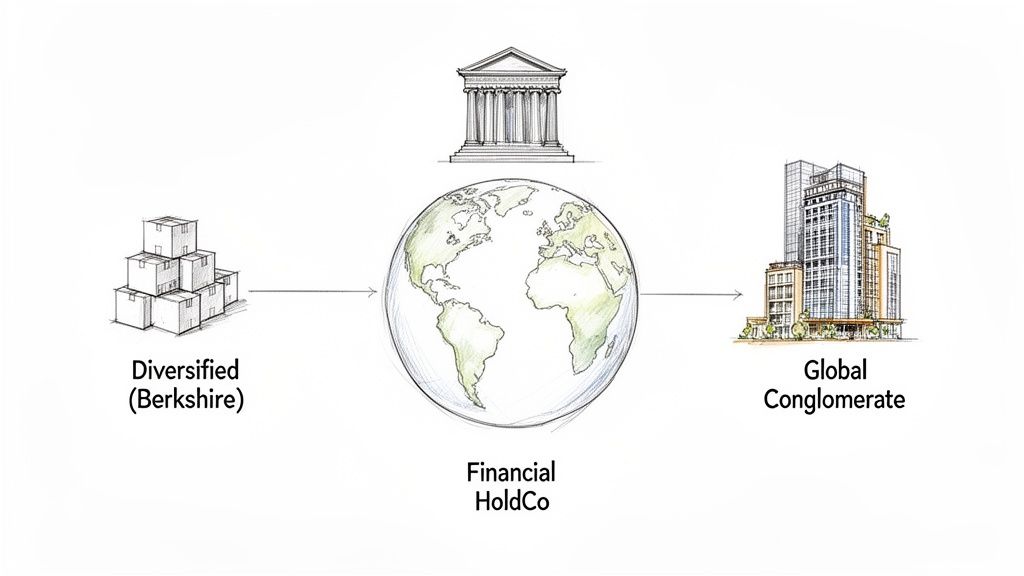
Understanding the theory of a holding company is one thing, but seeing how corporate titans actually wield this structure reveals its true power. These aren’t just abstract legal concepts; they are the blueprints behind some of the world’s most successful and resilient enterprises. By looking at their strategies, we can turn complex ideas into practical insights.
From sprawling conglomerates to focused financial powerhouses, the holding company model provides the framework for immense growth, diversification, and stability. Let’s dig into the real-world applications used by global giants to manage risk and cement their market dominance.
Berkshire Hathaway The Ultimate Diversification Machine
When you think of a masterfully run holding company, Berkshire Hathaway almost always comes to mind. Led by Warren Buffett, it stands as the gold standard of a pure holding company that has achieved extraordinary diversification. Berkshire Hathaway itself doesn’t manufacture anything or sell insurance; instead, it owns a controlling stake in a vast and varied portfolio of subsidiary companies.
This portfolio includes giants in completely unrelated industries, from insurance (GEICO) and railways (BNSF) to consumer goods (See’s Candies) and energy. This structure allows Berkshire to achieve several key goals:
- Risk Mitigation: A downturn in one sector, like retail, can be balanced by stability or growth in another, like insurance. This insulates the parent company from the volatility of any single market.
- Capital Allocation: Profits from cash-rich subsidiaries are efficiently reinvested into other businesses within the portfolio that have higher growth potential, all managed from the top.
- Operational Independence: Each subsidiary operates with significant autonomy, led by its own management team. Berkshire provides capital and strategic oversight without getting bogged down in the day-to-day grind.
Berkshire Hathaway’s model shows that a holding company isn’t just a defensive tool for asset protection; it’s a powerful engine for building and sustaining long-term value across a diverse economic landscape.
This approach demonstrates how a holding company can act as a strategic investor, nurturing its assets while maintaining a stable, resilient core.
Financial Powerhouses and Global Conglomerates
The financial sector provides another powerful case study. A financial holding company like JPMorgan Chase operates under specific regulations that allow it to engage in a wide range of financial activities—from commercial and investment banking to asset management—all through different subsidiaries. This structure is essential for navigating the complex regulatory maze of the financial world while separating different business lines to manage risk effectively.
On a global scale, the holding company landscape has shifted dramatically. While Western firms often lead in market value, Chinese financial institutions have become dominant players based on their massive asset bases. China’s ‘Big Four’ banks, led by the Industrial and Commercial Bank of China (ICBC), collectively control assets exceeding $7.3 trillion. For perspective, Berkshire Hathaway’s market capitalization is around $670.3 billion, while a financial behemoth like JPMorgan Chase manages $4.6 trillion in total assets. You can discover more insights about these global corporate giants and their structures.
This highlights the different ways to measure corporate power—market value versus sheer asset control—and shows how holding company structures adapt to different economic and regulatory systems worldwide. In fast-growing economies, conglomerates like the UAE’s International Holding Company (IHC) use this model to rapidly acquire and manage diverse businesses, from real estate to healthcare, driving national economic growth. By studying these global blueprints, you can see how a holding company can be tailored to achieve market influence, resilience, and strategic growth.
Choosing the Right Jurisdiction for Your Holding Company
Deciding where to establish your holding company is every bit as critical as designing its structure. The jurisdiction you select is the legal, tax, and regulatory world your entire portfolio will live in. This single choice has profound implications for your asset protection, tax efficiency, and long-term compliance, making it a true cornerstone of your entire corporate strategy.
Think of a jurisdiction as the foundation of your financial fortress. A weak or poorly chosen foundation can compromise the whole structure, no matter how brilliantly it’s designed. That’s why picking the right location demands a serious analysis of your specific goals—from privacy needs to global business ambitions.
Key Factors in Selecting a Jurisdiction
Before you even start comparing specific countries, you need to know what you’re looking for. These are the core criteria that determine how effective and viable your holding company will be for years to come.
- Taxation Laws: The goal is to find jurisdictions with low or zero corporate tax on foreign-sourced income and capital gains. Favorable tax treaties and the absence of withholding taxes on dividends are also absolutely critical for financial efficiency.
- Corporate Governance and Legal System: You need a stable legal framework, preferably based on common law, for predictability and robust shareholder protection. Clear and well-defined corporate governance standards are non-negotiable.
- Privacy and Confidentiality: For many high-net-worth individuals, discretion is key. Some jurisdictions offer powerful privacy protections, keeping shareholder and director information out of public view.
- Reporting Requirements: The administrative burden can vary wildly. Some locations have minimal annual reporting and accounting requirements, which simplifies management and keeps ongoing costs down.
A Comparison of Leading Global Hubs
The global landscape offers a variety of compelling options, each with its own distinct advantages. From established Western powerhouses to dynamic international business centers, the ideal choice comes down to your unique circumstances.
Established Western Jurisdictions
For anyone prioritizing stability, a long-standing legal precedent, and a world-class reputation, these Western jurisdictions are often the first port of call.
- Delaware (USA): Famous for its highly developed corporate law. The Delaware General Corporation Law gives directors incredible flexibility and protection, and its Court of Chancery is world-renowned for its expertise in settling corporate disputes.
- Wyoming (USA): A rising star in asset protection. Wyoming offers exceptional privacy with no corporate or personal state income tax. It’s particularly famous for the strength and anonymity of its LLCs, making it a powerful choice for holding assets discreetly.
- United Kingdom (UK): The UK brings a prestigious reputation and a vast network of double-taxation treaties to the table. Its legal system is respected globally, providing a rock-solid foundation for international operations.
Dynamic International Business Centers
If you’re an entrepreneur or investor focused on global growth, tax efficiency, and operational ease, these hubs offer a serious competitive edge.
- United Arab Emirates (UAE): Jurisdictions within the UAE, like the International Free Zone Authority (IFZA), offer 0% corporate and personal income tax, no currency restrictions, and 100% foreign ownership. They combine robust confidentiality with a fiercely pro-business regulatory environment.
- Singapore: As a premier financial hub in Asia, Singapore boasts incredible political stability, a strong legal framework, and attractive tax incentives. Its reputation for integrity makes it a top choice for businesses with significant Asian operations.
- Hong Kong: With its strategic location, simple tax system, and minimal government interference, Hong Kong remains a key gateway to the Asian market. It levies no tax on foreign-sourced income, making it highly efficient for international holding structures.
Selecting a jurisdiction isn’t about finding the “best” one in a vacuum; it’s about finding the one that is best aligned with your specific financial goals, risk tolerance, and operational needs. Each location offers a different mix of benefits.
Choosing the right jurisdiction is a complex process with long-term consequences. This decision often intertwines with where you can establish reliable banking relationships. To learn more, check out our guide on the best jurisdictions for offshore asset protection and banking. A careful, informed choice at this stage will ensure your holding company is built on a solid, compliant, and strategically advantageous foundation from day one.
Frequently Asked Questions About Holding Companies
Even with a good grasp of the basics, entrepreneurs often have practical questions about what a holding company really means for them. We’ve gathered the most common ones we hear from clients to give you direct, clear answers and help you figure out your next steps.
These aren’t theoretical questions—they’re about the real-world implications, from the initial investment to how a holding company stacks up against other asset protection tools.
How Much Does It Cost to Set Up a Holding Company?
There’s no one-size-fits-all answer here. The cost really depends on where you set it up and how complex your structure needs to be. For instance, a simple LLC in a state like Wyoming might only run you a few hundred dollars in filing fees.
But if you’re building a more sophisticated international structure in a top-tier hub like the UAE or Singapore, you’re looking at higher government fees and professional advisory costs. Realistically, expenses can range from a few thousand to tens of thousands of dollars once you factor in proper legal advice, corporate services, and annual upkeep.
The investment in establishing a holding company should be weighed against the long-term value it provides in asset protection, tax optimization, and streamlined management. It’s less about the initial cost and more about the future security it creates.
Can a Holding Company Own Real Estate?
Absolutely. In fact, owning real estate is one of the most common and powerful uses for a holding company. By placing each property into its own subsidiary LLC, which is then owned by the holding company, you cleverly isolate the liability tied to each asset.
What does that mean in practice? A lawsuit related to one property—say, a tenant dispute or an on-site accident—can’t touch your other real estate holdings or your other business ventures. It creates a protective “silo” around each property, shielding the rest of your portfolio. This strategy is a cornerstone for any serious real estate investor.
Is a Holding Company the Same as a Trust?
This is a critical distinction, and one that trips a lot of people up. While both are fantastic tools for asset protection, a holding company and a trust are fundamentally different and serve distinct purposes.
- Ownership and Control: A holding company owns assets through its subsidiaries. You stay in the driver’s seat by owning shares in the holding company and directing its strategy.
- Legal Title vs. Beneficial Interest: A trust, on the other hand, splits ownership. A trustee holds the legal title to the assets for the benefit of the beneficiaries (who hold the equitable interest). You can influence the trust, but you no longer “own” the assets directly.
Think of it this way: a holding company is a corporate structure designed for actively managing and controlling business assets. A trust is primarily an estate planning and wealth preservation vehicle designed to shield assets from creditors by legally separating them from you. They can even be used together to create an incredibly robust, multi-layered defense for your wealth.
How to Structure Your Holding Company Correctly
Knowing what a holding company is and actually putting one in place are two very different things. The gap between theory and action is where wealth is either protected or lost, and structuring your company correctly from day one is everything.
This isn’t just about filing paperwork. It’s about designing a strategic blueprint tailored to your specific goals for asset protection and tax optimisation.
The first major decision is choosing the right jurisdiction. With over 50 options worldwide, this choice will dictate your tax obligations, your level of financial privacy, and the overall strength of your structure. An experienced advisor is critical here to navigate the nuances and ensure you build on solid, compliant ground.
Once the jurisdiction is locked in, the next step is the formation itself. This involves creating a privacy-focused corporate entity and establishing the international banking relationships needed to make it all work.
Your Path to a Secure Structure
Think of this as a straightforward, three-part process:
- Strategic Consultation: We start with a confidential discussion to map out your assets, identify your risks, and get crystal clear on your goals for asset protection and tax efficiency.
- Jurisdiction and Design: Based on that conversation, we select the ideal location and legal framework for your holding company. For a deeper understanding of how this works, you can learn more about how an offshore registered company fits into this strategy.
- End-to-End Implementation: We then manage the entire setup—from the corporate documents to coordinating with international banks—to ensure everything is seamless and fully compliant.
A well-designed holding company is more than a legal entity; it’s the architectural blueprint for your financial legacy, built to withstand risk and adapt to future opportunities. It requires professional guidance to execute correctly.
At Protect Your Wealth, our team provides end-to-end solutions, guiding high-net-worth clients through every stage of this intricate process. We handle the complexities of jurisdiction selection, compliant formation, and international banking so you can focus on what you do best.
Schedule a confidential consultation to discuss your goals with an advisor who understands the nuances of sophisticated corporate strategy at https://www.protectyourwealth.com.


