


You're probably not looking for a hobby company.
You may be relocating capital, ring-fencing operating risk, building an Asian commercial base, or inserting a Singapore entity into a broader holding structure that also touches trusts, family wealth, licensing income, or regional distribution. In that context, most articles on how to open company in singapore are too shallow. They tell you where to click in ACRA's portal, but they skip the harder questions.
Those harder questions decide whether the structure works. Who will satisfy the resident director requirement without undermining your control. Whether your bank account will open smoothly or stall in compliance review. Whether the company will have enough governance, records, and local support to remain credible when a bank, investor, tax authority, or counterparty starts asking deeper questions.
Singapore still deserves serious attention because it combines a fast incorporation system with a legal environment that experienced founders and investors understand. But speed at formation doesn't remove discipline later. The filing is usually the easy part. The operating architecture is what separates a clean, durable setup from an expensive administrative shell.
Why Singapore is a Strategic Hub for Global Entrepreneurs
A founder wires capital into Asia, lines up suppliers in two countries, and expects the new Singapore company to start billing within weeks. The incorporation can move quickly. The real test comes right after formation, when the bank asks for group structure charts, source of funds, customer contracts, and a clear explanation of why Singapore sits in the middle of the transaction flow.

Singapore remains attractive because it performs well at that stage, not just at the filing stage. The legal system is familiar to international advisers, counterparties generally accept Singapore corporate documents without much friction, and the incorporation framework is clearly administered through ACRA. The government's business guidance also presents company setup as a structured process with defined compliance obligations, as reflected in Enterprise Singapore's overview for starting a business.
For foreign founders, that matters because a Singapore entity often serves a larger purpose. It may contract with regional customers, hold intellectual property, employ a commercial team, act as a procurement or distribution vehicle, or sit beneath a family holding structure that also includes trusts, investment companies, or operating subsidiaries in other jurisdictions. Used properly, it can support asset segregation and cleaner governance. Used poorly, it becomes an expensive file with little operational credibility.
Three points usually drive the decision.
- Institutional acceptance: Singapore companies are widely understood by banks, payment providers, legal counsel, and major counterparties.
- Predictable administration: Board approvals, share issuances, beneficial ownership records, and statutory filings follow a system that experienced cross-border operators recognize.
- Regional utility: Singapore can work well as an Asian contracting and management hub if the company has a real business reason to be there and the activity matches the structure.
The trade-off is straightforward. Singapore is not a casual mailbox jurisdiction.
Banks want to see commercial logic. Tax authorities and counterparties may ask why profits arise in Singapore, who manages the company, where decisions are made, and whether the entity has enough presence to support its role. That does not always require a large office or a local staff from day one. It does require a coherent story backed by records, governance, and genuine operating activity.
Clients who get the best result usually treat Singapore as part of an operating plan, not a prestige registration. They decide early how money will move, who will sign contracts, what level of local substance is appropriate, and how the entity fits into the wider ownership and asset protection structure. That is why Singapore continues to attract serious global entrepreneurs. It offers credibility, order, and practical utility, but only for founders prepared to build a company that can survive scrutiny after the certificate is issued.
Choosing Your Singapore Business Structure
For most foreign founders, the key choice isn't between several equally attractive options. It's between using the right structure at the start or fixing the wrong one later.
In Singapore, the structure that usually fits serious international planning is the Private Limited Company, commonly written as Pte. Ltd.. Other forms exist, but they rarely serve a high-net-worth founder who cares about risk isolation, bankability, investor optics, and long-term control.
Singapore Business Entity Comparison
| Feature | Private Limited (Pte. Ltd.) | Sole Proprietorship | LLP |
|---|---|---|---|
| Legal identity | Separate legal entity | Not separate from owner | Separate framework for partnership business |
| Liability profile | Better suited for separating business obligations from personal exposure | Owner exposure is direct | Better than a sole proprietorship for partnership operations, but less clean for many foreign-owned structures |
| Ownership transfer | More practical for adding investors or transferring shares | Less suitable for sophisticated ownership planning | Partnership interests can work, but often create more drafting and governance issues |
| Banking and investor perception | Usually the strongest option | Often weaker for institutional onboarding | Can work, but often less preferred than a company |
| Succession and continuity | Better for continuity independent of founders | Tied closely to the individual owner | Depends on partnership arrangements |
| Best use case | Foreign-owned operating company, holding company, regional vehicle | Small local owner-operated activity | Professional or partner-led ventures |
Why the Pte. Ltd. usually wins
A Pte. Ltd. gives you something foreign founders need, which is a legal person distinct from you. That separation matters if the Singapore entity is signing supply contracts, holding receivables, employing staff, licensing IP, or sitting inside a broader family or investment structure.
It also works better when you need to bring in another shareholder, create different classes of internal rights through shareholder arrangements, or present the business to banks and counterparties as a real company rather than an informal operating vehicle.
A sole proprietorship is usually the wrong answer for international clients. It may look simple, but simplicity at formation often creates fragility later. If your objective includes asset protection, governance discipline, or eventual expansion, you don't want the business legally fused with the individual founder.
Where LLPs fit and where they don't
An LLP can make sense in narrow cases, especially where two or more principals are running a professional or collaborative business and want a partnership-style arrangement. But many foreign founders overestimate its usefulness.
In practice, LLPs often complicate things that high-level clients care about:
- Bank conversations: Banks want a coherent ownership and control narrative.
- Governance drafting: Partnership dynamics can create avoidable ambiguity.
- Future restructuring: Moving from an LLP into a more institutional corporate setup can be cumbersome.
Practical rule: If you expect outside investment, intercompany transactions, licensing arrangements, or a future exit, start with the corporate vehicle that supports those outcomes.
How to decide correctly at the start
Use a Pte. Ltd. if any of the following are true:
- You need liability separation: The business will contract, hire, invoice, or hold meaningful assets.
- You want institutional credibility: A bank, investor, or major vendor will review your structure.
- You're building a cross-border group: The Singapore entity will sit under, above, or alongside other companies or private structures.
- You may scale or sell: Share-based ownership is easier to manage than informal or partner-style arrangements.
For nearly all foreign-owned businesses asking how to open company in singapore, that makes the private limited company the default answer. Not because it's fashionable. Because it aligns with how well-structured business operates.
Navigating Director and Residency Requirements
Many foreign founders encounter the first real constraint. Singapore requires at least one resident director for a private limited company. That rule isn't a technical annoyance. It reflects a policy choice about accountability inside the jurisdiction.
If you're not already based in Singapore, you need to solve that point properly. If you solve it badly, the rest of the structure becomes unstable.
The legal requirement and the practical sequence
The practical workflow is not random. For a Singapore private limited company, the sequence begins with ACRA approval for the proposed company name and registered address, then moves to preparation of the constitution and incorporation particulars, and only then to the BizFile+ filing. The submission set typically includes the company name, business activities, shareholder and director particulars, registered office address, paid-up capital, company secretary details, and the constitution, and the appointed officers must endorse consent online after filing, as outlined in Acclime's guide to registering a Singapore company.
That sequence tells you something important. The director issue isn't something to “sort out later.” It sits inside the filing architecture from the beginning.
Using a nominee director without losing control
For foreign founders, the common solution is a professional nominee director. That can work well, but only if the arrangement is drafted and managed as a compliance function rather than a casual favor.
A proper nominee setup should answer four questions clearly:
- Who holds operational control: The beneficial owner should retain real decision-making authority through constitutional documents, shareholder arrangements, board protocols, and banking mandates where appropriate.
- What the nominee will and won't do: The service agreement should define scope, approval thresholds, and reporting expectations.
- How risk is managed: A serious nominee provider will ask for records, business evidence, and transaction clarity. That's a good sign, not an obstacle.
- How replacement works: You need a practical path to change the nominee if the relationship ends.
If a nominee director service asks almost no questions, that's usually the wrong provider. The firms worth using care about what the company does, who owns it, and what risks they are assuming.
Red flags foreign founders miss
The wrong nominee arrangement usually shows up in one of these forms:
- Undocumented control assumptions: You believe you control everything, but the paperwork doesn't support that belief.
- Bare-bones service providers: They appear inexpensive because they provide little governance support and almost no strategic review.
- Banking mismatch: The nominee structure isn't aligned with the bank account application, so compliance officers start seeing inconsistencies.
- No residency plan: Some founders use a nominee as a permanent crutch when they intend to establish a deeper local footprint later.
If your long-term goal includes relocation or a more substantial presence, your incorporation strategy should fit that path from day one. A residency plan can affect who serves as director, how management is demonstrated, and how the company is perceived. For founders exploring that route, Singapore residency pathways are part of the same planning conversation, not a separate one.
The Official ACRA Registration Workflow
Singapore's setup system is fast, but only when the file is ready before anyone touches the portal. Founders often hear that incorporation is quick and assume the platform itself does the hard work. It doesn't. BizFile+ rewards preparation and exposes weak drafting immediately.
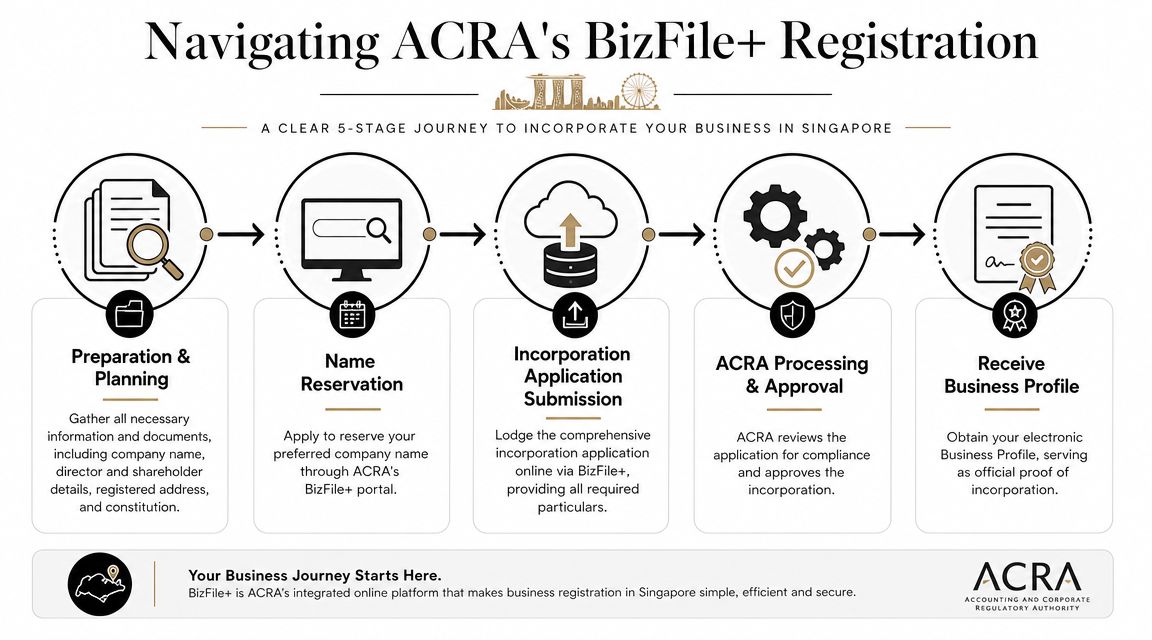
According to Oyster's summary of Singapore company setup requirements, the regime is built around ACRA's online BizFile+ system and typically requires a registered business name, a Singapore registered office address, at least one resident director, a resident company secretary appointed within six months, and minimum paid-up capital of S$1. Government filing fees are S$15 for the company name application plus S$300 for company registration, for a total baseline of S$315, and the process can be completed in about 1 business day if documents are complete.
What must be ready before filing
The founders who move fastest usually prepare the entire file before name submission. That means you don't just have a preferred company name. You also have consistency across ownership records, director details, business activity wording, registered office arrangements, and the constitution.
The minimum filing package typically needs:
- Company identity details: Proposed name and business activity description.
- People details: Shareholder and director particulars that match supporting identification and records.
- Local infrastructure: Registered office arrangements and secretary planning.
- Capital and governance basics: Paid-up capital position and a constitution suited to the intended ownership and control structure.
Where delays actually happen
Most delays aren't caused by the filing portal. They come from weak inputs.
Common choke points include:
- Name issues: A name that triggers objections, resembles an existing business too closely, or creates regulatory sensitivity.
- Incomplete officer information: Mismatched personal details slow down endorsements and raise compliance questions.
- Poor constitutional drafting: Generic documents can create problems if the company has more than one owner, nominee involvement, or future investor plans.
- Unclear business activity wording: If the company's stated activity doesn't match later banking submissions, you've created your own problem.
Fast incorporation in Singapore is a document exercise, not a clicking exercise.
A practical workflow that works
A clean process usually follows this order:
- Clear the ownership and control map first. Decide who owns shares, who acts as resident director, who will be secretary, and who has approval rights internally.
- Settle the registered office and constitutional documents. These aren't side issues. They're foundational.
- Reserve the company name only when the file is otherwise ready. That prevents dead time between approval and filing.
- Submit through BizFile+ with complete particulars.
- Get officer consents completed promptly. If appointed officers don't endorse in a timely way, the process stalls for avoidable reasons.
What works and what doesn't
What works is a fully coordinated file prepared by people who understand the end use of the company. What doesn't work is copying a generic setup from a local microbusiness and assuming it fits a foreign-owned holding or operating structure.
If your entity will later seek a bank account, sign cross-border contracts, receive investment proceeds, or sit in a group chart, build the registration file with those later stages in mind. That's the difference between incorporation and implementation.
Opening Your Corporate Bank Account
This is the stage most founders underestimate.
The company may exist on paper, but until a credible bank account is operating, the structure is only partially functional. For foreign-owned Singapore entities, banking is often more demanding than incorporation because banks assess not just legal formation, but commercial legitimacy, ownership transparency, and risk profile.

Why banks scrutinize foreign-owned structures so closely
A bank isn't impressed that your company was formed quickly. It wants to know what the company will do, who benefits economically, how funds will move, why Singapore makes sense for the business, and whether the profile fits the institution's risk appetite.
Expect detailed questions around:
- Source of wealth and source of funds
- Business model and expected counterparties
- Geographic exposure
- Ownership chain and beneficial owners
- Operational footprint and supporting documents
If the answers are inconsistent, vague, or unsupported by documents, the application can stall even if the company itself was incorporated correctly.
Substance beats presentation
Many applicants think banking is about polished forms. It isn't. It's about coherence.
Your company story must line up across all of these points:
- the incorporation documents
- the business description
- the shareholder profile
- the website and commercial materials, if any
- the anticipated transaction pattern
- the rationale for Singapore
If you say the company is a consulting business but submit materials that look like a passive holding vehicle, the bank notices. If you say the business is regional trading but can't explain supplier and customer geography, the bank notices that too.
Banks don't reject only because of risk. They also reject because the file makes too little sense to approve confidently.
Traditional banks versus alternatives
Not every client needs the same account type. Some need a traditional Singapore bank because they require stronger counterparty perception, broader banking services, or easier integration with a substantial operating company. Others can start with a regulated fintech or payments setup if the transaction profile fits.
The decision should be based on use case, not fashion. This comparison of fintech accounts and traditional banks is useful when deciding which route matches your company's real operating needs.
Why an introducer can matter
A professional bank introducer can help by pre-vetting the file, identifying weaknesses before submission, and aligning the bank target with the client's profile. That doesn't guarantee approval, and no serious adviser should promise that. But it often improves the quality of the application and reduces preventable friction.
One option in this space is Protect Your Wealth, which acts as an official bank introducer in several jurisdictions and coordinates account-opening support as part of broader structuring work. That kind of role is most useful when the company is part of a larger cross-border plan rather than a simple local startup.
What works in practice
A strong banking file usually includes clear beneficial ownership, consistent business documentation, a rational Singapore nexus, and realistic transaction expectations. The founder also needs to be responsive. Banks will test whether the client can answer sensible commercial questions directly and cleanly.
What doesn't work is trying to “keep things broad” by being vague. Vague files invite more questions, not fewer.
Post-Incorporation Strategy and Compliance
The incorporation certificate is the easy part. A significant test starts three months later, when the bank asks for updated invoices, your accountant asks how management decisions are made in practice, and a foreign tax adviser wants to know whether the Singapore company has real control over its own income.
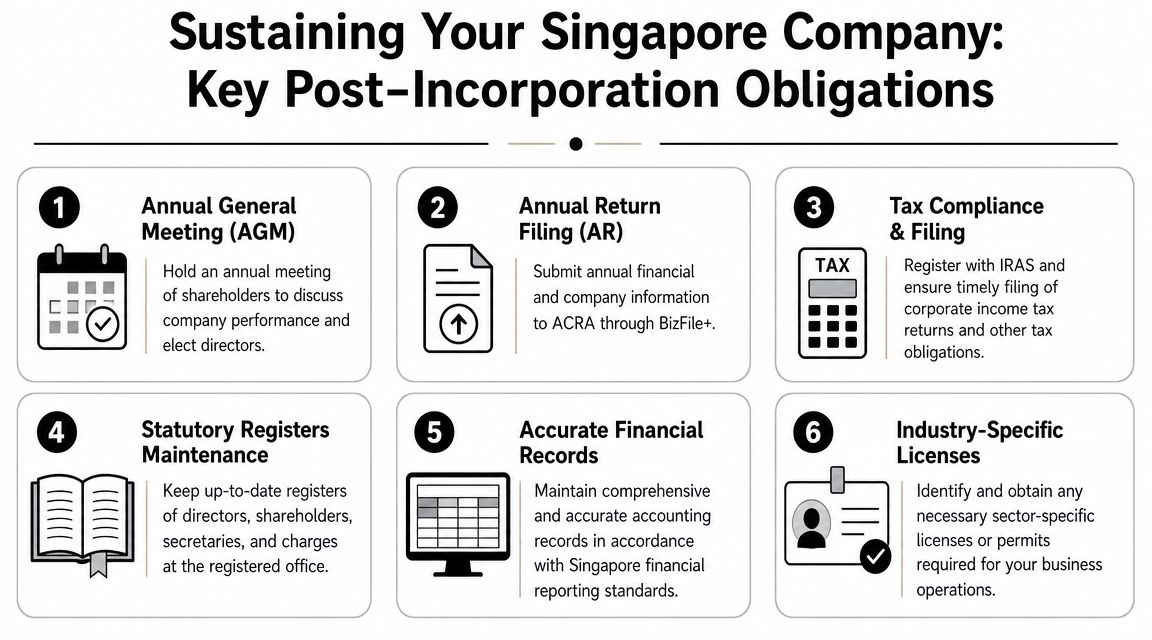
For foreign founders, post-incorporation risk usually comes from weak operating discipline, not the ACRA filing itself. Singapore expects the company to be maintained properly. That includes appointing a local-resident company secretary within the required period, keeping a registered office, maintaining statutory registers, and meeting annual filing and governance obligations. SBS Group's overview of foreigner incorporation and ongoing obligations gives a useful summary of that baseline.
The practical point is broader than secretarial compliance. A company that exists only on paper becomes harder to defend with banks, auditors, investors, and tax authorities. If board approvals are inconsistent, accounting records are reconstructed late, or the business model changes without reviewing licensing exposure, the structure starts to weaken.
What needs attention after setup
Founders usually need to manage four areas in parallel:
- Corporate upkeep: company secretary, statutory registers, registered office, share records, and board documentation
- Annual compliance: annual returns, meeting requirements where applicable, and clean supporting records
- Accounting and tax filings: books that match the commercial reality, with contracts, invoices, payroll, and intercompany charges documented properly
- Regulatory scope: confirmation that the company has not drifted into a licensed activity without approval
Each of these affects more than local compliance. They also affect whether the company looks credible as an operating business with real substance.
Tax efficiency depends on how the company is run
Singapore remains attractive because of its territorial features, single-tier dividend system, and generally business-friendly tax framework. The headline rate matters less than the facts behind the file. Inland Revenue Authority of Singapore guidance on corporate income tax rates, rebates and tax exemption schemes is the right starting point, but foreign founders should not stop there.
The harder questions come later. Where are key decisions made. Who controls contracts and pricing. Is the Singapore company earning margins that match its functions and risks. Does it have enough local presence to support the position being taken with banks and foreign tax authorities.
A low-tax outcome that cannot survive scrutiny is not a strategy.
Fitting the company into a wider structure
A Singapore company can serve well as a regional trading company, holding vehicle, IP licensing entity, or contract hub for Asian counterparties. The right use depends on who owns it, where the founder is tax resident, how cash will move, and whether profits will be retained or distributed.
Many foreign founders often make expensive mistakes. They form the company first, then try to retrofit asset protection, profit extraction, and family ownership planning after revenue has already built up. In practice, the better approach is to align the Singapore entity with the wider structure from the start, especially if trusts, holding companies, or residence planning are part of the picture. That is the point of doing cross-border tax planning for international structures before the company accumulates material profits.
The strongest Singapore structures hold up under routine pressure. A bank reviews the account activity. An investor reviews the cap table and governance history. Another jurisdiction asks why income sits in Singapore and whether the company has real decision-making capacity there.
Opening the company is only the first move. If the goal is to support international operations, preserve flexibility, and protect wealth over time, governance, tax positioning, and substance need to be treated as part of the structure itself.
If you want a Singapore company that fits your banking, tax, residency, and asset-protection goals, Protect Your Wealth can help map the structure before you file, coordinate the incorporation process, and align the company with the wider cross-border plan so you're not fixing avoidable problems after setup.


