
You already know the lifestyle pitch. Clean streets, strong passport adjacency, efficient government, low drama. That’s not why serious clients ask how to get residency in Singapore.
They ask when a banking relationship has become fragile, when a holding structure needs a credible operating base in Asia, when a founder wants substance in a jurisdiction that counterparties respect, or when a family wants one place that can anchor business, education, and succession planning. In that context, residency is not an admin exercise. It’s a positioning decision.
Singapore rewards applicants who fit its long-term interests. That sounds obvious, but most failed applications happen because people treat the process like a checklist. They focus on the form, not the profile. They ask which pass to file under, when they should first ask what strategic story they are building: executive, founder, investor, spouse, parent, or family establishing roots through education.
Why Singapore Residency is a Strategic Asset
A founder sells part of a business, shifts more capital into Asia, and suddenly the weak points in the structure become obvious. The banking setup depends on one jurisdiction, the family is spread across two others, and tax residence no longer matches where decisions are made. In that situation, Singapore residency is not a lifestyle upgrade. It is a risk-management tool.
For internationally mobile entrepreneurs and high-net-worth families, Singapore works best as part of a wider cross-border plan. That plan often includes an operating company, a credible place for management and control, private banking access, family relocation, and succession planning. Singapore holds its value because regulators, banks, and counterparties treat it as a serious base for real activity.
That credibility has practical consequences. A weak residence position creates friction across the entire structure. Account opening gets slower. Substance questions become harder to answer. Cross-border tax positions are easier to challenge. A Singapore base, set up properly, usually improves those conversations because it supports a clearer compliance narrative and a more defensible commercial footprint in Asia.
Temporary residence and permanent residence serve different purposes. A work pass gives mobility and operational access. Permanent residence gives more stability for long-term family planning, school choices, business continuity, and future integration. Anyone weighing those options should first understand the legal and practical differences between citizen and permanent resident status in Singapore.
Singapore residency has the most strategic value when it is backed by real economic activity, a coherent family plan, and credible long-term intent.
Singapore also selects carefully. Approval is realistic, but it is not mechanical. That matters for affluent applicants. A residency status issued by a jurisdiction that screens for contribution, profile, and fit carries more weight in banking, structuring, and reputational terms than a status obtained through a light-touch system.
There is also a current planning point many generic guides miss. The investor route that many people still mention, the Global Investor Programme, has been suspended. That changes the decision tree. For some clients, the better route is a high-quality employment profile through an Employment Pass or ONE Pass. For others, it is a founder-led strategy that builds operating substance first and permanent residence later. The right answer depends less on immigration labels and more on what role Singapore will play in the client’s asset protection, tax residence, and business expansion plan.
Navigating Employment-Based Residency Pathways
Employment routes remain the main practical entry point for many professionals, operators, and founder-executives. The mistake is assuming any work pass is equally useful. It isn’t. The right route depends on whether you are joining an established employer, relocating as a senior executive, or using your own Singapore company as the operating vehicle.
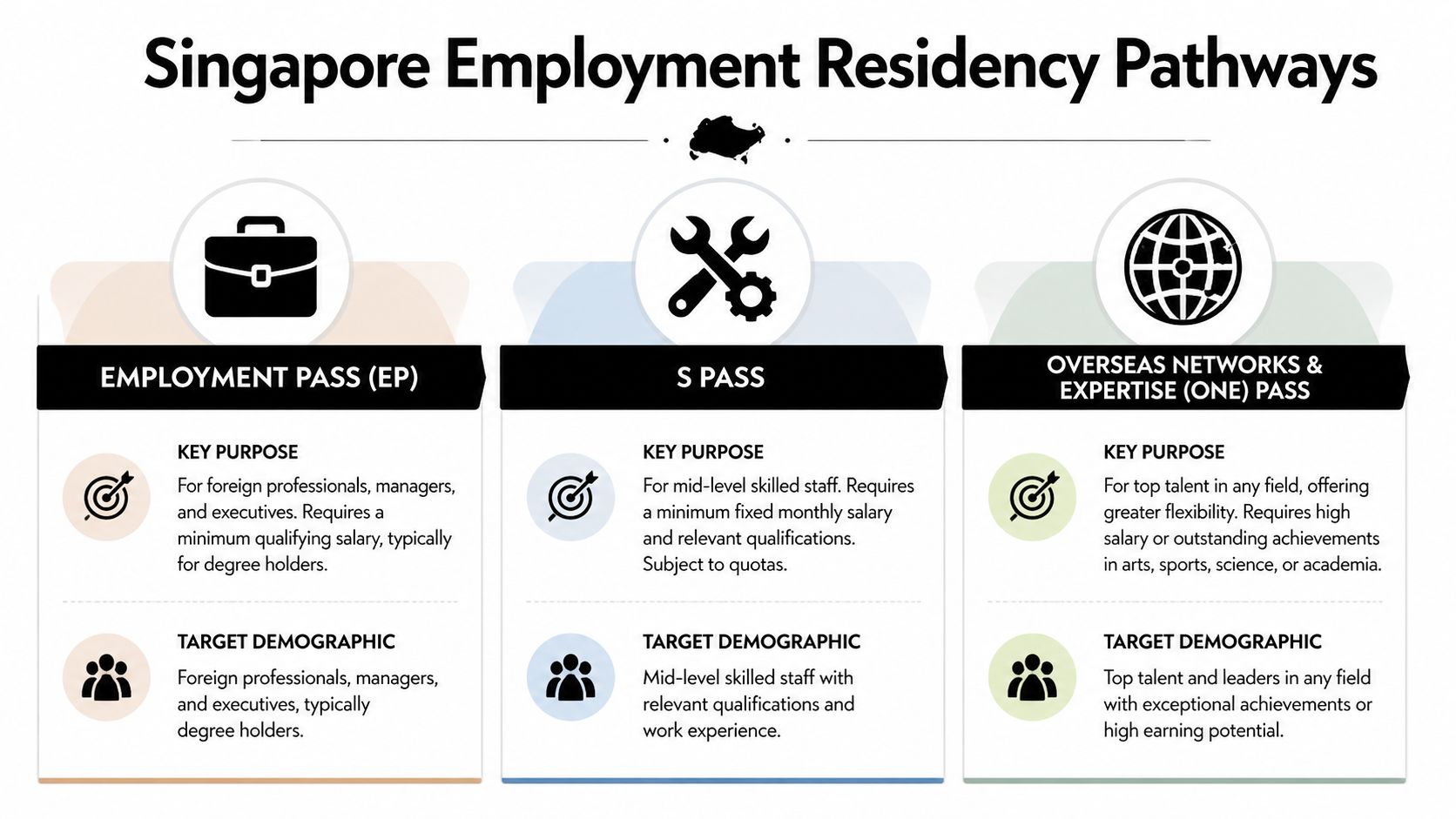
The three passes that matter most
| Pass | Best fit | Strategic use |
|---|---|---|
| Employment Pass | Professionals, managers, executives | Standard route for people building local employment history |
| S Pass | Mid-level skilled staff | Relevant when the role is skilled but not positioned at senior executive level |
| ONE Pass | Top-tier talent with strong profile | Best for applicants who need flexibility and already have an elite track record |
The Employment Pass, or EP, is the default route for globally mobile professionals. For residency planning, the EP matters because it creates a documented local employment record, payroll trail, and tax footprint. Those are the raw materials of a later PR case.
The S Pass can also lead into PR planning, but it usually serves a narrower profile. It can work, though it doesn’t carry the same signaling value as a strong executive EP profile.
The ONE Pass is different. It is built for applicants with a high-level profile and offers more flexibility than the standard employer-tied model. From a strategy perspective, that flexibility matters for founders, investors with operating roles, and globally recognized talent who don’t want immigration status tied too tightly to one employer.
COMPASS decides whether the EP case is viable
Since September 2023, Employment Pass applications under COMPASS require at least 40 points. A salary in the 90th percentile can yield 20 points, and the same framework also considers nationality diversity, qualifications, and support for local employment, as outlined in this ASEAN Briefing summary of Singapore PR and COMPASS.
That point system changed how good advisors assess a case. The old mindset was document collection. The current mindset is profile engineering.
Here’s what usually strengthens a COMPASS-linked EP case:
- Salary position: A stronger salary doesn’t just improve optics. It can materially improve the point profile.
- Qualifications: Recognized educational credentials still matter, especially when they support the commercial logic of the role.
- Employer profile: A company that hires credibly, supports local employment, and has a coherent business case is easier to defend.
- Diversity logic: Some firms gain an advantage when the hire supports workforce complementarity rather than obvious duplication.
What works in practice
A clean EP file tells a believable story. The role fits the company. The salary fits the role. The candidate’s background fits both. Most weak filings break one of those links.
For example, a founder who sets up a Singapore company and appoints himself to a role with no operational depth often struggles. The paper may exist, but the commercial narrative is thin. A stronger case usually shows active clients, a real management function, local counterparties, and business reasons for being in Singapore beyond immigration.
Practical rule: If the business would make no sense without the residency goal, authorities will usually see that.
By contrast, a senior commercial or technical operator hired into a genuine revenue or leadership role can be much easier to position. The pass then becomes more than entry permission. It becomes the first layer of a later PR application, because ICA looks at economic contribution, qualifications, age, family profile, and length of residency when it assesses PR.
Choosing between EP and ONE Pass
Business owners often make the wrong call. They chase the pass that sounds more prestigious, instead of the pass that aligns with their actual evidence.
Use the EP when:
- You have a real employer or operating company: The structure is straightforward and defensible.
- You want a stable runway into PR: Consistent payroll and local tax records help.
- You are building substance from the ground up: This route rewards disciplined execution.
Use the ONE Pass when:
- Your profile is already exceptional: Prior compensation and standing support the application.
- You need flexibility: This matters if your activity spans multiple ventures.
- You don’t want your status boxed into one narrow employment relationship: That can be important for investors and serial founders.
A final point on how to get residency in Singapore through employment. The pass itself is not the end goal. Think of it as the platform on which you build residency credibility. If you enter on the right pass but spend the next year with a weak local footprint, you waste the opportunity. If you enter on the right pass and build payroll consistency, tax filings, business presence, and local ties, your later PR file looks very different.
The Investor and Entrepreneur Roadmap to Singapore
Most investor content on Singapore residency is outdated because it still revolves around the Global Investor Programme as though nothing changed. That’s no longer a reliable starting point.

The key change is this. Following the suspension of the Global Investor Programme in late 2024, Singapore shifted toward talent-focused routes. Recent EDB data from Q1 2026 showed over 1,200 approvals under revised EntrePass and high-salary EP routes, and the ONE Pass, launched in 2025, saw 300 approvals in the first half of 2026, according to this summary of Singapore residency by investment developments.
That shift matters because investors now need to think like operators. Capital alone is less persuasive than capital paired with commercial relevance, employment, innovation, or executive substance.
For anyone comparing broader residency by investment programs, Singapore now sits in a different category. It’s less about passive capital deployment and more about proving that your presence benefits the local economy in a tangible way.
The old investor logic versus the current reality
Under the older mindset, applicants looked for the cleanest direct investment route. In today’s market, the better question is whether you should position yourself as:
- A founder building a company in Singapore
- A high-salary executive within your own or another Singapore business
- A globally accomplished individual whose profile supports a ONE Pass
- A family principal using a business platform, not a passive capital route
That’s a meaningful change in strategy.
EntrePass is a business case, not a wealth case
EntrePass suits founders better than passive investors. The profile has to point to innovation, traction, or a company with serious commercial logic. In practice, this route works best for tech, digital services, and venture-oriented businesses where the Singapore presence is commercially obvious.
A weak EntrePass case usually looks like a holding company pretending to be a startup. A strong one shows actual product logic, commercial need, and founder relevance.
Consider the difference:
- Weak profile: An applicant creates a new entity with vague consulting language and no reason the activity must be based in Singapore.
- Strong profile: A founder uses Singapore as the operational base for an expansion into Asian markets, with a clear management role and documented business activity.
Self-sponsored employment structures can work
For many entrepreneurs, the practical route is still a Singapore company employing the founder in a real executive role. That can be powerful if the structure is genuine.
The keyword is genuine. Authorities can distinguish between a company formed to run a business and a company formed to support an immigration narrative. If the entity has contracts, operations, governance, and commercial substance, the case becomes easier to defend.
Residency strategy for entrepreneurs starts with business reality. Immigration follows the business, not the other way around.
ONE Pass for established principals
ONE Pass is often the cleanest option for applicants who already have a global reputation, senior compensation history, or a profile that doesn’t fit neatly into a conventional employer model. For principals with cross-border income streams, this can avoid awkward structuring that exists only to force an EP narrative.
That said, prestige alone won’t save a weak local story. A strong global background helps. It doesn’t replace the need for a coherent Singapore rationale.
Investor decisions that age well
The best Singapore residency strategies for entrepreneurs tend to share the same traits:
- Operational reason for Singapore: The jurisdiction must fit the business model.
- Documented executive role: The applicant should be visibly necessary to the local structure.
- Substance over decoration: Office, payroll, contracts, counterparties, and governance matter more than glossy presentations.
- Alignment with long-term PR planning: The first filing should support the later objective, not just solve the current move.
If you are trying to understand how to get residency in Singapore as an investor, stop thinking in terms of passive entry. Start thinking in terms of defensible economic participation. That is where the system has moved.
Family Sponsorship and Student Pathways
A family office decision often starts with a practical question. Does the family need a route tied to an existing Singapore connection, or should it build one over time through education and residence?

For high-net-worth families, these pathways are rarely just immigration choices. They affect school planning, estate structuring, time spent on the ground, and whether Singapore becomes a genuine family base or only a useful jurisdiction on paper. ICA can see the difference.
Family sponsorship is relationship-led, but still evidence-heavy
Family-based eligibility exists for a limited group of applicants, typically including spouses and certain children of Singapore citizens or permanent residents, as well as parents in narrower circumstances. The logic is simple. A qualifying relationship creates the route.
The file still has to hold up.
In practice, strong family cases show a settled household, credible cohabitation, financial stability, and a real pattern of life in Singapore. Weak cases usually fail for predictable reasons: the sponsor lives mostly elsewhere, the marriage is recent and lightly documented, or the application reads like a residency tactic rather than a family unit putting down roots.
This matters for affluent families who divide time across jurisdictions. A spouse route can look attractive on paper, but if the family home, children’s schooling, and daily life remain centered elsewhere, the case loses force quickly.
The student route works best for families planning five to ten years ahead
The student pathway is often underestimated because it does not look like a classic investor solution. From a strategy perspective, it can be one of the more durable options available to families without an immediate sponsorship angle.
Singapore gives weight to education, local examination milestones, and visible integration. A child who studies in Singapore for years, progresses through the local system, and develops a credible long-term connection presents a very different profile from a student placed in Singapore only to create technical eligibility. Officers review the broader family story, not just the child’s enrollment status.
For many international families, that is the fundamental trade-off. The route can be strong, but only if the parents are prepared to support a genuine Singapore-centered education plan and spend enough time locally to make it believable.
Comparing the two routes
| Path | Main advantage | Main trade-off |
|---|---|---|
| Family sponsorship | Clear legal basis if the qualifying relationship already exists | Limited to narrow categories and still subject to discretionary review |
| Student pathway | Builds a stronger long-term integration case for the next generation | Slower, education-led, and less effective if the family treats Singapore as a temporary school stop |
A spouse of a Singapore citizen or PR should usually review sponsorship first. That is the more direct route if the family relationship and living arrangements are already real and well documented.
Families without that connection need a different frame. The student route is not a shortcut. It is a long-horizon residency strategy built through local presence, schooling, and consistency.
How sophisticated families should assess these options
I usually ask three questions.
First, is there already a qualifying family relationship that can support a credible application now? Second, is the family committed to anchoring part of its life in Singapore rather than rotate through it? Third, does the education plan make sense on its own merits, even if PR takes longer than expected?
Those questions filter out weak strategies fast.
A sound plan tends to work in layers:
- Residence reality: The family can show where it lives, who is based in Singapore, and why.
- Education credibility: The child’s school path is coherent, locally rooted, and not chosen solely for immigration optics.
- Long-term optionality: The family preserves flexibility for later PR applications without forcing structures that will be hard to defend.
Families who get this right do not treat sponsorship and schooling as separate tracks. They align the household, the child’s education, and the residency objective into one fact pattern. That is what makes the eventual application easier to justify.
The Definitive Strategy for Permanent Residency Approval
A client arrives in Singapore on a strong work pass, leases a premium residence, opens local accounts, and assumes permanent residence is the obvious next step. ICA often sees that profile very differently. Wealth and mobility help, but PR approval turns on whether your Singapore footprint looks durable, credible, and useful to the country over time.
For high-net-worth families and founders, that distinction matters. PR is not just an immigration upgrade. It is a long-term positioning tool that affects family continuity, banking relationships, business substance, and wider cross-border tax planning strategy. The filing itself is simple. The strategy behind it is not.
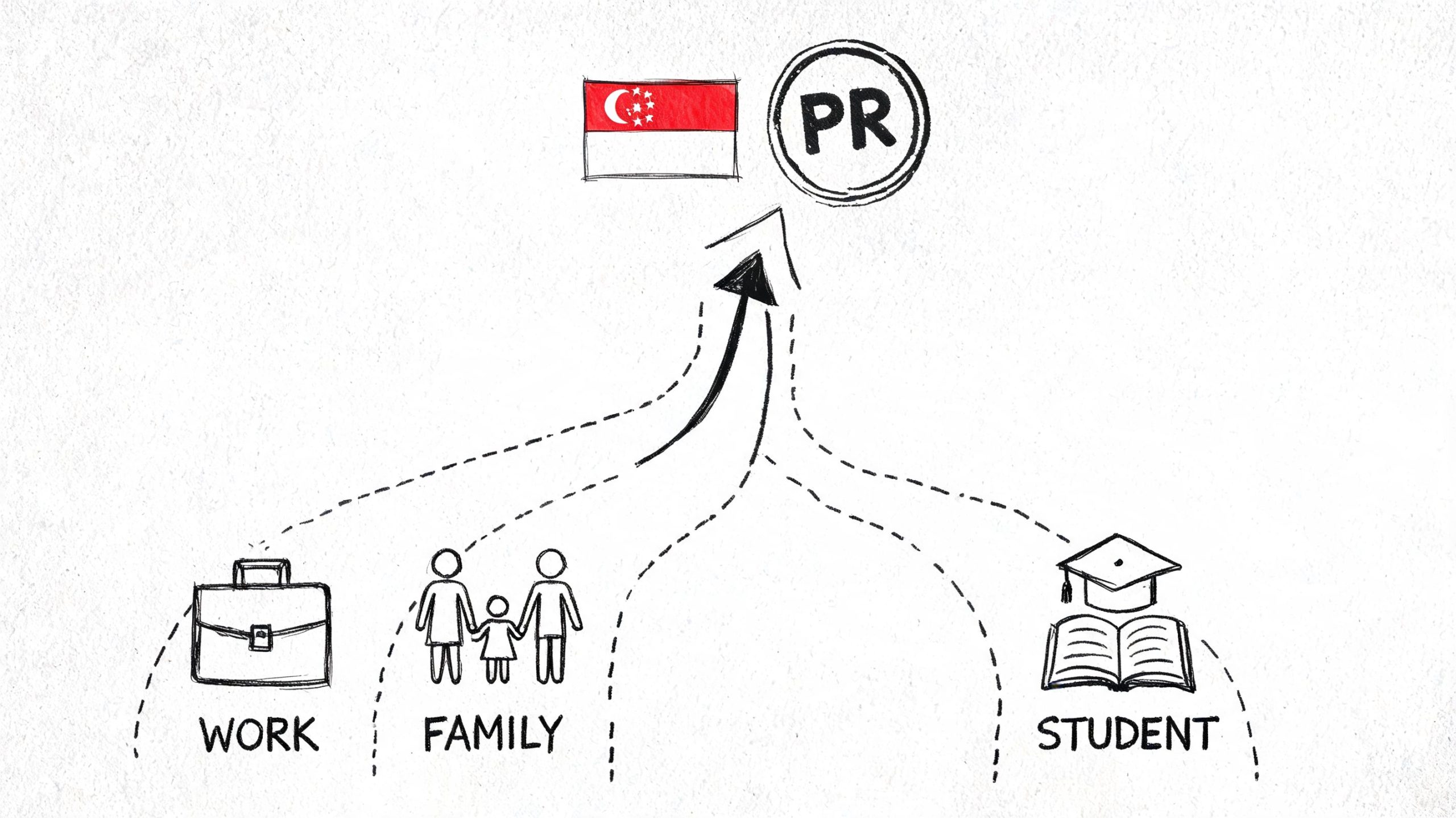
What ICA actually evaluates
ICA publishes the formal factors. Family ties, economic contribution, qualifications, age, family profile, and length of stay all matter. In practice, officers are assessing a broader point: does this person look like someone who is building a real future in Singapore?
That question is where many experienced applicants misjudge the process. They focus on status markers such as title, income, or company valuation. ICA is usually more persuaded by coherence. The role makes sense. The business activity is real. The household is based in Singapore. The documents are complete and consistent. The timeline does not look engineered for a quick PR conversion.
A strong file usually shows several things at once:
- Local economic relevance: meaningful employment, a credible business, or both
- Residence reality: actual living patterns that match the application story
- Household stability: spouse, children, and housing arrangements that support long-term presence
- Document discipline: clean records with no unexplained gaps or contradictions
- Integration evidence: professional, community, or social participation that does not look staged
The form is online. The assessment is discretionary
The PR application is submitted through ICA’s e-Service. The government’s official application page sets out the process, supporting documents, and current fees, as reflected in the official ICA PR application process summary.
What matters strategically is timing. Filing too early is one of the most common mistakes I see with globally mobile clients. A fast submission rarely compensates for a thin local record. It usually highlights it.
This point becomes sharper for applicants who entered Singapore through newer high-value routes. A ONE Pass holder may have an exceptional global profile but still need time to show Singapore-based substance. An entrepreneur may control substantial assets yet weaken the case if the local company remains light on staff, revenue, or operating activity. PR approval tends to follow evidence that the Singapore chapter is real, not provisional.
What convincing root-building evidence looks like
There is no single document that proves commitment. ICA looks at the pattern created by your life, business, and family decisions.
A persuasive record often includes four layers.
Residency continuity
Time spent in Singapore should be regular and explainable. Constant rotation through multiple jurisdictions weakens the case unless there is a clear business reason and the local base still looks genuine.Economic footprint
Payroll records, tax filings, local banking, and ordinary spending patterns support the argument that Singapore is part of your operating life, not just a flag on paper.Professional integration
Industry associations, board roles, local counterparties, and participation in Singapore’s business community can help, especially for founders and investors whose contribution is broader than a salary line.Family anchoring
Spouse relocation, children’s schooling, and stable housing often carry real weight because they are harder to manufacture credibly.
The best applications do not rely on a polished cover letter to explain weak facts. They use the documents to show a fact pattern that already makes sense.
Common errors that weaken otherwise strong cases
High-income applicants often damage their own file in predictable ways.
- Applying on eligibility alone: meeting the formal threshold is not the same as presenting a persuasive PR case
- Using the wrong pass as the foundation: a pass that gets you into Singapore may not create the strongest later PR profile
- Presenting a thin local business story: nominee structures, low-substance entities, or unclear commercial activity create avoidable skepticism
- Keeping family and residence arrangements ambiguous: if the family is meant to be Singapore-based, the evidence should show that plainly
- Submitting inconsistent records: mismatches across tax filings, corporate documents, addresses, and travel history are damaging
- Assuming wealth replaces integration: it does not
The suspended Global Investor Programme has made this even more important. Applicants who might once have pursued an investment-led route now need a stronger operating, employment, or founder-based narrative. That requires more planning, not less.
A practical way to stage the process
For serious applicants, PR should be handled in phases.
| Phase | What to focus on |
|---|---|
| Entry | Choose the pass that best supports the later PR profile, not just the fastest approval |
| Build | Create a clean record across residence, tax, banking, employment, and business activity |
| Anchor | Align family presence, housing, schooling, and local commitments with the long-term story |
| File | Apply when the documents and lived reality point in the same direction |
That sequencing is the difference between a technical application and a strategic one. The question is not only how to get residency in Singapore. The question is which path creates the strongest conversion from temporary status to permanent residence with the fewest credibility gaps.
The PR profile that travels best with ICA
The most effective profile is usually the one that gives the reviewing officer the least work. It is clear why the applicant is in Singapore, how the applicant contributes, where the family is based, and why remaining in the country is a logical continuation of an existing pattern.
That usually means:
- a real executive role or business presence
- a sensible period of residence before filing
- local tax and financial records that are complete
- family or personal ties that support staying
- integration evidence that fits naturally with the applicant’s life
For high-net-worth individuals, the right strategy is rarely the quickest filing. It is the filing that follows a deliberate build of substance, records, and residence reality. That is how PR starts to look less like a request for access and more like a rational next step for both the applicant and Singapore.
Post-Residency Compliance and Strategic Wealth Planning
Many applicants act as if the hard part ends when residency is approved. In reality, approval is when the strategic work begins. A poorly managed residency can decay into a weak renewal profile, tax confusion, or a structure that creates more questions than benefits.
ICA explicitly weighs commitment to sinking roots, and 2025 data from expat networks indicated successful PR applicants often had 24+ months of residency and involvement in local community or business groups. The same body of guidance also suggests that, for high-net-worth individuals, Singapore-based trusts or holdings can serve as tangible proof of long-term commitment aligned with economic contribution criteria, as reflected in the ICA PR guidance context discussed here.
Residency is an asset that must be maintained
After PR, your conduct still matters. Re-entry permit renewals, ongoing ties, business continuity, and family presence all affect how durable your status feels over time. A residency that exists only on paper is fragile.
This is why knowledgeable clients usually move from immigration planning into operational planning. They ask different questions:
- Where should income be earned?
- Which entities should sit in Singapore, and which should not?
- What should be held personally versus through trusts or holding companies?
- How do we create substance without creating unnecessary tax exposure elsewhere?
Those are wealth planning questions, not visa questions.
What strong post-residency planning usually includes
A clean long-term structure often involves a combination of legal residence, operating substance, and asset segregation. Singapore can play several roles in that architecture, but only if the planning is coherent.
Useful areas to review include:
- Entity placement: Decide which activities belong in Singapore and which should remain outside it.
- Personal tax residence: Make sure your residence pattern and economic facts support the intended outcome.
- Holding and trust design: For some families, local holdings or trusts can reinforce permanence and governance.
- Succession logic: Residency planning should sit comfortably with inter-generational transfer plans.
If you are working across multiple countries, cross-border tax friction becomes the hidden variable. That is where broader cross-border tax planning often matters more than the residency filing itself.
Good post-residency planning does two things at once. It preserves the immigration status and improves the resilience of the wider wealth structure.
National Service and family implications
For some families, especially those with sons, National Service considerations need to be addressed early and realistically. This isn’t an issue to discover after the fact. It sits inside the broader commitment analysis and should be handled as part of family planning from the outset.
Citizenship may eventually become relevant for some applicants as well, but it should not be treated as an automatic next step. Permanent residence and citizenship serve different strategic purposes. For many international entrepreneurs, PR provides enough stability without requiring every later decision to be made immediately.
The practical point is simple. Singapore residency can be one of the strongest pieces in a global mobility and asset protection plan. But it only works that way if you manage it actively after approval.
Protect Your Wealth helps high-net-worth individuals, founders, and international families structure compliant mobility, asset protection, and tax strategies around jurisdictions that hold up under scrutiny. If you want a practical plan for Singapore residency, business substance, cross-border structuring, and long-term wealth protection, speak with Protect Your Wealth.