
Holding two passports opens a world of opportunity, but it also creates a maze of financial complexity. The biggest challenge for dual citizens is the risk of double taxation, where two different countries might claim the right to tax the same income. Successfully navigating this requires a clear understanding of how each country's tax system applies to you.
The Global Citizen's Dilemma of Dual Taxation
Owning multiple citizenships is like playing a complex board game with two different rulebooks—to win, you have to know how they interact. This isn't just about travel freedom; it's a financial reality that demands sharp, strategic management. The core problem comes from the fundamentally different ways countries tax individuals, which can create overlapping obligations that quietly erode your wealth if you ignore them.
The journey starts with grasping two critical concepts:
- Citizenship-Based Taxation (CBT): This system taxes you based on your passport, no matter where you live or work. The United States is the most prominent example, requiring all its citizens to report their worldwide income to the IRS, even if they haven't set foot on U.S. soil in decades.
- Residence-Based Taxation (RBT): This is the global standard, where your tax obligations are tied to your physical location. If you live in a country for a certain period—often 183 days—you become a tax resident and owe taxes on your income there.
The conflict arises when you hold citizenship in a CBT country like the U.S. and live in an RBT country. Suddenly, you're subject to both systems at once. This is where the risk of double taxation becomes a very real problem.
Key Tax Systems at a Glance
To make this crystal clear, it helps to see the two primary taxation models side-by-side. This simple comparison highlights the fundamental differences in how countries claim the right to tax your income as a dual citizen.
| Taxation Model | Basis for Taxation | Who It Affects | Primary Example |
|---|---|---|---|
| Citizenship-Based | Your passport/nationality | Citizens, regardless of where they live or earn income | United States |
| Residence-Based | Your physical presence/domicile | Individuals who live in the country for a defined period | Most of the world (UK, Canada, Singapore, etc.) |
Understanding which system applies to each of your citizenships is the first and most crucial step in managing your global tax footprint.
Preventing Double Taxation
Fortunately, you’re not alone in this. Governments have created mechanisms to prevent citizens from being taxed into oblivion. Tax treaties act as an international rulebook, defining which country gets to tax what and providing tools to prevent you from paying twice on the same earnings.
The most common tool is the foreign tax credit, which allows you to reduce your tax bill in one country by the amount of taxes you've already paid to another.
For dual citizens, compliance is not just about paying taxes; it's about meticulous reporting. Systems like FATCA (Foreign Account Tax Compliance Act) and FBAR (Report of Foreign Bank and Financial Accounts) demand total transparency of foreign assets, and the penalties for getting it wrong are severe.
Ultimately, mastering your dual citizenship tax implications requires a shift in mindset. It’s not a passive activity; it demands proactive and careful management to ensure your global lifestyle enhances your wealth, not complicates it. For anyone looking to build a resilient financial future, gaining a deeper understanding of cross-border tax planning is the first essential step.
Citizenship vs. Residence: The Pillars of Global Taxation
To get a handle on how dual citizenship impacts your taxes, you first need to understand the two fundamental systems countries use to tax people across borders. These aren't just abstract legal ideas; they're the core rules that decide how much of your worldwide income you owe, and to whom. Think of them as the twin pillars holding up the entire structure of international taxation.
The first, and far less common, pillar is Citizenship-Based Taxation (CBT). Imagine your citizenship is like a lifelong club membership that comes with an annual fee, no matter where on the planet you happen to live. That’s exactly how CBT works. Your tax obligation is welded to your passport, not your physical address.
The United States is the prime example of a country running on this model. Once you hold a U.S. passport, the IRS expects you to file a tax return and report your worldwide income every single year. It doesn’t matter if you’re living in Toronto, Tokyo, or Tuscany—your American citizenship creates an unbreakable tax link.
The More Common Approach: Residence-Based Taxation
In sharp contrast, most of the world operates on Residence-Based Taxation (RBT). This system is much more intuitive and follows a simple principle: you pay taxes where you make your home. Your tax obligations are tied to your physical presence or established residency within a country's borders, not the passport you carry.
Countries like Canada, the United Kingdom, and nearly all of Europe use this model. Under RBT, if you aren't a resident, you typically only pay tax on income you earn inside that country. But once you become a tax resident—often by spending a certain number of days there—you're usually taxed on your worldwide income by that nation.
This visual map breaks down how citizenship tax, residence tax, and the treaties that connect them all fit together.
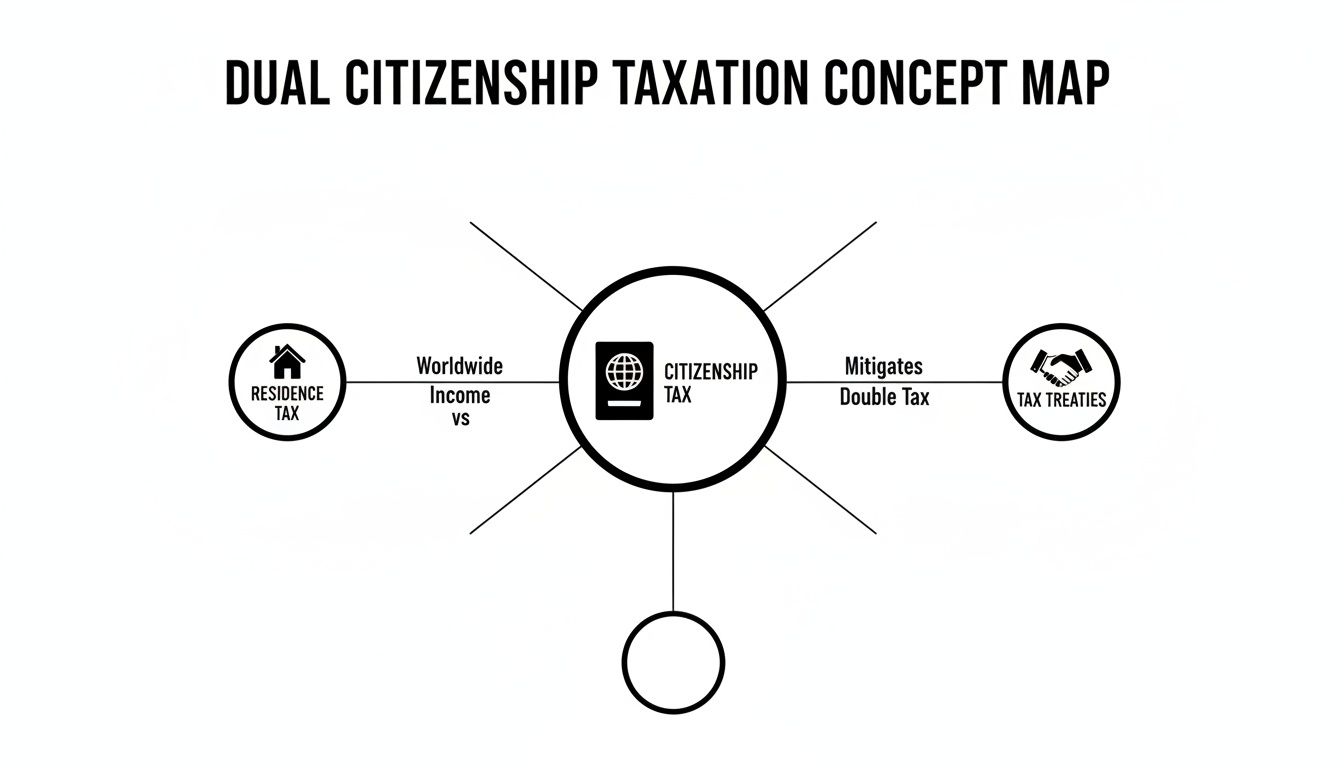
The key takeaway? Your passport (citizenship) and your home (residence) create distinct, and often overlapping, tax duties. This is precisely why tax treaties are so essential.
When Two Tax Worlds Collide
The real complexity kicks in when these two systems overlap for one person. This is where the threat of double taxation goes from a theoretical risk to a very real problem, demanding careful planning to navigate successfully.
The most challenging scenario for a dual national is holding citizenship in a CBT country while living in an RBT country. This creates a dual filing obligation on the same global income, making tax treaty benefits and foreign tax credits absolutely critical for financial survival.
Take a U.S.-Canada dual citizen living in Toronto, for example. They owe the Canada Revenue Agency (CRA) taxes on their global earnings, with rates climbing up to 33% federally plus provincial taxes. At the same time, the IRS is demanding its cut based on their U.S. passport. You can delve deeper into the tax rules for dual citizens and see how this plays out in different countries.
This overlap is the central dilemma for so many global citizens. It isn't a matter of choosing one system over the other; you are legally bound by both. The Canadian government taxes you because you live there (RBT), while the U.S. government taxes you because of your passport (CBT). Without the right mechanisms in place, you’d pay full tax on the same dollar to two different countries, which would gut your finances. This sets the stage for why tax treaties aren’t just a convenience, but an absolute necessity.
How Tax Treaties Prevent Double Taxation
The biggest financial headache for any dual citizen is the threat of being taxed twice on the same income. It’s a legitimate fear, but thankfully, not a problem without a solution.
Countries have built a global network of bilateral tax treaties that act as an international rulebook, designed specifically to prevent this exact scenario. Think of a tax treaty as a referee between two countries, stepping in to decide which one gets the first shot at taxing your income.
These agreements are absolutely essential. They provide clear, legally binding ways to get tax relief. For dual citizens of the U.S., this relief usually comes in two powerful forms: the Foreign Tax Credit (FTC) and the Foreign Earned Income Exclusion (FEIE).
While both can slash or even eliminate your U.S. tax bill, they work in completely different ways. Getting a handle on how each one functions is critical for managing your finances across borders.
The Lifeline of Foreign Tax Credits
The Foreign Tax Credit is often the most direct and effective weapon against double taxation. It works on a simple, dollar-for-dollar principle.
For every dollar you pay in taxes to your country of residence, you can claim a credit to reduce your U.S. tax liability by the same amount. It’s like showing up to the IRS with a voucher that proves you’ve already paid your dues somewhere else.
This credit is a game-changer for people living in countries with tax rates similar to or higher than those in the U.S. Because you can offset your U.S. tax bill with taxes you've already paid, you often end up owing little to nothing to the IRS on that foreign income. It ensures you aren’t punished for earning a living outside the United States.
A common misconception is that dual citizens must choose between paying taxes to their country of residence or the U.S. In reality, you comply with both, but use tools like the FTC to ensure you don't pay twice. The goal is tax neutrality, not tax avoidance.
Let’s see this in action. Imagine you're an entrepreneur with dual U.S. and U.K. citizenship, living in London and earning £80,000—about $100,000. Your U.S. passport means you have to report this income to the IRS. But the U.S.-U.K. tax treaty provides a lifeline.
You first pay your U.K. income tax as required. Then, you claim the FTC on U.S. Form 1116, and that credit directly offsets almost your entire IRS liability. It’s a clean, efficient process detailed in the tax rules for dual citizens.
An Alternative Path: The Foreign Earned Income Exclusion
While the FTC is a credit against taxes owed, the Foreign Earned Income Exclusion (FEIE) works very differently. Instead of reducing your tax bill, it lets you exclude a huge chunk of your foreign income from U.S. taxation altogether.
For 2024, you can exclude up to $126,500. If you qualify, that first $126,500 of your salary or self-employment income is simply invisible to the IRS for income tax purposes.
But there’s a catch. The rules to qualify for the FEIE are strict. You have to meet either the "bona fide residence test" or the "physical presence test," which prove you have real, substantial ties to a foreign country. On top of that, the FEIE only applies to earned income—like your salary—not passive income from investments, dividends, or rent.
Choosing the Right Tool for Your Situation
Deciding between the FTC and the FEIE is a critical strategic choice. One isn't universally "better" than the other; the right option depends entirely on your personal financial picture.
High-income earners in high-tax countries like France or Canada almost always benefit more from the FTC. The taxes they pay locally often exceed what they'd owe in the U.S., allowing them to wipe out their U.S. liability and even carry forward excess credits for future years.
On the other hand, someone living in a low- or no-tax jurisdiction, like the UAE, will likely find the FEIE far more valuable. With no local income taxes to credit, excluding their income is the only way to reduce their U.S. tax bill.
To help you compare these two powerful tools, here's a side-by-side breakdown:
Foreign Tax Credit (FTC) vs Foreign Earned Income Exclusion (FEIE)
| Feature | Foreign Tax Credit (FTC) | Foreign Earned Income Exclusion (FEIE) |
|---|---|---|
| Primary Function | Dollar-for-dollar reduction of your U.S. tax liability. | Excludes a portion of your foreign earned income from U.S. taxation. |
| Best For | High-income earners in high-tax countries (e.g., Western Europe). | Individuals in low- or no-tax countries (e.g., UAE, Monaco). |
| Income Type | Applies to both earned and passive income (e.g., salary, interest, dividends). | Applies only to earned income (e.g., salary, self-employment). |
| Limit | Capped by the amount of foreign tax paid or the U.S. tax on that income. | Annual inflation-adjusted cap ($126,500 for 2024). |
| Excess Amounts | Excess credits can be carried back 1 year and forward 10 years. | No carryover. The exclusion is “use it or lose it” each year. |
| Qualification | No residency test required, just need to have paid foreign income taxes. | Must pass the Bona Fide Residence Test or Physical Presence Test. |
Ultimately, analyzing your income level, income type, and local tax rate is the only way to determine which mechanism will best protect your wealth. Making the wrong choice can lead to overpaying taxes by thousands, so it's a decision worth getting right.
Understanding Your Global Reporting Obligations
Once you've wrapped your head around how to avoid double taxation, the next hurdle is global financial transparency. For dual citizens, what you report is just as critical as what you pay. Governments worldwide have built powerful, interconnected systems to track assets held abroad, and failing to play by their rules can bring staggering financial penalties.
Think of it as a ‘global financial GPS’ for tax authorities. These systems give them a crystal-clear map of the assets their citizens are holding outside the country, ensuring nothing slips through the cracks just because it’s parked offshore. For U.S. citizens, the two big names you absolutely must know are FATCA and FBAR.
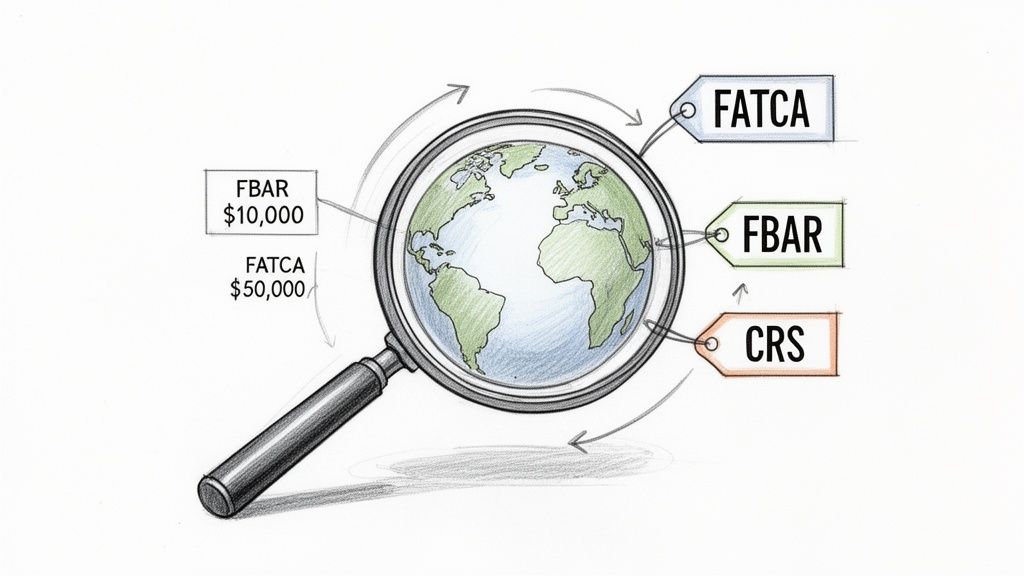
Cracking the Code on FBAR and FATCA
They sound alike, but FBAR and FATCA are entirely different beasts with their own separate filing rules. Getting them straight is non-negotiable for anyone managing their dual citizenship tax implications.
FBAR (Report of Foreign Bank and Financial Accounts)
This one isn’t actually an IRS form. It’s a disclosure tool used by FinCEN (the Financial Crimes Enforcement Network), a bureau of the U.S. Treasury. Its main job is to sniff out money laundering and other financial crimes.
- Who Files: Any U.S. person with a financial interest in or signature authority over foreign financial accounts.
- Filing Threshold: You’re on the hook if the combined value of all your foreign accounts tops $10,000 at any point during the year.
- How to File: You must file FinCEN Form 114 electronically. This is completely separate from your income tax return.
That $10,000 threshold is deceptively low and catches people by surprise all the time. A single, modest savings account in another country can easily trigger this mandatory filing.
FATCA (Foreign Account Tax Compliance Act)
FATCA, on the other hand, is an IRS tool built purely for tax compliance. It forces individuals to report their foreign assets and compels foreign banks to report on their U.S. clients. For individuals needing to get on the right side of U.S. tax compliance, figuring out how to get an ITIN number is often a crucial first step.
- Who Files: U.S. citizens who meet much higher asset thresholds.
- Filing Threshold (for those living abroad): For single filers, it's assets over $200,000 on the last day of the year or over $300,000 at any time. These amounts double if you file jointly.
- How to File: You’ll file Form 8938, which gets attached directly to your annual U.S. income tax return.
The High Cost of Non-Compliance
The penalties for ignoring these forms aren't just steep—they're financially crippling. They are designed to make you take reporting seriously.
The penalties for non-compliance are severe and non-negotiable. A non-willful FBAR violation can result in a fine of over $10,000 per account, per year. A willful violation can lead to penalties of $100,000 or 50% of the account's balance, whichever is greater—and can even bring criminal charges.
These are not numbers you can afford to overlook. For any global citizen, meticulous reporting isn't just a good habit; it's a fundamental pillar of protecting your wealth and staying in the clear. It's simply part of the deal when you hold more than one passport.
Advanced Wealth Strategies for Dual Citizens
For high-net-worth dual citizens, simple tax filing is just the beginning. The real opportunity is using fully legal, sophisticated strategies to protect your assets, optimize your tax position, and build a truly resilient global wealth structure. This isn't about finding sketchy loopholes—it's about intelligent, compliant planning that turns the complexities of holding two passports into a powerful advantage.
Think of it like building a diversified investment portfolio. Instead of just holding different stocks, you're strategically using different legal structures and residency programs across multiple jurisdictions to create a robust financial foundation that can weather any storm.
Using International Trusts and Foundations
One of the most powerful tools in the asset protection playbook is the international trust. A trust is like a secure vault for your most important assets. When you transfer property, investments, or business shares into a trust, you legally separate them from your personal ownership.
This separation creates a formidable barrier against potential creditors, lawsuits, or even political instability back home. The assets are then managed by a professional trustee who follows your exact instructions, ensuring your wealth is preserved and passed down to future generations just as you intended.
Foundations, which are especially common in civil law countries like Panama, can serve a similar purpose. While often used for charity, a private foundation can be structured to hold and manage a family's wealth, offering privacy and long-term control that lasts far beyond a single lifetime.
The key here is achieving control without direct ownership. This distinction is fundamental to legitimate asset protection, placing a solid legal wall between your personal liabilities and the wealth you’ve worked so hard to build.
Leveraging Favorable Residency Programs
For many dual citizens, especially those holding a U.S. passport, optimizing tax residency is a cornerstone of any serious wealth plan. Securing residency in a country with a territorial or low-tax system can dramatically cut your global tax bill on any non-U.S. source income.
Here are a few strategic options to consider:
- United Arab Emirates (UAE): With zero personal income tax, the UAE is a premier destination for entrepreneurs and investors. A U.S. citizen living in the UAE can use the Foreign Earned Income Exclusion (FEIE) to wipe out U.S. tax on their first $126,500 of earned income (for 2024), while any income above that is only taxed by the U.S.
- Singapore: This global financial hub runs on a territorial tax system. It taxes income earned in Singapore but generally leaves foreign-sourced income alone as long as it isn't brought into the country. This makes it a fantastic place to hold international investments and receive foreign dividends without triggering local tax.
- Hong Kong: Much like Singapore, Hong Kong has a territorial tax system. Income generated outside of Hong Kong is generally not subject to Hong Kong tax, giving a massive advantage to those with international business operations or investment portfolios.
Structuring International Business Activities
How and where you set up your business has huge tax implications for a dual citizen. By choosing the right jurisdiction for your company, you can create a far more efficient operational and tax structure from day one.
Ireland, for example, is famous for its low corporate tax rate of 12.5% on trading income, making it a top choice for international companies, particularly those doing business in the European Union. A U.S. entrepreneur could run their European operations through an Irish company to take advantage of this low rate on all business profits earned there.
But U.S. citizens have to be extremely careful to follow specific IRS regulations. You can learn more about how the IRS taxes foreign companies owned by Americans in our guide to Controlled Foreign Corporation rules.
Proper structuring ensures you stay fully compliant while benefiting from these powerful international tax regimes. When combined, these strategies allow savvy global citizens to build a truly resilient and tax-efficient financial future.
Navigating US Exit Taxes and Renunciation
For some high-net-worth U.S. citizens, the lifelong reach of citizenship-based taxation eventually becomes too much. This leads them to a final, drastic step: renouncing their citizenship. This isn't just filling out a form; it's a profound legal and financial break from the U.S., triggering a final, and often costly, reckoning with the IRS known as the "exit tax."
This tax isn't a penalty for leaving. It’s better to think of it as a final settling of accounts. The U.S. government’s position is, essentially, "Before you go, let's square up on all the appreciation your assets have seen while under our jurisdiction." Without meticulous planning, this can lead to a staggering tax bill.
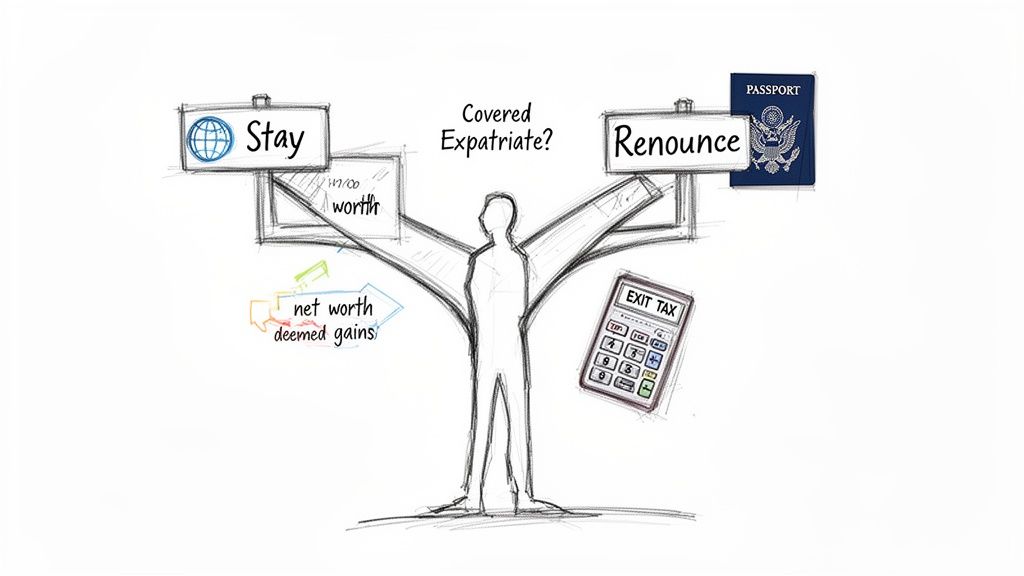
Who Pays the Exit Tax
Not everyone who gives up their U.S. passport gets hit with this tax. It specifically targets individuals defined as "covered expatriates." You'll fall into this category if you meet any one of these three conditions on the day you renounce:
- The Net Worth Test: Your net worth is $2 million or more.
- The Average Tax Liability Test: Your average annual net income tax bill for the five years before you leave is over an inflation-adjusted threshold (around $201,000 for 2024).
- The Tax Compliance Test: You fail to certify on Form 8854 that you've met all your U.S. federal tax obligations for the past five years.
That last one is a trap for the unwary. Failing to be fully compliant automatically makes you a covered expatriate, no matter how little you’re worth. It highlights just how critical it is to have your tax affairs in perfect order before you even start down this road.
How the Exit Tax Is Calculated
For a covered expatriate, the exit tax is calculated using a "mark-to-market" regime. Here's how it works: on the day before you officially renounce, the IRS treats your worldwide assets as if you sold everything at its current fair market value.
This idea of a "deemed sale" is the heart of the exit tax. You are forced to pay capital gains tax on phantom profits from this theoretical sale, even though you haven't actually sold a single asset. This means you need real cash on hand to pay a tax bill generated by unrealized gains.
The process calculates all the appreciation in your assets—stocks, real estate, business interests, everything. You get a capital gains exclusion (around $866,000 for 2024) to offset these deemed gains. But any profit above that exclusion gets taxed at the current long-term capital gains rates.
For anyone with substantial assets, this can easily create a seven-figure tax bill that's due immediately. To make matters worse, certain assets like deferred compensation plans or trusts are subject to their own special—and often much harsher—tax rules. Managing the dual citizenship tax implications of renunciation demands expert legal and financial guidance. It is truly the final, and potentially most expensive, chapter in a global citizen’s financial story.
Frequently Asked Questions
When you're dealing with the financial side of dual citizenship, the same practical questions tend to pop up. Here are some direct answers to the most common queries we hear, helping clear up any lingering doubts about your obligations and opportunities.
Do I File US Taxes If I Live Abroad with No US Income?
Yes, you absolutely do. If you're a U.S. citizen, your tax obligations follow you no matter where you live or earn your money. This is the core principle of citizenship-based taxation, and it’s a rule that trips up many expats.
This means you must file a U.S. federal tax return every single year to report your worldwide income. While tools like the Foreign Tax Credit (FTC) or the Foreign Earned Income Exclusion (FEIE) can often shrink your U.S. tax bill to zero, the requirement to file never goes away. Ignoring it can lead to some surprisingly harsh penalties, even if you didn't owe any tax in the first place.
Can I Use Both the FTC and the FEIE?
You generally can't apply both the FTC and the FEIE to the same bucket of income. You have to pick one primary method for handling your foreign earned income.
That said, a hybrid approach is sometimes possible. You could use the FEIE to exclude your earned income up to the annual limit, and then use the FTC to get a credit for foreign taxes you paid on any unexcluded income. This might be earnings above the FEIE threshold or passive income like dividends and interest. This is a complex area, and the right choice really depends on your income level and the tax rates in your country of residence.
For people in high-tax countries, the Foreign Tax Credit is almost always the better deal. It has no income cap and can even generate excess credits you can use in future years. But for those in low or zero-tax jurisdictions, the FEIE is typically the more straightforward and beneficial option.
What Happens If I Never Filed an FBAR?
Failing to file an FBAR (Report of Foreign Bank and Financial Accounts) for your foreign accounts can have severe consequences. The penalties are designed to be punitive and can be financially crippling.
- Non-Willful Violations: Penalties can hit $10,000 per account, for each year you failed to file.
- Willful Violations: This is where it gets serious. The penalties jump to the greater of $100,000 or 50% of the account's highest balance during the year.
The good news is the IRS has amnesty programs, like the Streamlined Filing Compliance Procedures, which let people catch up with reduced or even waived penalties. If you've missed filings, it is critical to proactively address the issue with a tax professional to find the safest way back to compliance.
Navigating the complexities of dual citizenship tax implications requires expert guidance. The team at Protect Your Wealth specializes in crafting compliant, tax-efficient strategies for global citizens. Book a consultation today to secure your assets and optimize your international financial structure.